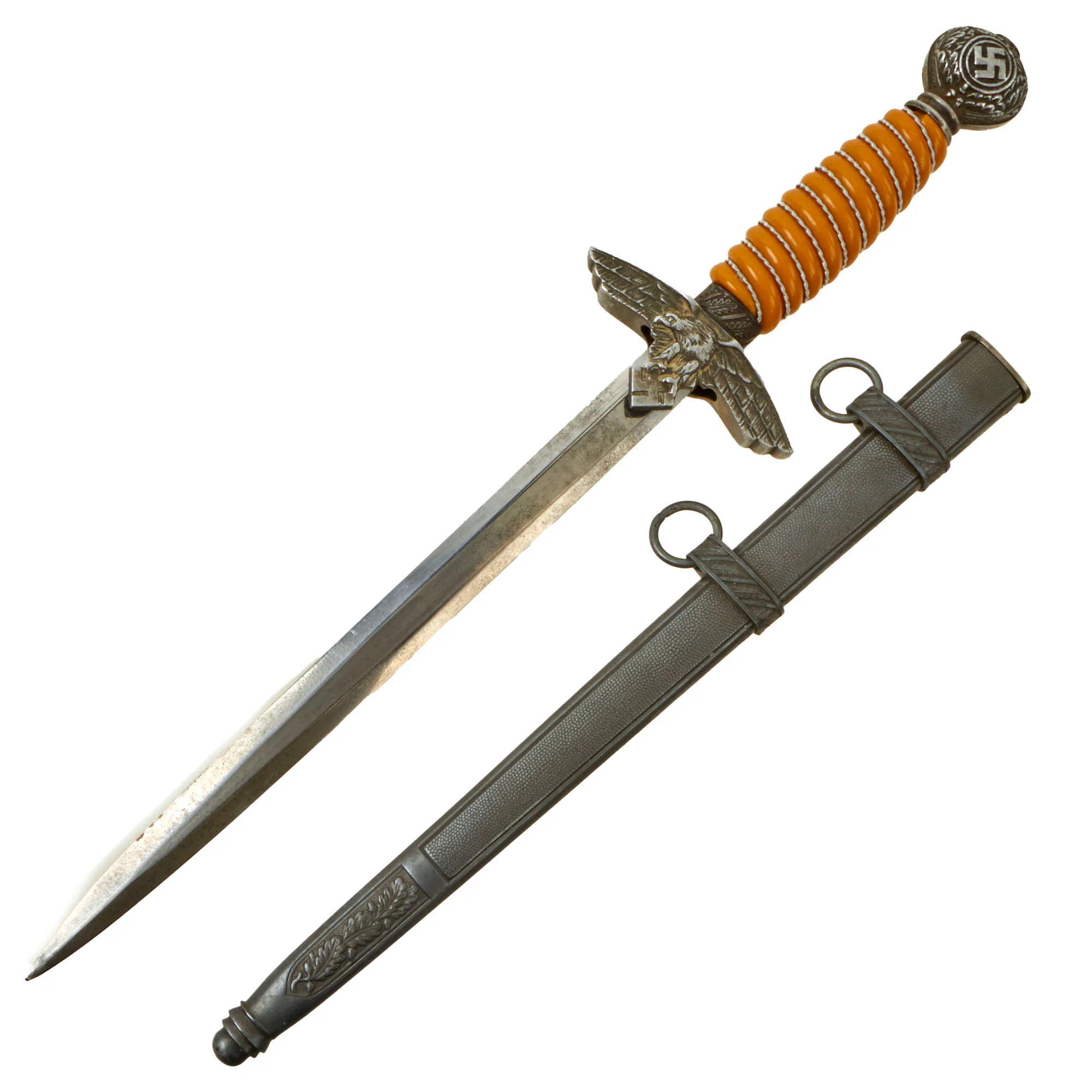
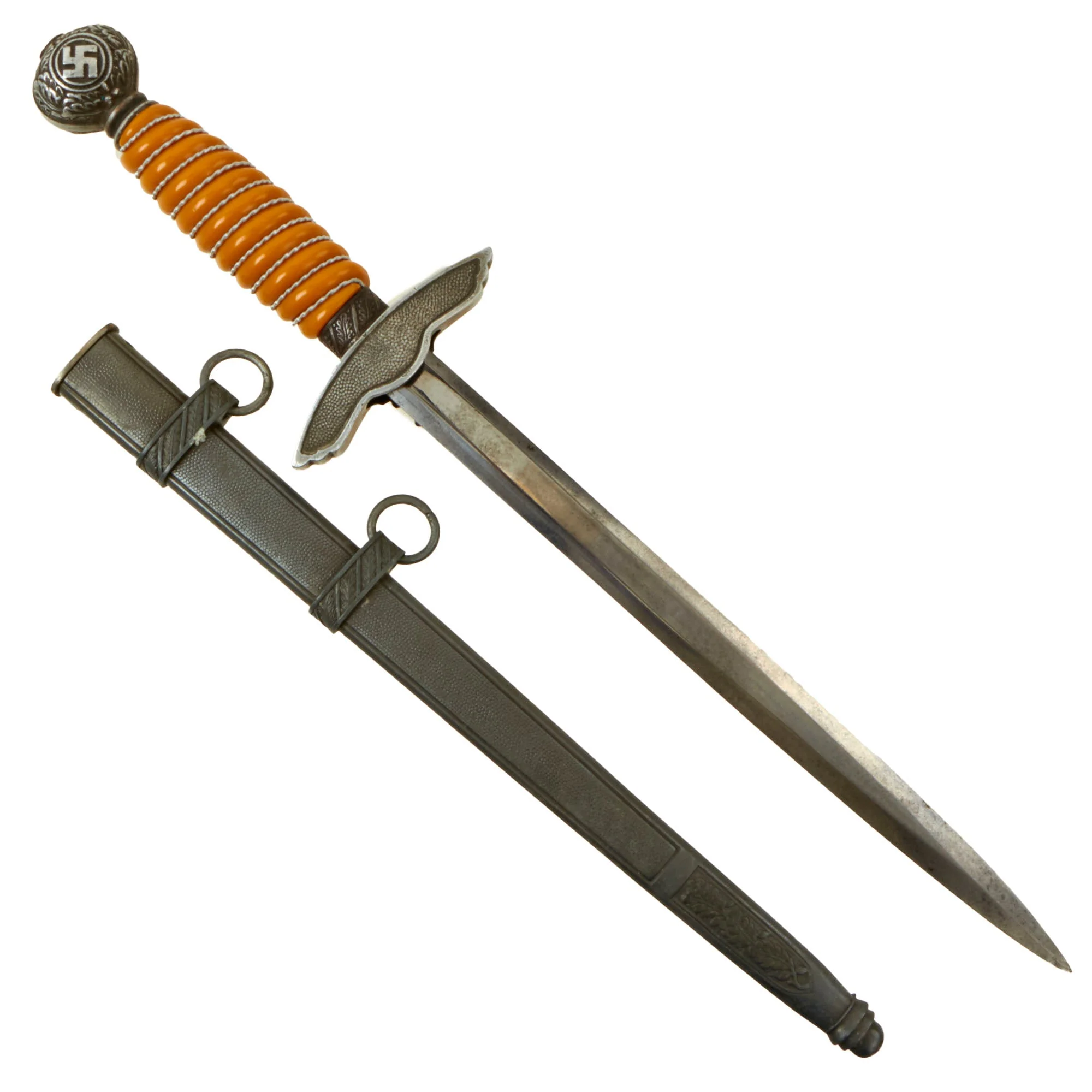
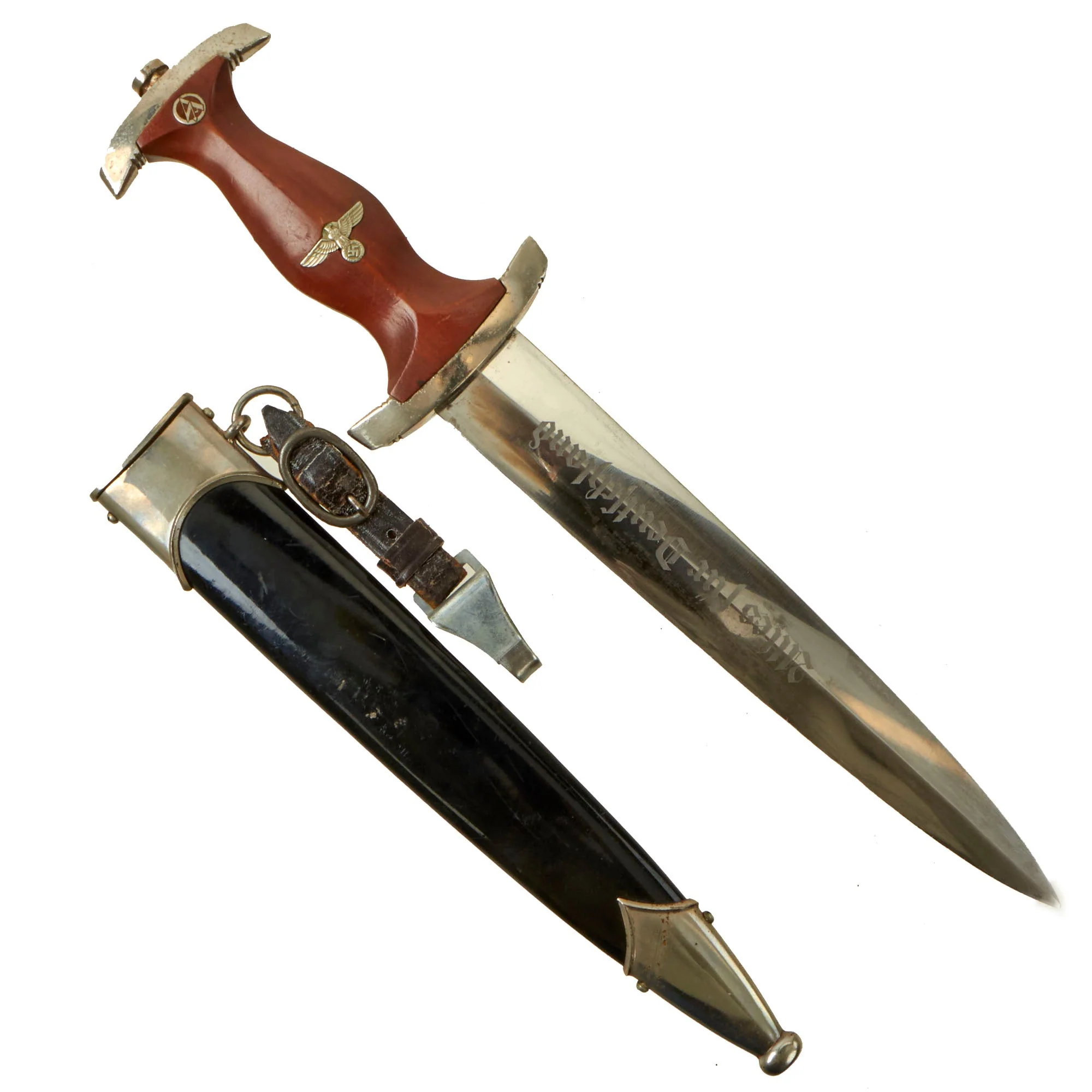
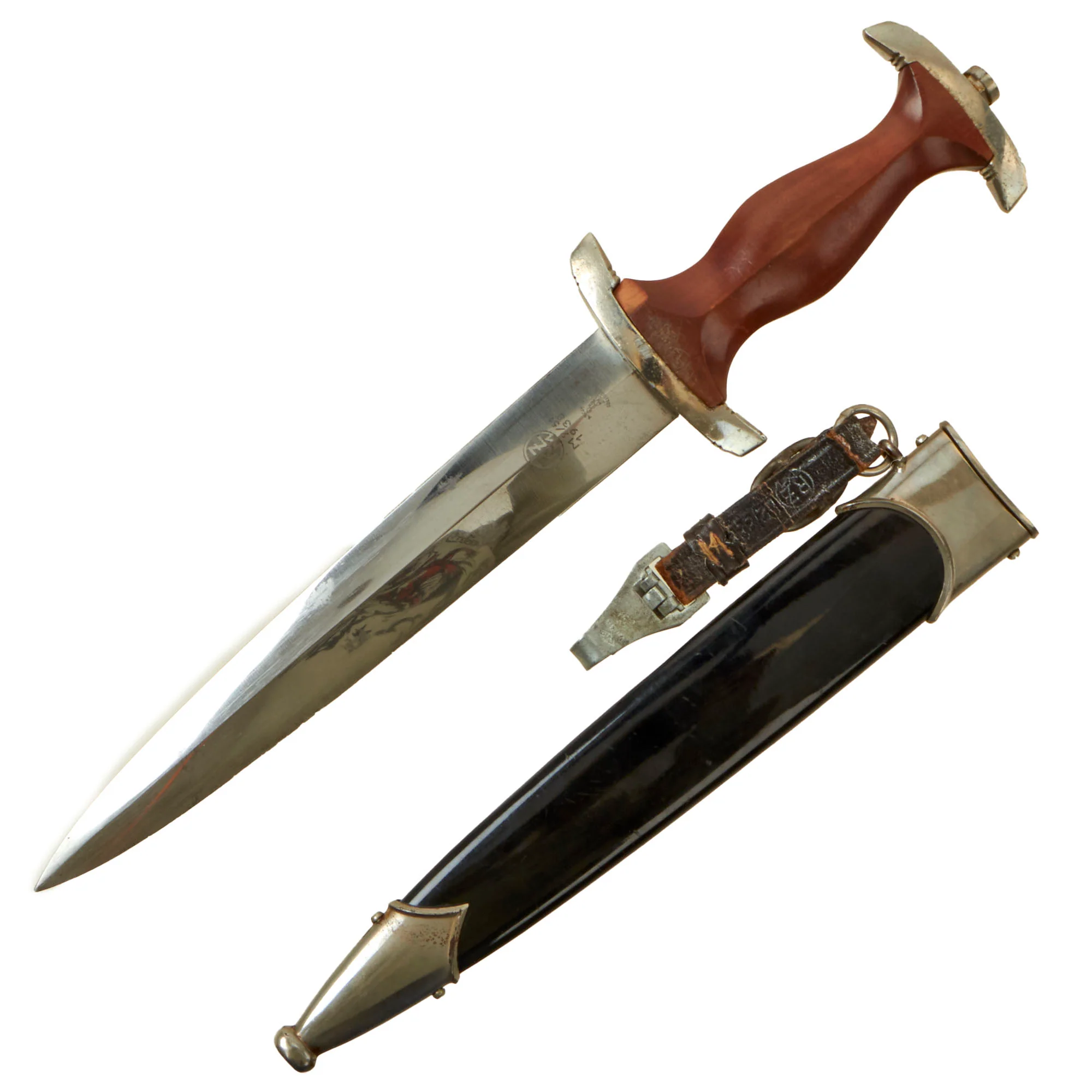
Original Item. Only One Available. This is a tremendously scarce Austro-Hungarian Naval officer’s dagger dating from the era of the last emperor of Austria and the last king of Hungary, Karl IV, whose short reign lasted only from 1916 to 1918. The dagger is of extremely high quality with a double-etched blade, exquisitely etched on both sides - with the Austrian coat of arms on one side and the Hungarian coat of arms on the other, both gold-inlaid. This is the first example of this scarce dagger we have offered.
The dagger is brass-fitted with a lovely bakelite handle, very high quality for this early. The crossguard is gorgeously shaped into waves of the sea with the pommel shaped into a bundle of knotted ropes, a very well-known symbol of the Navy. The 10⅜” blade is gorgeously etched, and the gold-inlay of the coats of arms is very well-retained. The ricasso is marked:
TILLS NEFFEN
in WIEN
This was the only maker of this dagger from what we can find in our research. The blade has some light oxidation spotting near the tip and ricasso. The crossguard shows some verdigris in some of the harder-to-reach spots.
The all-brass scabbard is very well-made with a motif of Neptune behind his trident, with a fish or sea monster wrapped around its pole. Near the throat is the Naval anchor under the cypher for Karl IV reading IV K I. Both suspension rings are retained without much denting.
This is a tremendous dagger, the first and likely last Austro-Hungarian Naval officer’s dagger we will offer. Comes ready for further research and display.
Specifications:
Blade Length: 10⅜"
Overall length: 15⅝”
Crossguard: 3⅛”
Scabbard Length: 11⅛"
The Austro-Hungarian Navy
The Austro-Hungarian Navy or Imperial and Royal War Navy was the naval force of Austria-Hungary. Ships of the Austro-Hungarian Navy were designated SMS, for Seiner Majestät Schiff (His Majesty's Ship). The k.u.k. Kriegsmarine came into being after the formation of Austria-Hungary in 1867, and ceased to exist in 1918 upon the Empire's defeat and subsequent collapse at the end of World War I.
Before 1867, the Imperial Austrian Navy or simply the Austrian Navy, saw action in the French Revolutionary Wars, the Napoleonic Wars, the Austrian expedition against Morocco (1829), the Second Egyptian–Ottoman War, the First and Second Wars of Italian Independence, the Second Schleswig War, and the Third War of Italian Independence. Following Austria's defeat by Prussia and Italy during the Seven Weeks' War, the Austrian Empire reformed itself into the dual monarchy of Austria-Hungary, and the navy also became the Austro-Hungarian Navy. Largely neglected by the Empire in its early years, the k.u.k. Kriegsmarine expanded along with Austro-Hungarian industrialization into one of the largest navies in the Adriatic and Mediterranean Seas. By 1914, the k.u.k. Kriegsmarine had a peacetime strength of 20,000 personnel, seeing action in the Boxer Rebellion and other conflicts before World War I.
During most of World War I, the Allied Powers maintained the Otranto Barrage to bottle up the k.u.k. Kriegsmarine in the Adriatic Sea. Largely tasked with defending the Empire's 1,130 nautical miles (2,090 km; 1,300 mi) of coastline and 2,172.4 nautical miles (4,023.3 km; 2,500.0 mi) of island seaboard, the Navy chose to rely on its U-boats to attack Allied shipping rather than risk the destruction of its battleships, cruisers and other surface vessels. In June 1918, it attempted to break the Otranto Barrage with a large naval fleet, but the attack was called off after the battleship Szent István was sunk by an Italian torpedo boat on 10 June.
Five months later, with the Austro-Hungarian Empire facing collapse and defeat in the war, the Empire decided to transfer most of its navy to the newly declared State of Slovenes, Croats and Serbs on 31 October, effectively bringing the k.u.k. Kriegsmarine to an end. Three days later, the Empire's military authorities signed the Armistice of Villa Giusti, pulling the rapidly disintegrating empire out of the war. With the signing of the Treaty of Saint-Germain-en-Laye and the Treaty of Trianon, Austria and Hungary became landlocked, and the Empire's most important ports of Trieste, Pola, Fiume and Ragusa became part of Italy and Yugoslavia. The k.u.k. Kriegsmarine's main ships were turned over to the Allies, who scrapped most of them in the 1920s during the era of naval disarmament.