
Original Austro-Hungarian WWI Trench Raiding Club with Belt Hook - From Personal Collection of David Machnicki, Author of At Arm's Length Series & Featured in Upcoming Volume III
Original Austro-Hungarian WWI Trench Raiding Club with Belt Hook - From Personal Collection of David Machnicki, Author of At Arm's Length Series & Featured in Upcoming Volume III
Original: $1,995.00
-70%$1,995.00
$598.50The Story
Original Item. One-of-a-Kind. Purchased directly from David F. Machnicki, the author of At Arm's Length Trench Club book Series, the most up-to-date reference on the topic today. This is a tremendous well-used trench club with a very interesting belt hook, great patina & character. This very club is slated to be featured in book three of the series AT ARMS LENGTH.
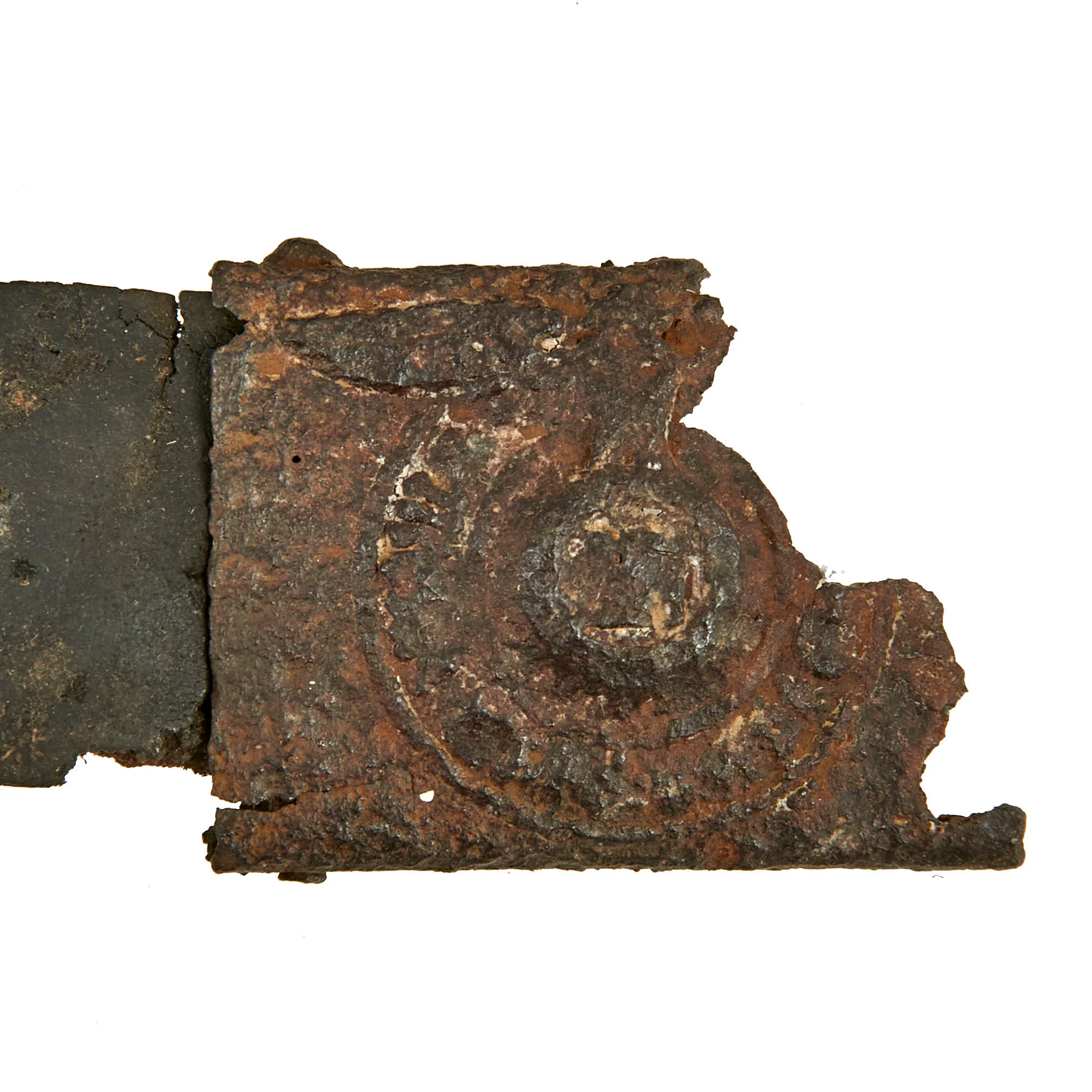
The head for the club is constructed from a piece of iron pipe, which was anchored onto the wood handle and covered with eighteen spikes embedded on, with a very interesting belt hook added at the bottom of the pipe, seemingly for attachment to a soldier’s belt, though it is now up against the wooden shaft.
The club has an overall length of 21 ⅛” with a 4 ⅞” head and very heavy wear to the wood. The carved pommel has a very small fragment of an original leather lanyard or wrist strap that is very weak and not well-attached. There is some heavy cracking in the wooden handle as shown.
The handle is now quite weak though the wood is still strong overall. This is a very excellent example that certainly spent a lot of time in the trenches and is slated to be featured in Volume III of “At Arm’s Length”!
Ready for display.
Trench raiding clubs were homemade melee weapons used by both the Allies and the Central Powers during World War I. Clubs were used during nighttime trench raiding expeditions as a quiet and effective way of killing or wounding enemy soldiers. The clubs were usually made out of wood. It was common practice to fix a metal object at the striking end (e.g. an empty Mills bomb) in order to maximize the injury inflicted. Another common design comprised a simple stave with the end drilled out and a lead weight inserted, with rows of large hobnails hammered in around its circumference. Most designs had some form of cord or leather strap at the end to wrap around the user's wrist. Bosnian soldiers serving in the Austro-Hungarian army were fond of using maces. They were also used by officers to finish enemy soldiers wounded by poison gas attacks.
Trench clubs were manufactured in bulk by units based behind the lines. Typically, regimental carpenters and metal workers would make large numbers of the same design of club. They were generally used along with other "quiet" weapons such as trench knives, entrenching tools, bayonets, hatchets and pickaxe handles – backed up with revolvers and hand grenades.

Details & Craftsmanship
Every detail has been carefully considered to bring you the perfect product.

Details & Craftsmanship
Every detail has been carefully considered to bring you the perfect product.

Details & Craftsmanship
Every detail has been carefully considered to bring you the perfect product.

Details & Craftsmanship
Every detail has been carefully considered to bring you the perfect product.

Details & Craftsmanship
Every detail has been carefully considered to bring you the perfect product.

Details & Craftsmanship
Every detail has been carefully considered to bring you the perfect product.

Details & Craftsmanship
Every detail has been carefully considered to bring you the perfect product.

Details & Craftsmanship
Every detail has been carefully considered to bring you the perfect product.

Details & Craftsmanship
Every detail has been carefully considered to bring you the perfect product.

Details & Craftsmanship
Every detail has been carefully considered to bring you the perfect product.
Description
Original Item. One-of-a-Kind. Purchased directly from David F. Machnicki, the author of At Arm's Length Trench Club book Series, the most up-to-date reference on the topic today. This is a tremendous well-used trench club with a very interesting belt hook, great patina & character. This very club is slated to be featured in book three of the series AT ARMS LENGTH.
The head for the club is constructed from a piece of iron pipe, which was anchored onto the wood handle and covered with eighteen spikes embedded on, with a very interesting belt hook added at the bottom of the pipe, seemingly for attachment to a soldier’s belt, though it is now up against the wooden shaft.
The club has an overall length of 21 ⅛” with a 4 ⅞” head and very heavy wear to the wood. The carved pommel has a very small fragment of an original leather lanyard or wrist strap that is very weak and not well-attached. There is some heavy cracking in the wooden handle as shown.
The handle is now quite weak though the wood is still strong overall. This is a very excellent example that certainly spent a lot of time in the trenches and is slated to be featured in Volume III of “At Arm’s Length”!
Ready for display.
Trench raiding clubs were homemade melee weapons used by both the Allies and the Central Powers during World War I. Clubs were used during nighttime trench raiding expeditions as a quiet and effective way of killing or wounding enemy soldiers. The clubs were usually made out of wood. It was common practice to fix a metal object at the striking end (e.g. an empty Mills bomb) in order to maximize the injury inflicted. Another common design comprised a simple stave with the end drilled out and a lead weight inserted, with rows of large hobnails hammered in around its circumference. Most designs had some form of cord or leather strap at the end to wrap around the user's wrist. Bosnian soldiers serving in the Austro-Hungarian army were fond of using maces. They were also used by officers to finish enemy soldiers wounded by poison gas attacks.
Trench clubs were manufactured in bulk by units based behind the lines. Typically, regimental carpenters and metal workers would make large numbers of the same design of club. They were generally used along with other "quiet" weapons such as trench knives, entrenching tools, bayonets, hatchets and pickaxe handles – backed up with revolvers and hand grenades.