
Original: $3,995.00
-70%$3,995.00
$1,198.50The Story
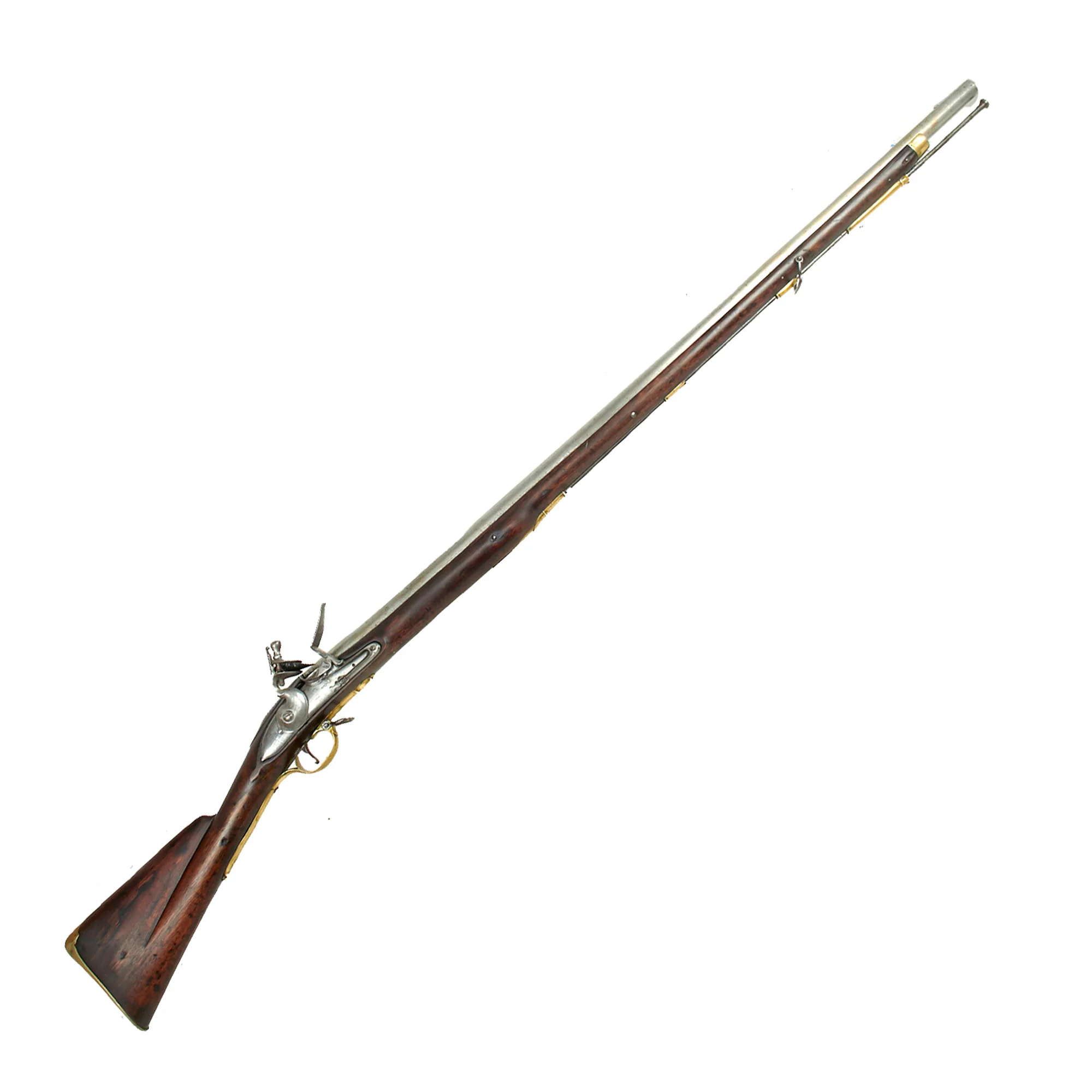
Original Item: Only One Available. Acquired recently from a large military show, this is a fantastic well-marked third Pattern Brown Bess, with the 39" barrel adopted in 1796. Also known as the "India Pattern", it was the standard Musket of the line during 1815, the time of the Battle of Waterloo. This example also still retains the "bannister rail" butt stock, a feature that was basically done away with after 1807. The musket has a full 39" regulation length, .75" smoothbore iron barrel, which has some partial proof marks on the breech end, which are unfortunately unclear due to powder burn.
The lock plate is correctly marked with CROWN over G.R. mid lock for King George III, and TOWER across the tail. There is also the CROWN / BROAD ARROW lock viewer's mark from the ordnance proofhouse under the pan. The lock has a swan neck cock, indicating pre-1808 construction, so this is a rifle that was in service during the Napoleonic wars. It is also equipped with the frizzen support bridle on the pan, and two screws behind the lock, both late 18th Century improvements to the design.
It has all regulation brass furniture, including three ramrod pipes, together with correct issue iron ramrod. Shows use but remains in amazingly tight and clean condition. Action is strong and holds at half cock, firing correctly at full cock. The lock is quite clean and in very good shape. The barrel has a lovely patina of age, showing some wear from powder burn near the touch hole, as mentioned previously.
The brass side plate plate has a lovely regimental marking, which is still clear, and helps give some great history to this piece:-
4 2 - REG"T
The 42nd (Royal Highland) Regiment of Foot saw extensive service during the Napoleonic wars, having fought during many barrels, including the final Battle of Waterloo. This musket is the correct style, and definitely could have been there! The stock has additional markings, such as the "Crown" / B O / "Broad Arrow" marking from the Board of Ordnance on the left side of the butt stock. There are other smaller markings which could be additional avenues of further research.
Another marking of we noticed is on the top of the barrel and on the butt stock, which are both clear and read T-Y 3339, which is very interesting indeed. This looks to be an Irish Government marking, required by the Irish registration Act of 1843. Weapons all had to be taken to the local constabulary and registered, and were marked with two letters for the district / county, followed by a number. "T-Y" is the code for Tyrone County in what is today Northern Ireland. This was realized to be mostly a waste of time and lasted only until August 1846. This musket looks to have led a very interesting life, probably sent as a local militia arm to Ireland during the Victorian Era.
The stock has a lovely color, showing wear and age, and also some expertly executed wood graft repairs along the woodline on the right hand side. There are also some additional repairs around the holes for the barrel pins, which often suffer rust rot. There are not any major structural issues we can see, and the stock has a lovely color and polished glow that would look fantastic under any type of lighting. The carved surround for the barrel tang is still crisp. Both sling swivels are present and move easily, and the ramrod is in great shape.
A lovely example of the Third Model Brown Bess, marked to a regiment that used these muskets extensively during the Napoleonic Wars, including the battles of Quatre Bras and Waterloo. Ready to research and display!
Specifications:
Years of Manufacture: Circa 1800
Caliber: .75" Musket
Ammunition Type: Lead Ball & Powder
Barrel Length: 39 1/4 inches
Overall Length: 55 inches
Action: Flintlock
Feed System: Muzzle-Loaded
The 42nd (Royal Highland) Regiment of Foot was a Scottish infantry regiment in the British Army also known as the Black Watch. Originally titled Crawford's Highlanders or the Highland Regiment (mustered 1739) and numbered 43rd in the line, in 1748, on the disbanding of Oglethorpe's Regiment of Foot, they were renumbered 42nd, and in 1751 formally titled the 42nd (Highland) Regiment of Foot. The 42nd Regiment was one of the first three Highland Regiments to fight in North America.
The 1st battalion embarked for Portugal in August 1808 for service in the Peninsular War. At the Battle of Corunna in January 1809 it was a soldier of the 42nd Highlanders who carried the mortally wounded General Sir John Moore to cover, and six more who carried him to the rear, but only after he had witnessed the victory in which the stout defense of the Black Watch played a major part. Moore's army was evacuated from Spain and the 1st Battalion of the 42nd Highlanders went with them.
The now single battalion 42nd fought at the chaotic Battle of Quatre Bras on 16 June 1815 under Lieutenant-colonel Sir Robert Macara, who was killed by French lancers. The 42nd was one of four battalions mentioned by Wellington in despatches after the battle. Two days later at the Battle of Waterloo, the 42nd and also the 2nd/73rd Highlanders, which was later to become the new 2nd Battalion, Black Watch, were both in some of the most intense fighting in the battle.
NOTE: International orders of antique firearms MUST be shipped using UPS WW Services (courier). USPS Priority Mail international will not accept these. International customers should always consult their country's antique gun laws prior to ordering.

Details & Craftsmanship
Every detail has been carefully considered to bring you the perfect product.

Details & Craftsmanship
Every detail has been carefully considered to bring you the perfect product.

Details & Craftsmanship
Every detail has been carefully considered to bring you the perfect product.

Details & Craftsmanship
Every detail has been carefully considered to bring you the perfect product.

Details & Craftsmanship
Every detail has been carefully considered to bring you the perfect product.

Details & Craftsmanship
Every detail has been carefully considered to bring you the perfect product.

Details & Craftsmanship
Every detail has been carefully considered to bring you the perfect product.

Details & Craftsmanship
Every detail has been carefully considered to bring you the perfect product.

Details & Craftsmanship
Every detail has been carefully considered to bring you the perfect product.

Details & Craftsmanship
Every detail has been carefully considered to bring you the perfect product.

Details & Craftsmanship
Every detail has been carefully considered to bring you the perfect product.

Details & Craftsmanship
Every detail has been carefully considered to bring you the perfect product.

Details & Craftsmanship
Every detail has been carefully considered to bring you the perfect product.

Details & Craftsmanship
Every detail has been carefully considered to bring you the perfect product.

Details & Craftsmanship
Every detail has been carefully considered to bring you the perfect product.

Details & Craftsmanship
Every detail has been carefully considered to bring you the perfect product.

Details & Craftsmanship
Every detail has been carefully considered to bring you the perfect product.

Details & Craftsmanship
Every detail has been carefully considered to bring you the perfect product.

Details & Craftsmanship
Every detail has been carefully considered to bring you the perfect product.
Description
Original Item: Only One Available. Acquired recently from a large military show, this is a fantastic well-marked third Pattern Brown Bess, with the 39" barrel adopted in 1796. Also known as the "India Pattern", it was the standard Musket of the line during 1815, the time of the Battle of Waterloo. This example also still retains the "bannister rail" butt stock, a feature that was basically done away with after 1807. The musket has a full 39" regulation length, .75" smoothbore iron barrel, which has some partial proof marks on the breech end, which are unfortunately unclear due to powder burn.
The lock plate is correctly marked with CROWN over G.R. mid lock for King George III, and TOWER across the tail. There is also the CROWN / BROAD ARROW lock viewer's mark from the ordnance proofhouse under the pan. The lock has a swan neck cock, indicating pre-1808 construction, so this is a rifle that was in service during the Napoleonic wars. It is also equipped with the frizzen support bridle on the pan, and two screws behind the lock, both late 18th Century improvements to the design.
It has all regulation brass furniture, including three ramrod pipes, together with correct issue iron ramrod. Shows use but remains in amazingly tight and clean condition. Action is strong and holds at half cock, firing correctly at full cock. The lock is quite clean and in very good shape. The barrel has a lovely patina of age, showing some wear from powder burn near the touch hole, as mentioned previously.
The brass side plate plate has a lovely regimental marking, which is still clear, and helps give some great history to this piece:-
4 2 - REG"T
The 42nd (Royal Highland) Regiment of Foot saw extensive service during the Napoleonic wars, having fought during many barrels, including the final Battle of Waterloo. This musket is the correct style, and definitely could have been there! The stock has additional markings, such as the "Crown" / B O / "Broad Arrow" marking from the Board of Ordnance on the left side of the butt stock. There are other smaller markings which could be additional avenues of further research.
Another marking of we noticed is on the top of the barrel and on the butt stock, which are both clear and read T-Y 3339, which is very interesting indeed. This looks to be an Irish Government marking, required by the Irish registration Act of 1843. Weapons all had to be taken to the local constabulary and registered, and were marked with two letters for the district / county, followed by a number. "T-Y" is the code for Tyrone County in what is today Northern Ireland. This was realized to be mostly a waste of time and lasted only until August 1846. This musket looks to have led a very interesting life, probably sent as a local militia arm to Ireland during the Victorian Era.
The stock has a lovely color, showing wear and age, and also some expertly executed wood graft repairs along the woodline on the right hand side. There are also some additional repairs around the holes for the barrel pins, which often suffer rust rot. There are not any major structural issues we can see, and the stock has a lovely color and polished glow that would look fantastic under any type of lighting. The carved surround for the barrel tang is still crisp. Both sling swivels are present and move easily, and the ramrod is in great shape.
A lovely example of the Third Model Brown Bess, marked to a regiment that used these muskets extensively during the Napoleonic Wars, including the battles of Quatre Bras and Waterloo. Ready to research and display!
Specifications:
Years of Manufacture: Circa 1800
Caliber: .75" Musket
Ammunition Type: Lead Ball & Powder
Barrel Length: 39 1/4 inches
Overall Length: 55 inches
Action: Flintlock
Feed System: Muzzle-Loaded
The 42nd (Royal Highland) Regiment of Foot was a Scottish infantry regiment in the British Army also known as the Black Watch. Originally titled Crawford's Highlanders or the Highland Regiment (mustered 1739) and numbered 43rd in the line, in 1748, on the disbanding of Oglethorpe's Regiment of Foot, they were renumbered 42nd, and in 1751 formally titled the 42nd (Highland) Regiment of Foot. The 42nd Regiment was one of the first three Highland Regiments to fight in North America.
The 1st battalion embarked for Portugal in August 1808 for service in the Peninsular War. At the Battle of Corunna in January 1809 it was a soldier of the 42nd Highlanders who carried the mortally wounded General Sir John Moore to cover, and six more who carried him to the rear, but only after he had witnessed the victory in which the stout defense of the Black Watch played a major part. Moore's army was evacuated from Spain and the 1st Battalion of the 42nd Highlanders went with them.
The now single battalion 42nd fought at the chaotic Battle of Quatre Bras on 16 June 1815 under Lieutenant-colonel Sir Robert Macara, who was killed by French lancers. The 42nd was one of four battalions mentioned by Wellington in despatches after the battle. Two days later at the Battle of Waterloo, the 42nd and also the 2nd/73rd Highlanders, which was later to become the new 2nd Battalion, Black Watch, were both in some of the most intense fighting in the battle.
NOTE: International orders of antique firearms MUST be shipped using UPS WW Services (courier). USPS Priority Mail international will not accept these. International customers should always consult their country's antique gun laws prior to ordering.