
Original: $1,895.00
-70%$1,895.00
$568.50The Story
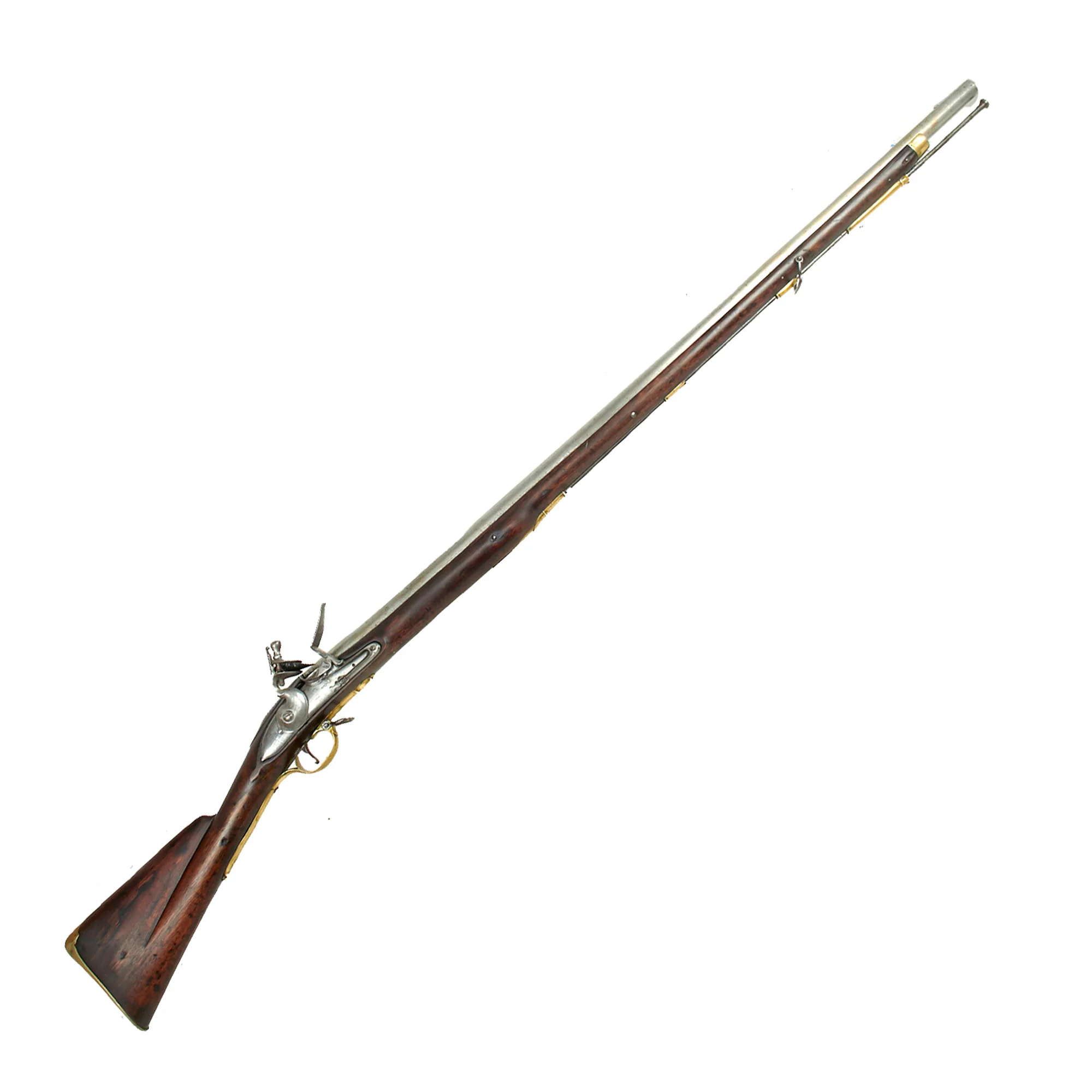
Original Item: Only One Available. Just purchased at a recent military auction, this lovely hard to find rifle is 100% all British manufacture, starting life in 1861 as a .577 caliber two band ENFIELD Percussion Naval Rifle, Pattern of1858. This design was similar to the "4th Model" P-1853 Enfield, and it has the correct "Baddeley" type bands with a recessed screw, as would be used on the later Martini-Henry rifles. These also had a shorter heavier barrel with 5 groove progressive rifling, as well as a bayonet bar on the barrel. The rifle was then later converted to the new Snider Breech loading system first adopted in 1866, and has a lovely patina of age. It should have brass fittings on the stock, but instead they are all iron / steel, so it looks like it may have had parts swapped during the Snider conversion. It comes complete with a VERY hard to find Cutlass bayonet, which bears British markings but was originally manufactured in Germany, or at least the blade was.
The lock is plate stamped "CROWN" over V.R. and 1861 / ENFIELD, indicating manufacture at the Royal Small Arms factory at Enfield lock. There is also the correct CROWN / ARROW / 52 "lock viewer's mark" on the lock plate as well. This was a military issued rifle, as indicated by the royal monogram. The left side of the barrel and the snider breech have proof marks stamped on them, which look to be from Enfield. There is the correct II * * stamped on top of the breech "shoe", indicating it is the MkII** version of the breech. This was the last version before the "latch" was introduced, though it does have a small "button" at the bottom of the breech plug that grips the breech block.
The whole rifle is in just outstanding collector's condition, with a lovely glow and no signs of major post military service restoration. The wood butt stock retains parts of its original stock cartouche, which is actually marked B. S. A. Co, so it may have been converted at Birmingham Small Arms Co, and not Enfield. It is also possible that it was later restocked and parts on hand were used. Definitely some great potential for future research! The bore has the correct five groove progressive rifling of a P-1858 Naval Rifle, which is still in very good condition. There is some past fouling and oxidation, now removed, but considering the naval service and black powder era, it's really in great shape. Overall there isn't really any rust pitting on the metal components, just a worn patina with past peppering. The breech opens correctly, and is still held closed by the retaining button on the bottom. The firing pin is present and moves easily, and the cartridge extractor mechanism is fully functional. The lock functions correctly, holding at half cock and firing at full, and both sling swivels are present and move easily. The original cleaning rod is in good shape, though it looks like the knurling on the end is worn.
The included rare cutlass bayonet is in very good condition, showing wear from service but no abuse or major damage. The blade has evidence of past oxidation, now cleaned away, and we also noted that the ricasso of the blade is marked with the manufacturer's logo of a Königskopf (King's Head) on the blade ricasso, the logo of Gebrüder Weyersberg, Waffenfabrik, which from 1859 onward operated a factory on Hochstrasse in the Ohligs area of the City of Solingen. Called "The City of Blades", Solingen is a world-renowned edged weapon area, with a history dating back to the middle ages. The Weyersberg family itself had a history of swordmaking going back at least 6 generations. The company supplied edges weapons to numerous countries during the 19th Century, and had made saber bayonets for numerous arms for the British. The leather over wood grip on the hilt is still in great shape, and the basket has a lovely aged patina. The bayonet locks correctly onto the front of the rifle, and really adds to the piece. This is the first time we have had one of these rare cutlass bayonets.
An all British P-1858 Converted Snider Naval Rifle originally made at ENFIELD, complete with a great example of a rare Naval Cutlass bayonet. Definitely some great display and research potential here!
Specifications (Rifle):-
Year of Manufacture: 1861 - Converted Later
Caliber: .58 inches - 5 Groove Rifling
Ammunition Type: .577 Centerfire Cartridge
Barrel Length: 30.5 inches
Overall Length: 48.5 inches
Action: Side Action Lock
Feed System: Side Hinge Rotating Breech block
Specifications (Cutlass Bayonet):-
Blade Length: 26 1/2"
Blade Style: Single Edge with Spear Type - Slightly Curved
Overall length: 32 1/4“
Basket dimensions: 5" width x 5” length
More on the P-1853 Rifle-Musket: The Enfield Pattern 1853 rifle-musket (also known as the Pattern 1853 Enfield, P53 Enfield, and Enfield rifle-musket) was a .577 calibre Minié-type muzzle-loading rifle-musket, used by the British Empire from 1853 to 1867, after which many Enfield 1853 rifle-muskets were converted to (and replaced in service by) the cartridge-loaded Snider-Enfield rifle.
The term "rifle-musket" originally referred to muskets with the smooth-bored barrels replaced with rifled barrels. The length of the barrels were unchanged, allowing the weapons to be fired by rank, since a long rifle was necessary to enable the muzzles of the second rank of soldiers to project beyond the faces of the men in front. The weapon would also be sufficiently long when fitted with a bayonet to be effective against cavalry. Such guns manufactured with rifled barrels, muzzle loading, single shot, and utilizing the same firing mechanism, also came to be called rifle-muskets.
The 39 in (99 cm) barrel had three grooves, with a 1:78 rifling twist, and was fastened to the stock with three metal bands, so that the rifle was often called a "three band" model.
History of the Snider rifle- Jacob Snider, an American from New York, developed this breech loading system for the P-1853 Enfield, the most prolific imported Percussion rifle in use by both the North and South during the U.S. Civil War. When the British Board of Ordnance appointed a Select Committee in 1864 the Snider system was swiftly adopted with the first breech loaders being issued in 1865 to British forces.
Improved in 1867 by the use of Colonel Boxer's center fire brass bodied cartridge, the rifle was used very effectively in the Abyssinian Campaign of 1868. The system utilized a hinged breech block with an internal firing pin assembly that permitted the use of a self contained cartridge of lead bullet in cardboard, and, after 1867, brass casing. This highly efficient conversion system prolonged the active life of the P-1853 rifles up until 1871 when the Martini System was adopted. Snider rifles saw continued use throughout the Empire but were officially obsoleted by the late 1880s.
NOTE: International orders of antique firearms MUST be shipped using UPS WW Services (courier). USPS Priority Mail international will not accept these. International customers should always consult their country's antique gun laws prior to ordering.

Details & Craftsmanship
Every detail has been carefully considered to bring you the perfect product.

Details & Craftsmanship
Every detail has been carefully considered to bring you the perfect product.

Details & Craftsmanship
Every detail has been carefully considered to bring you the perfect product.

Details & Craftsmanship
Every detail has been carefully considered to bring you the perfect product.

Details & Craftsmanship
Every detail has been carefully considered to bring you the perfect product.

Details & Craftsmanship
Every detail has been carefully considered to bring you the perfect product.

Details & Craftsmanship
Every detail has been carefully considered to bring you the perfect product.

Details & Craftsmanship
Every detail has been carefully considered to bring you the perfect product.

Details & Craftsmanship
Every detail has been carefully considered to bring you the perfect product.

Details & Craftsmanship
Every detail has been carefully considered to bring you the perfect product.

Details & Craftsmanship
Every detail has been carefully considered to bring you the perfect product.

Details & Craftsmanship
Every detail has been carefully considered to bring you the perfect product.

Details & Craftsmanship
Every detail has been carefully considered to bring you the perfect product.

Details & Craftsmanship
Every detail has been carefully considered to bring you the perfect product.

Details & Craftsmanship
Every detail has been carefully considered to bring you the perfect product.

Details & Craftsmanship
Every detail has been carefully considered to bring you the perfect product.

Details & Craftsmanship
Every detail has been carefully considered to bring you the perfect product.

Details & Craftsmanship
Every detail has been carefully considered to bring you the perfect product.

Details & Craftsmanship
Every detail has been carefully considered to bring you the perfect product.

Details & Craftsmanship
Every detail has been carefully considered to bring you the perfect product.

Details & Craftsmanship
Every detail has been carefully considered to bring you the perfect product.

Details & Craftsmanship
Every detail has been carefully considered to bring you the perfect product.

Details & Craftsmanship
Every detail has been carefully considered to bring you the perfect product.

Details & Craftsmanship
Every detail has been carefully considered to bring you the perfect product.

Details & Craftsmanship
Every detail has been carefully considered to bring you the perfect product.

Details & Craftsmanship
Every detail has been carefully considered to bring you the perfect product.

Details & Craftsmanship
Every detail has been carefully considered to bring you the perfect product.

Details & Craftsmanship
Every detail has been carefully considered to bring you the perfect product.

Details & Craftsmanship
Every detail has been carefully considered to bring you the perfect product.

Details & Craftsmanship
Every detail has been carefully considered to bring you the perfect product.

Details & Craftsmanship
Every detail has been carefully considered to bring you the perfect product.

Details & Craftsmanship
Every detail has been carefully considered to bring you the perfect product.

Details & Craftsmanship
Every detail has been carefully considered to bring you the perfect product.
Description
Original Item: Only One Available. Just purchased at a recent military auction, this lovely hard to find rifle is 100% all British manufacture, starting life in 1861 as a .577 caliber two band ENFIELD Percussion Naval Rifle, Pattern of1858. This design was similar to the "4th Model" P-1853 Enfield, and it has the correct "Baddeley" type bands with a recessed screw, as would be used on the later Martini-Henry rifles. These also had a shorter heavier barrel with 5 groove progressive rifling, as well as a bayonet bar on the barrel. The rifle was then later converted to the new Snider Breech loading system first adopted in 1866, and has a lovely patina of age. It should have brass fittings on the stock, but instead they are all iron / steel, so it looks like it may have had parts swapped during the Snider conversion. It comes complete with a VERY hard to find Cutlass bayonet, which bears British markings but was originally manufactured in Germany, or at least the blade was.
The lock is plate stamped "CROWN" over V.R. and 1861 / ENFIELD, indicating manufacture at the Royal Small Arms factory at Enfield lock. There is also the correct CROWN / ARROW / 52 "lock viewer's mark" on the lock plate as well. This was a military issued rifle, as indicated by the royal monogram. The left side of the barrel and the snider breech have proof marks stamped on them, which look to be from Enfield. There is the correct II * * stamped on top of the breech "shoe", indicating it is the MkII** version of the breech. This was the last version before the "latch" was introduced, though it does have a small "button" at the bottom of the breech plug that grips the breech block.
The whole rifle is in just outstanding collector's condition, with a lovely glow and no signs of major post military service restoration. The wood butt stock retains parts of its original stock cartouche, which is actually marked B. S. A. Co, so it may have been converted at Birmingham Small Arms Co, and not Enfield. It is also possible that it was later restocked and parts on hand were used. Definitely some great potential for future research! The bore has the correct five groove progressive rifling of a P-1858 Naval Rifle, which is still in very good condition. There is some past fouling and oxidation, now removed, but considering the naval service and black powder era, it's really in great shape. Overall there isn't really any rust pitting on the metal components, just a worn patina with past peppering. The breech opens correctly, and is still held closed by the retaining button on the bottom. The firing pin is present and moves easily, and the cartridge extractor mechanism is fully functional. The lock functions correctly, holding at half cock and firing at full, and both sling swivels are present and move easily. The original cleaning rod is in good shape, though it looks like the knurling on the end is worn.
The included rare cutlass bayonet is in very good condition, showing wear from service but no abuse or major damage. The blade has evidence of past oxidation, now cleaned away, and we also noted that the ricasso of the blade is marked with the manufacturer's logo of a Königskopf (King's Head) on the blade ricasso, the logo of Gebrüder Weyersberg, Waffenfabrik, which from 1859 onward operated a factory on Hochstrasse in the Ohligs area of the City of Solingen. Called "The City of Blades", Solingen is a world-renowned edged weapon area, with a history dating back to the middle ages. The Weyersberg family itself had a history of swordmaking going back at least 6 generations. The company supplied edges weapons to numerous countries during the 19th Century, and had made saber bayonets for numerous arms for the British. The leather over wood grip on the hilt is still in great shape, and the basket has a lovely aged patina. The bayonet locks correctly onto the front of the rifle, and really adds to the piece. This is the first time we have had one of these rare cutlass bayonets.
An all British P-1858 Converted Snider Naval Rifle originally made at ENFIELD, complete with a great example of a rare Naval Cutlass bayonet. Definitely some great display and research potential here!
Specifications (Rifle):-
Year of Manufacture: 1861 - Converted Later
Caliber: .58 inches - 5 Groove Rifling
Ammunition Type: .577 Centerfire Cartridge
Barrel Length: 30.5 inches
Overall Length: 48.5 inches
Action: Side Action Lock
Feed System: Side Hinge Rotating Breech block
Specifications (Cutlass Bayonet):-
Blade Length: 26 1/2"
Blade Style: Single Edge with Spear Type - Slightly Curved
Overall length: 32 1/4“
Basket dimensions: 5" width x 5” length
More on the P-1853 Rifle-Musket: The Enfield Pattern 1853 rifle-musket (also known as the Pattern 1853 Enfield, P53 Enfield, and Enfield rifle-musket) was a .577 calibre Minié-type muzzle-loading rifle-musket, used by the British Empire from 1853 to 1867, after which many Enfield 1853 rifle-muskets were converted to (and replaced in service by) the cartridge-loaded Snider-Enfield rifle.
The term "rifle-musket" originally referred to muskets with the smooth-bored barrels replaced with rifled barrels. The length of the barrels were unchanged, allowing the weapons to be fired by rank, since a long rifle was necessary to enable the muzzles of the second rank of soldiers to project beyond the faces of the men in front. The weapon would also be sufficiently long when fitted with a bayonet to be effective against cavalry. Such guns manufactured with rifled barrels, muzzle loading, single shot, and utilizing the same firing mechanism, also came to be called rifle-muskets.
The 39 in (99 cm) barrel had three grooves, with a 1:78 rifling twist, and was fastened to the stock with three metal bands, so that the rifle was often called a "three band" model.
History of the Snider rifle- Jacob Snider, an American from New York, developed this breech loading system for the P-1853 Enfield, the most prolific imported Percussion rifle in use by both the North and South during the U.S. Civil War. When the British Board of Ordnance appointed a Select Committee in 1864 the Snider system was swiftly adopted with the first breech loaders being issued in 1865 to British forces.
Improved in 1867 by the use of Colonel Boxer's center fire brass bodied cartridge, the rifle was used very effectively in the Abyssinian Campaign of 1868. The system utilized a hinged breech block with an internal firing pin assembly that permitted the use of a self contained cartridge of lead bullet in cardboard, and, after 1867, brass casing. This highly efficient conversion system prolonged the active life of the P-1853 rifles up until 1871 when the Martini System was adopted. Snider rifles saw continued use throughout the Empire but were officially obsoleted by the late 1880s.
NOTE: International orders of antique firearms MUST be shipped using UPS WW Services (courier). USPS Priority Mail international will not accept these. International customers should always consult their country's antique gun laws prior to ordering.