
The Story
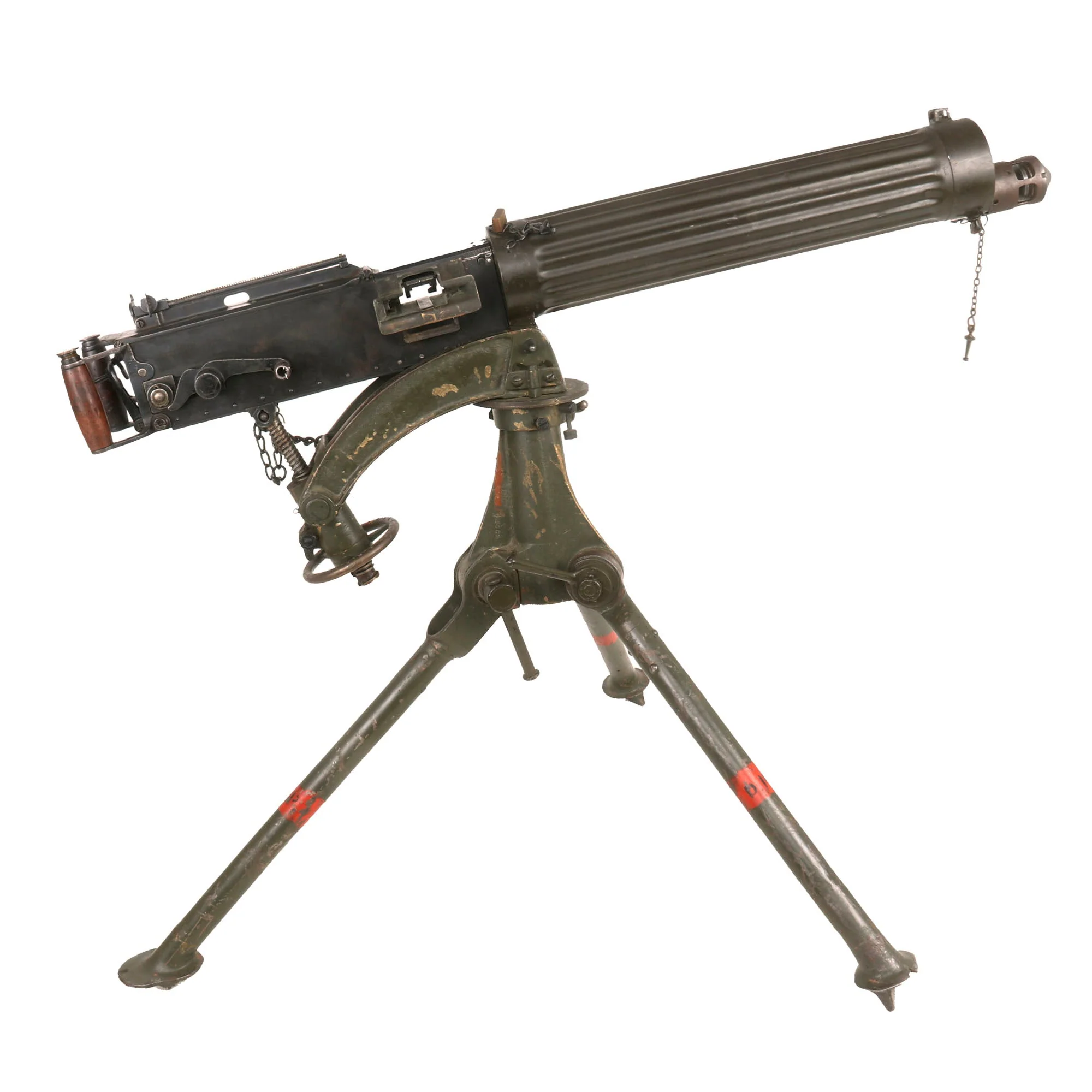
Original Item: Only One Available. One of the first we have had in some time! This is a fantastic British WWI Production Vickers Inert Fluted display non-firing Medium Machine Gun, complete with multiple accessories and an original tripod. The display gun was built to BATF specifications using an all original Vickers parts sets assembled on a BATF compliant inert non-firing dummy receiver. Both the left and right side plate are BATF compliant and completely inert, newly made from steel several times as thick as the originals, which makes it impossible to insert unaltered original components. They lack any type of functional cams or protrusions, and as they are new made inert pieces this display "non-gun" is totally legal to own without any federal restrictions or license as it is no longer legally considered a firearm.
The inside of the receiver still incorporates many of the original internal components, which have been modified to fit into the narrower receiver by removing the protrusions that would engage the sideplates. They have been deactivated to BATF specifications by welding up the firing pin and some of the moving components. The crank can still be moved back and forth with spring action. A truly fantastic display set!
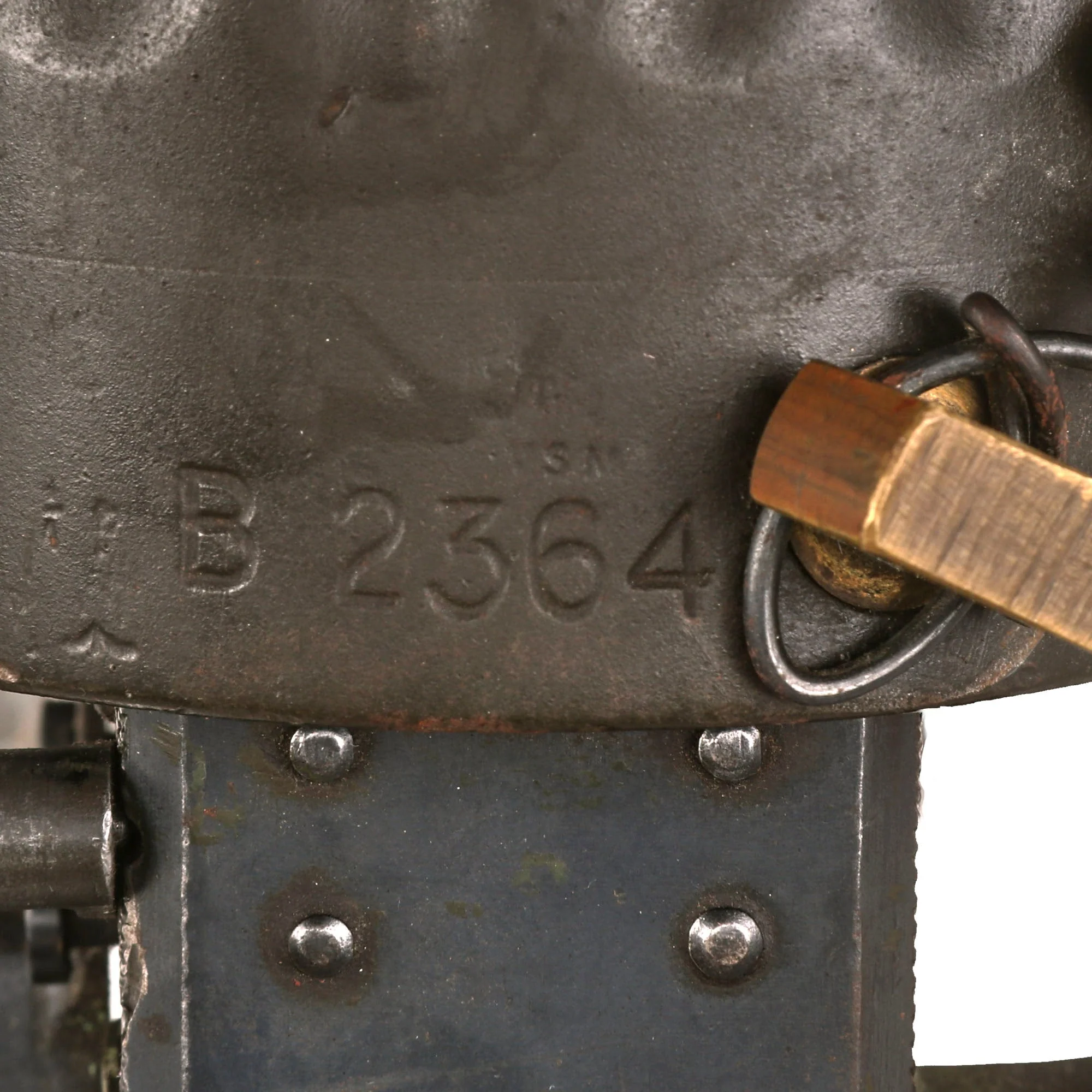
The water jacket on this example bears serial number B2364, with a small VSM stamped above, for manufacture by Vickers, Sons & Maxim, the name the company went by during the WWI Era. The company had several factories making Vickers guns, with "B" indicating manufacture at their Erith plant in August 1918, making this a true WWI produced gun. Really a great early example!
Like many Vickers guns, it continued to see service after the war, and the parts on it are now mostly in the WWII configuration, without the "flat-nose" muzzle gland it would originally have had. Many parts are marked DP, as these were kept as drill purpose guns long after their active service had ended.
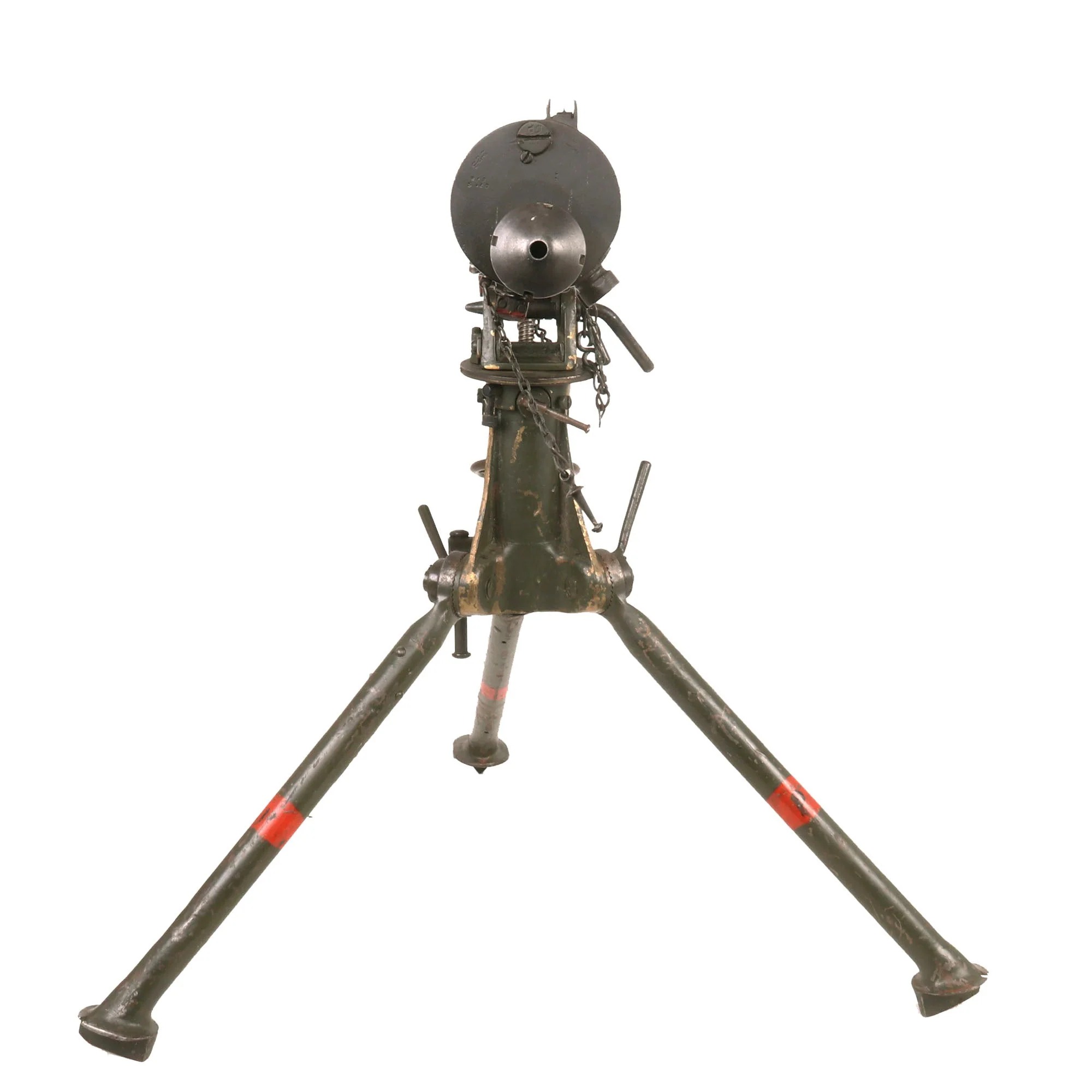
The gun comes with an extremely hard to find complete Vickers Tripod, with a brass crosshead and elevation mechanism. It does not have any data plate on the legs, and looks to be an interwar or WWII issue example, paired with an earlier produced gun. The tripod is fitted with a British brass crosshead which has some great markings on the top: M.T. 303 M.G.M J. 38 REG : No 2104, which is the tripod designation and probably information on where it was made. The elevation mechanism is present and functional, as are both cross pins, and all of the retaining chains look to be present, definitely a rarity.
These have become EXTREMELY scarce recently, especially complete original tripods. Many more parts sets were imported than tripods, and they are highly sought after. This is the first example we have had in some time that is complete and totally correct. A fantastic collector's opportunity that we do not expect to see again anytime soon!
The Vickers machine gun or Vickers gun is a name primarily used to refer to the water-cooled .303 inch (7.7 mm) machine gun produced by Vickers Limited, originally for the British Army. The machine gun typically required a six to eight-man team to operate: one to fire, one to feed the ammunition, the rest to help carry the weapon, its ammunition and spare parts. It was in service from before the First World War until the 1960s.
The weapon had a reputation for great solidity and reliability. Ian V. Hogg, in Weapons & War Machines, describes an action that took place in August 1916, during which the British Army's 100th Company of the Machine Gun Corps fired their ten Vickers guns continuously for twelve hours. Using 100 new barrels, they fired a million rounds without a single breakdown. "It was this absolute foolproof reliability which endeared the Vickers to every British soldier who ever fired one."
The Vickers machine gun was based on the successful Maxim gun of the late 19th century. After purchasing the Maxim company outright in 1896, Vickers took the design of the Maxim gun and improved it, reducing its weight by lightening and simplifying the action and substituting components made with high strength alloys. A muzzle booster was also added.
The British Army formally adopted the Vickers gun as its standard machine gun on 26 November 1912, using it alongside their Maxims. There were still great shortages when the First World War began, and the British Expeditionary Force was still equipped with Maxims when sent to France in 1914. Vickers was, in fact, threatened with prosecution for war profiteering, due to the exorbitant price it was demanding for each gun. As a result, the price was slashed. As the war progressed, and numbers increased, it became the British Army's primary machine gun, and served on all fronts during the conflict. When the Lewis Gun was adopted as a light machine gun and issued to infantry units, the Vickers guns were redefined as heavy machine guns, withdrawn from infantry units, and grouped in the hands of the new Machine Gun Corps.
After the First World War, the Machine Gun Corps (MGC) was disbanded and the Vickers returned to infantry units. Before the Second World War, there were plans to replace the Vickers gun; one of the contenders was the 7.92 mm (.312 in) Besa machine gun (a Czech design), which eventually became the British Army's standard tank-mounted machine gun. However, the Vickers remained in service with the British Army until 30 March 1968. Its last operational use was in the Radfan during the Aden Emergency.

Details & Craftsmanship
Every detail has been carefully considered to bring you the perfect product.
Details & Craftsmanship
Every detail has been carefully considered to bring you the perfect product.

Details & Craftsmanship
Every detail has been carefully considered to bring you the perfect product.
Details & Craftsmanship
Every detail has been carefully considered to bring you the perfect product.

Details & Craftsmanship
Every detail has been carefully considered to bring you the perfect product.

Details & Craftsmanship
Every detail has been carefully considered to bring you the perfect product.

Details & Craftsmanship
Every detail has been carefully considered to bring you the perfect product.

Details & Craftsmanship
Every detail has been carefully considered to bring you the perfect product.

Details & Craftsmanship
Every detail has been carefully considered to bring you the perfect product.

Details & Craftsmanship
Every detail has been carefully considered to bring you the perfect product.

Details & Craftsmanship
Every detail has been carefully considered to bring you the perfect product.

Details & Craftsmanship
Every detail has been carefully considered to bring you the perfect product.

Details & Craftsmanship
Every detail has been carefully considered to bring you the perfect product.

Details & Craftsmanship
Every detail has been carefully considered to bring you the perfect product.

Details & Craftsmanship
Every detail has been carefully considered to bring you the perfect product.

Details & Craftsmanship
Every detail has been carefully considered to bring you the perfect product.

Details & Craftsmanship
Every detail has been carefully considered to bring you the perfect product.

Details & Craftsmanship
Every detail has been carefully considered to bring you the perfect product.

Details & Craftsmanship
Every detail has been carefully considered to bring you the perfect product.

Details & Craftsmanship
Every detail has been carefully considered to bring you the perfect product.
Details & Craftsmanship
Every detail has been carefully considered to bring you the perfect product.

Details & Craftsmanship
Every detail has been carefully considered to bring you the perfect product.
Description
Original Item: Only One Available. One of the first we have had in some time! This is a fantastic British WWI Production Vickers Inert Fluted display non-firing Medium Machine Gun, complete with multiple accessories and an original tripod. The display gun was built to BATF specifications using an all original Vickers parts sets assembled on a BATF compliant inert non-firing dummy receiver. Both the left and right side plate are BATF compliant and completely inert, newly made from steel several times as thick as the originals, which makes it impossible to insert unaltered original components. They lack any type of functional cams or protrusions, and as they are new made inert pieces this display "non-gun" is totally legal to own without any federal restrictions or license as it is no longer legally considered a firearm.
The inside of the receiver still incorporates many of the original internal components, which have been modified to fit into the narrower receiver by removing the protrusions that would engage the sideplates. They have been deactivated to BATF specifications by welding up the firing pin and some of the moving components. The crank can still be moved back and forth with spring action. A truly fantastic display set!
The water jacket on this example bears serial number B2364, with a small VSM stamped above, for manufacture by Vickers, Sons & Maxim, the name the company went by during the WWI Era. The company had several factories making Vickers guns, with "B" indicating manufacture at their Erith plant in August 1918, making this a true WWI produced gun. Really a great early example!
Like many Vickers guns, it continued to see service after the war, and the parts on it are now mostly in the WWII configuration, without the "flat-nose" muzzle gland it would originally have had. Many parts are marked DP, as these were kept as drill purpose guns long after their active service had ended.
The gun comes with an extremely hard to find complete Vickers Tripod, with a brass crosshead and elevation mechanism. It does not have any data plate on the legs, and looks to be an interwar or WWII issue example, paired with an earlier produced gun. The tripod is fitted with a British brass crosshead which has some great markings on the top: M.T. 303 M.G.M J. 38 REG : No 2104, which is the tripod designation and probably information on where it was made. The elevation mechanism is present and functional, as are both cross pins, and all of the retaining chains look to be present, definitely a rarity.
These have become EXTREMELY scarce recently, especially complete original tripods. Many more parts sets were imported than tripods, and they are highly sought after. This is the first example we have had in some time that is complete and totally correct. A fantastic collector's opportunity that we do not expect to see again anytime soon!
The Vickers machine gun or Vickers gun is a name primarily used to refer to the water-cooled .303 inch (7.7 mm) machine gun produced by Vickers Limited, originally for the British Army. The machine gun typically required a six to eight-man team to operate: one to fire, one to feed the ammunition, the rest to help carry the weapon, its ammunition and spare parts. It was in service from before the First World War until the 1960s.
The weapon had a reputation for great solidity and reliability. Ian V. Hogg, in Weapons & War Machines, describes an action that took place in August 1916, during which the British Army's 100th Company of the Machine Gun Corps fired their ten Vickers guns continuously for twelve hours. Using 100 new barrels, they fired a million rounds without a single breakdown. "It was this absolute foolproof reliability which endeared the Vickers to every British soldier who ever fired one."
The Vickers machine gun was based on the successful Maxim gun of the late 19th century. After purchasing the Maxim company outright in 1896, Vickers took the design of the Maxim gun and improved it, reducing its weight by lightening and simplifying the action and substituting components made with high strength alloys. A muzzle booster was also added.
The British Army formally adopted the Vickers gun as its standard machine gun on 26 November 1912, using it alongside their Maxims. There were still great shortages when the First World War began, and the British Expeditionary Force was still equipped with Maxims when sent to France in 1914. Vickers was, in fact, threatened with prosecution for war profiteering, due to the exorbitant price it was demanding for each gun. As a result, the price was slashed. As the war progressed, and numbers increased, it became the British Army's primary machine gun, and served on all fronts during the conflict. When the Lewis Gun was adopted as a light machine gun and issued to infantry units, the Vickers guns were redefined as heavy machine guns, withdrawn from infantry units, and grouped in the hands of the new Machine Gun Corps.
After the First World War, the Machine Gun Corps (MGC) was disbanded and the Vickers returned to infantry units. Before the Second World War, there were plans to replace the Vickers gun; one of the contenders was the 7.92 mm (.312 in) Besa machine gun (a Czech design), which eventually became the British Army's standard tank-mounted machine gun. However, the Vickers remained in service with the British Army until 30 March 1968. Its last operational use was in the Radfan during the Aden Emergency.