
The Story
Original Item: Only One Available. These are so very rare, a real pre-1899 Antique Russian Mosin-Nagant Rifle, originally referred to as the "Three Line Infantry Rifle, Model of 1891." This example was almost certainly one of 190,000 or so Mosin-Nagant M1891 Full Length Rifles left behind in Imperial Russian depots when the country gained its independence in 1917-1918. The rifle was quickly adopted as the standard weapon of the fledgling country, and quickly the need arose to overhaul these to meet Finnish Army standards. This resulted in the first of many upgraded Finnish Mosin-Nagant rifles, the M/91. Due to the large number of rifles already present, until close to the WWII era all Finnish Mosin-Nagant rifles were built on the original Russian receivers.
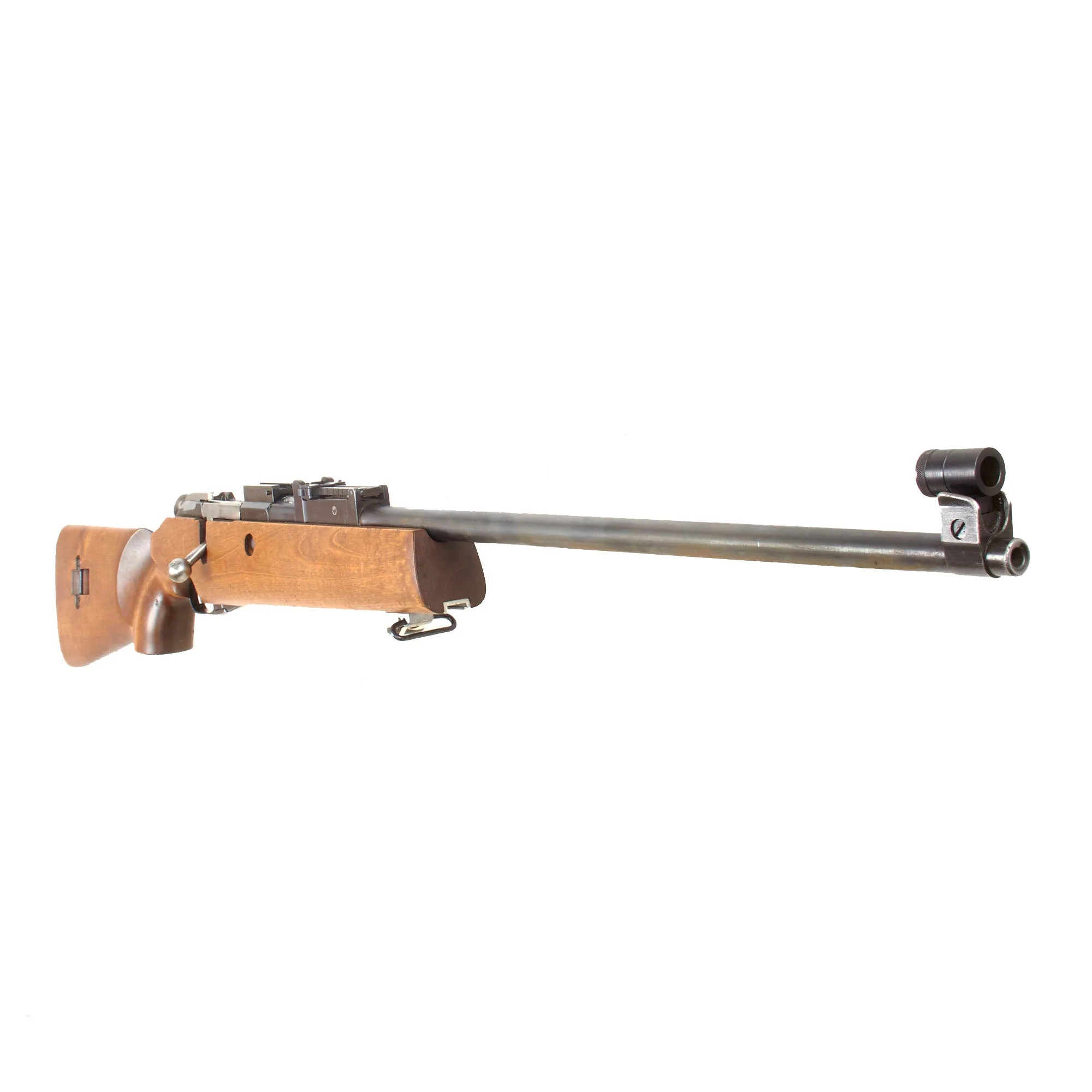
This also continued well into the post war era, as the receivers were robust, and that is exactly what happened in this case. This is a very nice example of the Finnish M/28–76 Dual Purpose sniper rifle and target rifle for CISM 300 m standard rifle competition. It was constructed in 1976 using an antique 1895 dated Imperial Russian receiver. These were an improvement over the previous M/28–57 and M/27–66 target rifles, and like those, often utilized barrels and receivers from existing rifles.
They were modified from existing M/28–30 and M/28–57 rifles, using the M/28–30 barrel and sights, often with new barrels, but sometimes original from M/28–30. These were then fitted with new birch wood stocks of the same profile as the M/27–66. The target rifle version had a diopter rear sight added and a modified front sight, while the sniper rifle version had a scope base. Modification work for the rifles was carried out by Finnish Defense Forces Asevarikko 1 ('Arsenal 1') in Kuopio.
Only about 1,000 of these target rifles were ever imported into the United States, making each example rare. These were assumed to be non-antique, so many were stamped with import stamps on the bottom of the barrel, such as this example:
PRI GARDEN CITY KS
FINLAND VALMET 28-76 7.62X54R
This indicates importation by Postrock Imports, a known importer of Mosin-Nagant rifles. It also gives the chambering as 7.62×54mmR Russian, but we do not know if this was verified by slugging and chambering, or just assumed. Most of these were made for 7.62×53mmR Finnish, however we have no way to verify which chambering it is for. The barrel is the correct shorter 27 inch version, which is thicker than the original Russian specification for greater accuracy. The top of the barrel base is marked with the following information:
ASEV1
10913
28-76
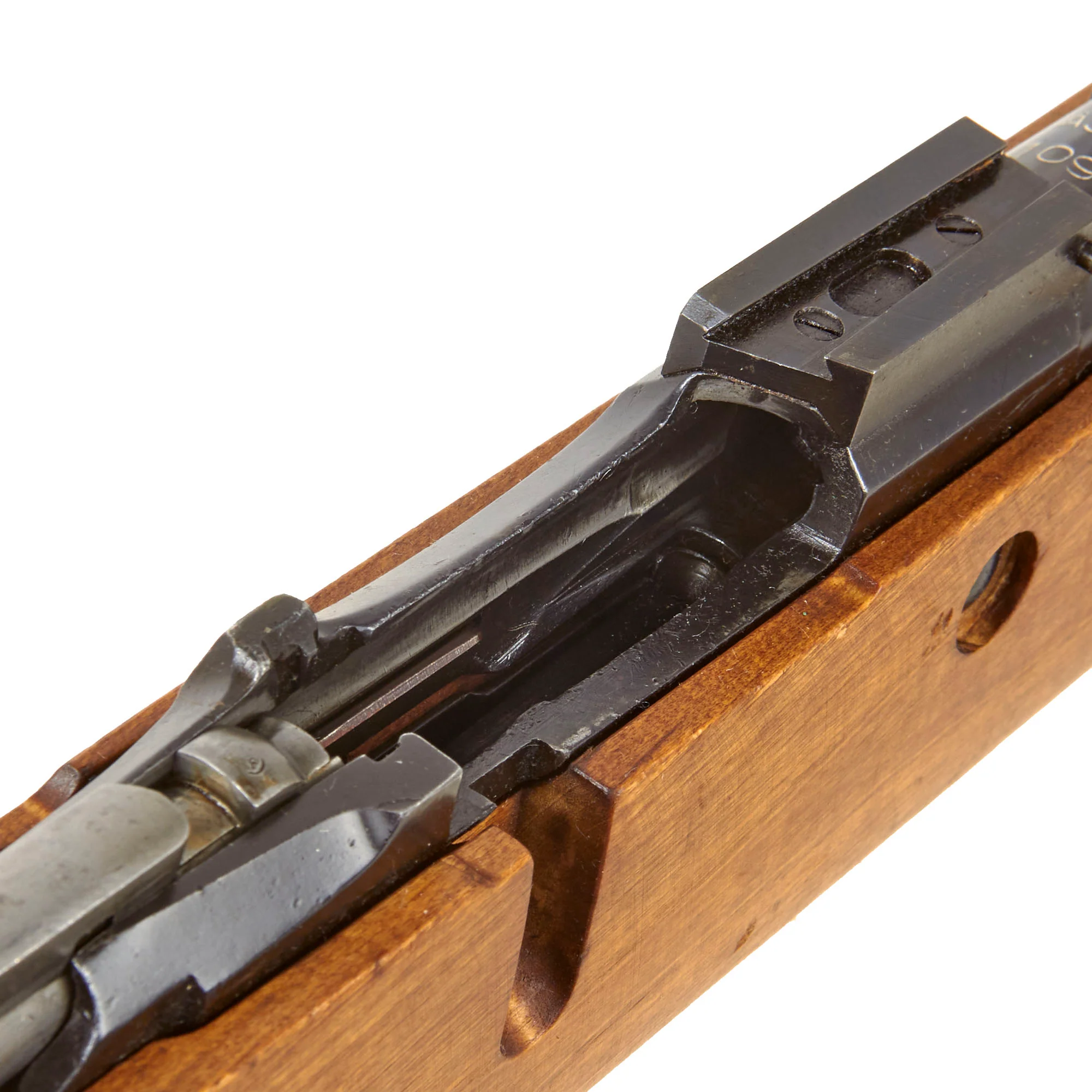
It is also marked on the left side with 3600 which we do not understand the significance of. From what we have read, the "ASEV1" marking and 28-76 indicate inspection as a "match grade" barrel in 1976. This example is also a bit different from most, as it is not fitted with the usual long range sight on the rear left, and instead has a Sniper scope rail added to the top front of the receiver, which also means that we cannot see the markings on the top of the receiver. It is marked on the left side with both serial number 35050 as well as 94615. The bolt is marked with serial number 0913, and has been significantly modified from the original shape. We also noticed that one of the bolt components has the Bow and Arrow proof of Izhvesk arsenal, so even in those days the Finns were still reusing the Imperial Russian components.
The bottom of the receiver tang is dated 95г for 1895 (г is short for год "god", or year in English), legally classifying this as a Pre-1899 Antique Firearm. Above the date is a HAMMER, the marking of Императорскій Тулбскій Оружейнбій Заводъ, the "Imperial Tula Arms Factory", one of the most prominent in Russia. Reconstructed in the 19th century Tula Arms Factory became one of the most prominent arms factories in Europe. In 1879 the plant started production of the famous Berdan rifle with an improved bolt. Workshop was organized by a model where created their own models of small arms and hunting weapons. Increased production of various products: single- and double-barrel muzzle-loading shotguns, breech-loading center-fire rifles. Designer Sergei Ivanovich Mosin took part in devising damascus steel technology used in production of barrels. He also designed a bolt-action rifle which was put to testing along with a rifle developed by Émile Nagant. In 1891, as a result of complex tests Mosin's entry was chosen over the Belgian design and it was adopted by the Imperial Russian Army as the three-line rifle of 1891.
The condition of the rifle is really very good, showing some light wear on the marksmanship style stock, but nothing out of line for being close to 50 years of age. The finish on the barrel and receiver is very well retained. The aluminum dovetails on the bottom and left side of the stock show some marring from having items attached in the past, and as a rarity, the bottom still has a sling swivel fitting present in the rail!
The rifle cycles correctly with a strong dry fire, though we have no way to test to see if the magazine still feeds. The M/39 pattern rear sight is fully functional, but most likely no longer used due to being set up with a sniper scope (not included). The front globe sight is in great shape, and we assume is intended for use with the existing rear sight when a scope is not fitted. We checked the bore, and it is in excellent condition, showing a bright finish with crisp lands and grooves. It looks to have seen little to no use since conversion.
A wonderful piece of Finnish and Firearms history! Ready to research and display!
Specifications:
Year of Manufacture: 1895
Caliber: 7.62×54mmR Russian or possibly 7.62×53mmR Finnish
Cartridge Type: Centerfire Cartridge
Length (overall): 46 1/2"
Barrel Length: 27"
Stock length: 29 1/4"
Action type: Bolt Action
Feed System: 5 Round Internal
During the Winter War of 1939/1940, Finland heroically fought the forces of the Soviet Union in a David-versus-Goliath struggle that lasted about 100 days. Though the Finns eventually lost about 11 percent of their territory to the Soviet Union, they inflicted 323,000 casualties on the Soviets while suffering only 70,000 casualties themselves. Of course, for a small country that was a lot of casualties. As a result of Finland’s tenacity and courage during the Winter War, the reputation of the Finns around the world was enhanced, while the Soviet’s poor performance in combat may have contributed to AH's decision to invade the Soviet Union less than a year and a half later.
Finland’s greatest asset during the Winter War was a large cadre of citizen soldiers who combined their skills as skiers, woodsmen and riflemen to ambush and carry out hit-and-run attacks on the Soviets. The principal weapons for the Finnish raiders were the Suomi submachine gun and the Finnish versions of the Mosin-Nagant rifle, chambered for the Finnish 7.62x53R round, which is virtually identical to the Russian 7.62x54R round used in their version of the Mosin-Nagant.
Originally, Finland had a large number of Soviet Mosin-Nagant M/91 rifles, which were in military arms depots when they achieved their independence from Russia in December 1917. Within a few years, however, the Finns would begin producing Mosin-Nagant rifles at SAKO, Tikka and Valmet, three arms producers that remain famous today for high-quality rifles.
The first large-scale upgrade of Finnish Mosin-Nagant rifles was the M/24 rifle for the Finnish Civil Guard. The Finnish Civil Guard (the Suojeluskunta) fulfilled a function similar to the U.S. National Guard. It was composed of volunteers, many of whom were outdoorsmen, hunters and shooters. They were separate from the Finnish Army, which was composed primarily of conscripts. Civil Guard members trained frequently and realistically. So much stress was put on marksmanship that the Civil Guard actually owned the Sako gun works. Most who have studied the Winter War believe that the Civil Guard was the most important element early in the conflict to slow the Russian advance. Their M/24 rifles used German barrels from Venus Arms, or barrels purchased from SIG in Switzerland. These rifles are often referred to as the “Lotta Rifle” after Lotta Svard, the women’s auxiliary of the Civil Guard, which helped raise the money for the rifle upgrades.
Next, the Finns reworked the M1891 Mosin-Nagant by retaining the receiver and magazine, but using a shorter, heavier barrel, improved sights, an improved bolt and new barrel bands, among other changes. After problems arose with the stock breaking when using the bayonet, the stocks were also modified. An interesting point is that many Finn soldiers didn’t like the bayonet, but preferred to use their traditional puukko knives for close combat. The current bayonet for the Valmet M/76 rifle is actually a knife bayonet of traditional style. A shortened cavalry version, the M/27rv, was also produced in limited numbers. Very similar to the M/27 was the M/28, which had a different barrel band and improved trigger. Initially, M/28 barrels were purchased from SIG, but later they were produced by Tikka and SAKO. All of the rifles, however, were assembled at SAKO. The major criticism of the M/28 was that it retained the Russian “Konovalov” rear sight, which Finnish troops did not like. This is one of the primary reasons for the development of the M/28-30.

Details & Craftsmanship
Every detail has been carefully considered to bring you the perfect product.

Details & Craftsmanship
Every detail has been carefully considered to bring you the perfect product.

Details & Craftsmanship
Every detail has been carefully considered to bring you the perfect product.

Details & Craftsmanship
Every detail has been carefully considered to bring you the perfect product.

Details & Craftsmanship
Every detail has been carefully considered to bring you the perfect product.

Details & Craftsmanship
Every detail has been carefully considered to bring you the perfect product.

Details & Craftsmanship
Every detail has been carefully considered to bring you the perfect product.

Details & Craftsmanship
Every detail has been carefully considered to bring you the perfect product.

Details & Craftsmanship
Every detail has been carefully considered to bring you the perfect product.

Details & Craftsmanship
Every detail has been carefully considered to bring you the perfect product.

Details & Craftsmanship
Every detail has been carefully considered to bring you the perfect product.

Details & Craftsmanship
Every detail has been carefully considered to bring you the perfect product.

Details & Craftsmanship
Every detail has been carefully considered to bring you the perfect product.

Details & Craftsmanship
Every detail has been carefully considered to bring you the perfect product.

Details & Craftsmanship
Every detail has been carefully considered to bring you the perfect product.

Details & Craftsmanship
Every detail has been carefully considered to bring you the perfect product.

Details & Craftsmanship
Every detail has been carefully considered to bring you the perfect product.

Details & Craftsmanship
Every detail has been carefully considered to bring you the perfect product.

Details & Craftsmanship
Every detail has been carefully considered to bring you the perfect product.
Details & Craftsmanship
Every detail has been carefully considered to bring you the perfect product.
Details & Craftsmanship
Every detail has been carefully considered to bring you the perfect product.

Details & Craftsmanship
Every detail has been carefully considered to bring you the perfect product.

Details & Craftsmanship
Every detail has been carefully considered to bring you the perfect product.
Description
Original Item: Only One Available. These are so very rare, a real pre-1899 Antique Russian Mosin-Nagant Rifle, originally referred to as the "Three Line Infantry Rifle, Model of 1891." This example was almost certainly one of 190,000 or so Mosin-Nagant M1891 Full Length Rifles left behind in Imperial Russian depots when the country gained its independence in 1917-1918. The rifle was quickly adopted as the standard weapon of the fledgling country, and quickly the need arose to overhaul these to meet Finnish Army standards. This resulted in the first of many upgraded Finnish Mosin-Nagant rifles, the M/91. Due to the large number of rifles already present, until close to the WWII era all Finnish Mosin-Nagant rifles were built on the original Russian receivers.
This also continued well into the post war era, as the receivers were robust, and that is exactly what happened in this case. This is a very nice example of the Finnish M/28–76 Dual Purpose sniper rifle and target rifle for CISM 300 m standard rifle competition. It was constructed in 1976 using an antique 1895 dated Imperial Russian receiver. These were an improvement over the previous M/28–57 and M/27–66 target rifles, and like those, often utilized barrels and receivers from existing rifles.
They were modified from existing M/28–30 and M/28–57 rifles, using the M/28–30 barrel and sights, often with new barrels, but sometimes original from M/28–30. These were then fitted with new birch wood stocks of the same profile as the M/27–66. The target rifle version had a diopter rear sight added and a modified front sight, while the sniper rifle version had a scope base. Modification work for the rifles was carried out by Finnish Defense Forces Asevarikko 1 ('Arsenal 1') in Kuopio.
Only about 1,000 of these target rifles were ever imported into the United States, making each example rare. These were assumed to be non-antique, so many were stamped with import stamps on the bottom of the barrel, such as this example:
PRI GARDEN CITY KS
FINLAND VALMET 28-76 7.62X54R
This indicates importation by Postrock Imports, a known importer of Mosin-Nagant rifles. It also gives the chambering as 7.62×54mmR Russian, but we do not know if this was verified by slugging and chambering, or just assumed. Most of these were made for 7.62×53mmR Finnish, however we have no way to verify which chambering it is for. The barrel is the correct shorter 27 inch version, which is thicker than the original Russian specification for greater accuracy. The top of the barrel base is marked with the following information:
ASEV1
10913
28-76
It is also marked on the left side with 3600 which we do not understand the significance of. From what we have read, the "ASEV1" marking and 28-76 indicate inspection as a "match grade" barrel in 1976. This example is also a bit different from most, as it is not fitted with the usual long range sight on the rear left, and instead has a Sniper scope rail added to the top front of the receiver, which also means that we cannot see the markings on the top of the receiver. It is marked on the left side with both serial number 35050 as well as 94615. The bolt is marked with serial number 0913, and has been significantly modified from the original shape. We also noticed that one of the bolt components has the Bow and Arrow proof of Izhvesk arsenal, so even in those days the Finns were still reusing the Imperial Russian components.
The bottom of the receiver tang is dated 95г for 1895 (г is short for год "god", or year in English), legally classifying this as a Pre-1899 Antique Firearm. Above the date is a HAMMER, the marking of Императорскій Тулбскій Оружейнбій Заводъ, the "Imperial Tula Arms Factory", one of the most prominent in Russia. Reconstructed in the 19th century Tula Arms Factory became one of the most prominent arms factories in Europe. In 1879 the plant started production of the famous Berdan rifle with an improved bolt. Workshop was organized by a model where created their own models of small arms and hunting weapons. Increased production of various products: single- and double-barrel muzzle-loading shotguns, breech-loading center-fire rifles. Designer Sergei Ivanovich Mosin took part in devising damascus steel technology used in production of barrels. He also designed a bolt-action rifle which was put to testing along with a rifle developed by Émile Nagant. In 1891, as a result of complex tests Mosin's entry was chosen over the Belgian design and it was adopted by the Imperial Russian Army as the three-line rifle of 1891.
The condition of the rifle is really very good, showing some light wear on the marksmanship style stock, but nothing out of line for being close to 50 years of age. The finish on the barrel and receiver is very well retained. The aluminum dovetails on the bottom and left side of the stock show some marring from having items attached in the past, and as a rarity, the bottom still has a sling swivel fitting present in the rail!
The rifle cycles correctly with a strong dry fire, though we have no way to test to see if the magazine still feeds. The M/39 pattern rear sight is fully functional, but most likely no longer used due to being set up with a sniper scope (not included). The front globe sight is in great shape, and we assume is intended for use with the existing rear sight when a scope is not fitted. We checked the bore, and it is in excellent condition, showing a bright finish with crisp lands and grooves. It looks to have seen little to no use since conversion.
A wonderful piece of Finnish and Firearms history! Ready to research and display!
Specifications:
Year of Manufacture: 1895
Caliber: 7.62×54mmR Russian or possibly 7.62×53mmR Finnish
Cartridge Type: Centerfire Cartridge
Length (overall): 46 1/2"
Barrel Length: 27"
Stock length: 29 1/4"
Action type: Bolt Action
Feed System: 5 Round Internal
During the Winter War of 1939/1940, Finland heroically fought the forces of the Soviet Union in a David-versus-Goliath struggle that lasted about 100 days. Though the Finns eventually lost about 11 percent of their territory to the Soviet Union, they inflicted 323,000 casualties on the Soviets while suffering only 70,000 casualties themselves. Of course, for a small country that was a lot of casualties. As a result of Finland’s tenacity and courage during the Winter War, the reputation of the Finns around the world was enhanced, while the Soviet’s poor performance in combat may have contributed to AH's decision to invade the Soviet Union less than a year and a half later.
Finland’s greatest asset during the Winter War was a large cadre of citizen soldiers who combined their skills as skiers, woodsmen and riflemen to ambush and carry out hit-and-run attacks on the Soviets. The principal weapons for the Finnish raiders were the Suomi submachine gun and the Finnish versions of the Mosin-Nagant rifle, chambered for the Finnish 7.62x53R round, which is virtually identical to the Russian 7.62x54R round used in their version of the Mosin-Nagant.
Originally, Finland had a large number of Soviet Mosin-Nagant M/91 rifles, which were in military arms depots when they achieved their independence from Russia in December 1917. Within a few years, however, the Finns would begin producing Mosin-Nagant rifles at SAKO, Tikka and Valmet, three arms producers that remain famous today for high-quality rifles.
The first large-scale upgrade of Finnish Mosin-Nagant rifles was the M/24 rifle for the Finnish Civil Guard. The Finnish Civil Guard (the Suojeluskunta) fulfilled a function similar to the U.S. National Guard. It was composed of volunteers, many of whom were outdoorsmen, hunters and shooters. They were separate from the Finnish Army, which was composed primarily of conscripts. Civil Guard members trained frequently and realistically. So much stress was put on marksmanship that the Civil Guard actually owned the Sako gun works. Most who have studied the Winter War believe that the Civil Guard was the most important element early in the conflict to slow the Russian advance. Their M/24 rifles used German barrels from Venus Arms, or barrels purchased from SIG in Switzerland. These rifles are often referred to as the “Lotta Rifle” after Lotta Svard, the women’s auxiliary of the Civil Guard, which helped raise the money for the rifle upgrades.
Next, the Finns reworked the M1891 Mosin-Nagant by retaining the receiver and magazine, but using a shorter, heavier barrel, improved sights, an improved bolt and new barrel bands, among other changes. After problems arose with the stock breaking when using the bayonet, the stocks were also modified. An interesting point is that many Finn soldiers didn’t like the bayonet, but preferred to use their traditional puukko knives for close combat. The current bayonet for the Valmet M/76 rifle is actually a knife bayonet of traditional style. A shortened cavalry version, the M/27rv, was also produced in limited numbers. Very similar to the M/27 was the M/28, which had a different barrel band and improved trigger. Initially, M/28 barrels were purchased from SIG, but later they were produced by Tikka and SAKO. All of the rifles, however, were assembled at SAKO. The major criticism of the M/28 was that it retained the Russian “Konovalov” rear sight, which Finnish troops did not like. This is one of the primary reasons for the development of the M/28-30.


