
Original: $2,995.00
-70%$2,995.00
$898.50The Story
Original Item: Only One Available. The "Charleville" line of flintlock muskets is the French equivalent of the venerable "Brown Bess" used by the British. First introduced in 1717, the design was updated numerous times until production finally ceased in the early 1840s, when it was superseded by the "back action" Modèle 1842 percussion musket. The M1763 and M1786 versions were supplied in some quantities to the American Colonies during the Revolutionary War.
However, the most well-known variants worldwide are probably the Modèle 1777 and later Modèle 1777 corrigé en l'an IX (Model 1777 corrected in the year IX, or 1800 in the French Revolutionary Calendar), which were the primary muskets of the line during the French Napoleonic Wars. Compared to the earlier Modèle 1763, these introduced a cheek rest on the left hand side of the butt stock, and also featured a slanted brass priming pan and bridle. The trigger guard was modified with two rear finger ridges, a design also seen in the later M1842 muskets. In 1800 French Consul Napoleon Bonaparte had revised the design Mle 1777 design, adding band springs to the nose cap and middle barrel band, which had previously been screw retained.
Following the end of the Napoleonic Wars, the M1777 was further modified to the Modèle 1816, which changed the angled brass flash pan to a flat one with a rear "fence" to stop powder remnants and other debris from flying into the eyes of the solder. The shape of the flashhole was changed to be conical as well. Six years later, the Modèle 1822 was introduced, which mainly involved changes to the lock, with many more components being made from steel instead of iron, to increase longevity. All told, 7 million of all variants of the M1777 were made, making it the largest produced firearm until World War I came around.
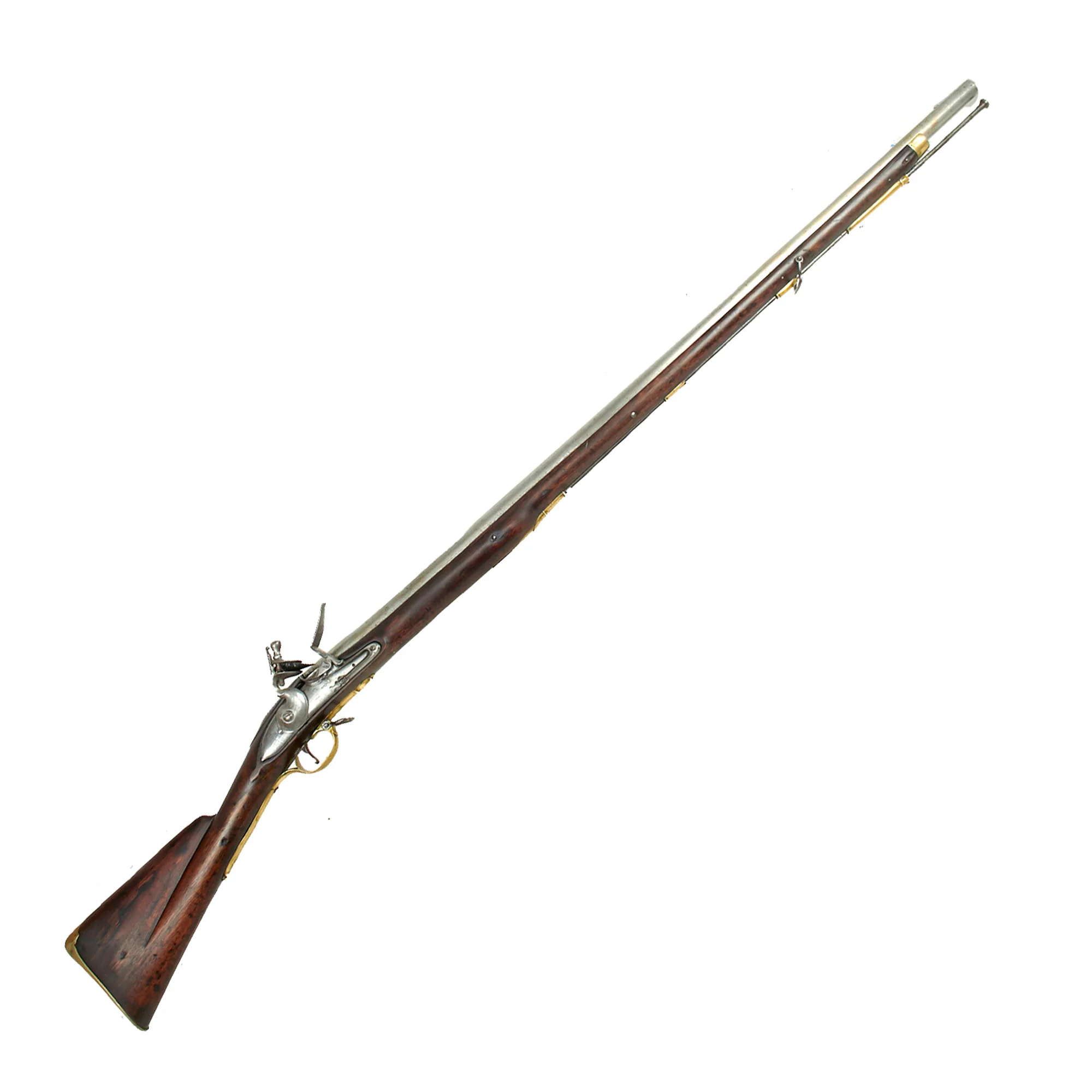
This is a great example of the Modèle 1777 corrigé en l'an IX, most likely the best that we have sever seen, showing a lovely honest used patina with no signs of alterations or replaced parts. It even still has the M. 1777 marking on the barrel tang, which we rarely see. It has the correct all steel and iron fittings for an infantry musket, as well as the two finger ribs on the rear of the trigger guard. The left side of the butt stock has the correct cheek rest carved into the left side, and there is correctly no rear sight present. There are some markings around the breech area including 93, VI, and PF, but we do not know the significance. There are two script letter A's in the cheek rest inlet as well. Definitely some great research potential here!
Many of these were later converted to percussion and often shortened as well, but this musket is still in the original flintlock configuration, and has the correct overall length of 60 inches. The lock is marked faintly with Manuf're Imp'le / de Charleville, the abbreviation for Manufacture Impériale de Charleville used during the Napoleonic Era. This indicates production at the famed IMPERIAL ARSENAL at CHARLEVILLE. This Arms Manufacturing installation was located in Charleville-Mézières, Ardennes, France, to the far north east of Paris, and was responsible for developing the famous "Charleville" muskets of the line and many other firearms. It was later closed, as it was realized that having an arsenal that close to the eastern border of France was not strategically viable, especially after the Prussian army plundered it in 1815. Differing from the Brown Bess not only using all steel mounts the barrel is secured by three-barrel bands, and not pins.
Condition is very good, with the original bright steel finish of the metalwork now faded to a lightly stained patina that is simply lovely. We do not see any signs of refinishing or restoration to the metalwork. There are also some faint arsenal markings on various components of the musket. The lock is fully functional, holding correctly at half cock, firing only at full. It is also very tight mechanically, with crisp mechanics and a strong mainspring. The cock is in great shape, fully adjustable, and has been fitted with a flint and leather pad to complete the look. Both sling swivels are present, as is the original ramrod under the barrel, which still has intact threads on the narrow end.
The stock is in very good condition, showing a beautiful red brown color, and has some fantastic grain patterns in the butt stock area. Not quite "flame", we would still consider this "figured", and it is a beautiful example of fine French walnut. There is the expected light wear from service, which has made some of the markings on the stock faint, such as the "holy water plug" on the left side of the stock. There are also a few tiny worm holes scattered over the stock, which have not impacted structural integrity at all.
This is a beautiful example of the legendary "Charleville" line of muskets from the Napoleonic era, ready to research and display!
Year of Manufacture: circa 1800-1810
Caliber: .69"
Cartridge Type: Ball and Powder
Barrel Length: 44 5/8 Inches
Overall Length: 60 1/4 Inches
Action type: Side Action Flintlock
Feed System: Muzzle Loaded
NOTE: International orders of antique firearms MUST be shipped using UPS WW Services (courier). USPS Priority Mail international will not accept these. International customers should always consult their country's antique gun laws prior to ordering.

Details & Craftsmanship
Every detail has been carefully considered to bring you the perfect product.

Details & Craftsmanship
Every detail has been carefully considered to bring you the perfect product.

Details & Craftsmanship
Every detail has been carefully considered to bring you the perfect product.

Details & Craftsmanship
Every detail has been carefully considered to bring you the perfect product.

Details & Craftsmanship
Every detail has been carefully considered to bring you the perfect product.

Details & Craftsmanship
Every detail has been carefully considered to bring you the perfect product.

Details & Craftsmanship
Every detail has been carefully considered to bring you the perfect product.

Details & Craftsmanship
Every detail has been carefully considered to bring you the perfect product.

Details & Craftsmanship
Every detail has been carefully considered to bring you the perfect product.

Details & Craftsmanship
Every detail has been carefully considered to bring you the perfect product.

Details & Craftsmanship
Every detail has been carefully considered to bring you the perfect product.

Details & Craftsmanship
Every detail has been carefully considered to bring you the perfect product.

Details & Craftsmanship
Every detail has been carefully considered to bring you the perfect product.

Details & Craftsmanship
Every detail has been carefully considered to bring you the perfect product.

Details & Craftsmanship
Every detail has been carefully considered to bring you the perfect product.

Details & Craftsmanship
Every detail has been carefully considered to bring you the perfect product.

Details & Craftsmanship
Every detail has been carefully considered to bring you the perfect product.

Details & Craftsmanship
Every detail has been carefully considered to bring you the perfect product.

Details & Craftsmanship
Every detail has been carefully considered to bring you the perfect product.

Details & Craftsmanship
Every detail has been carefully considered to bring you the perfect product.

Details & Craftsmanship
Every detail has been carefully considered to bring you the perfect product.

Details & Craftsmanship
Every detail has been carefully considered to bring you the perfect product.
Description
Original Item: Only One Available. The "Charleville" line of flintlock muskets is the French equivalent of the venerable "Brown Bess" used by the British. First introduced in 1717, the design was updated numerous times until production finally ceased in the early 1840s, when it was superseded by the "back action" Modèle 1842 percussion musket. The M1763 and M1786 versions were supplied in some quantities to the American Colonies during the Revolutionary War.
However, the most well-known variants worldwide are probably the Modèle 1777 and later Modèle 1777 corrigé en l'an IX (Model 1777 corrected in the year IX, or 1800 in the French Revolutionary Calendar), which were the primary muskets of the line during the French Napoleonic Wars. Compared to the earlier Modèle 1763, these introduced a cheek rest on the left hand side of the butt stock, and also featured a slanted brass priming pan and bridle. The trigger guard was modified with two rear finger ridges, a design also seen in the later M1842 muskets. In 1800 French Consul Napoleon Bonaparte had revised the design Mle 1777 design, adding band springs to the nose cap and middle barrel band, which had previously been screw retained.
Following the end of the Napoleonic Wars, the M1777 was further modified to the Modèle 1816, which changed the angled brass flash pan to a flat one with a rear "fence" to stop powder remnants and other debris from flying into the eyes of the solder. The shape of the flashhole was changed to be conical as well. Six years later, the Modèle 1822 was introduced, which mainly involved changes to the lock, with many more components being made from steel instead of iron, to increase longevity. All told, 7 million of all variants of the M1777 were made, making it the largest produced firearm until World War I came around.
This is a great example of the Modèle 1777 corrigé en l'an IX, most likely the best that we have sever seen, showing a lovely honest used patina with no signs of alterations or replaced parts. It even still has the M. 1777 marking on the barrel tang, which we rarely see. It has the correct all steel and iron fittings for an infantry musket, as well as the two finger ribs on the rear of the trigger guard. The left side of the butt stock has the correct cheek rest carved into the left side, and there is correctly no rear sight present. There are some markings around the breech area including 93, VI, and PF, but we do not know the significance. There are two script letter A's in the cheek rest inlet as well. Definitely some great research potential here!
Many of these were later converted to percussion and often shortened as well, but this musket is still in the original flintlock configuration, and has the correct overall length of 60 inches. The lock is marked faintly with Manuf're Imp'le / de Charleville, the abbreviation for Manufacture Impériale de Charleville used during the Napoleonic Era. This indicates production at the famed IMPERIAL ARSENAL at CHARLEVILLE. This Arms Manufacturing installation was located in Charleville-Mézières, Ardennes, France, to the far north east of Paris, and was responsible for developing the famous "Charleville" muskets of the line and many other firearms. It was later closed, as it was realized that having an arsenal that close to the eastern border of France was not strategically viable, especially after the Prussian army plundered it in 1815. Differing from the Brown Bess not only using all steel mounts the barrel is secured by three-barrel bands, and not pins.
Condition is very good, with the original bright steel finish of the metalwork now faded to a lightly stained patina that is simply lovely. We do not see any signs of refinishing or restoration to the metalwork. There are also some faint arsenal markings on various components of the musket. The lock is fully functional, holding correctly at half cock, firing only at full. It is also very tight mechanically, with crisp mechanics and a strong mainspring. The cock is in great shape, fully adjustable, and has been fitted with a flint and leather pad to complete the look. Both sling swivels are present, as is the original ramrod under the barrel, which still has intact threads on the narrow end.
The stock is in very good condition, showing a beautiful red brown color, and has some fantastic grain patterns in the butt stock area. Not quite "flame", we would still consider this "figured", and it is a beautiful example of fine French walnut. There is the expected light wear from service, which has made some of the markings on the stock faint, such as the "holy water plug" on the left side of the stock. There are also a few tiny worm holes scattered over the stock, which have not impacted structural integrity at all.
This is a beautiful example of the legendary "Charleville" line of muskets from the Napoleonic era, ready to research and display!
Year of Manufacture: circa 1800-1810
Caliber: .69"
Cartridge Type: Ball and Powder
Barrel Length: 44 5/8 Inches
Overall Length: 60 1/4 Inches
Action type: Side Action Flintlock
Feed System: Muzzle Loaded
NOTE: International orders of antique firearms MUST be shipped using UPS WW Services (courier). USPS Priority Mail international will not accept these. International customers should always consult their country's antique gun laws prior to ordering.