
Original: $1,195.00
-70%$1,195.00
$358.50The Story
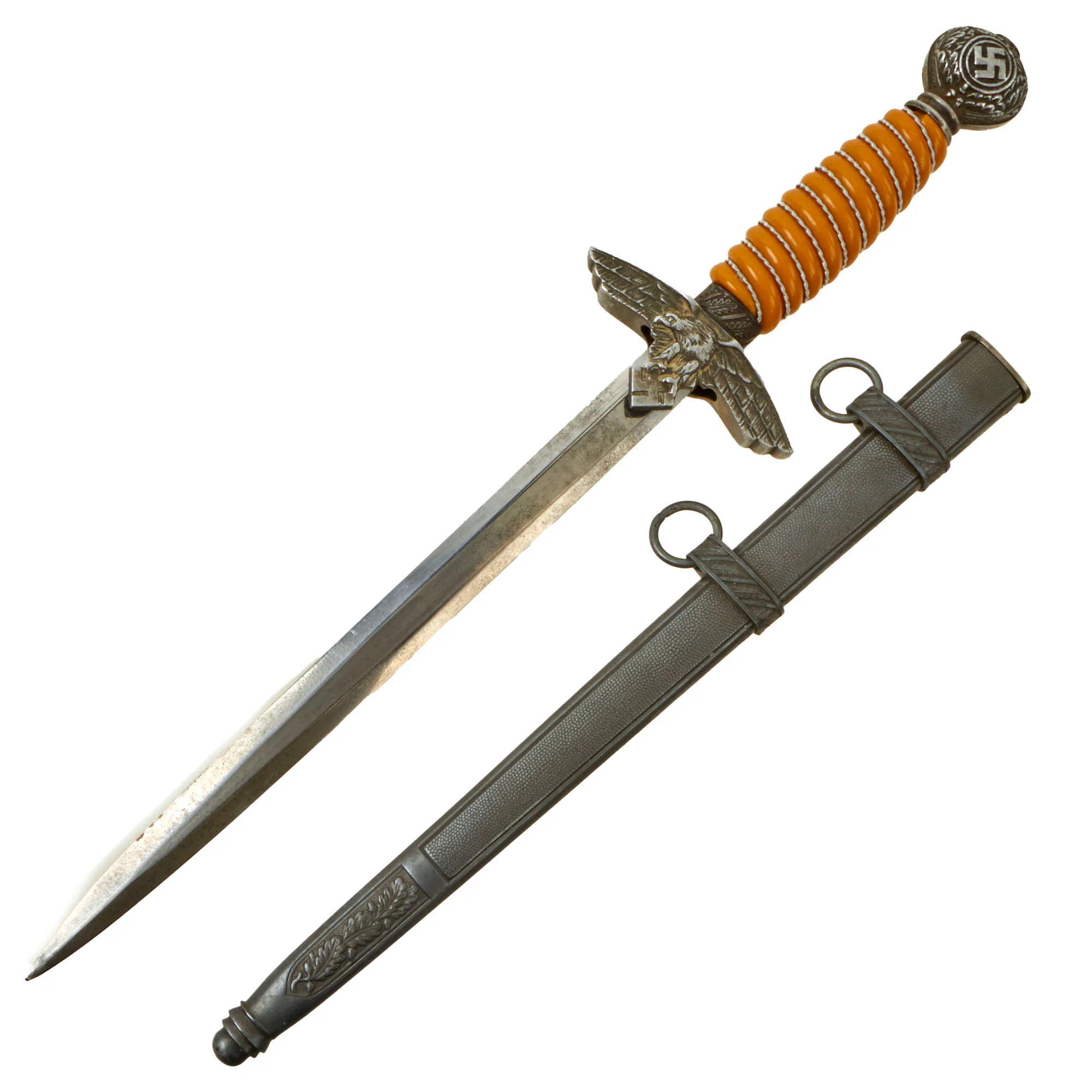
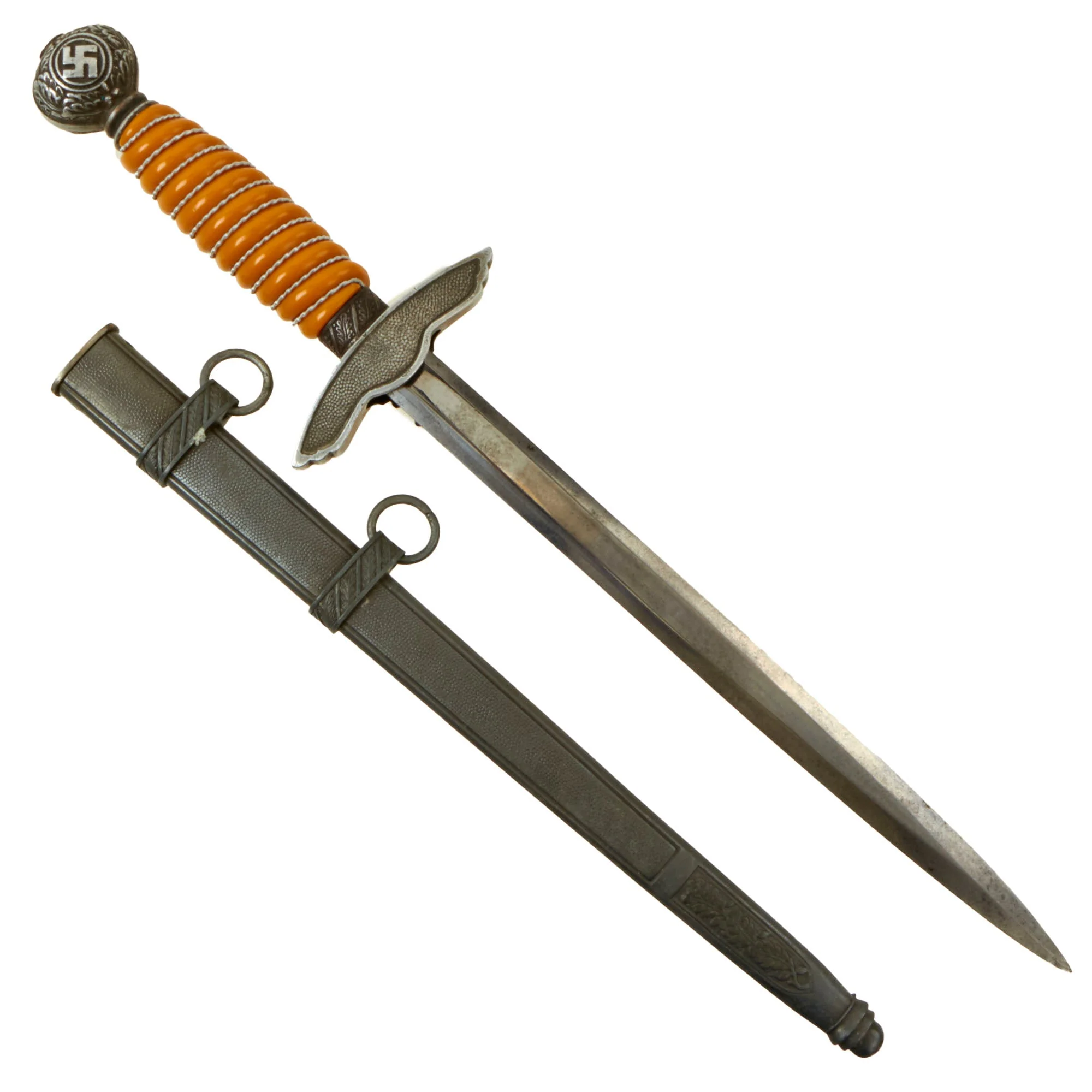
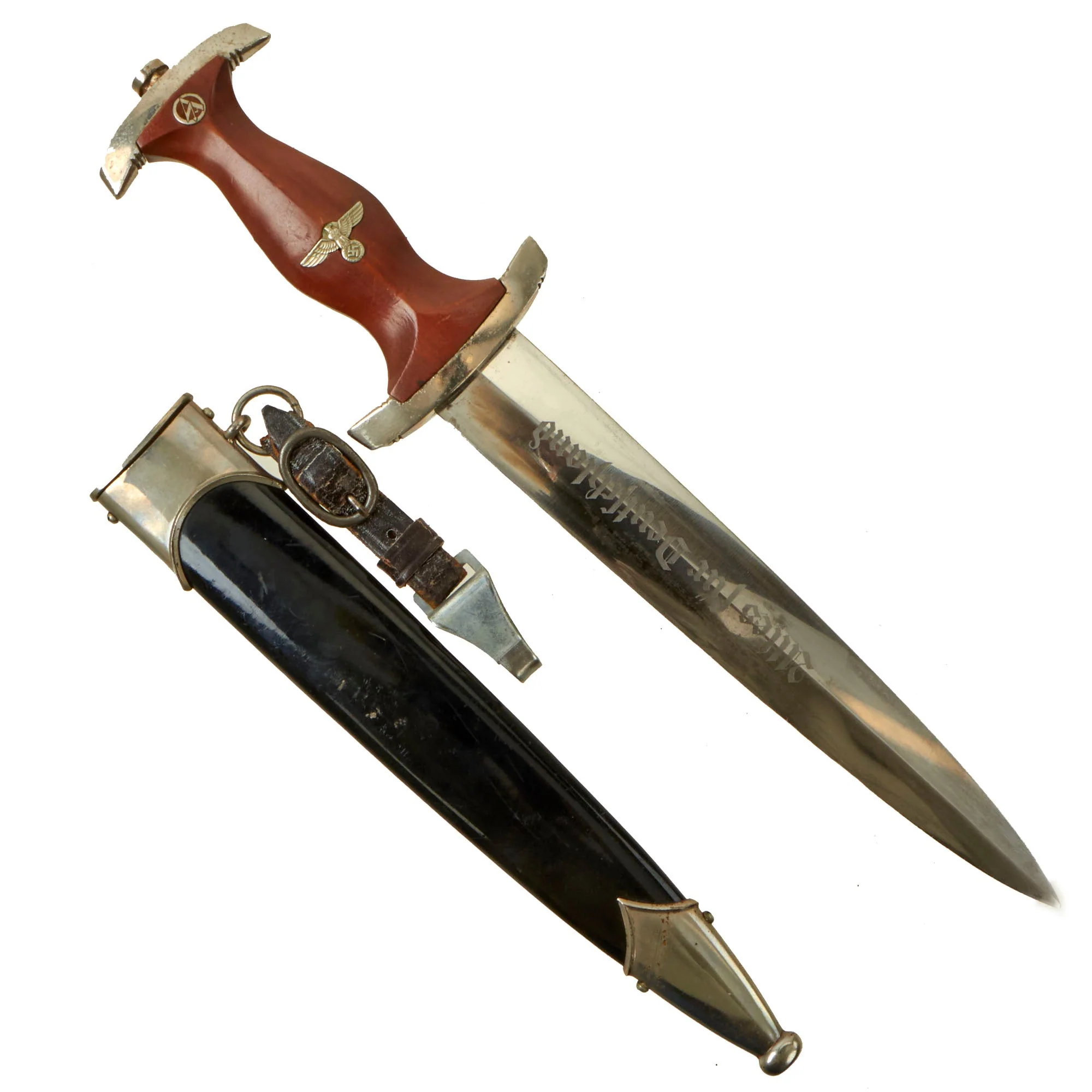
Original Item: Only One Available. This is a lovely early pattern SA Dagger, made by the rare maker Carl Wüsthof KG, Gladiatorwerk of Solingen, the legendary "City of Blades" in Western Germany. This is a very rare maker, one we do not see often. It comes complete with an original scabbard, which is in very good shape, and is the correct early type. This is in turn fitted with an early war pattern hanger.
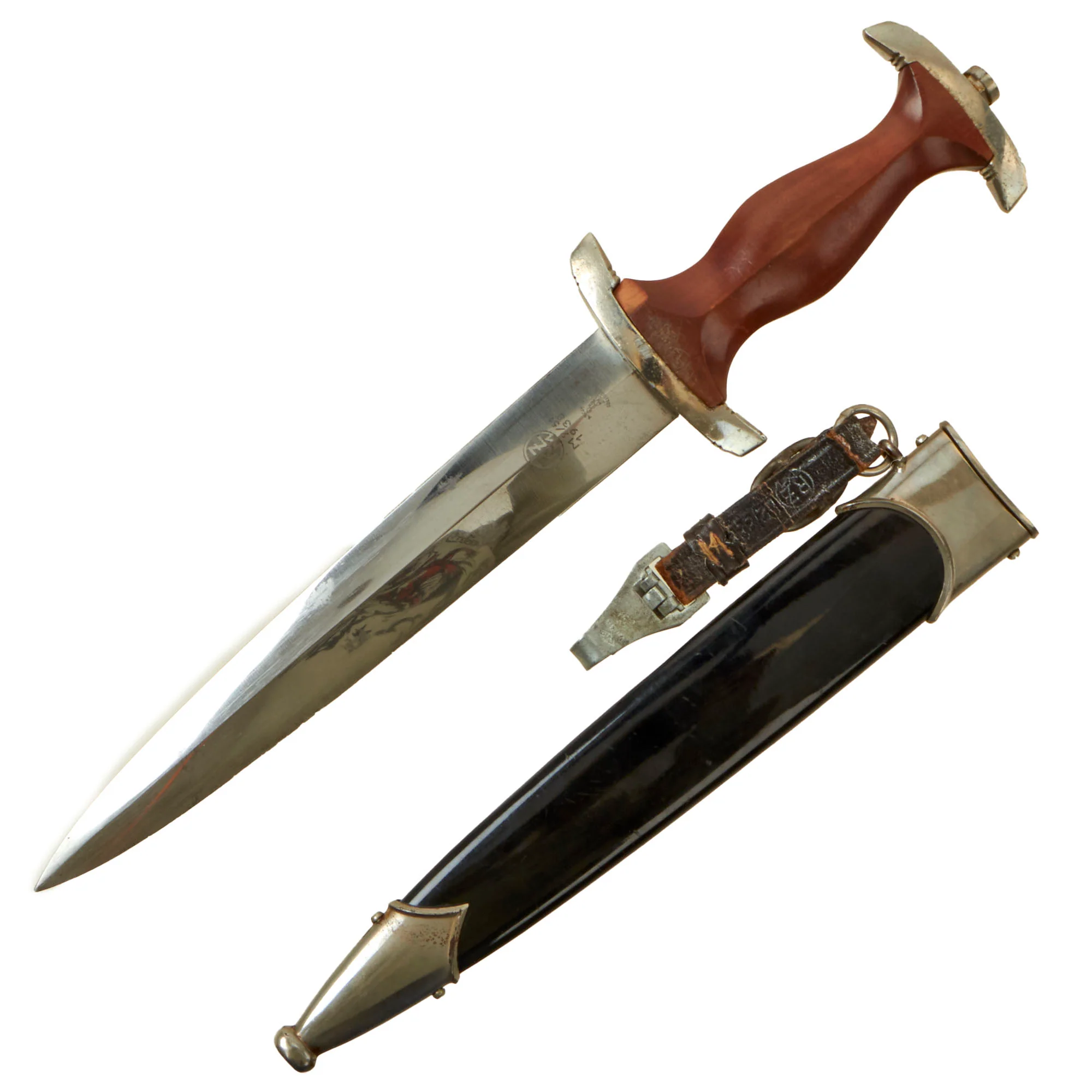
The dagger has solid nickel silver fittings throughout, and is a really nice example. The cross guards and tang nut are in very good condition throughout with all fittings having a nice lightly aged patina. The lower reverse guard is Gruppe/Gau marked S, for Schlesien (Silesia), a district in eastern Germany, with the principal city being Breslau, today Wrocław in Poland. This feature was only seen on daggers produced 1935 and prior. The nickel alloy end nut is still tight, as is the hilt to the blade.
The grip is a fine product having a lovely cherry red mahogany brown brown color, with a medium center ridge construction. There is the expected wear from use and age, including minor pressure dents, but there is no cracking we can see. The dye used on these grips combined with age makes them prone to cracking, but this example survived well. The grip fits the guards nicely, and the SA symbol button is nicely set, and still has most of the enamel intact with minor loss. There is a bit of verdigris surrounding the emblem due to contact with the wood. The grip eagle is a fine example being the style with beak that points straight. Most of the details are still there to the eagle to include the beak, breast feathering, wing feathering, talons, wreath and mobile swas. There is a bit of wear as well as more verdigris oxidation, showing that this is the correct solid nickel silver for an early pattern eagle.
The blade of this example is in very good condition, with the factory final grind cross grain retained throughout the blade! This texture is iconic, and is the definitive identifying characteristic for a real WWII German Blade. There is the usual wear from the scabbard runners, present on just about every German dagger out there, as well as wear from cleaning, which has made the cross grain faint in areas. The finish is still reflective, rare to see. The tip is intact, and the original factory edges may have been sharpened, but not much. The acid-etched Alles für Deutschland (Everything for Germany) SA motto is still crisp, however cleaning has removed much of the factory darkening.
The ricasso of the blade has a double oval "losenge" trademark logo surrounding a "man pole vaulting a ditch", known as the "Springer", with the address surrounding it between the ovals:
CARL WÜSTHOF
(Springer Logo)
SOLINGEN
Solingen, Germany is a city famous since the middle ages for its metal-working and craftsmanship in sword making. Per J. Anthony Carter's fine work GERMAN SWORD AND KNIFE MAKERS, Carl Wüsthof KG, Gladiatorwerk (Gladiator works) was founded in 1895 by one of the branches of the Wüsthof family. They were a known maker of SA daggers during the war, first with the oval "losenge" trademark, and then with RZM number M7/112 along with the trademark. They also made all types of cutlery through both World Wars, and operated into the 21st century.
The scabbard shell is straight throughout and is the early-war style, which were produced with a brown "anodized" finish on the steel, which was then lacquered. This example has lost over 70% of the original lacquer, with some retained in scattered patches on the surface. However, it still retains most of the anodized finish on both sides, with no dents or major damage we can see. There are some small areas of oxidation, which are probably best left alone. The upper and lower fittings are solid nickel silver, with a great look and some dents and scratches showing typical wear. The chape is dented in at the end, as the nickel alloy is somewhat soft, making this a common thing to see. The throat nicely matches the crossguards, and all four dome headed screws are retained, rare to see. The scabbard will not go the final ⅛” onto the blade, but this could likely be remedied.
Attached to the hanger ring on the scabbard is a very nice early pattern belt hanger, with solid nickel hardware and brown finished leather. The leather is in good condition, showing a wear and cracking to the finish, but no tearing or other major damage. The stitching is fully intact, though the leather is a bit delicate. There is no maker marking we can see on the fully functional end clip.
A great early war SA dagger from a rare and desirable maker, complete with a lovely original scabbard and hanger! Ready to display!
Specifications:
Blade Length: 8 3/4"
Overall length: 13 3/4”
Crossguard: 3”
Scabbard Length: 10”
History of the SA-
The SA or Brown Shirts, were a private political formation which Adolf AH and the NSDAP used to maintain order at organized Party meetings and demonstrations. The group was formed in 1921, and grew to a huge force of nearly 3,000,000 men by the later 1930's. To instill esprit de corps, as well as create employment for the Blade City of Solingen, it was decided each SA man would carry a dagger with his Brown Shirt uniform. Huge quantities needed to be produced to accommodate the demand. The dagger initially was produced of hand-fitted nickel mounts with attractive finished wood grip and brown anodized (a bluing process) finished scabbard.
The blade was etched with the SA motto, Alles für Deutschland. Examples produced prior to 1935 were stamped with the German sector of the SA group on reverse lower crossguard. Later examples underwent standardization through the RZM ministry. These pieces were produced of cheaper plated zinc-base fittings and scabbards were simply painted brown.
Prior to his "unmasking" as a traitor, Ernst Röhm was the leader of the SA. In 1934, he distributed approximately 100,000 SA daggers with his personal inscription on the reverse blade. These daggers were to honor individuals who had served with the SA prior to December, 1931. Other than the inscription, these pieces were identical to the standard M1933 SA dagger. After the Röhm purge, the inscription was ordered to be removed. Many examples were returned to the factory for grinding. Others were simply ground in the field by whatever means were available. Examples will occasionally be encountered with remnants of the original inscription remaining on the blade, but mostly none will remain. Some blades exist with an intact inscription, reflecting only the removal of the Röhm signature. Very very rarely is an example seen with a full, untouched inscription, as the holder would have surely risked a charge of treason.

Details & Craftsmanship
Every detail has been carefully considered to bring you the perfect product.

Details & Craftsmanship
Every detail has been carefully considered to bring you the perfect product.

Details & Craftsmanship
Every detail has been carefully considered to bring you the perfect product.

Details & Craftsmanship
Every detail has been carefully considered to bring you the perfect product.

Details & Craftsmanship
Every detail has been carefully considered to bring you the perfect product.

Details & Craftsmanship
Every detail has been carefully considered to bring you the perfect product.

Details & Craftsmanship
Every detail has been carefully considered to bring you the perfect product.

Details & Craftsmanship
Every detail has been carefully considered to bring you the perfect product.

Details & Craftsmanship
Every detail has been carefully considered to bring you the perfect product.

Details & Craftsmanship
Every detail has been carefully considered to bring you the perfect product.

Details & Craftsmanship
Every detail has been carefully considered to bring you the perfect product.

Details & Craftsmanship
Every detail has been carefully considered to bring you the perfect product.

Details & Craftsmanship
Every detail has been carefully considered to bring you the perfect product.

Details & Craftsmanship
Every detail has been carefully considered to bring you the perfect product.

Details & Craftsmanship
Every detail has been carefully considered to bring you the perfect product.

Details & Craftsmanship
Every detail has been carefully considered to bring you the perfect product.
Description
Original Item: Only One Available. This is a lovely early pattern SA Dagger, made by the rare maker Carl Wüsthof KG, Gladiatorwerk of Solingen, the legendary "City of Blades" in Western Germany. This is a very rare maker, one we do not see often. It comes complete with an original scabbard, which is in very good shape, and is the correct early type. This is in turn fitted with an early war pattern hanger.
The dagger has solid nickel silver fittings throughout, and is a really nice example. The cross guards and tang nut are in very good condition throughout with all fittings having a nice lightly aged patina. The lower reverse guard is Gruppe/Gau marked S, for Schlesien (Silesia), a district in eastern Germany, with the principal city being Breslau, today Wrocław in Poland. This feature was only seen on daggers produced 1935 and prior. The nickel alloy end nut is still tight, as is the hilt to the blade.
The grip is a fine product having a lovely cherry red mahogany brown brown color, with a medium center ridge construction. There is the expected wear from use and age, including minor pressure dents, but there is no cracking we can see. The dye used on these grips combined with age makes them prone to cracking, but this example survived well. The grip fits the guards nicely, and the SA symbol button is nicely set, and still has most of the enamel intact with minor loss. There is a bit of verdigris surrounding the emblem due to contact with the wood. The grip eagle is a fine example being the style with beak that points straight. Most of the details are still there to the eagle to include the beak, breast feathering, wing feathering, talons, wreath and mobile swas. There is a bit of wear as well as more verdigris oxidation, showing that this is the correct solid nickel silver for an early pattern eagle.
The blade of this example is in very good condition, with the factory final grind cross grain retained throughout the blade! This texture is iconic, and is the definitive identifying characteristic for a real WWII German Blade. There is the usual wear from the scabbard runners, present on just about every German dagger out there, as well as wear from cleaning, which has made the cross grain faint in areas. The finish is still reflective, rare to see. The tip is intact, and the original factory edges may have been sharpened, but not much. The acid-etched Alles für Deutschland (Everything for Germany) SA motto is still crisp, however cleaning has removed much of the factory darkening.
The ricasso of the blade has a double oval "losenge" trademark logo surrounding a "man pole vaulting a ditch", known as the "Springer", with the address surrounding it between the ovals:
CARL WÜSTHOF
(Springer Logo)
SOLINGEN
Solingen, Germany is a city famous since the middle ages for its metal-working and craftsmanship in sword making. Per J. Anthony Carter's fine work GERMAN SWORD AND KNIFE MAKERS, Carl Wüsthof KG, Gladiatorwerk (Gladiator works) was founded in 1895 by one of the branches of the Wüsthof family. They were a known maker of SA daggers during the war, first with the oval "losenge" trademark, and then with RZM number M7/112 along with the trademark. They also made all types of cutlery through both World Wars, and operated into the 21st century.
The scabbard shell is straight throughout and is the early-war style, which were produced with a brown "anodized" finish on the steel, which was then lacquered. This example has lost over 70% of the original lacquer, with some retained in scattered patches on the surface. However, it still retains most of the anodized finish on both sides, with no dents or major damage we can see. There are some small areas of oxidation, which are probably best left alone. The upper and lower fittings are solid nickel silver, with a great look and some dents and scratches showing typical wear. The chape is dented in at the end, as the nickel alloy is somewhat soft, making this a common thing to see. The throat nicely matches the crossguards, and all four dome headed screws are retained, rare to see. The scabbard will not go the final ⅛” onto the blade, but this could likely be remedied.
Attached to the hanger ring on the scabbard is a very nice early pattern belt hanger, with solid nickel hardware and brown finished leather. The leather is in good condition, showing a wear and cracking to the finish, but no tearing or other major damage. The stitching is fully intact, though the leather is a bit delicate. There is no maker marking we can see on the fully functional end clip.
A great early war SA dagger from a rare and desirable maker, complete with a lovely original scabbard and hanger! Ready to display!
Specifications:
Blade Length: 8 3/4"
Overall length: 13 3/4”
Crossguard: 3”
Scabbard Length: 10”
History of the SA-
The SA or Brown Shirts, were a private political formation which Adolf AH and the NSDAP used to maintain order at organized Party meetings and demonstrations. The group was formed in 1921, and grew to a huge force of nearly 3,000,000 men by the later 1930's. To instill esprit de corps, as well as create employment for the Blade City of Solingen, it was decided each SA man would carry a dagger with his Brown Shirt uniform. Huge quantities needed to be produced to accommodate the demand. The dagger initially was produced of hand-fitted nickel mounts with attractive finished wood grip and brown anodized (a bluing process) finished scabbard.
The blade was etched with the SA motto, Alles für Deutschland. Examples produced prior to 1935 were stamped with the German sector of the SA group on reverse lower crossguard. Later examples underwent standardization through the RZM ministry. These pieces were produced of cheaper plated zinc-base fittings and scabbards were simply painted brown.
Prior to his "unmasking" as a traitor, Ernst Röhm was the leader of the SA. In 1934, he distributed approximately 100,000 SA daggers with his personal inscription on the reverse blade. These daggers were to honor individuals who had served with the SA prior to December, 1931. Other than the inscription, these pieces were identical to the standard M1933 SA dagger. After the Röhm purge, the inscription was ordered to be removed. Many examples were returned to the factory for grinding. Others were simply ground in the field by whatever means were available. Examples will occasionally be encountered with remnants of the original inscription remaining on the blade, but mostly none will remain. Some blades exist with an intact inscription, reflecting only the removal of the Röhm signature. Very very rarely is an example seen with a full, untouched inscription, as the holder would have surely risked a charge of treason.