
Original: $1,295.00
-70%$1,295.00
$388.50The Story
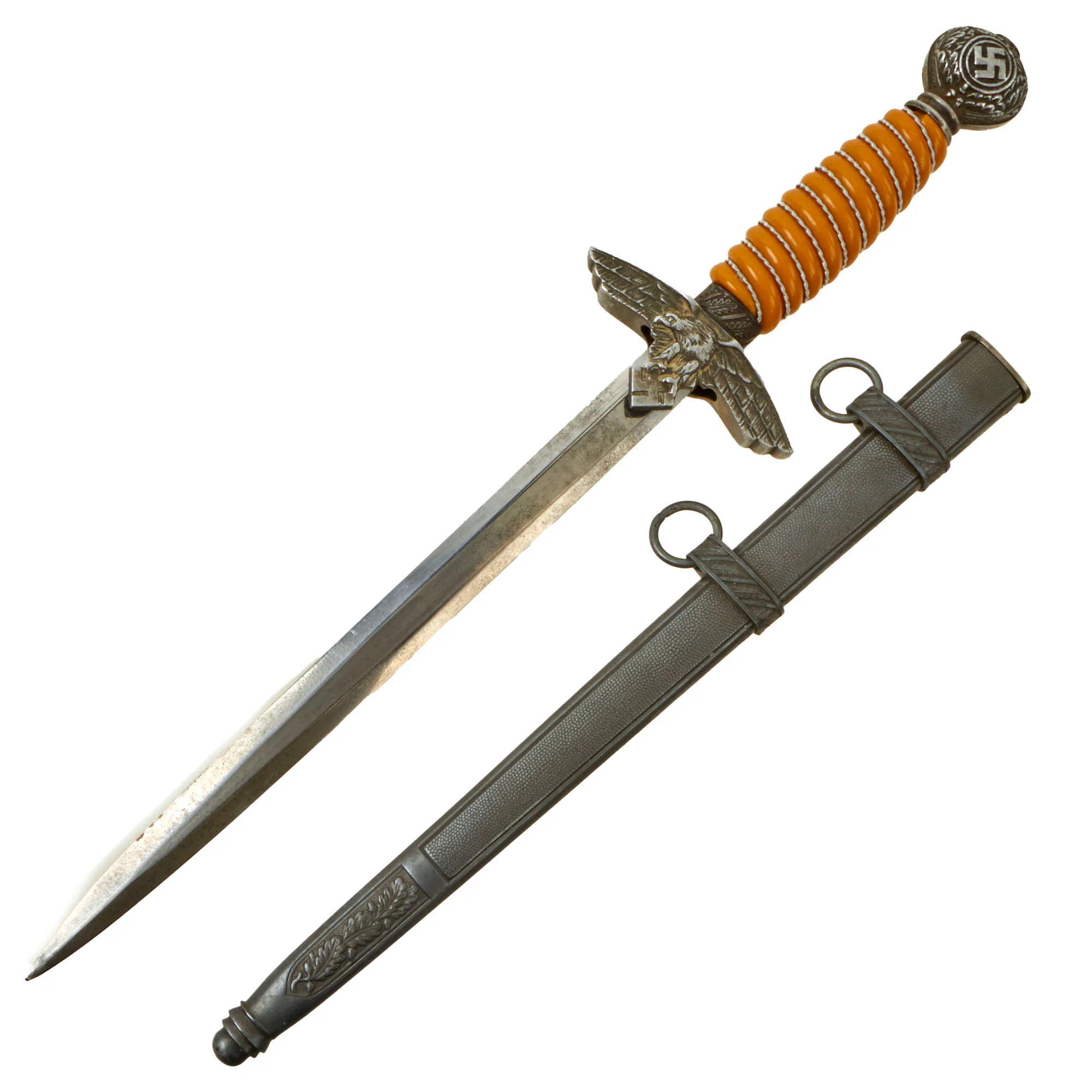
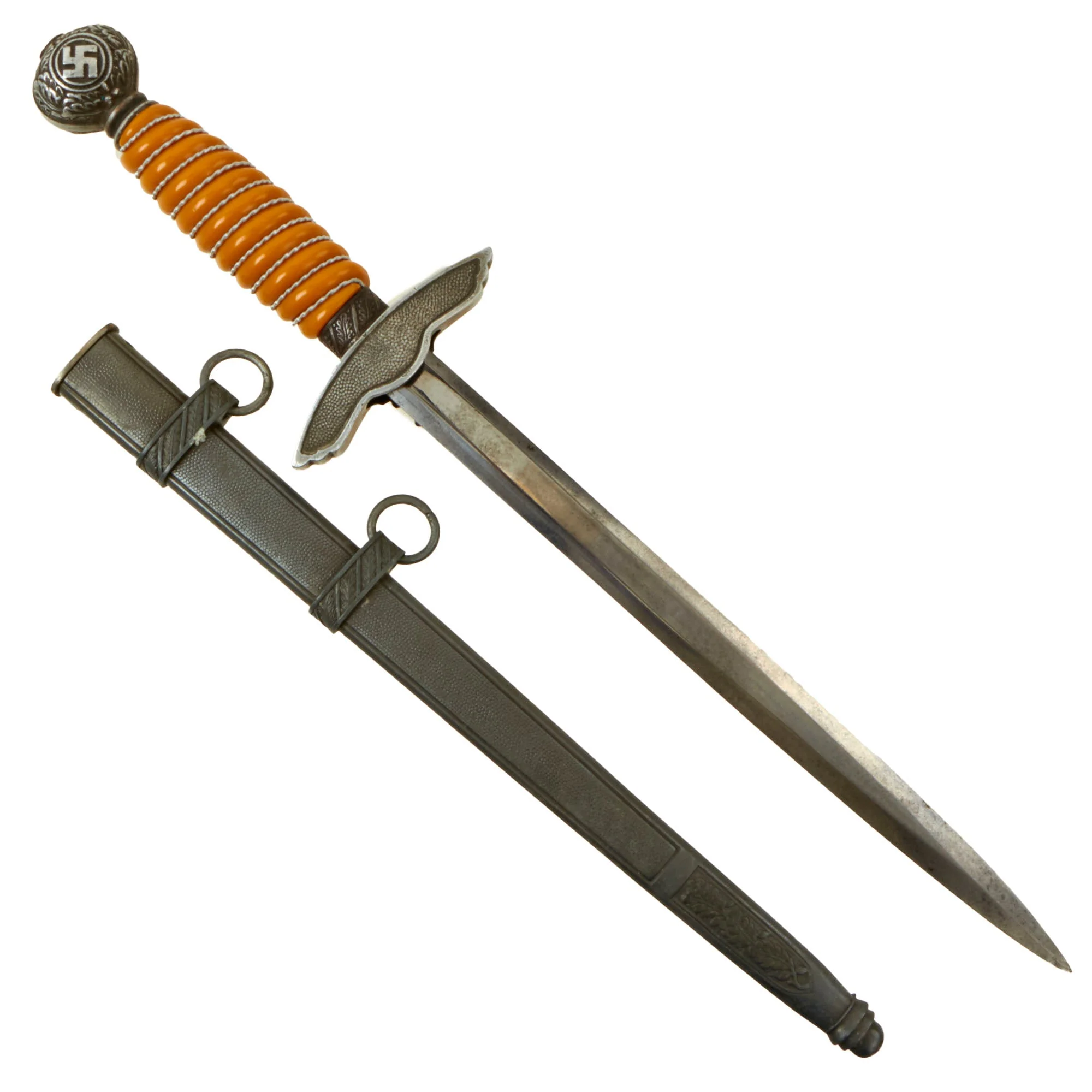
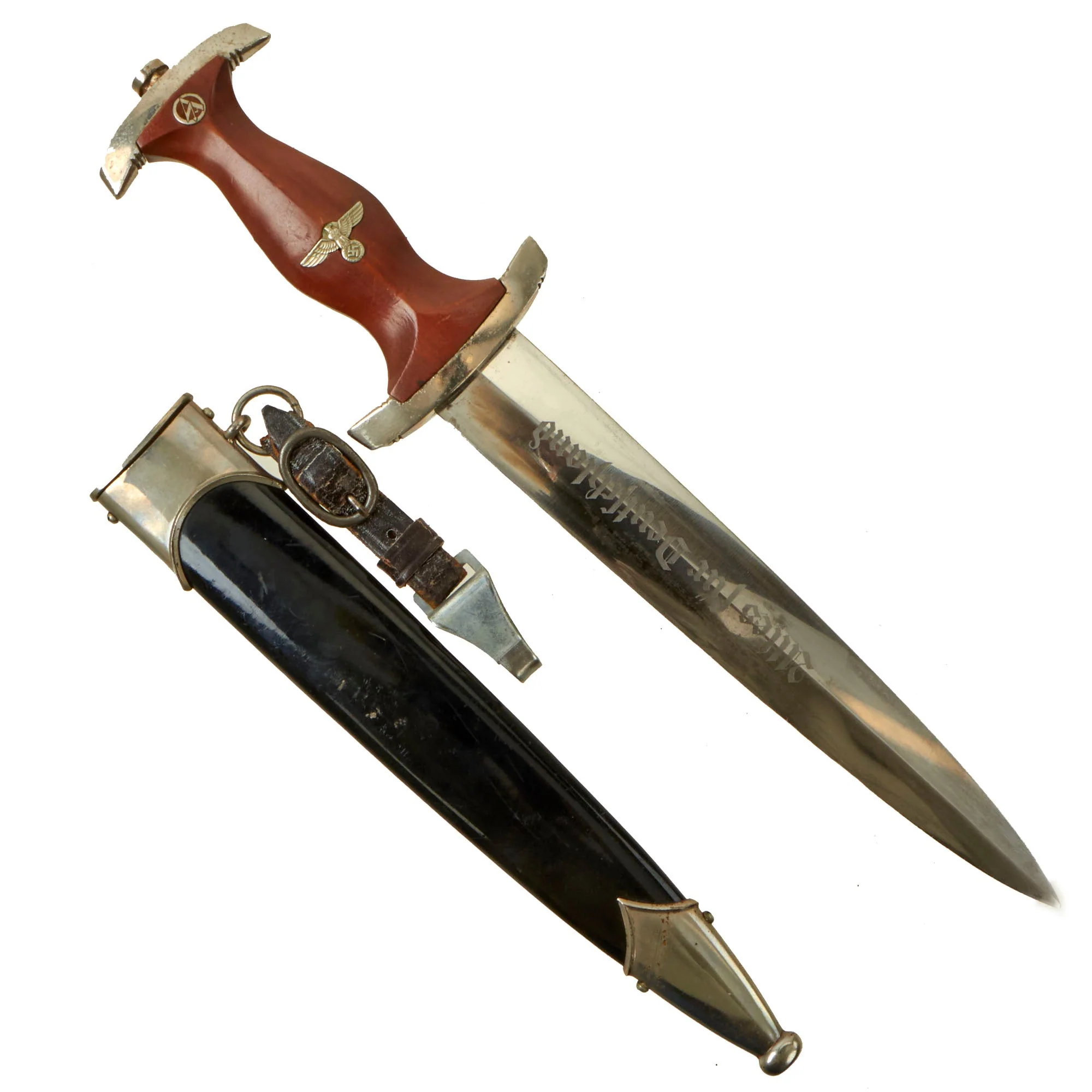
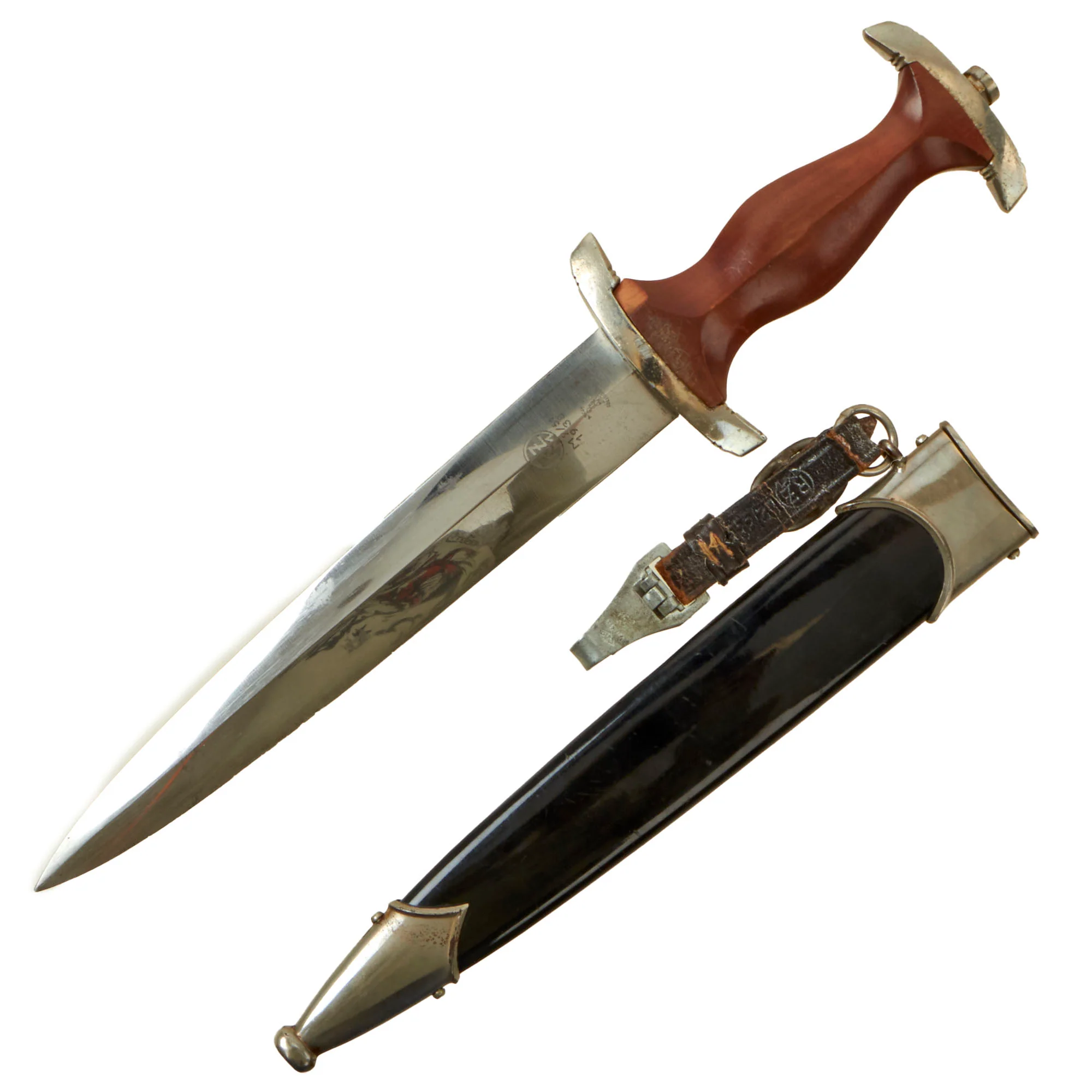
Original Item: Only One Available. This is an very good condition early pattern SA Dagger, made by the rare and desirable firm of J.A. Henckels AG, Zwillingswerk, located in Solingen, Germany. This company is known for making early pattern SA and NSKK daggers in somewhat limited numbers, being rated 4 of 10 on the McSARR (McAlvanah SA Rarity Rating) scale, assembled based on 18,000 daggers as seen by Mike McAlvanah. It comes comes compete with an original service used scabbard, which is the correct early pattern, and has a very nice early pattern belt hanger installed.
The dagger has solid nickel silver fittings throughout, and is a very good example. The crossguards and tang nut are in very good condition throughout with all fittings having a nice aged patina. There is some age to these mounts but there is no lifting anywhere, showing that they are solid and not plated. There are a few scratches and dents, and no signs of major cleaning. The lower reverse guard is Gruppe/Gau marked OST, for Ostland, made up of captured Baltic states surrounding Königsberg and the area of "East Prussia", which had been where Prussian Monarchs were crowned for centuries. After the war the area was annexed by the Soviet Union, and is today a Russian exclave, with Königsberg renamed Kaliningrad. This feature was only seen on daggers produced 1935 and prior.
The grip is a fine product having a lovely mahogany color, with medium center ridge construction, showing wear from service, including some scratches and pressure dents, as well as a bit of cracking and chipping near the pommel guard. The alloy pommel nut does show a bit of turning, and the grip does wiggle a bit, possibly from the pommel nut bottoming out. The SA symbol button is nicely set, and still has about 50% of the translucent enamel intact, with the nickel plating showing minor oxidation. The grip eagle is a fine example being the style with beak that points straight. It has some verdigris on it, showing that it is solid nickel alloy, and it has patinated nicely. The details are still there to the eagle to include the beak, breast feathering, wing feathering, talons, wreath and mobile swas (hook cross).
The blade is in excellent condition and bright, still showing almost all of the original factory final grind cross grain on both sides! This texture is iconic, and is the definitive identifying characteristic for a real WWII German Blade. It shows some signs of past light staining and cleaning, particularly on the reverse, but the grain is still present in most areas, except where the runners have worn it smooth. There is just a tiny bit of scuffing on one of the edges, with no signs of post manufacture sharpening, and there is just the tiniest dent on the very tip. The acid-etched Alles für Deutschland (Everything for Germany) SA motto is crisp, with the factory darkening very well retained.. Definitely a great condition blade!
The reverse ricasso is maker marked with the "losenge" style double oval "Twins" (Zwilling) trademark logo of J.A. Henckels AG, Zwillingswerk, Stahlwarenfabrik ("Twin Works" Steelware Factory) of Solingen, surrounded by:
J.A. HENCKELS.
ZWILLINGSWERK SOLINGEN
This well-known company has used the "Twins" trademark since it was founded June 13th, 1731 by Johann Peter Henckels as Die Zwillinge. The brand's namesake was Johann Abraham Henckels the Elder (1771–1850), who renamed the brand after himself while under his leadership. The company registered several additional brands and trademarks over the years, including "triplets" and "quadruplets" to avoid confusion with their "twins" logo. The company was officially registered with Solingen in 1882, and became purveyors to the Prussian and Austrian imperial houses. They also began a healthy export business not long after.
During the third reich era, the company made SA and NSKK daggers, as well as forged blades for other manufacturers. They made these in the early period, and are known makers of Röhm daggers. They manufactured HJ knives, but they seem to be somewhat rare, so production was probably limited. They also made early period army and Luftwaffe daggers, per J. Anthony Carter's fine work GERMAN SWORD AND KNIFE MAKERS. The company survived the war, and is still in operation today as one of the world's leading manufacturers of chef's knives.
The scabbard shell is mostly straight throughout and is the early-war style, showing a large wide dent on the reverse, which does not interfere with sheathing the blade. These were produced with a brown "anodized" finish on the steel, which was then lacquered. Like many we see, the lacquer has completely worn away, as well as almost all of the anodization. It now shows an oxidized patina on the body, with areas of rust peppering on both sides. The upper and lower fittings are solid nickel silver with a great aged look, showing wear from use and cleaning. The chape lower ball is not really dented in, which is uncommon due to how soft the nickel alloy is. It has some old sticker residue on the front side, which appears dark in the photos, but is not any type of oxidation. The throat nicely matches the crossguards, and all fittings have their original dome headed screws.
Attached to the hanger ring on the scabbard is a nice early pattern belt hanger, with solid nickel alloy hardware and brown finished leather. The leather is in good condition, showing a wear and wrinkling to the finish, and some cracking around the scabbard ring and clip. The keeper loop is missing, and we can see that the edge of the hanger leather has worn away around the scabbard loop. The spring clip is fully functional, and we were not able to see any maker markings on the leather or hardware.
A lovely early war SA dagger from a rare and desirable maker, complete with an original scabbard and hanger. Ready to display!
Specifications:
Blade Length: 8 3/4"
Overall length: 13 3/4”
Crossguard: 3”
Scabbard Length: 10”
History of the SA-
The SA or Brown Shirts, were a private political formation which Adolf AH and the NSDAP used to maintain order at organized Party meetings and demonstrations. The group was formed in 1921, and grew to a huge force of nearly 3,000,000 men by the later 1930's. To instill esprit de corps, as well as create employment for the Blade City of Solingen, it was decided each SA man would carry a dagger with his Brown Shirt uniform. Huge quantities needed to be produced to accommodate the demand. The dagger initially was produced of hand-fitted nickel mounts with attractive finished wood grip and brown anodized (a bluing process) finished scabbard.
The blade was etched with the SA motto, Alles für Deutschland. Examples produced prior to 1935 were stamped with the German sector of the SA group on reverse lower crossguard. Later examples underwent standardization through the RZM ministry. These pieces were produced of cheaper plated zinc-base fittings and scabbards were simply painted brown.
Prior to his "unmasking" as a traitor, Ernst Röhm was the leader of the SA. In 1934, he distributed approximately 100,000 SA daggers with his personal inscription on the reverse blade. These daggers were to honor individuals who had served with the SA prior to December, 1931. Other than the inscription, these pieces were identical to the standard M1933 SA dagger. After the Röhm purge, the inscription was ordered to be removed. Many examples were returned to the factory for grinding. Others were simply ground in the field by whatever means were available. Examples will occasionally be encountered with remnants of the original inscription remaining on the blade, but mostly none will remain. Some blades exist with an intact inscription, reflecting only the removal of the Röhm signature. Very very rarely is an example seen with a full, untouched inscription, as the holder would have surely risked a charge of treason.

Details & Craftsmanship
Every detail has been carefully considered to bring you the perfect product.

Details & Craftsmanship
Every detail has been carefully considered to bring you the perfect product.

Details & Craftsmanship
Every detail has been carefully considered to bring you the perfect product.

Details & Craftsmanship
Every detail has been carefully considered to bring you the perfect product.

Details & Craftsmanship
Every detail has been carefully considered to bring you the perfect product.

Details & Craftsmanship
Every detail has been carefully considered to bring you the perfect product.

Details & Craftsmanship
Every detail has been carefully considered to bring you the perfect product.

Details & Craftsmanship
Every detail has been carefully considered to bring you the perfect product.

Details & Craftsmanship
Every detail has been carefully considered to bring you the perfect product.

Details & Craftsmanship
Every detail has been carefully considered to bring you the perfect product.

Details & Craftsmanship
Every detail has been carefully considered to bring you the perfect product.

Details & Craftsmanship
Every detail has been carefully considered to bring you the perfect product.

Details & Craftsmanship
Every detail has been carefully considered to bring you the perfect product.

Details & Craftsmanship
Every detail has been carefully considered to bring you the perfect product.

Details & Craftsmanship
Every detail has been carefully considered to bring you the perfect product.

Details & Craftsmanship
Every detail has been carefully considered to bring you the perfect product.
Description
Original Item: Only One Available. This is an very good condition early pattern SA Dagger, made by the rare and desirable firm of J.A. Henckels AG, Zwillingswerk, located in Solingen, Germany. This company is known for making early pattern SA and NSKK daggers in somewhat limited numbers, being rated 4 of 10 on the McSARR (McAlvanah SA Rarity Rating) scale, assembled based on 18,000 daggers as seen by Mike McAlvanah. It comes comes compete with an original service used scabbard, which is the correct early pattern, and has a very nice early pattern belt hanger installed.
The dagger has solid nickel silver fittings throughout, and is a very good example. The crossguards and tang nut are in very good condition throughout with all fittings having a nice aged patina. There is some age to these mounts but there is no lifting anywhere, showing that they are solid and not plated. There are a few scratches and dents, and no signs of major cleaning. The lower reverse guard is Gruppe/Gau marked OST, for Ostland, made up of captured Baltic states surrounding Königsberg and the area of "East Prussia", which had been where Prussian Monarchs were crowned for centuries. After the war the area was annexed by the Soviet Union, and is today a Russian exclave, with Königsberg renamed Kaliningrad. This feature was only seen on daggers produced 1935 and prior.
The grip is a fine product having a lovely mahogany color, with medium center ridge construction, showing wear from service, including some scratches and pressure dents, as well as a bit of cracking and chipping near the pommel guard. The alloy pommel nut does show a bit of turning, and the grip does wiggle a bit, possibly from the pommel nut bottoming out. The SA symbol button is nicely set, and still has about 50% of the translucent enamel intact, with the nickel plating showing minor oxidation. The grip eagle is a fine example being the style with beak that points straight. It has some verdigris on it, showing that it is solid nickel alloy, and it has patinated nicely. The details are still there to the eagle to include the beak, breast feathering, wing feathering, talons, wreath and mobile swas (hook cross).
The blade is in excellent condition and bright, still showing almost all of the original factory final grind cross grain on both sides! This texture is iconic, and is the definitive identifying characteristic for a real WWII German Blade. It shows some signs of past light staining and cleaning, particularly on the reverse, but the grain is still present in most areas, except where the runners have worn it smooth. There is just a tiny bit of scuffing on one of the edges, with no signs of post manufacture sharpening, and there is just the tiniest dent on the very tip. The acid-etched Alles für Deutschland (Everything for Germany) SA motto is crisp, with the factory darkening very well retained.. Definitely a great condition blade!
The reverse ricasso is maker marked with the "losenge" style double oval "Twins" (Zwilling) trademark logo of J.A. Henckels AG, Zwillingswerk, Stahlwarenfabrik ("Twin Works" Steelware Factory) of Solingen, surrounded by:
J.A. HENCKELS.
ZWILLINGSWERK SOLINGEN
This well-known company has used the "Twins" trademark since it was founded June 13th, 1731 by Johann Peter Henckels as Die Zwillinge. The brand's namesake was Johann Abraham Henckels the Elder (1771–1850), who renamed the brand after himself while under his leadership. The company registered several additional brands and trademarks over the years, including "triplets" and "quadruplets" to avoid confusion with their "twins" logo. The company was officially registered with Solingen in 1882, and became purveyors to the Prussian and Austrian imperial houses. They also began a healthy export business not long after.
During the third reich era, the company made SA and NSKK daggers, as well as forged blades for other manufacturers. They made these in the early period, and are known makers of Röhm daggers. They manufactured HJ knives, but they seem to be somewhat rare, so production was probably limited. They also made early period army and Luftwaffe daggers, per J. Anthony Carter's fine work GERMAN SWORD AND KNIFE MAKERS. The company survived the war, and is still in operation today as one of the world's leading manufacturers of chef's knives.
The scabbard shell is mostly straight throughout and is the early-war style, showing a large wide dent on the reverse, which does not interfere with sheathing the blade. These were produced with a brown "anodized" finish on the steel, which was then lacquered. Like many we see, the lacquer has completely worn away, as well as almost all of the anodization. It now shows an oxidized patina on the body, with areas of rust peppering on both sides. The upper and lower fittings are solid nickel silver with a great aged look, showing wear from use and cleaning. The chape lower ball is not really dented in, which is uncommon due to how soft the nickel alloy is. It has some old sticker residue on the front side, which appears dark in the photos, but is not any type of oxidation. The throat nicely matches the crossguards, and all fittings have their original dome headed screws.
Attached to the hanger ring on the scabbard is a nice early pattern belt hanger, with solid nickel alloy hardware and brown finished leather. The leather is in good condition, showing a wear and wrinkling to the finish, and some cracking around the scabbard ring and clip. The keeper loop is missing, and we can see that the edge of the hanger leather has worn away around the scabbard loop. The spring clip is fully functional, and we were not able to see any maker markings on the leather or hardware.
A lovely early war SA dagger from a rare and desirable maker, complete with an original scabbard and hanger. Ready to display!
Specifications:
Blade Length: 8 3/4"
Overall length: 13 3/4”
Crossguard: 3”
Scabbard Length: 10”
History of the SA-
The SA or Brown Shirts, were a private political formation which Adolf AH and the NSDAP used to maintain order at organized Party meetings and demonstrations. The group was formed in 1921, and grew to a huge force of nearly 3,000,000 men by the later 1930's. To instill esprit de corps, as well as create employment for the Blade City of Solingen, it was decided each SA man would carry a dagger with his Brown Shirt uniform. Huge quantities needed to be produced to accommodate the demand. The dagger initially was produced of hand-fitted nickel mounts with attractive finished wood grip and brown anodized (a bluing process) finished scabbard.
The blade was etched with the SA motto, Alles für Deutschland. Examples produced prior to 1935 were stamped with the German sector of the SA group on reverse lower crossguard. Later examples underwent standardization through the RZM ministry. These pieces were produced of cheaper plated zinc-base fittings and scabbards were simply painted brown.
Prior to his "unmasking" as a traitor, Ernst Röhm was the leader of the SA. In 1934, he distributed approximately 100,000 SA daggers with his personal inscription on the reverse blade. These daggers were to honor individuals who had served with the SA prior to December, 1931. Other than the inscription, these pieces were identical to the standard M1933 SA dagger. After the Röhm purge, the inscription was ordered to be removed. Many examples were returned to the factory for grinding. Others were simply ground in the field by whatever means were available. Examples will occasionally be encountered with remnants of the original inscription remaining on the blade, but mostly none will remain. Some blades exist with an intact inscription, reflecting only the removal of the Röhm signature. Very very rarely is an example seen with a full, untouched inscription, as the holder would have surely risked a charge of treason.