
The Story
Original Item: One-of-a-kind. This is a fantastic genuine medal set, which we assume was owned by a German soldier who fought during WWI, and possibly served during the interwar years. They definitely served into the WWII era, identified by the 40 Year Civil Service award. They also seem to have a lot of awards from the Kingdom of Bavaria, so they may have been from that area, or at least served there.
The set of 6 medals offered in good condition is mounted on a very nice metal supported medal bar, which has a long securing pin. The colors are very well retained, with some light staining and overall oxidation on the various awards.
It consists of the following medals with Ribbons:
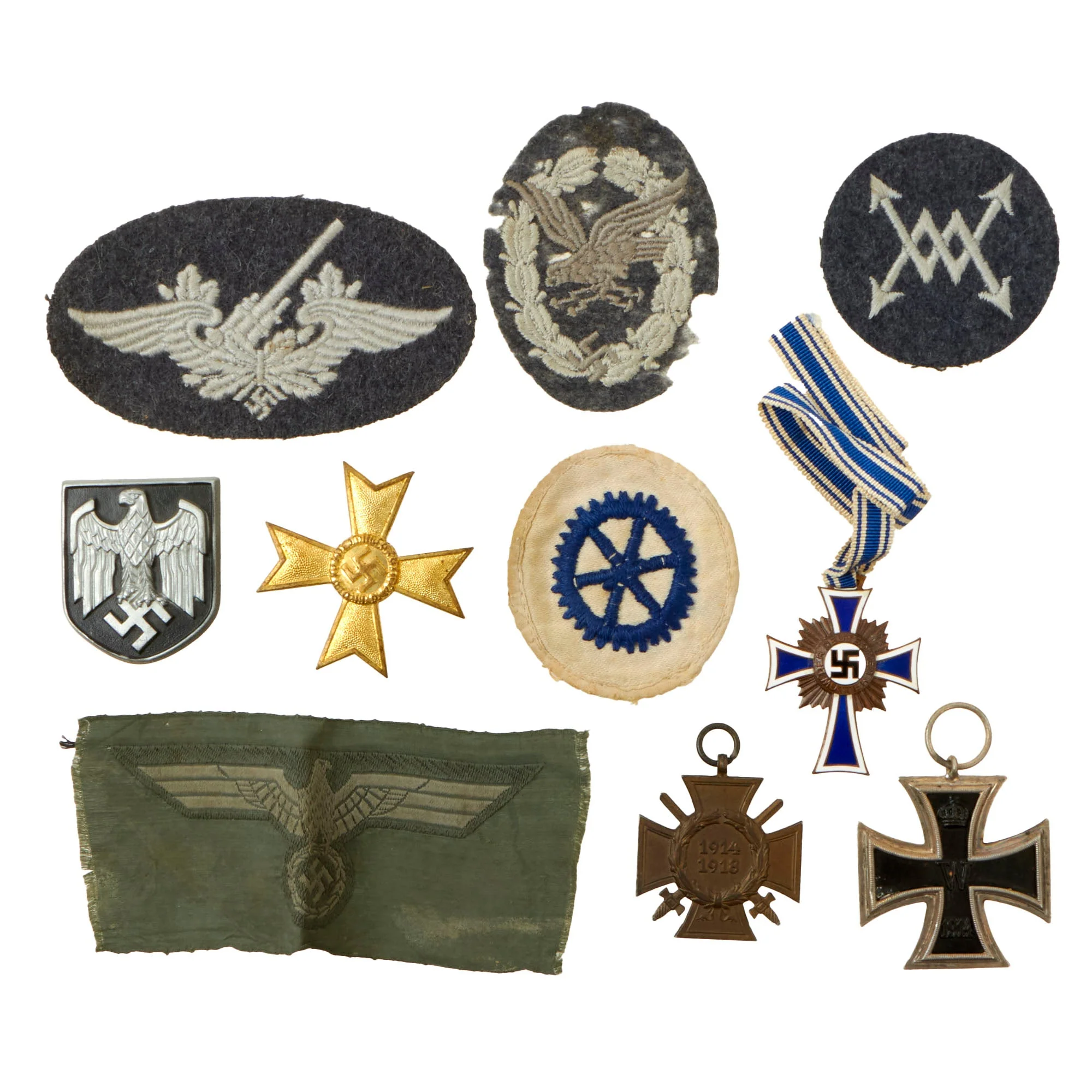
- Imperial German WWI Iron Cross 1914 2nd Class Medal.
- Bavarian Merenti Cross of Military Merit with Crown, 3rd Class, 1913 version with Military Ribbon
- Imperial German WWI Honor Cross of the World War 1914/1918 (Hindenburg Cross) Medal with Swords (for combat)
- WWI Bavarian Long Service Medal, 3rd Class - 9 Years
- WWII German 1st Class 40 Year Civil Service Faithful Service Medal
- WWII Austrian Anschluss 13 March 1938 Commemorative Medal
A gorgeous ribbon bar spanning two World Wars. Comes ready for further research and display!
Below is an explanation of each medal in detail:
German WWI Prussian Iron Cross 2nd Class with Ribbon:
Established by Frederick William in 1813 for gallantry in action, the decoration was revived several times for later conflicts. The bulk of the issues are divided into 1st and 2nd class versions, but a rare and superior 'Grand Cross' was also awarded for successful field commanders. During WW1 the lower decoration was freely awarded with 5½ million second class types issued. Originally, the Iron Cross was an award of the Kingdom of Prussia, however given Prussia's pre-eminent place in the German Empire formed in 1871, it became an award for all of Germany.
The basic design of the WW1 crosses is a central Tatzenkreuz (cross pattée) struck from iron and mounted in a silver frame which has a raised crenulated decorative border. The obverse of the cross bears the date 1914 under a crowned 'W' monogram. Reverse bears an oak leaf cluster with the date of the decoration’s institution, 1813 underneath - the crowned initials of Frederick William are in the top arm above the oak leaf cluster. Suspension for second-class types is by means of a ring, and frequently this ring bears a maker's stamp.
Please examine the edge seam for authentication, which is not present on reproductions. Iron crosses were commonly constructed from an iron core sandwiched in a surrounding two part silver frame, normally the seam of these two silver parts is visible around the edge of the cross as is seen on this fine example.
Bavarian Merenti Cross of Military Merit with Swords, 3rd Class 1913.
Order of Military Merit was instituted in 1866 in 5 Classes. In 1905 the Cross of Military Merit was revised initially to 2 Classes and in 1913 to 3 classes. Each class was awarded according to the rank of the recipient and could be issued with or without swords (for peace or war time period) and crown (for a 2nd award). The old non-enameled 2nd Class became the 3rd Class and was changed from silver to bronze. The old 1st Class became the 2nd Class. The new 1st Class was identical to the 2nd Class except that it was gilt rather than silver.
This is the third class award, indicating it was received by a low rank soldier, and the swords indicate it was awarded during wartime.
Hindenburg Cross with Crossed Swords (for combat):
The Honor Cross of the World War 1914/1918 (German: Das Ehrenkreuz des Weltkriegs 1914/1918), commonly, but incorrectly, known as the Hindenburg Cross was established by Field Marshal Paul von Hindenburg, President of the German Republic, by an order dated 13 July 1934, to commemorate the distinguished deeds of the German people during the First World War. This was Germany's first official service medal for soldiers of Imperial Germany who had taken part in the war, and where they had since died it was also awarded to their surviving next-of-kin. Shortly after its issuance, the government of NSDAP Germany declared the award as the only official service decoration of the First World War and further forbid the continued wearing of German Free Corps awards on any military or paramilitary uniform of a state or NSDAP Party organization.
Bavarian Long Service Medal, 3rd Class / 9 Years (Bayerische Dienstauszeichnung III. Klasse)
This is one of the many long service awards given during the WWI period by the various states of the German empire, many of which were Kingdoms and Grand Duchies in their own right. The front of the award is marked with the phrase TREUE DIENSTE BEI DER FAHNE (Faithful service to the flag) and the rear identifies the award, with IX in a shield, for the 9 years of service.
WWII German 1st Class 40 Year Civil Service Faithful Service Medal: The Civil Service Faithful Service Medal (Treudienst-Ehrenzeichen für Beamte Angestellte und Arbeiter im öffentlichen Dienst) was a NSDAP Germany medal of honor that was founded on 30 January 1938, in two grades, to reward civilians and military in the employ of the German public services for long and faithful service.
All officials, employees, and laborers at any level of the public service (local, regional or national) who complete 25 or 40 years service were eligible. The second class award was for 25 years of service was a silver cross, with a silver wreath and a black enameled swas in the center of the cross. The first class award was for 40 years of service was a gold cross, with a gold wreath and a black enameled swas in the center of the cross.
The reverse of both classes was stamped with Für treue Dienste (For faithful Services). in German black letter typeface. The ribbon for the medal is cornflower blue.
Anschluss Commemorative Medal
(German: Die Medaille zur Erinnerung an den 13. März 1938) was a decoration of NSDAP Germany awarded in the interwar period. Instituted on 1 May 1938, the medal commemorated the annexation of Austria to the German Reich, the so-called Anschluss. The move was the first in AH's quest for Lebensraum, and it strengthened German flanks while weakening those of Czechoslovakia. German troops crossed the border on 12 March 1938, without any resistance. The medal, known as the "Anschluss medal", was awarded to all persons, both military and civilian, who contributed to or participated in the annexation. It was also awarded to German State officials and members of the German Wehrmacht and SS who marched into Austria. It was awarded until 31 December 1940, and a total of 318,689 medals were awarded.
The round, highly detailed, die-struck medal was based on the 1938 Party Day Badge and designed by Professor Richard Klein. On the obverse of the medal, symbolic of becoming part of the German realm, a man holding the NSDAP flag stands on a podium bearing the eagle emblem of the "Third Reich"; he assists onto the podium a second man, on whose right hand a broken shackle is seen. On the reverse is the inscription "13. März 1938" (13 March 1938), the date of the Anschluss. The date is surrounded on the outer edge by the words, "Ein Volk, Ein Reich, Ein Führer" ("One People, One Empire, One Leader"). It is suspended from a red ribbon with white-black-white stripes at the edges of the ribbon. It was made of brass or tombak bronze with a silvered matte finish.

Details & Craftsmanship
Every detail has been carefully considered to bring you the perfect product.

Details & Craftsmanship
Every detail has been carefully considered to bring you the perfect product.

Details & Craftsmanship
Every detail has been carefully considered to bring you the perfect product.

Details & Craftsmanship
Every detail has been carefully considered to bring you the perfect product.

Details & Craftsmanship
Every detail has been carefully considered to bring you the perfect product.

Details & Craftsmanship
Every detail has been carefully considered to bring you the perfect product.

Details & Craftsmanship
Every detail has been carefully considered to bring you the perfect product.

Details & Craftsmanship
Every detail has been carefully considered to bring you the perfect product.

Details & Craftsmanship
Every detail has been carefully considered to bring you the perfect product.

Details & Craftsmanship
Every detail has been carefully considered to bring you the perfect product.

Details & Craftsmanship
Every detail has been carefully considered to bring you the perfect product.

Details & Craftsmanship
Every detail has been carefully considered to bring you the perfect product.

Details & Craftsmanship
Every detail has been carefully considered to bring you the perfect product.

Details & Craftsmanship
Every detail has been carefully considered to bring you the perfect product.
Description
Original Item: One-of-a-kind. This is a fantastic genuine medal set, which we assume was owned by a German soldier who fought during WWI, and possibly served during the interwar years. They definitely served into the WWII era, identified by the 40 Year Civil Service award. They also seem to have a lot of awards from the Kingdom of Bavaria, so they may have been from that area, or at least served there.
The set of 6 medals offered in good condition is mounted on a very nice metal supported medal bar, which has a long securing pin. The colors are very well retained, with some light staining and overall oxidation on the various awards.
It consists of the following medals with Ribbons:
- Imperial German WWI Iron Cross 1914 2nd Class Medal.
- Bavarian Merenti Cross of Military Merit with Crown, 3rd Class, 1913 version with Military Ribbon
- Imperial German WWI Honor Cross of the World War 1914/1918 (Hindenburg Cross) Medal with Swords (for combat)
- WWI Bavarian Long Service Medal, 3rd Class - 9 Years
- WWII German 1st Class 40 Year Civil Service Faithful Service Medal
- WWII Austrian Anschluss 13 March 1938 Commemorative Medal
A gorgeous ribbon bar spanning two World Wars. Comes ready for further research and display!
Below is an explanation of each medal in detail:
German WWI Prussian Iron Cross 2nd Class with Ribbon:
Established by Frederick William in 1813 for gallantry in action, the decoration was revived several times for later conflicts. The bulk of the issues are divided into 1st and 2nd class versions, but a rare and superior 'Grand Cross' was also awarded for successful field commanders. During WW1 the lower decoration was freely awarded with 5½ million second class types issued. Originally, the Iron Cross was an award of the Kingdom of Prussia, however given Prussia's pre-eminent place in the German Empire formed in 1871, it became an award for all of Germany.
The basic design of the WW1 crosses is a central Tatzenkreuz (cross pattée) struck from iron and mounted in a silver frame which has a raised crenulated decorative border. The obverse of the cross bears the date 1914 under a crowned 'W' monogram. Reverse bears an oak leaf cluster with the date of the decoration’s institution, 1813 underneath - the crowned initials of Frederick William are in the top arm above the oak leaf cluster. Suspension for second-class types is by means of a ring, and frequently this ring bears a maker's stamp.
Please examine the edge seam for authentication, which is not present on reproductions. Iron crosses were commonly constructed from an iron core sandwiched in a surrounding two part silver frame, normally the seam of these two silver parts is visible around the edge of the cross as is seen on this fine example.
Bavarian Merenti Cross of Military Merit with Swords, 3rd Class 1913.
Order of Military Merit was instituted in 1866 in 5 Classes. In 1905 the Cross of Military Merit was revised initially to 2 Classes and in 1913 to 3 classes. Each class was awarded according to the rank of the recipient and could be issued with or without swords (for peace or war time period) and crown (for a 2nd award). The old non-enameled 2nd Class became the 3rd Class and was changed from silver to bronze. The old 1st Class became the 2nd Class. The new 1st Class was identical to the 2nd Class except that it was gilt rather than silver.
This is the third class award, indicating it was received by a low rank soldier, and the swords indicate it was awarded during wartime.
Hindenburg Cross with Crossed Swords (for combat):
The Honor Cross of the World War 1914/1918 (German: Das Ehrenkreuz des Weltkriegs 1914/1918), commonly, but incorrectly, known as the Hindenburg Cross was established by Field Marshal Paul von Hindenburg, President of the German Republic, by an order dated 13 July 1934, to commemorate the distinguished deeds of the German people during the First World War. This was Germany's first official service medal for soldiers of Imperial Germany who had taken part in the war, and where they had since died it was also awarded to their surviving next-of-kin. Shortly after its issuance, the government of NSDAP Germany declared the award as the only official service decoration of the First World War and further forbid the continued wearing of German Free Corps awards on any military or paramilitary uniform of a state or NSDAP Party organization.
Bavarian Long Service Medal, 3rd Class / 9 Years (Bayerische Dienstauszeichnung III. Klasse)
This is one of the many long service awards given during the WWI period by the various states of the German empire, many of which were Kingdoms and Grand Duchies in their own right. The front of the award is marked with the phrase TREUE DIENSTE BEI DER FAHNE (Faithful service to the flag) and the rear identifies the award, with IX in a shield, for the 9 years of service.
WWII German 1st Class 40 Year Civil Service Faithful Service Medal: The Civil Service Faithful Service Medal (Treudienst-Ehrenzeichen für Beamte Angestellte und Arbeiter im öffentlichen Dienst) was a NSDAP Germany medal of honor that was founded on 30 January 1938, in two grades, to reward civilians and military in the employ of the German public services for long and faithful service.
All officials, employees, and laborers at any level of the public service (local, regional or national) who complete 25 or 40 years service were eligible. The second class award was for 25 years of service was a silver cross, with a silver wreath and a black enameled swas in the center of the cross. The first class award was for 40 years of service was a gold cross, with a gold wreath and a black enameled swas in the center of the cross.
The reverse of both classes was stamped with Für treue Dienste (For faithful Services). in German black letter typeface. The ribbon for the medal is cornflower blue.
Anschluss Commemorative Medal
(German: Die Medaille zur Erinnerung an den 13. März 1938) was a decoration of NSDAP Germany awarded in the interwar period. Instituted on 1 May 1938, the medal commemorated the annexation of Austria to the German Reich, the so-called Anschluss. The move was the first in AH's quest for Lebensraum, and it strengthened German flanks while weakening those of Czechoslovakia. German troops crossed the border on 12 March 1938, without any resistance. The medal, known as the "Anschluss medal", was awarded to all persons, both military and civilian, who contributed to or participated in the annexation. It was also awarded to German State officials and members of the German Wehrmacht and SS who marched into Austria. It was awarded until 31 December 1940, and a total of 318,689 medals were awarded.
The round, highly detailed, die-struck medal was based on the 1938 Party Day Badge and designed by Professor Richard Klein. On the obverse of the medal, symbolic of becoming part of the German realm, a man holding the NSDAP flag stands on a podium bearing the eagle emblem of the "Third Reich"; he assists onto the podium a second man, on whose right hand a broken shackle is seen. On the reverse is the inscription "13. März 1938" (13 March 1938), the date of the Anschluss. The date is surrounded on the outer edge by the words, "Ein Volk, Ein Reich, Ein Führer" ("One People, One Empire, One Leader"). It is suspended from a red ribbon with white-black-white stripes at the edges of the ribbon. It was made of brass or tombak bronze with a silvered matte finish.