
Original: $1,495.00
-70%$1,495.00
$448.50The Story
Original Item: Only One Available. The Kugelhandgranate ("ball hand grenade") is the name given to several models of hand thrown fragmentation grenades manufactured in WWI Germany. This example is known as the Model 1913, which differs from the later version in that it has more fragmentation sections unlike the more simplified 1915 model. As they were not made in any large quantities, German Ball Grenades are rare in any condition.
This example is totally inert and cannot be rendered live again to be used as an explosive device. This Kugelhandgrante is in total compliance under the current standards put out by the BATF. This example comes in its original extremely scarce belt carrier, which is NOT GROUND DUG! These are unbelievably difficult to find even as relics, as once the grenade was used, soldiers were instructed to dispose of the carrier. This example even retains some of the original paint.
Unloaded or dummy grenades, artillery shell casings, and similar devices, which are cut or drilled in an BATF-approved manner so that they cannot be used as ammunition components for destructive devices, are not considered NFA weapons. This example is in total compliance and is NOT AVAILABLE FOR EXPORT.
The grenade itself is in great condition with its original finish, and an original friction-ignited fuze, complete with the pull wire.
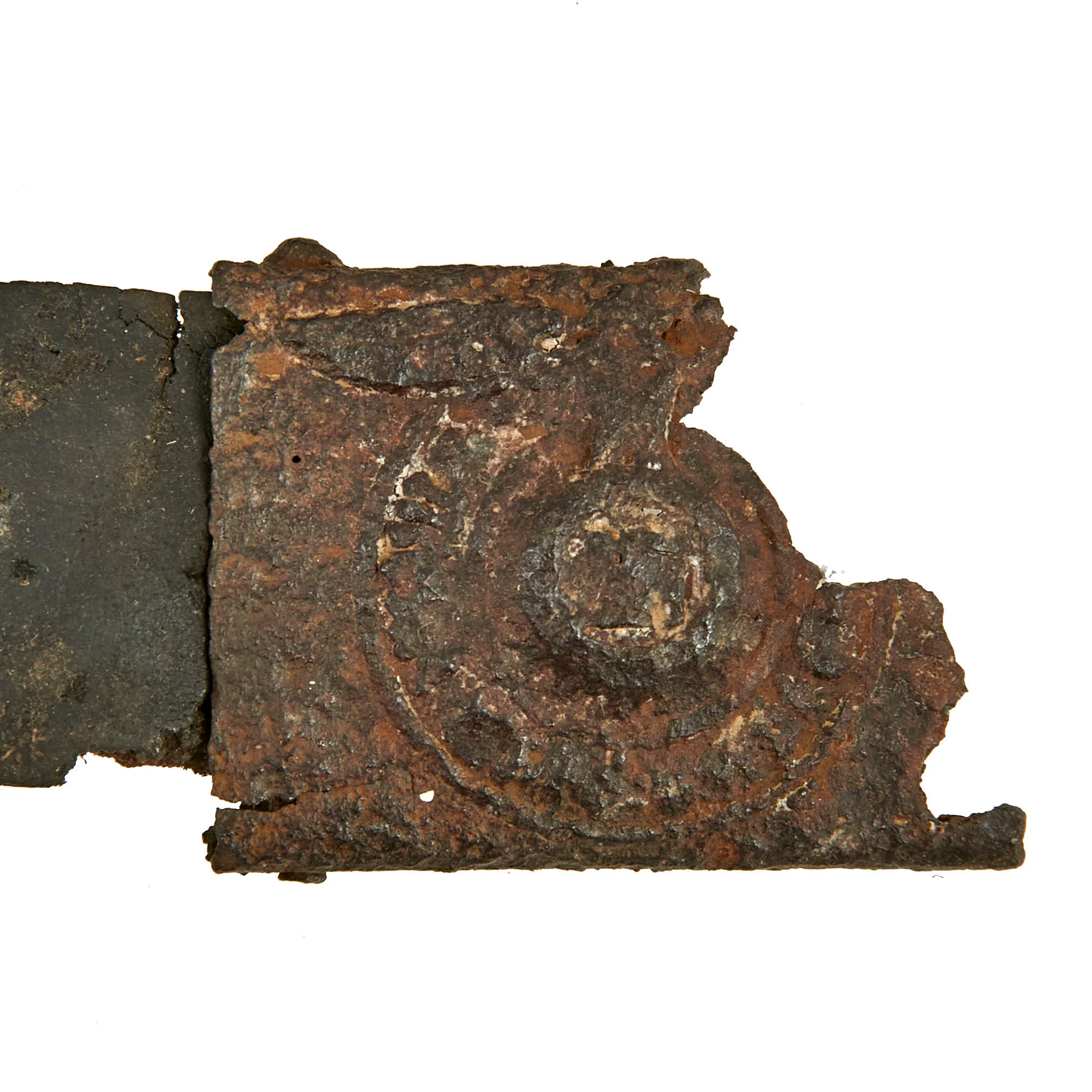
The original belt carrier has a leather strap with small cup on the bottom to keep the grenade in place. The strap shows heavy crazing but is in good shape. The carrier retains some of its original feldgrau paint and has a great patina.
This is the first original belt carrier we’ve had, and it comes with an outstanding early 1913 model grenade! Comes ready to become the centerpiece of your grenade collection.
Germany entered World War I with this single grenade design: a heavy 750-gram (26 oz) ball-shaped fragmentation grenade for use only by pioneers in attacking fortifications. It was too heavy for regular use on the battlefield by untrained troops and not suitable for mass production. This left Germany without a standard-issue grenade and improvised designs similar to those of the British were used until a proper grenade could be supplied.
The body of the Kugelhandgranate was cast iron 8 mm thick, spherical shaped and externally segmented designed to produce between 70 and 80 fragments. A bronze-like stick (which was the igniter) was introduced to the spherical body. The filling was a mixture of black powder, barium nitrate, and potassium perchlorate, and did not require a detonator. The friction igniter consisted of a bronze body with a central chamber filled with black powder and supplied with a 5 or 7 second delay, the powder train was topped with a priming wire made of brass with a loop at one end and serrated on the other. The serrated portion was coated with a mixture of ground glass, manganese dioxide, and potassium chlorate.
To be used, the friction wire had to be pulled from the igniter, starting the delay train at the last possible moment. To do this, a piece of leather was attached to the igniter with a snap hook; pulling this removed the wire so the grenade could be thrown. A man with average strength could throw this grenade about 15 m, which made it completely ineffective for standard infantry uses, unless they were used on a slope where the grenade could roll. The only way to reach longer (up to 300 m) ranges was the use of mechanical spring based grenade launchers.

Details & Craftsmanship
Every detail has been carefully considered to bring you the perfect product.

Details & Craftsmanship
Every detail has been carefully considered to bring you the perfect product.

Details & Craftsmanship
Every detail has been carefully considered to bring you the perfect product.

Details & Craftsmanship
Every detail has been carefully considered to bring you the perfect product.

Details & Craftsmanship
Every detail has been carefully considered to bring you the perfect product.
Description
Original Item: Only One Available. The Kugelhandgranate ("ball hand grenade") is the name given to several models of hand thrown fragmentation grenades manufactured in WWI Germany. This example is known as the Model 1913, which differs from the later version in that it has more fragmentation sections unlike the more simplified 1915 model. As they were not made in any large quantities, German Ball Grenades are rare in any condition.
This example is totally inert and cannot be rendered live again to be used as an explosive device. This Kugelhandgrante is in total compliance under the current standards put out by the BATF. This example comes in its original extremely scarce belt carrier, which is NOT GROUND DUG! These are unbelievably difficult to find even as relics, as once the grenade was used, soldiers were instructed to dispose of the carrier. This example even retains some of the original paint.
Unloaded or dummy grenades, artillery shell casings, and similar devices, which are cut or drilled in an BATF-approved manner so that they cannot be used as ammunition components for destructive devices, are not considered NFA weapons. This example is in total compliance and is NOT AVAILABLE FOR EXPORT.
The grenade itself is in great condition with its original finish, and an original friction-ignited fuze, complete with the pull wire.
The original belt carrier has a leather strap with small cup on the bottom to keep the grenade in place. The strap shows heavy crazing but is in good shape. The carrier retains some of its original feldgrau paint and has a great patina.
This is the first original belt carrier we’ve had, and it comes with an outstanding early 1913 model grenade! Comes ready to become the centerpiece of your grenade collection.
Germany entered World War I with this single grenade design: a heavy 750-gram (26 oz) ball-shaped fragmentation grenade for use only by pioneers in attacking fortifications. It was too heavy for regular use on the battlefield by untrained troops and not suitable for mass production. This left Germany without a standard-issue grenade and improvised designs similar to those of the British were used until a proper grenade could be supplied.
The body of the Kugelhandgranate was cast iron 8 mm thick, spherical shaped and externally segmented designed to produce between 70 and 80 fragments. A bronze-like stick (which was the igniter) was introduced to the spherical body. The filling was a mixture of black powder, barium nitrate, and potassium perchlorate, and did not require a detonator. The friction igniter consisted of a bronze body with a central chamber filled with black powder and supplied with a 5 or 7 second delay, the powder train was topped with a priming wire made of brass with a loop at one end and serrated on the other. The serrated portion was coated with a mixture of ground glass, manganese dioxide, and potassium chlorate.
To be used, the friction wire had to be pulled from the igniter, starting the delay train at the last possible moment. To do this, a piece of leather was attached to the igniter with a snap hook; pulling this removed the wire so the grenade could be thrown. A man with average strength could throw this grenade about 15 m, which made it completely ineffective for standard infantry uses, unless they were used on a slope where the grenade could roll. The only way to reach longer (up to 300 m) ranges was the use of mechanical spring based grenade launchers.