
Original German WWI Trench Raiding Club with Eierhandgranate-Shaped Head - Featured in “At Arms Length: Trench Clubs and Knives Volume I” by David F. Machnicki - Only Known Example of Type
Original German WWI Trench Raiding Club with Eierhandgranate-Shaped Head - Featured in “At Arms Length: Trench Clubs and Knives Volume I” by David F. Machnicki - Only Known Example of Type
The Story
Original Item. One-of-a-Kind. Purchased directly from David F. Machnicki, the author of At Arm's Length Trench Clubs and Knives (Vol. 1), where this very club is featured on page 24. Please note that the attached page image from the book is copyrighted material and the use of the page is done by permission of the author. A printed copy of the page will accompany the purchase of this club.
The entry reads:
“The trench club described above was designed with a slim profile and a length of 544,,. Its cast iron head resembles the shape of a doorknob bearing a large rounded terminal knob with eight flattened rectangular-shaped projections. The head was attached to the wood handle by using two round-headed nails. ITs wood handle retains a cylindrical shape for the first three-quarters of its length where it then begins to quickly narrow (near the bottom quarter of its length) to form the grip with a rounded pommel. The 8.0mm hole drilled through its pommel was intended for the attachment of a lanyard. At the time of writing, the club’s country of origins or manufacture has remained undetermined. Further research is required.”
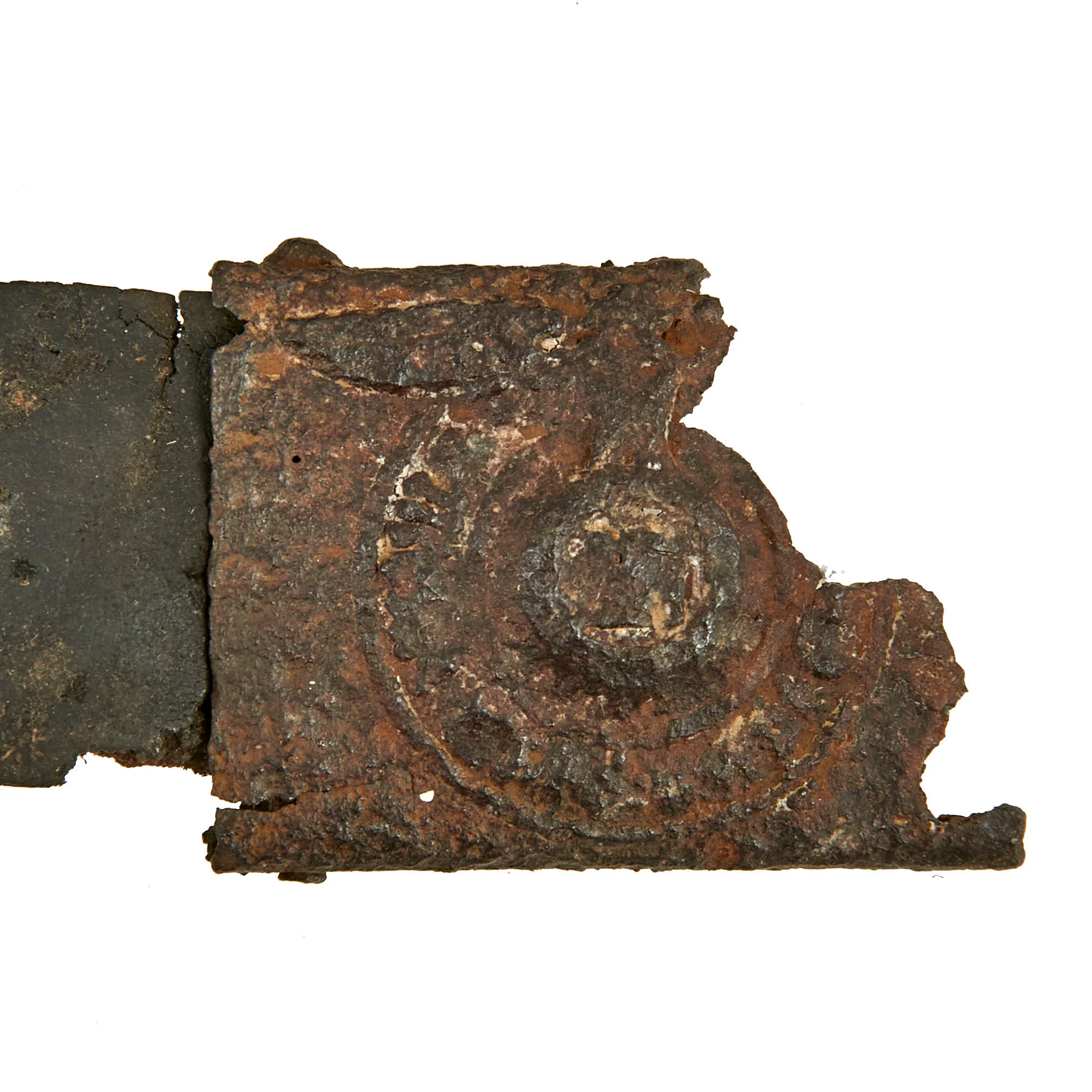
This is a fantastic documented example of a trench club which we believe to be of German origin. As shown in the book, the author was not sure about its country of origin, but we believe it to be German for the fact that the head is shaped very similarly to a German Model 1917 n/A Inert Egg Hand Fragmentation Grenade or “Eierhandgranate”. The head is now very oxidized as shown but retains some of the original paint which is also similar to that of the Eierhandgranate.
The club measures roughly 21 ⅝” overall, and as shown there is a large crack at the pommel going up the shaft.
A great example, ready for display.
Trench raiding clubs were homemade melee weapons used by both the Allies and the Central Powers during World War I. Clubs were used during nighttime trench raiding expeditions as a quiet and effective way of killing or wounding enemy soldiers. The clubs were usually made out of wood. It was common practice to fix a metal object at the striking end (e.g. an empty Mills bomb) in order to maximize the injury inflicted. Another common design comprised a simple stave with the end drilled out and a lead weight inserted, with rows of large hobnails hammered in around its circumference. Most designs had some form of cord or leather strap at the end to wrap around the user's wrist. Bosnian soldiers serving in the Austro-Hungarian army were fond of using maces. They were also used by officers to finish enemy soldiers wounded by poison gas attacks.
Trench clubs were manufactured in bulk by units based behind the lines. Typically, regimental carpenters and metal workers would make large numbers of the same design of club. They were generally used along with other "quiet" weapons such as trench knives, entrenching tools, bayonets, hatchets and pickaxe handles – backed up with revolvers and hand grenades.

Details & Craftsmanship
Every detail has been carefully considered to bring you the perfect product.

Details & Craftsmanship
Every detail has been carefully considered to bring you the perfect product.

Details & Craftsmanship
Every detail has been carefully considered to bring you the perfect product.

Details & Craftsmanship
Every detail has been carefully considered to bring you the perfect product.

Details & Craftsmanship
Every detail has been carefully considered to bring you the perfect product.

Details & Craftsmanship
Every detail has been carefully considered to bring you the perfect product.

Details & Craftsmanship
Every detail has been carefully considered to bring you the perfect product.

Details & Craftsmanship
Every detail has been carefully considered to bring you the perfect product.

Details & Craftsmanship
Every detail has been carefully considered to bring you the perfect product.

Details & Craftsmanship
Every detail has been carefully considered to bring you the perfect product.

Details & Craftsmanship
Every detail has been carefully considered to bring you the perfect product.
Description
Original Item. One-of-a-Kind. Purchased directly from David F. Machnicki, the author of At Arm's Length Trench Clubs and Knives (Vol. 1), where this very club is featured on page 24. Please note that the attached page image from the book is copyrighted material and the use of the page is done by permission of the author. A printed copy of the page will accompany the purchase of this club.
The entry reads:
“The trench club described above was designed with a slim profile and a length of 544,,. Its cast iron head resembles the shape of a doorknob bearing a large rounded terminal knob with eight flattened rectangular-shaped projections. The head was attached to the wood handle by using two round-headed nails. ITs wood handle retains a cylindrical shape for the first three-quarters of its length where it then begins to quickly narrow (near the bottom quarter of its length) to form the grip with a rounded pommel. The 8.0mm hole drilled through its pommel was intended for the attachment of a lanyard. At the time of writing, the club’s country of origins or manufacture has remained undetermined. Further research is required.”
This is a fantastic documented example of a trench club which we believe to be of German origin. As shown in the book, the author was not sure about its country of origin, but we believe it to be German for the fact that the head is shaped very similarly to a German Model 1917 n/A Inert Egg Hand Fragmentation Grenade or “Eierhandgranate”. The head is now very oxidized as shown but retains some of the original paint which is also similar to that of the Eierhandgranate.
The club measures roughly 21 ⅝” overall, and as shown there is a large crack at the pommel going up the shaft.
A great example, ready for display.
Trench raiding clubs were homemade melee weapons used by both the Allies and the Central Powers during World War I. Clubs were used during nighttime trench raiding expeditions as a quiet and effective way of killing or wounding enemy soldiers. The clubs were usually made out of wood. It was common practice to fix a metal object at the striking end (e.g. an empty Mills bomb) in order to maximize the injury inflicted. Another common design comprised a simple stave with the end drilled out and a lead weight inserted, with rows of large hobnails hammered in around its circumference. Most designs had some form of cord or leather strap at the end to wrap around the user's wrist. Bosnian soldiers serving in the Austro-Hungarian army were fond of using maces. They were also used by officers to finish enemy soldiers wounded by poison gas attacks.
Trench clubs were manufactured in bulk by units based behind the lines. Typically, regimental carpenters and metal workers would make large numbers of the same design of club. They were generally used along with other "quiet" weapons such as trench knives, entrenching tools, bayonets, hatchets and pickaxe handles – backed up with revolvers and hand grenades.