The Story
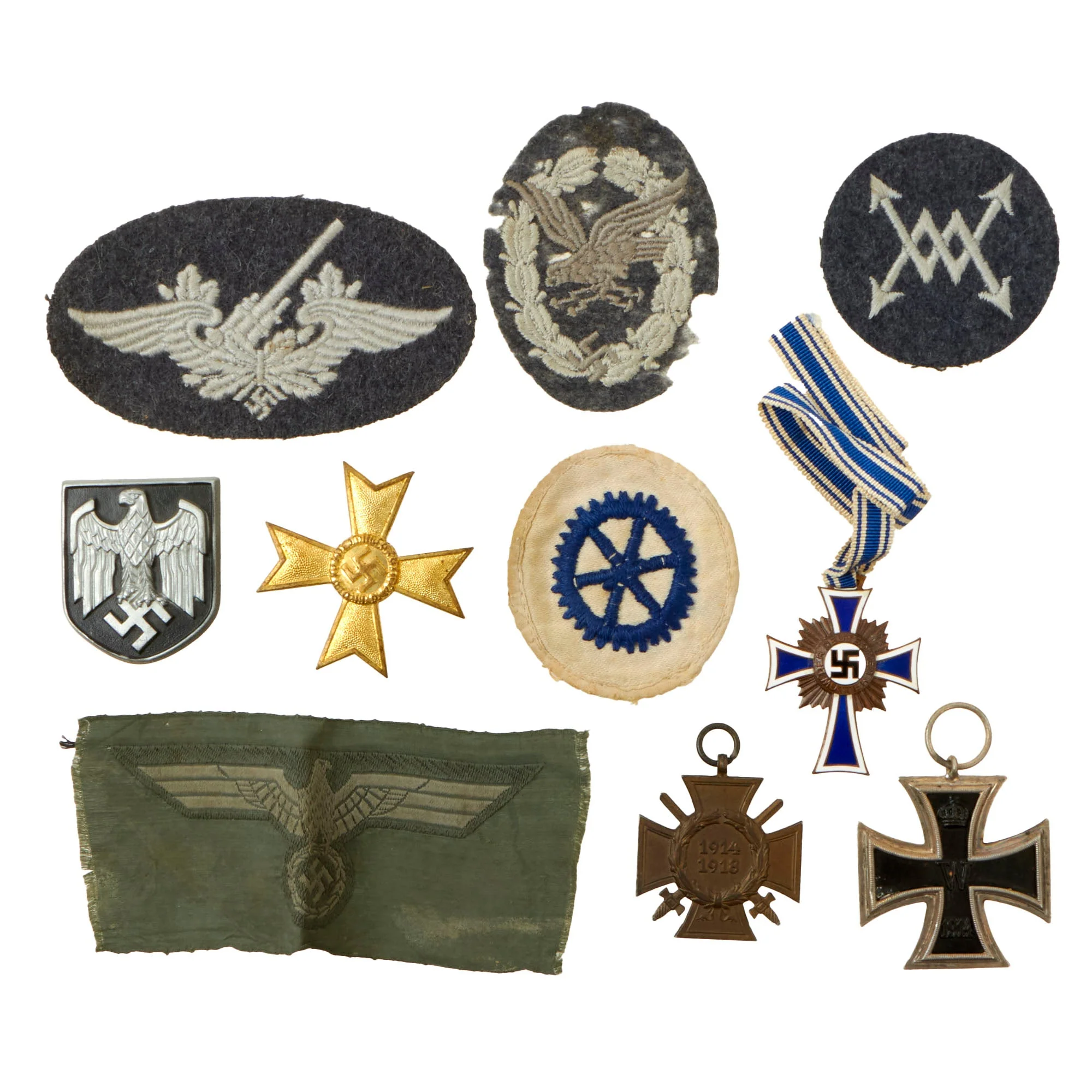
Original Items: Only One Set Available. This is a very nice collection of German WWII Insignia & Awards, which was brought back from the European theater by a USGI after the war was concluded. Many solders traded these on the way back, and would end up with a pocket full of various different collectible items, and this set represents the typical "haul" one might have come back with. It includes a good variety of medals and insignia, including a 1939 EKII, a desirable Panzer Officer Bullion Breast eagle, and more!
This lovely set includes:
- One Royal Bavarian WWI 25 Year Industrial Faithful Service Award (Treuedienstabzeichen der Bayerischen Industrie), with ribbon pin. These were issued to individuals in Bavaria who had served industry / labor in Bavaria for over 25 years.
- One Imperial German WWI Era 1866 War cross, without ribbon.
- One Imperial German WWI Era 1895 Franco-Prussian 25 Year Commemorative Medal, without ribbon.
- One German WWI Kaiser Wilhelm II 1916 Commemorative Medal.
- One Interwar Weimar Republic Eagle Insignia.
- One Interwar Weimar Republic Era 1930 Gymnastics Festival in Bad Bibra tinnie.
- One German WWII Eastern Front Medal (Ostmedaille), complete with ribbon and ribbon bar pin. The set is in very good shape, with a lightly oxidized patina on the medal, and the ribbon and ribbon bar pin are in great shape.
- One German WWII Era TAG DER WEHRMACHT WHW 19. 3. 1939 tinnie. "Wehrmacht day" to both help generate appreciation for the armed forces, as well as to raise money for the WHW.
- One German WWII Gau Düsseldorf WHW 1937-1938 Tinnie. One of many "Winter Help Work" organizations to help raise Germany's agricultural capacity.
- One German WWII DAF Labor Front Visor Cap "Festival" Badge. This shows the organization’s "Mobile Swas in a cog gear" emblem over oak leaves. The cog has the correct 14 teeth, and is really in great shape, not showing any real wear or oxidation. It is maker marked on the back.
- One German WWII Small NSDAP Swas Stickpin with Wings.
- One German WWII Heer Army Visor Cap Aluminum Eagle Insignia.
A wonderful totally genuine grouping perfect for the German Medal and Insignia collector. Ready to research and display!
More Details on some of the Items in this set:
German WWI Prussian Iron Cross 2nd Class:
Established by Frederick William in 1813 for gallantry in action, the decoration was revived several times for later conflicts. The bulk of the issues are divided into 1st and 2nd class versions, but a rare and superior 'Grand Cross' was also awarded for successful field commanders. During WW1 the lower decoration was freely awarded with 5½ million second class types issued. Originally, the Iron Cross was an award of the Kingdom of Prussia, however given Prussia's pre-eminent place in the German Empire formed in 1871, it became an award for all of Germany.
The basic design of the WW1 crosses is a central Tatzenkreuz (cross pattée) struck from iron and mounted in a silver frame which has a raised crenulated decorative border. The obverse of the cross bears the date 1914 under a crowned 'W' monogram. Reverse bears an oak leaf cluster with the date of the decoration’s institution, 1813 underneath - the crowned initials of Frederick William are in the top arm above the oak leaf cluster. Suspension for second-class types is by means of a ring, and frequently this ring bears a maker's stamp.
Please examine the edge seam for authentication, which is not present on reproductions. Iron crosses were commonly constructed from an iron core sandwiched in a surrounding two part silver frame, normally the seam of these two silver parts is visible around the edge of the cross as is seen on this fine example.
War Merit Cross 2nd Class (Kriegsverdienstkreuz) with Swords (for Combat)
This was a decoration of NSDAP Germany during the Second World War, which could be awarded to military personnel and civilians alike. By the end of the war it was issued in four degrees, and had a related civil decoration. It was created by Adolf AH in October 1939 as a successor to the non-combatant Iron Cross which was used in earlier wars. The award was graded the same as the Iron Cross: War Merit Cross Second Class, War Merit Cross First Class, and Knights Cross of the War Merit Cross. The award had two variants: with swords given to soldiers for exceptional service "not in direct connection with combat", and without swords for meritorious service to civilians in "furtherance of the war effort". As with the Iron Cross, Recipients had to have the lower grade of the award before getting the next level.
The War Merit Medal (Kriegsverdienstmedaille) was a World War II German military decoration awarded to recognize outstanding service by civilians in relation to the war effort. It was instituted on 19 August 1940 and usually awarded to those workers in factories who significantly exceeded work quotas. The War Merit Medal was awarded only to Germans and non-Germans civilians, to men and women. An estimated 4.9 million medals were awarded by the end of the war in Europe. It was closely related to the War Merit Cross, which could be awarded to military personnel and civilians alike for outstanding service to the war effort.
The medal was designed by Professor Richard Klein of Munich. It was a circular bronze award bearing the design of the War Merit Cross on the front (obverse), and the inscription "For War Merit 1939" (Für Kriegsverdienst 1939) on the reverse side. It was suspended from a ribbon colored similar to the War Merit Cross, except for a thin red vertical strip added to the center of the black portion. When worn, it was either as a medal ribbon bar above the left breast pocket (soldiers who had earned the medal as civilians could wear it on their uniform), or with the ribbon only through the second buttonhole of a jacket. Since this was a non-combat award, the medal never incorporated swords. After 15 May, 1943, the award of this medal to foreigners was superseded by the Medal of Merit of the Order of the German Eagle.
The Eastern Medal (Ostmedaille), officially the Winter Battle in the East 1941–42 Medal (Medaille Winterschlacht im Osten 1941/42), was a military award of the Wehrmacht which was created by ordinance of Adolf H on 26 May 1942.
The Eastern Medal was awarded to any member of the Wehrmacht and Waffen-SS "in recognition of experience in the struggle against the Bolshevik enemy and the Russian winter within the period from 15 November 1941 to 15 April 1942." It was also awarded posthumously to any service member who died in the line of duty within the Soviet Union. It was wryly called the Frozen Meat Medal or the "Order of the Frozen Flesh" (Gefrierfleischorden).

Details & Craftsmanship
Every detail has been carefully considered to bring you the perfect product.

Details & Craftsmanship
Every detail has been carefully considered to bring you the perfect product.

Details & Craftsmanship
Every detail has been carefully considered to bring you the perfect product.

Details & Craftsmanship
Every detail has been carefully considered to bring you the perfect product.

Details & Craftsmanship
Every detail has been carefully considered to bring you the perfect product.

Details & Craftsmanship
Every detail has been carefully considered to bring you the perfect product.

Details & Craftsmanship
Every detail has been carefully considered to bring you the perfect product.

Details & Craftsmanship
Every detail has been carefully considered to bring you the perfect product.
Description
Original Items: Only One Set Available. This is a very nice collection of German WWII Insignia & Awards, which was brought back from the European theater by a USGI after the war was concluded. Many solders traded these on the way back, and would end up with a pocket full of various different collectible items, and this set represents the typical "haul" one might have come back with. It includes a good variety of medals and insignia, including a 1939 EKII, a desirable Panzer Officer Bullion Breast eagle, and more!
This lovely set includes:
- One Royal Bavarian WWI 25 Year Industrial Faithful Service Award (Treuedienstabzeichen der Bayerischen Industrie), with ribbon pin. These were issued to individuals in Bavaria who had served industry / labor in Bavaria for over 25 years.
- One Imperial German WWI Era 1866 War cross, without ribbon.
- One Imperial German WWI Era 1895 Franco-Prussian 25 Year Commemorative Medal, without ribbon.
- One German WWI Kaiser Wilhelm II 1916 Commemorative Medal.
- One Interwar Weimar Republic Eagle Insignia.
- One Interwar Weimar Republic Era 1930 Gymnastics Festival in Bad Bibra tinnie.
- One German WWII Eastern Front Medal (Ostmedaille), complete with ribbon and ribbon bar pin. The set is in very good shape, with a lightly oxidized patina on the medal, and the ribbon and ribbon bar pin are in great shape.
- One German WWII Era TAG DER WEHRMACHT WHW 19. 3. 1939 tinnie. "Wehrmacht day" to both help generate appreciation for the armed forces, as well as to raise money for the WHW.
- One German WWII Gau Düsseldorf WHW 1937-1938 Tinnie. One of many "Winter Help Work" organizations to help raise Germany's agricultural capacity.
- One German WWII DAF Labor Front Visor Cap "Festival" Badge. This shows the organization’s "Mobile Swas in a cog gear" emblem over oak leaves. The cog has the correct 14 teeth, and is really in great shape, not showing any real wear or oxidation. It is maker marked on the back.
- One German WWII Small NSDAP Swas Stickpin with Wings.
- One German WWII Heer Army Visor Cap Aluminum Eagle Insignia.
A wonderful totally genuine grouping perfect for the German Medal and Insignia collector. Ready to research and display!
More Details on some of the Items in this set:
German WWI Prussian Iron Cross 2nd Class:
Established by Frederick William in 1813 for gallantry in action, the decoration was revived several times for later conflicts. The bulk of the issues are divided into 1st and 2nd class versions, but a rare and superior 'Grand Cross' was also awarded for successful field commanders. During WW1 the lower decoration was freely awarded with 5½ million second class types issued. Originally, the Iron Cross was an award of the Kingdom of Prussia, however given Prussia's pre-eminent place in the German Empire formed in 1871, it became an award for all of Germany.
The basic design of the WW1 crosses is a central Tatzenkreuz (cross pattée) struck from iron and mounted in a silver frame which has a raised crenulated decorative border. The obverse of the cross bears the date 1914 under a crowned 'W' monogram. Reverse bears an oak leaf cluster with the date of the decoration’s institution, 1813 underneath - the crowned initials of Frederick William are in the top arm above the oak leaf cluster. Suspension for second-class types is by means of a ring, and frequently this ring bears a maker's stamp.
Please examine the edge seam for authentication, which is not present on reproductions. Iron crosses were commonly constructed from an iron core sandwiched in a surrounding two part silver frame, normally the seam of these two silver parts is visible around the edge of the cross as is seen on this fine example.
War Merit Cross 2nd Class (Kriegsverdienstkreuz) with Swords (for Combat)
This was a decoration of NSDAP Germany during the Second World War, which could be awarded to military personnel and civilians alike. By the end of the war it was issued in four degrees, and had a related civil decoration. It was created by Adolf AH in October 1939 as a successor to the non-combatant Iron Cross which was used in earlier wars. The award was graded the same as the Iron Cross: War Merit Cross Second Class, War Merit Cross First Class, and Knights Cross of the War Merit Cross. The award had two variants: with swords given to soldiers for exceptional service "not in direct connection with combat", and without swords for meritorious service to civilians in "furtherance of the war effort". As with the Iron Cross, Recipients had to have the lower grade of the award before getting the next level.
The War Merit Medal (Kriegsverdienstmedaille) was a World War II German military decoration awarded to recognize outstanding service by civilians in relation to the war effort. It was instituted on 19 August 1940 and usually awarded to those workers in factories who significantly exceeded work quotas. The War Merit Medal was awarded only to Germans and non-Germans civilians, to men and women. An estimated 4.9 million medals were awarded by the end of the war in Europe. It was closely related to the War Merit Cross, which could be awarded to military personnel and civilians alike for outstanding service to the war effort.
The medal was designed by Professor Richard Klein of Munich. It was a circular bronze award bearing the design of the War Merit Cross on the front (obverse), and the inscription "For War Merit 1939" (Für Kriegsverdienst 1939) on the reverse side. It was suspended from a ribbon colored similar to the War Merit Cross, except for a thin red vertical strip added to the center of the black portion. When worn, it was either as a medal ribbon bar above the left breast pocket (soldiers who had earned the medal as civilians could wear it on their uniform), or with the ribbon only through the second buttonhole of a jacket. Since this was a non-combat award, the medal never incorporated swords. After 15 May, 1943, the award of this medal to foreigners was superseded by the Medal of Merit of the Order of the German Eagle.
The Eastern Medal (Ostmedaille), officially the Winter Battle in the East 1941–42 Medal (Medaille Winterschlacht im Osten 1941/42), was a military award of the Wehrmacht which was created by ordinance of Adolf H on 26 May 1942.
The Eastern Medal was awarded to any member of the Wehrmacht and Waffen-SS "in recognition of experience in the struggle against the Bolshevik enemy and the Russian winter within the period from 15 November 1941 to 15 April 1942." It was also awarded posthumously to any service member who died in the line of duty within the Soviet Union. It was wryly called the Frozen Meat Medal or the "Order of the Frozen Flesh" (Gefrierfleischorden).