The Story
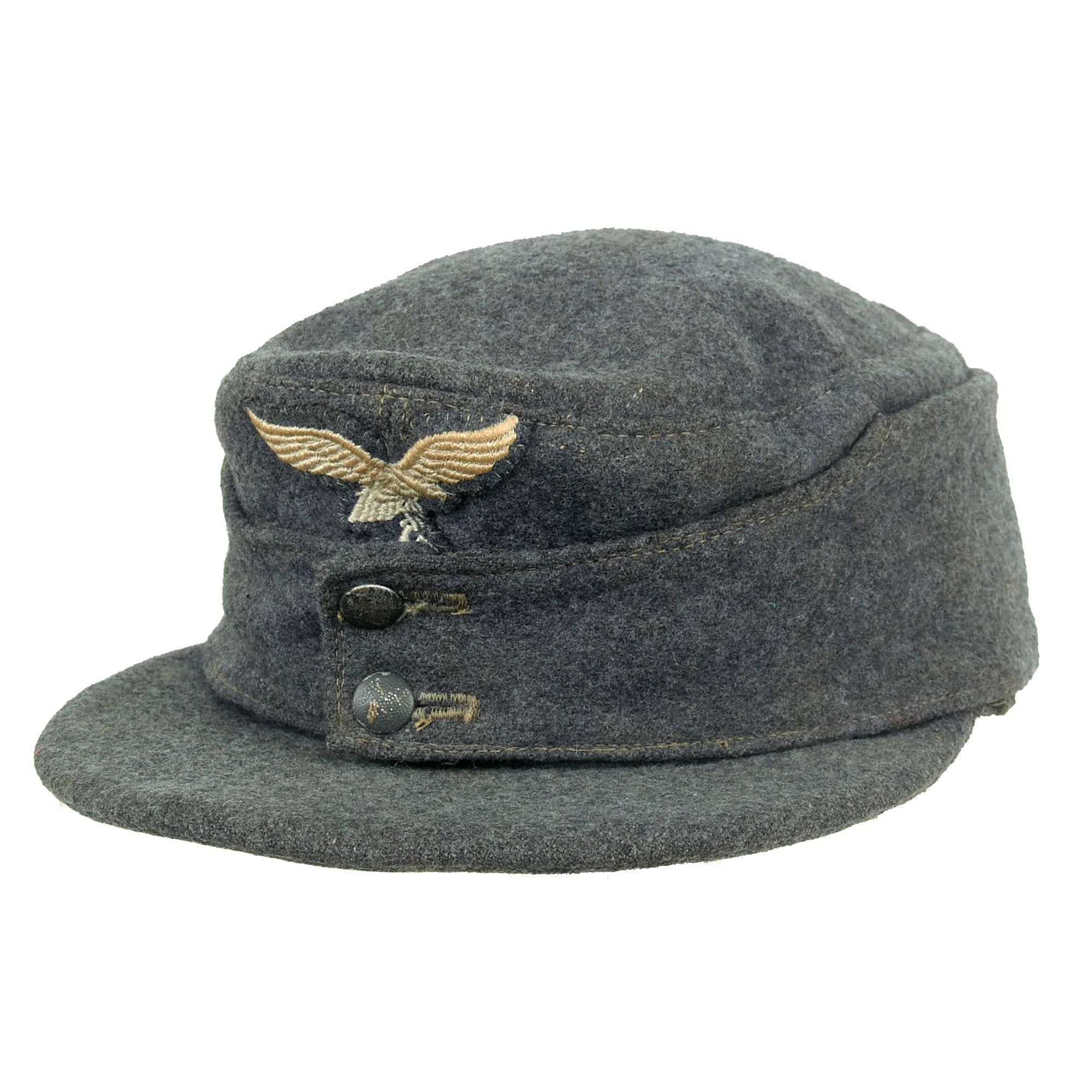
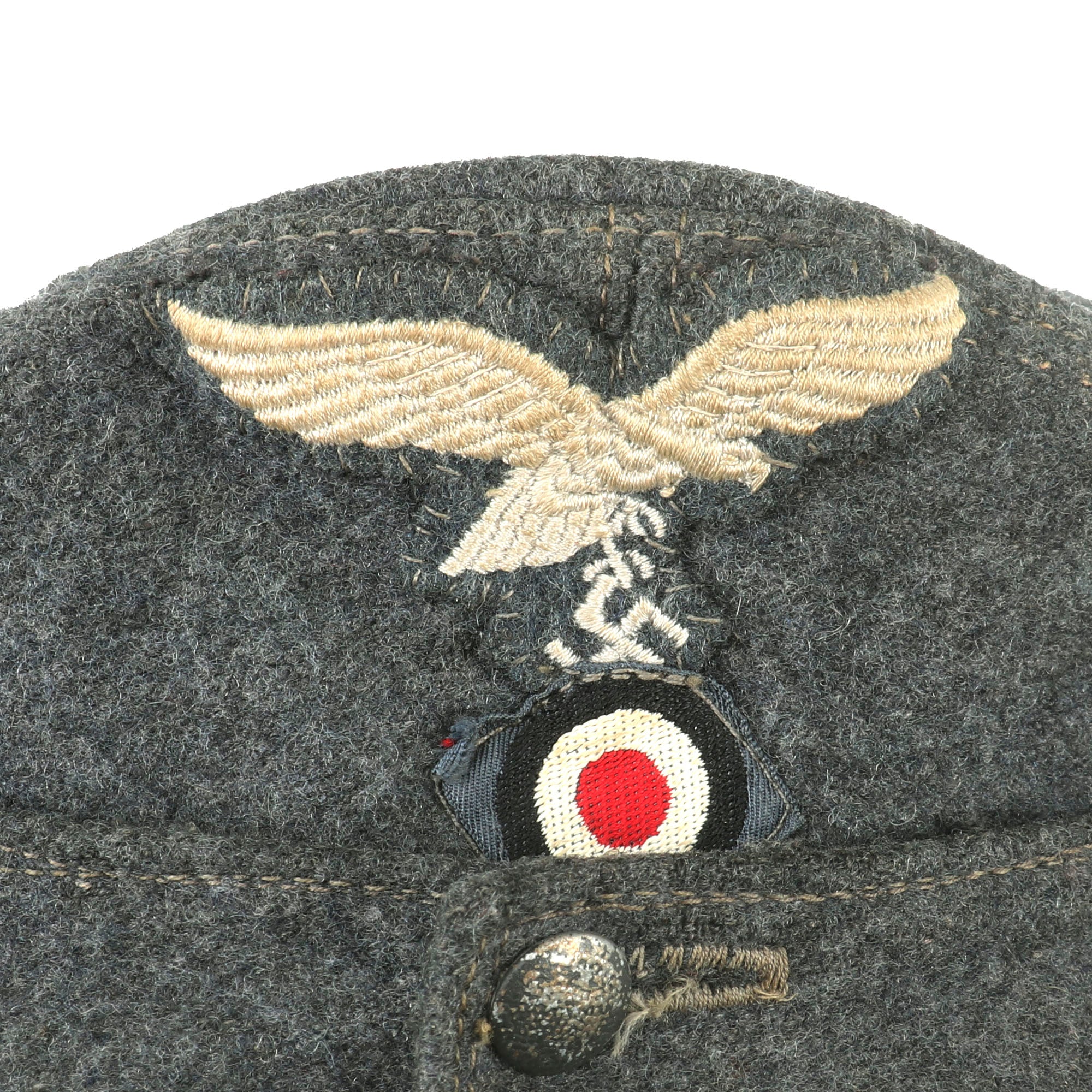
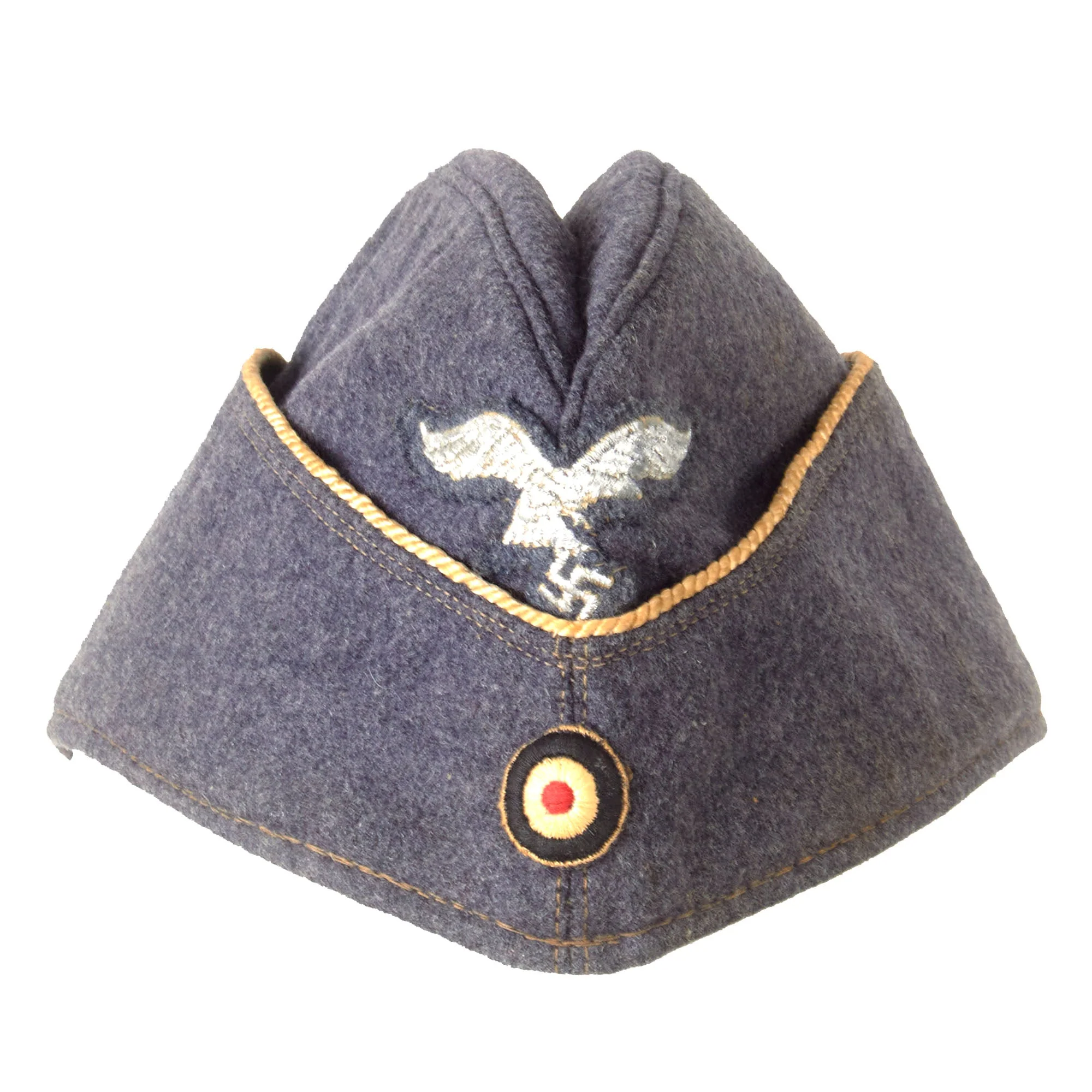
Original Item: Only One Available. This is a lovely service used example of a German WWII Luftwaffe M38 Overseas cap (Schiffchen), which we believe is from an officer in the 1st Paratroop Panzer Division Hermann Göring. It is a somewhat rare variant featuring white braided piping on the top of the flap, which as noted as a known pattern in Uniforms and Traditions of the Luftwaffe by John R. Angolia and Adolf Schlicht. These were made in the usual Luftwaffe Flyer's Blue color, as well as black for the ground crew and panzer troops. The cap definitely has a lovely lightly used look that is impossible to duplicate.
The overseas cap, nicknamed in German military slang as "Schiffchen", or literally "little ship" as it resembled an up-turned row-boat, was standard issue for the Luftwaffe for most occasions. The cap is constructed of the correct Luftwaffe Fliegerblau (Flyer's Blue) blue gray wool exterior, and features a fine embroidered eagle and tri-color cockade sewn to the front. These are only stitched to the outer layer of fabric, which means they were sewn on during production. We did notice that for some reason the eagle is silver, which looks to be from paint applied long ago.
The cap features blue gray canvas lining, which shows fading and staining on the interior from use and subsequent cleaning. We can see several stampings on the left side, which partly overlap, and are also faded from use. One looks like a maker marking, and there is also a 1937 date over a size of 54. Under this is LBA 37, which indicates processing at the Luftwaffebekleidungsamt (Air Force Clothing Office) in 1937.
Overall condition is very good, and the original fuzzy "nap" of the fabric is still mostly present, with some wear and fading around the bottom rim and also on the top edges. A lovely example of a rare cap that was "really there", ready to add to your collection!
The Fallschirm-Panzer-Division 1. Hermann Göring (1st Paratroop Panzer Division Hermann Göring - abbreviated Fallschirm-Panzer-Div 1 HG) was an elite German Luftwaffe armoured division. The HG saw action in North Africa, Sicily, Italy and on the Eastern Front. The division began as a battalion-sized police unit in 1933. Over time it grew into a regiment, brigade, division, and finally was combined with the Parachute-Panzer Division 2 Hermann Göring in 1944 to form a Panzer corps under the by then Reichsmarschall. It surrendered to the Soviet Army near Dresden on May 8, 1945.
With the NSDAP seizure of 1933, Hermann Göring was appointed as Prussian Minister of the Interior. In this capacity, all Police units in Prussia came under Göring's control. On 24 February 1933, Göring authorized the creation of a police battalion. Working in conjunction with Göring's secret police, the Gestapo, the unit was involved in many attacks against Communists and Social democrats. In January 1934, under pressure from AH and Himmler, Göring gave Himmler's SS control of the Gestapo. To reinforce the position of his remaining unit, Göring increased its size and instituted a military training program. During the Night of the Long Knives, the unit and Leibstandarte SS Adolf AH executed many SA leaders, removing the formation as a threat to the NSDAP.
In 1935, Göring was promoted to command of the Luftwaffe and ordered the unit transferred to the Luftwaffe, renaming it Regiment General Göring in September 1935. Two sub-units were separated from the regiment in March 1938 and redesignated German 1st Parachute Division, the first of the Fallschirmjäger (airborne) units. In 1936, the regiment was assigned for Göring's bodyguards and as flak protection for AH's Headquarters. The regiment participated in the annexation of Austrian (Anschluss) and the invasion of the Occupation of Czechoslovakia in 1938, and then in March 1939. During Fall Gelb, this force took part in the invasion of the Netherlands and Belgium.
During Operation Barbarossa, the regiment was attached to the 11th Panzer Division, a part of Army Group South. The regiment saw action around the areas of Radziechów, Kiev and Bryansk. In July 1942 the regiment was upgraded to brigade status, and then to full division in October 1942 as a Panzer division. While the division was in formation, the Second Battle of El Alamein had forced Field Marshal Erwin Rommel's Afrika Korps to retreat to Tunisia. The division was sent to Tunisia piecemeal, where it eventually surrendered with the rest of Panzer Army Africa.
The reformed division was designated Panzer Division Hermann Göring and sent to Sicily. After the Allied invasion of Sicily was launched on 10 July 1943, the division was engaged at the Amphibious Battle of Gela and the Battle of Centuripe, retreating to Messina afterwards. When the armistice between Italy and Allied armed forces was signed, the division took part in the Operation Achse to disarm Italian troops. The division participated in the fighting following the Allied landing at Salerno in Operation Avalanche on 9 September. It then retreated towards the VolturnoTermoli line, and then to the Gustav Line, where it was pulled out of the line for rest and refit.
The Corps size Fallschirm-Panzerkorps Hermann Göring was created in 1944 through the combination of the unit with the Fallschirm-Panzergrenadier Division 2 Hermann Göring. After the start of the Allied offensive, Operation Diadem, on 12 May, the division retreated towards Rome and then abandoned the city. The division arrived in Poland in late-July and fought alongside SS Division Wiking and the 19th Panzer Division on the Vistula River between Modlin Fortress and Warsaw. In August, its counter-attack against the Magnaszew bridgehead, defended by the 8th Guards Army, failed after heavy fighting. Between August and September 1944, the division used captured Polish non-combatant civilians as human shields when attacking the insurgents' positions during the Warsaw uprising. Following the destruction of the town, the division was attached to the newly formed Army Group Vistula formed 24 January 1945, defending the ruins of Warsaw in what AH termed "Festung Warschau", or Fortress Warsaw. During the Vistula-Oder Offensive, much of the division was broken in battle.
In April, the remnants of the Hermann Göring Panzerkorps were sent to Silesia, and in heavy fighting were slowly pushed back into Saxony. On April 22, the Fallschirm-Panzer-Division 1. Hermann Göring was one of two divisions that broke through the inter-army boundary of the Polish 2nd Army (Polish People's Army or LWP) and the Soviet 52nd Army, in an action near Bautzen, destroying parts of their communications and logistics trains and severely damaging the Polish (LWP) 5th Infantry Division and 16th Tank Brigade before being stopped two days later.
In early May, units of the corps attempted to break out towards the American forces on the Elbe, but were unsuccessful. The corps surrendered to the Red Army on 8 May 1945.
Side Cap
A side cap is a military cap that can be folded flat when not being worn. It is also known as a garrison cap or flight cap in the United States, wedge cap in Canada, or field service cap in the United Kingdom. In form the side cap is comparable to the glengarry, a folding version of the Scottish military bonnet. It has been associated with various military forces since the middle of the 19th century, as well as various civilian organizations.

Details & Craftsmanship
Every detail has been carefully considered to bring you the perfect product.

Details & Craftsmanship
Every detail has been carefully considered to bring you the perfect product.

Details & Craftsmanship
Every detail has been carefully considered to bring you the perfect product.

Details & Craftsmanship
Every detail has been carefully considered to bring you the perfect product.

Details & Craftsmanship
Every detail has been carefully considered to bring you the perfect product.

Details & Craftsmanship
Every detail has been carefully considered to bring you the perfect product.

Details & Craftsmanship
Every detail has been carefully considered to bring you the perfect product.

Details & Craftsmanship
Every detail has been carefully considered to bring you the perfect product.

Details & Craftsmanship
Every detail has been carefully considered to bring you the perfect product.
Description
Original Item: Only One Available. This is a lovely service used example of a German WWII Luftwaffe M38 Overseas cap (Schiffchen), which we believe is from an officer in the 1st Paratroop Panzer Division Hermann Göring. It is a somewhat rare variant featuring white braided piping on the top of the flap, which as noted as a known pattern in Uniforms and Traditions of the Luftwaffe by John R. Angolia and Adolf Schlicht. These were made in the usual Luftwaffe Flyer's Blue color, as well as black for the ground crew and panzer troops. The cap definitely has a lovely lightly used look that is impossible to duplicate.
The overseas cap, nicknamed in German military slang as "Schiffchen", or literally "little ship" as it resembled an up-turned row-boat, was standard issue for the Luftwaffe for most occasions. The cap is constructed of the correct Luftwaffe Fliegerblau (Flyer's Blue) blue gray wool exterior, and features a fine embroidered eagle and tri-color cockade sewn to the front. These are only stitched to the outer layer of fabric, which means they were sewn on during production. We did notice that for some reason the eagle is silver, which looks to be from paint applied long ago.
The cap features blue gray canvas lining, which shows fading and staining on the interior from use and subsequent cleaning. We can see several stampings on the left side, which partly overlap, and are also faded from use. One looks like a maker marking, and there is also a 1937 date over a size of 54. Under this is LBA 37, which indicates processing at the Luftwaffebekleidungsamt (Air Force Clothing Office) in 1937.
Overall condition is very good, and the original fuzzy "nap" of the fabric is still mostly present, with some wear and fading around the bottom rim and also on the top edges. A lovely example of a rare cap that was "really there", ready to add to your collection!
The Fallschirm-Panzer-Division 1. Hermann Göring (1st Paratroop Panzer Division Hermann Göring - abbreviated Fallschirm-Panzer-Div 1 HG) was an elite German Luftwaffe armoured division. The HG saw action in North Africa, Sicily, Italy and on the Eastern Front. The division began as a battalion-sized police unit in 1933. Over time it grew into a regiment, brigade, division, and finally was combined with the Parachute-Panzer Division 2 Hermann Göring in 1944 to form a Panzer corps under the by then Reichsmarschall. It surrendered to the Soviet Army near Dresden on May 8, 1945.
With the NSDAP seizure of 1933, Hermann Göring was appointed as Prussian Minister of the Interior. In this capacity, all Police units in Prussia came under Göring's control. On 24 February 1933, Göring authorized the creation of a police battalion. Working in conjunction with Göring's secret police, the Gestapo, the unit was involved in many attacks against Communists and Social democrats. In January 1934, under pressure from AH and Himmler, Göring gave Himmler's SS control of the Gestapo. To reinforce the position of his remaining unit, Göring increased its size and instituted a military training program. During the Night of the Long Knives, the unit and Leibstandarte SS Adolf AH executed many SA leaders, removing the formation as a threat to the NSDAP.
In 1935, Göring was promoted to command of the Luftwaffe and ordered the unit transferred to the Luftwaffe, renaming it Regiment General Göring in September 1935. Two sub-units were separated from the regiment in March 1938 and redesignated German 1st Parachute Division, the first of the Fallschirmjäger (airborne) units. In 1936, the regiment was assigned for Göring's bodyguards and as flak protection for AH's Headquarters. The regiment participated in the annexation of Austrian (Anschluss) and the invasion of the Occupation of Czechoslovakia in 1938, and then in March 1939. During Fall Gelb, this force took part in the invasion of the Netherlands and Belgium.
During Operation Barbarossa, the regiment was attached to the 11th Panzer Division, a part of Army Group South. The regiment saw action around the areas of Radziechów, Kiev and Bryansk. In July 1942 the regiment was upgraded to brigade status, and then to full division in October 1942 as a Panzer division. While the division was in formation, the Second Battle of El Alamein had forced Field Marshal Erwin Rommel's Afrika Korps to retreat to Tunisia. The division was sent to Tunisia piecemeal, where it eventually surrendered with the rest of Panzer Army Africa.
The reformed division was designated Panzer Division Hermann Göring and sent to Sicily. After the Allied invasion of Sicily was launched on 10 July 1943, the division was engaged at the Amphibious Battle of Gela and the Battle of Centuripe, retreating to Messina afterwards. When the armistice between Italy and Allied armed forces was signed, the division took part in the Operation Achse to disarm Italian troops. The division participated in the fighting following the Allied landing at Salerno in Operation Avalanche on 9 September. It then retreated towards the VolturnoTermoli line, and then to the Gustav Line, where it was pulled out of the line for rest and refit.
The Corps size Fallschirm-Panzerkorps Hermann Göring was created in 1944 through the combination of the unit with the Fallschirm-Panzergrenadier Division 2 Hermann Göring. After the start of the Allied offensive, Operation Diadem, on 12 May, the division retreated towards Rome and then abandoned the city. The division arrived in Poland in late-July and fought alongside SS Division Wiking and the 19th Panzer Division on the Vistula River between Modlin Fortress and Warsaw. In August, its counter-attack against the Magnaszew bridgehead, defended by the 8th Guards Army, failed after heavy fighting. Between August and September 1944, the division used captured Polish non-combatant civilians as human shields when attacking the insurgents' positions during the Warsaw uprising. Following the destruction of the town, the division was attached to the newly formed Army Group Vistula formed 24 January 1945, defending the ruins of Warsaw in what AH termed "Festung Warschau", or Fortress Warsaw. During the Vistula-Oder Offensive, much of the division was broken in battle.
In April, the remnants of the Hermann Göring Panzerkorps were sent to Silesia, and in heavy fighting were slowly pushed back into Saxony. On April 22, the Fallschirm-Panzer-Division 1. Hermann Göring was one of two divisions that broke through the inter-army boundary of the Polish 2nd Army (Polish People's Army or LWP) and the Soviet 52nd Army, in an action near Bautzen, destroying parts of their communications and logistics trains and severely damaging the Polish (LWP) 5th Infantry Division and 16th Tank Brigade before being stopped two days later.
In early May, units of the corps attempted to break out towards the American forces on the Elbe, but were unsuccessful. The corps surrendered to the Red Army on 8 May 1945.
Side Cap
A side cap is a military cap that can be folded flat when not being worn. It is also known as a garrison cap or flight cap in the United States, wedge cap in Canada, or field service cap in the United Kingdom. In form the side cap is comparable to the glengarry, a folding version of the Scottish military bonnet. It has been associated with various military forces since the middle of the 19th century, as well as various civilian organizations.