
Original: $795.00
-70%$795.00
$238.50The Story
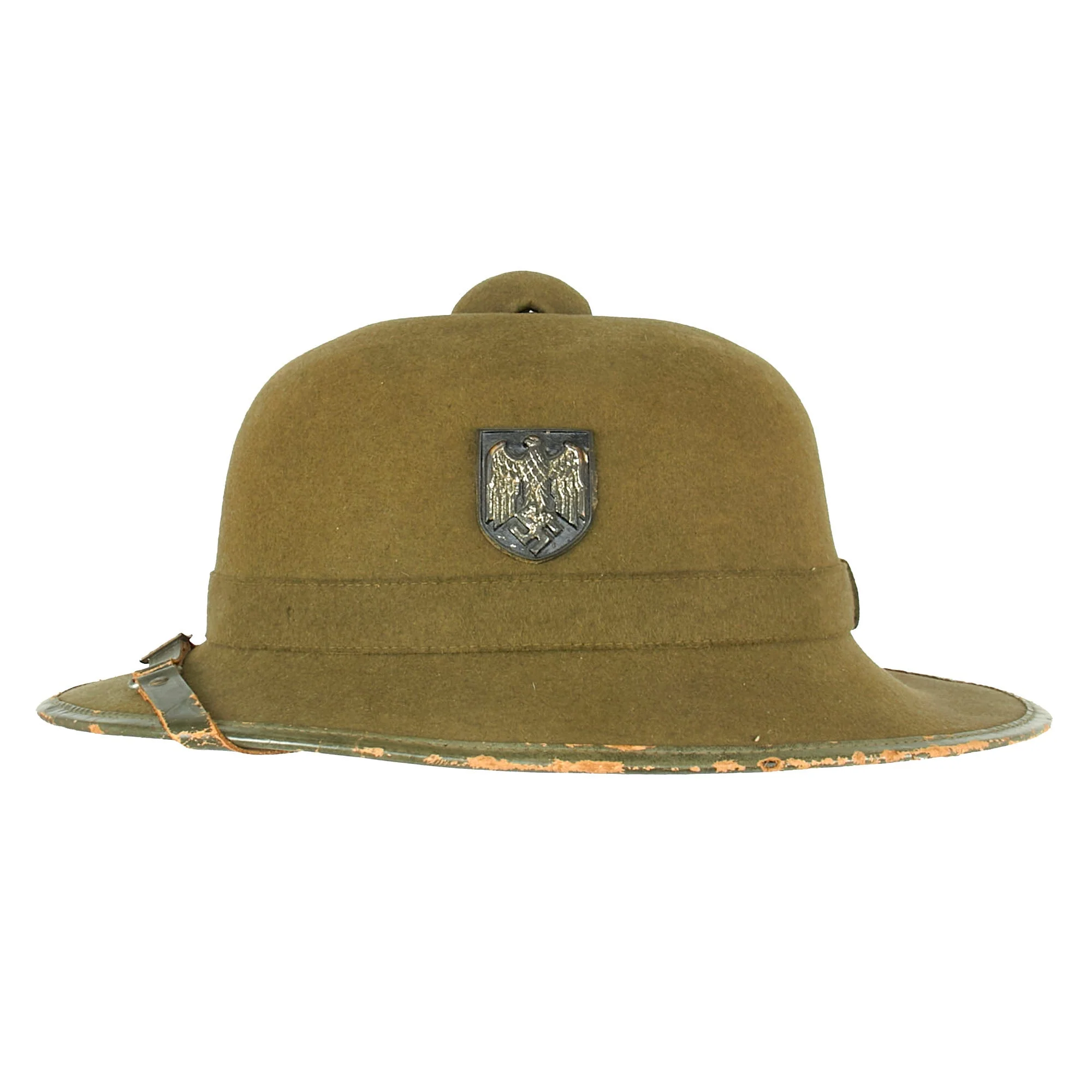
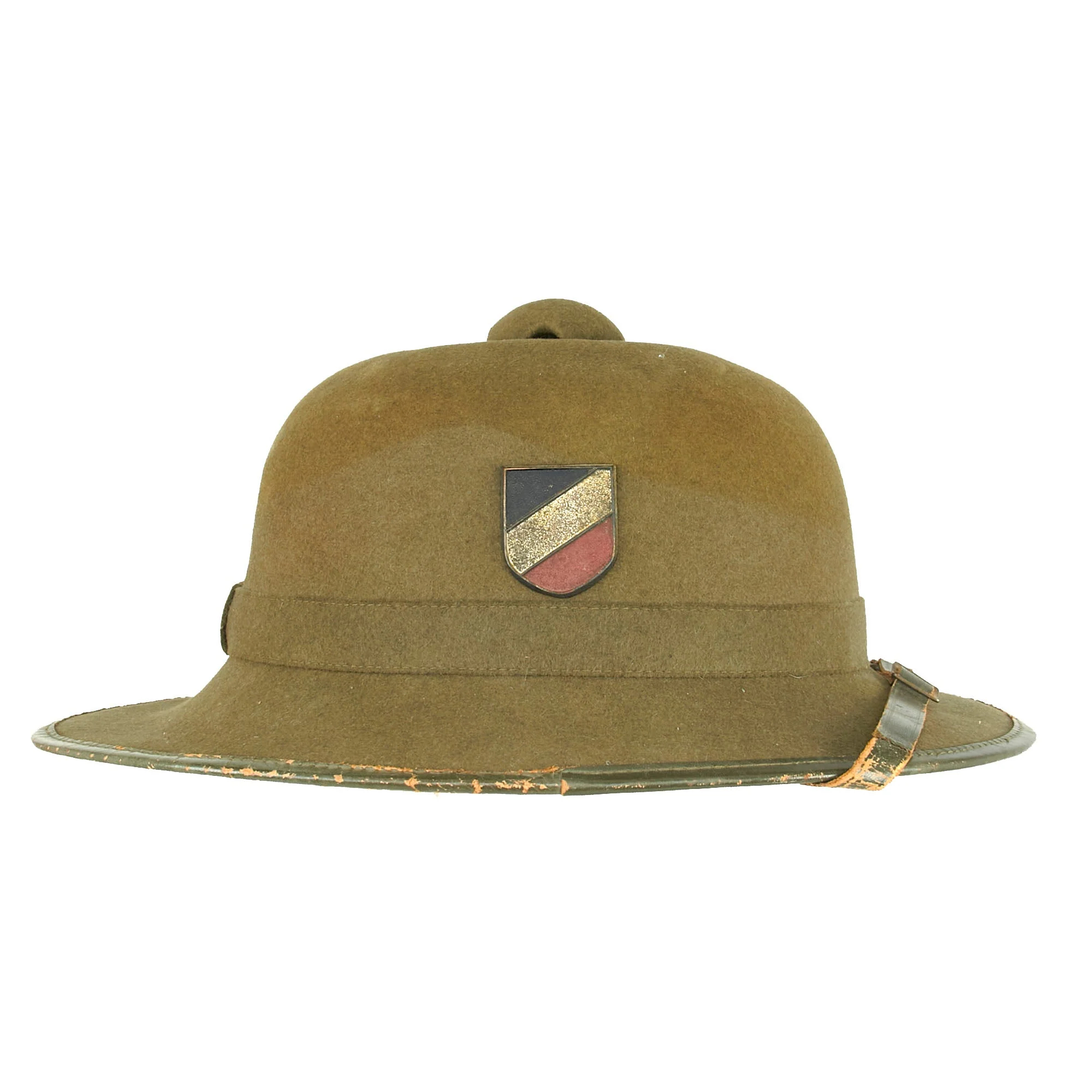
Original Item: Only One Available. This is a very nice 1936 Metropolitan Police Officer's pattern Tschako, made by Robert Lubstein under their very desirable EREL brand, a top class maker of headwear during the war. They manufactured many police shakos before the war, and this the later pattern police green wool body and black leather trim, which replaced the original all leather style. It has a very fine quality police officer eagle wappen (front plate) with aluminum Feldzeichen cockade (often missing), dated 1938 and maker marked with S.R.M.. The chinstrap is the correct black leather for the metropolitan police, and shows some age. A great Polizei helmet (shako) as used by the metropolitan police! Unlike some of the more common ones found trimmed in brown for rural police, this one is with black trim for the municipal police.
The interior is in very good condition, showing only light wear to the leather, and the original leather top tie is still present. There is just a bit of light staining from sweat and oils, especially on the forehead area. We checked under the liner, and there is a faint stamp reading 1938, as well as a Po / [1938] stamp on either side, indicating 1938 issued to the Polizei. The top crown is marked with a size 56 paint stamp, and there is also still the retailer and maker on the inner dome top (partly missing):
Robert Lubſt[ein]
Berlin NW 21,A[lt Moabit 105]
GES. GESCH.
FABRIKMARKE
(Logo)
EREL
BERLIN
FIBER-TSCHAKO
The mesh vents are in very good condition, with the sliding cover on the right side moving easily, while the left side is currently stuck. With both the Maker and Retailer located in Berlin, we can probably assume that this was issued to a Police Officer in the Berlin Metropolitan area.
Overall condition is very good, showing only light wear and some deterioration due to age and storage. This is particularly apparent on the gloss black leather areas, which show checking and crazing due to the finish deteriorating. There are just a few small moth nips to the fuzzy "nap" of the wool covering the main body of the shako, as well as some scattered staining.
A very good example from one of Germany's best manufactures of the time! Ready to display!
History of the shako-
The word shako originated from the Hungarian name csákós süveg ("peaked cap"), which was a part of the uniform of the Hungarian hussar of the 18th century. Other spellings include chako, czako, schako and tschako.
From 1800 on the shako became a common military headdress, worn by the majority of regiments in the armies of Europe and the Americas. Replacing in most instances the light bicorne, the shako was initially considered an improvement. Made of heavy felt and leather, it retained its shape and provided some protection for the soldier's skull, while its visor shaded his eyes. The shako retained this pre-eminence until the mid-19th century, when spiked helmets began to appear in the armies of the various German States, and the more practical kepi replaced it for all but parade wear in the French Army. The Imperial Russian Army substituted a spiked helmet for the shako in 1844-45 but returned to the latter headdress in 1855, before adopting a form of kepi in 1864. Following the Franco-Prussian War of 1870, military fashions changed and cloth or leather helmets based on the German headdress began to supersede the shako in many armies.
Although the mid-nineteenth century shako was impressive in appearance and added to the height of the wearer, it was also heavy and by itself provided little protection against bad weather as most models were made of cloth or felt material over a leather body and peak. Many armies countered this by utilizing specially designed oilskin covers to protect the shako and the wearer from heavy rain while on campaign. The shako provided little protection from enemy action as the most it could offer was in giving partial shielding of the skull from enemy cavalry sabers.

Details & Craftsmanship
Every detail has been carefully considered to bring you the perfect product.

Details & Craftsmanship
Every detail has been carefully considered to bring you the perfect product.

Details & Craftsmanship
Every detail has been carefully considered to bring you the perfect product.

Details & Craftsmanship
Every detail has been carefully considered to bring you the perfect product.

Details & Craftsmanship
Every detail has been carefully considered to bring you the perfect product.

Details & Craftsmanship
Every detail has been carefully considered to bring you the perfect product.

Details & Craftsmanship
Every detail has been carefully considered to bring you the perfect product.

Details & Craftsmanship
Every detail has been carefully considered to bring you the perfect product.

Details & Craftsmanship
Every detail has been carefully considered to bring you the perfect product.

Details & Craftsmanship
Every detail has been carefully considered to bring you the perfect product.

Details & Craftsmanship
Every detail has been carefully considered to bring you the perfect product.

Details & Craftsmanship
Every detail has been carefully considered to bring you the perfect product.
Description
Original Item: Only One Available. This is a very nice 1936 Metropolitan Police Officer's pattern Tschako, made by Robert Lubstein under their very desirable EREL brand, a top class maker of headwear during the war. They manufactured many police shakos before the war, and this the later pattern police green wool body and black leather trim, which replaced the original all leather style. It has a very fine quality police officer eagle wappen (front plate) with aluminum Feldzeichen cockade (often missing), dated 1938 and maker marked with S.R.M.. The chinstrap is the correct black leather for the metropolitan police, and shows some age. A great Polizei helmet (shako) as used by the metropolitan police! Unlike some of the more common ones found trimmed in brown for rural police, this one is with black trim for the municipal police.
The interior is in very good condition, showing only light wear to the leather, and the original leather top tie is still present. There is just a bit of light staining from sweat and oils, especially on the forehead area. We checked under the liner, and there is a faint stamp reading 1938, as well as a Po / [1938] stamp on either side, indicating 1938 issued to the Polizei. The top crown is marked with a size 56 paint stamp, and there is also still the retailer and maker on the inner dome top (partly missing):
Robert Lubſt[ein]
Berlin NW 21,A[lt Moabit 105]
GES. GESCH.
FABRIKMARKE
(Logo)
EREL
BERLIN
FIBER-TSCHAKO
The mesh vents are in very good condition, with the sliding cover on the right side moving easily, while the left side is currently stuck. With both the Maker and Retailer located in Berlin, we can probably assume that this was issued to a Police Officer in the Berlin Metropolitan area.
Overall condition is very good, showing only light wear and some deterioration due to age and storage. This is particularly apparent on the gloss black leather areas, which show checking and crazing due to the finish deteriorating. There are just a few small moth nips to the fuzzy "nap" of the wool covering the main body of the shako, as well as some scattered staining.
A very good example from one of Germany's best manufactures of the time! Ready to display!
History of the shako-
The word shako originated from the Hungarian name csákós süveg ("peaked cap"), which was a part of the uniform of the Hungarian hussar of the 18th century. Other spellings include chako, czako, schako and tschako.
From 1800 on the shako became a common military headdress, worn by the majority of regiments in the armies of Europe and the Americas. Replacing in most instances the light bicorne, the shako was initially considered an improvement. Made of heavy felt and leather, it retained its shape and provided some protection for the soldier's skull, while its visor shaded his eyes. The shako retained this pre-eminence until the mid-19th century, when spiked helmets began to appear in the armies of the various German States, and the more practical kepi replaced it for all but parade wear in the French Army. The Imperial Russian Army substituted a spiked helmet for the shako in 1844-45 but returned to the latter headdress in 1855, before adopting a form of kepi in 1864. Following the Franco-Prussian War of 1870, military fashions changed and cloth or leather helmets based on the German headdress began to supersede the shako in many armies.
Although the mid-nineteenth century shako was impressive in appearance and added to the height of the wearer, it was also heavy and by itself provided little protection against bad weather as most models were made of cloth or felt material over a leather body and peak. Many armies countered this by utilizing specially designed oilskin covers to protect the shako and the wearer from heavy rain while on campaign. The shako provided little protection from enemy action as the most it could offer was in giving partial shielding of the skull from enemy cavalry sabers.