
Original: $1,395.00
-70%$1,395.00
$418.50The Story
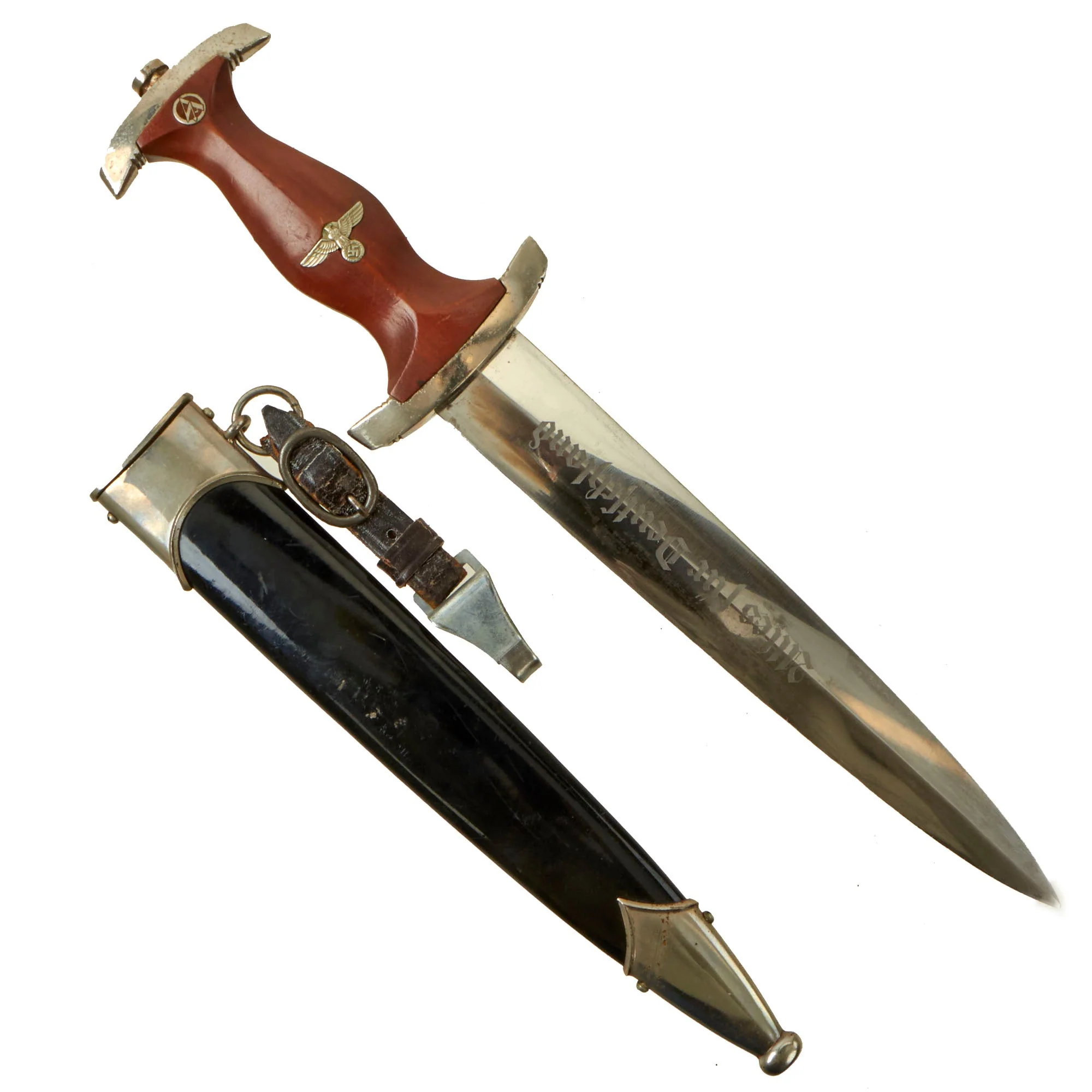
Original Item: Only One Available. This is an excellent condition Mid-war production HJ Fahrtenmesser (HJ Trip Knife), marked on the blade with both the trademark logo and RZM code of legendary maker W.K.C. Waffenfabrik GmbH of Solingen. This is definitely a transitional period knife, with characteristics of both the early and later pattern. This HJ Knife is a solid example of the type, with a handle that is nickel-plated over an alloy base. Almost all of the plating remains, over 95%, with just some slight patination on the pommel.
Unlike the early pattern knives, these have a thicker blade with a raised ricasso, which significantly strengthened the blade. The acid-etched motto Blut und Ehre! (Blood and Honor!) is present and fully legible, with the dark frosting retained almost completely, something we almost never see! Usually these later pattern knives did not have the motto, however as this was made during the 1936-1938 changeover period, this is correct.
The Bakelite grip plates are closely checkered and in very good condition, showing only light wear and a bit if chipping at the edge, with no cracks or maker damage. They are retained by plated steel rivets with dressed obverse heads, which still retain their plating, though it is a bit oxidized. The HJ insignia is also in very good condition with only a bit of wear, and the enamel is fully intact. The borders between the panels have lost their plating, and the brass shows a lovely "mustard" patina. The bakelite shrinks slightly over the years, which is why the logo is a bit sunken in and loose, confirming the authenticity.
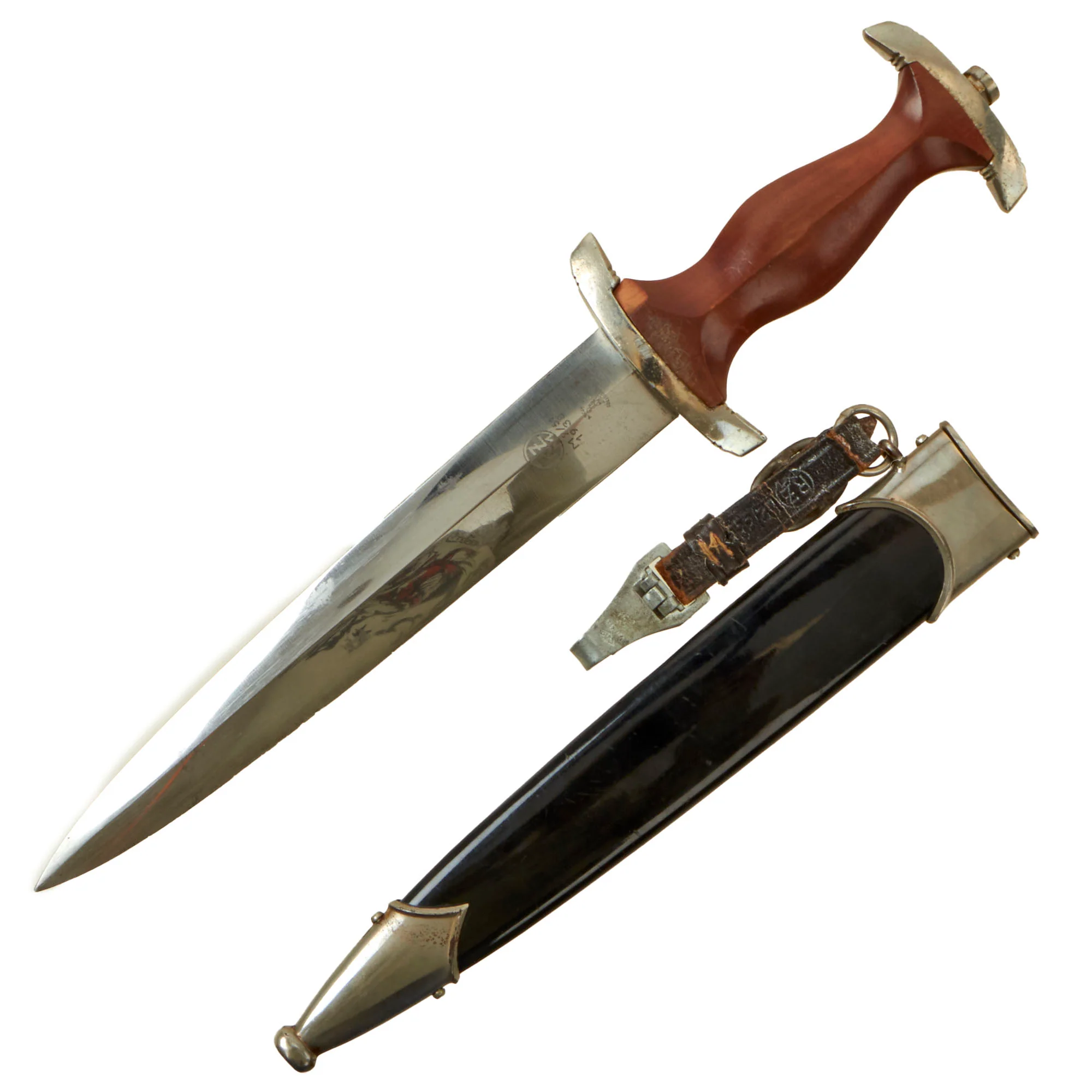
The blade of this example is in excellent condition, with the strengthened ricasso, showing only very light wear with a bit of staining near the edge, which looks to have been sharpened a bit long ago. The factory final polish grind cross grain is present throughout the blade, and can be seen in the light, though it is faint in areas due to runner wear. This texture is iconic, and is the definitive identifying characteristic for a real WWII German Blade. Definitely a great example of one of these, which often have the blades quite worn down from use in service, and afterwards.
The reverse of the blade is stamped with the trademark "Knight's Helmet" (Ritter-helm) logo of legendary maker Weyersberg Kirschbaum & Cie Waffenfabrik of Solingen, later rebranded as WKC Waffenfabrik:
(Knight's Helmet)
W K C
SOLINGEN
This company is a famous manufacturer of military swords and cutlery in Solingen, Germany - a city famous since the middle ages for its metal-working and craftsmanship in sword making. Per J. Anthony Carter's fine work GERMAN SWORD AND KNIFE MAKERS, the traditional manufacturing of swords at WKC dates back to the year 1774 when the Weyersberg first registered the ''Kings head'' as their trademark. Later in 1883 the company merged with the Kirschbaums, and the company Weyersberg Kirschbaum & Cie was formed, which continued into the Weimar Period. It was then rebranded as W.K.C. Waffenfabrik GmbH, and produced many edged weapons during the NSDAP Period. The company is still in operation today.
Avove the trademark logo is the additional marking (RZM) M7/42 1938, indicating 1936 manufacture by WKC. The Reichszeugmeisterei, or RZM, was was based at the Brown house in Munich and NSDAP party headquarters in Berlin. The RZM ensured that the manufacturers of military items were consistent in design, quality of materials and other characteristics of the items. It also defined standards of design, manufacturing and quality and published an authoritative color chart for textiles. The M7 in the code stands for knives/daggers, with WKC Waffenfabrik being contractor number 42.
The scabbard shell is the typical tapered example, and still retains over 95% of the original black enamel finish. The texture of the rolled steel body can still be seen, and where the paint has flaked, we can see that the steel still has the original purple / blue color. There is some checking and flaking to the paint, but it really is in great shape, as is the black leather belt hanger, which is fully intact. The finish on the leather is great, and the securing strap snap is fully functional. This is a great example of an HJ Scabbard which fits the knife perfectly.
A wonderful HJ Knife from the transitional period, made by a legendary Solingen Maker! Ready to add to your collection and display!
Specifications:
Blade Length: 5 1/2"
Blade Style: Single Edged Knife
Overall length: 9 5/8”
Crossguard: 1 7/8”
Scabbard Length: 5 7/8” with belt loop
AH believed German youth to be the future of his 3rd Reich. The HJ (AH Jugend) was formed officially in 1935, and with the exception of NSDAP ideology indoctrination was very similar to the Boy Scouts. Beginning at about the age of ten years, both boys (AH Jugend) and girls (Bund Deutscher Mädel) were enlisted in the Party-run organization. The boys only were given HJ Knives after having passed minor exams. The knives had nickeled hilts with black checkered grip plates. The obverse plate was fitted with an enameled HJ swas insignia. Through 1937, these knives were etched with the motto of the organization, Blut und Ehre! (Blood and Honor!). Examples produced after this date were made with plain blades usually bearing an RZM marking.
The HJ Leaders were professionals in charge of the training and NSDAP education of the German Youth. They wore a special dagger consisting of silvered hilt fittings with blue-black leather-covered scabbard. The grip was composed of tightly wrapped silver wire, over a wood base. The pommel cap featured an HJ diamond on top, complete with swas. The upper scabbard fitting portrayed an open-winged HJ eagle with swas cut into the bird's chest. The blade was etched with the HJ motto, Blut und Ehre!

Details & Craftsmanship
Every detail has been carefully considered to bring you the perfect product.

Details & Craftsmanship
Every detail has been carefully considered to bring you the perfect product.

Details & Craftsmanship
Every detail has been carefully considered to bring you the perfect product.

Details & Craftsmanship
Every detail has been carefully considered to bring you the perfect product.

Details & Craftsmanship
Every detail has been carefully considered to bring you the perfect product.

Details & Craftsmanship
Every detail has been carefully considered to bring you the perfect product.

Details & Craftsmanship
Every detail has been carefully considered to bring you the perfect product.

Details & Craftsmanship
Every detail has been carefully considered to bring you the perfect product.

Details & Craftsmanship
Every detail has been carefully considered to bring you the perfect product.

Details & Craftsmanship
Every detail has been carefully considered to bring you the perfect product.

Details & Craftsmanship
Every detail has been carefully considered to bring you the perfect product.

Details & Craftsmanship
Every detail has been carefully considered to bring you the perfect product.

Details & Craftsmanship
Every detail has been carefully considered to bring you the perfect product.

Details & Craftsmanship
Every detail has been carefully considered to bring you the perfect product.
Description
Original Item: Only One Available. This is an excellent condition Mid-war production HJ Fahrtenmesser (HJ Trip Knife), marked on the blade with both the trademark logo and RZM code of legendary maker W.K.C. Waffenfabrik GmbH of Solingen. This is definitely a transitional period knife, with characteristics of both the early and later pattern. This HJ Knife is a solid example of the type, with a handle that is nickel-plated over an alloy base. Almost all of the plating remains, over 95%, with just some slight patination on the pommel.
Unlike the early pattern knives, these have a thicker blade with a raised ricasso, which significantly strengthened the blade. The acid-etched motto Blut und Ehre! (Blood and Honor!) is present and fully legible, with the dark frosting retained almost completely, something we almost never see! Usually these later pattern knives did not have the motto, however as this was made during the 1936-1938 changeover period, this is correct.
The Bakelite grip plates are closely checkered and in very good condition, showing only light wear and a bit if chipping at the edge, with no cracks or maker damage. They are retained by plated steel rivets with dressed obverse heads, which still retain their plating, though it is a bit oxidized. The HJ insignia is also in very good condition with only a bit of wear, and the enamel is fully intact. The borders between the panels have lost their plating, and the brass shows a lovely "mustard" patina. The bakelite shrinks slightly over the years, which is why the logo is a bit sunken in and loose, confirming the authenticity.
The blade of this example is in excellent condition, with the strengthened ricasso, showing only very light wear with a bit of staining near the edge, which looks to have been sharpened a bit long ago. The factory final polish grind cross grain is present throughout the blade, and can be seen in the light, though it is faint in areas due to runner wear. This texture is iconic, and is the definitive identifying characteristic for a real WWII German Blade. Definitely a great example of one of these, which often have the blades quite worn down from use in service, and afterwards.
The reverse of the blade is stamped with the trademark "Knight's Helmet" (Ritter-helm) logo of legendary maker Weyersberg Kirschbaum & Cie Waffenfabrik of Solingen, later rebranded as WKC Waffenfabrik:
(Knight's Helmet)
W K C
SOLINGEN
This company is a famous manufacturer of military swords and cutlery in Solingen, Germany - a city famous since the middle ages for its metal-working and craftsmanship in sword making. Per J. Anthony Carter's fine work GERMAN SWORD AND KNIFE MAKERS, the traditional manufacturing of swords at WKC dates back to the year 1774 when the Weyersberg first registered the ''Kings head'' as their trademark. Later in 1883 the company merged with the Kirschbaums, and the company Weyersberg Kirschbaum & Cie was formed, which continued into the Weimar Period. It was then rebranded as W.K.C. Waffenfabrik GmbH, and produced many edged weapons during the NSDAP Period. The company is still in operation today.
Avove the trademark logo is the additional marking (RZM) M7/42 1938, indicating 1936 manufacture by WKC. The Reichszeugmeisterei, or RZM, was was based at the Brown house in Munich and NSDAP party headquarters in Berlin. The RZM ensured that the manufacturers of military items were consistent in design, quality of materials and other characteristics of the items. It also defined standards of design, manufacturing and quality and published an authoritative color chart for textiles. The M7 in the code stands for knives/daggers, with WKC Waffenfabrik being contractor number 42.
The scabbard shell is the typical tapered example, and still retains over 95% of the original black enamel finish. The texture of the rolled steel body can still be seen, and where the paint has flaked, we can see that the steel still has the original purple / blue color. There is some checking and flaking to the paint, but it really is in great shape, as is the black leather belt hanger, which is fully intact. The finish on the leather is great, and the securing strap snap is fully functional. This is a great example of an HJ Scabbard which fits the knife perfectly.
A wonderful HJ Knife from the transitional period, made by a legendary Solingen Maker! Ready to add to your collection and display!
Specifications:
Blade Length: 5 1/2"
Blade Style: Single Edged Knife
Overall length: 9 5/8”
Crossguard: 1 7/8”
Scabbard Length: 5 7/8” with belt loop
AH believed German youth to be the future of his 3rd Reich. The HJ (AH Jugend) was formed officially in 1935, and with the exception of NSDAP ideology indoctrination was very similar to the Boy Scouts. Beginning at about the age of ten years, both boys (AH Jugend) and girls (Bund Deutscher Mädel) were enlisted in the Party-run organization. The boys only were given HJ Knives after having passed minor exams. The knives had nickeled hilts with black checkered grip plates. The obverse plate was fitted with an enameled HJ swas insignia. Through 1937, these knives were etched with the motto of the organization, Blut und Ehre! (Blood and Honor!). Examples produced after this date were made with plain blades usually bearing an RZM marking.
The HJ Leaders were professionals in charge of the training and NSDAP education of the German Youth. They wore a special dagger consisting of silvered hilt fittings with blue-black leather-covered scabbard. The grip was composed of tightly wrapped silver wire, over a wood base. The pommel cap featured an HJ diamond on top, complete with swas. The upper scabbard fitting portrayed an open-winged HJ eagle with swas cut into the bird's chest. The blade was etched with the HJ motto, Blut und Ehre!