
The Story
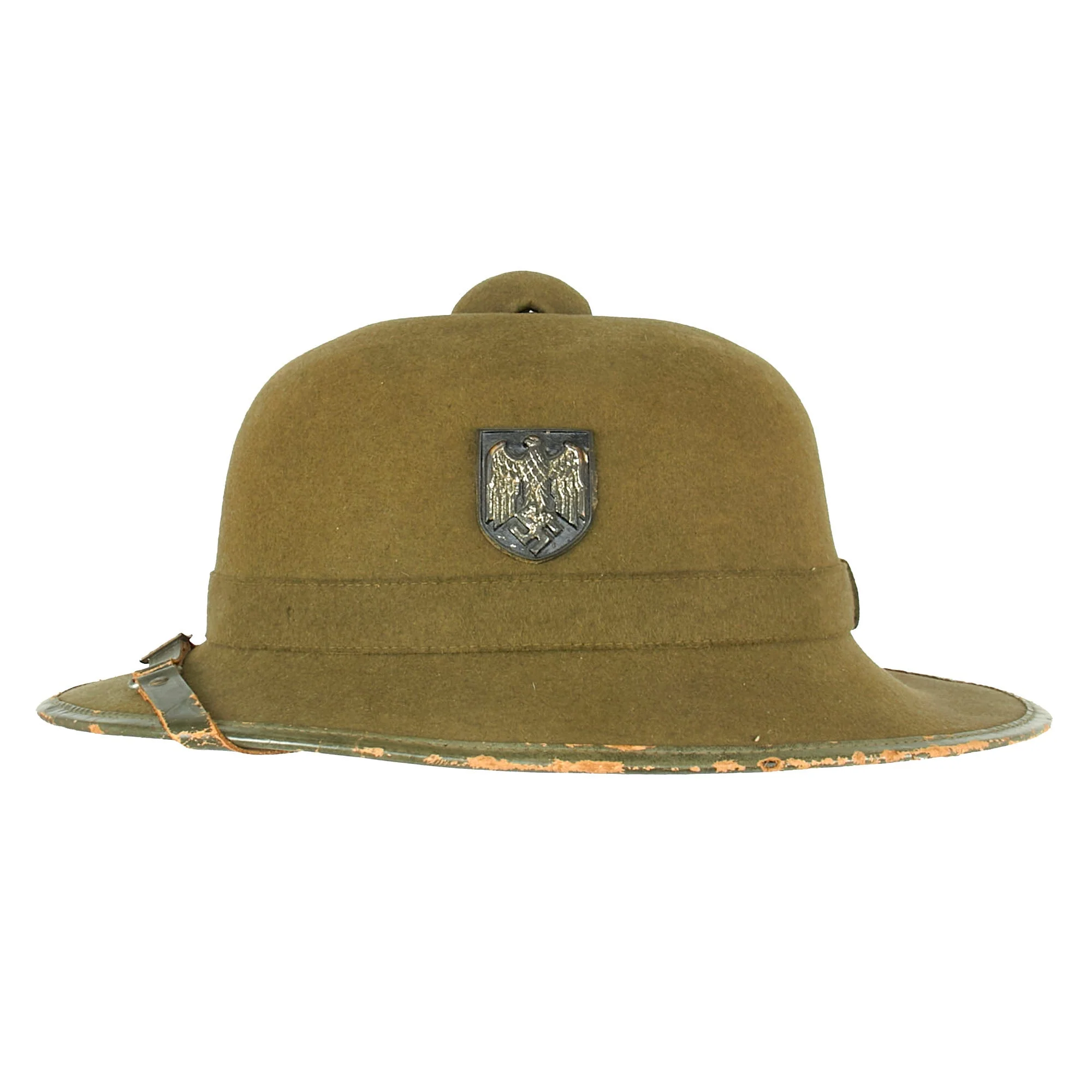
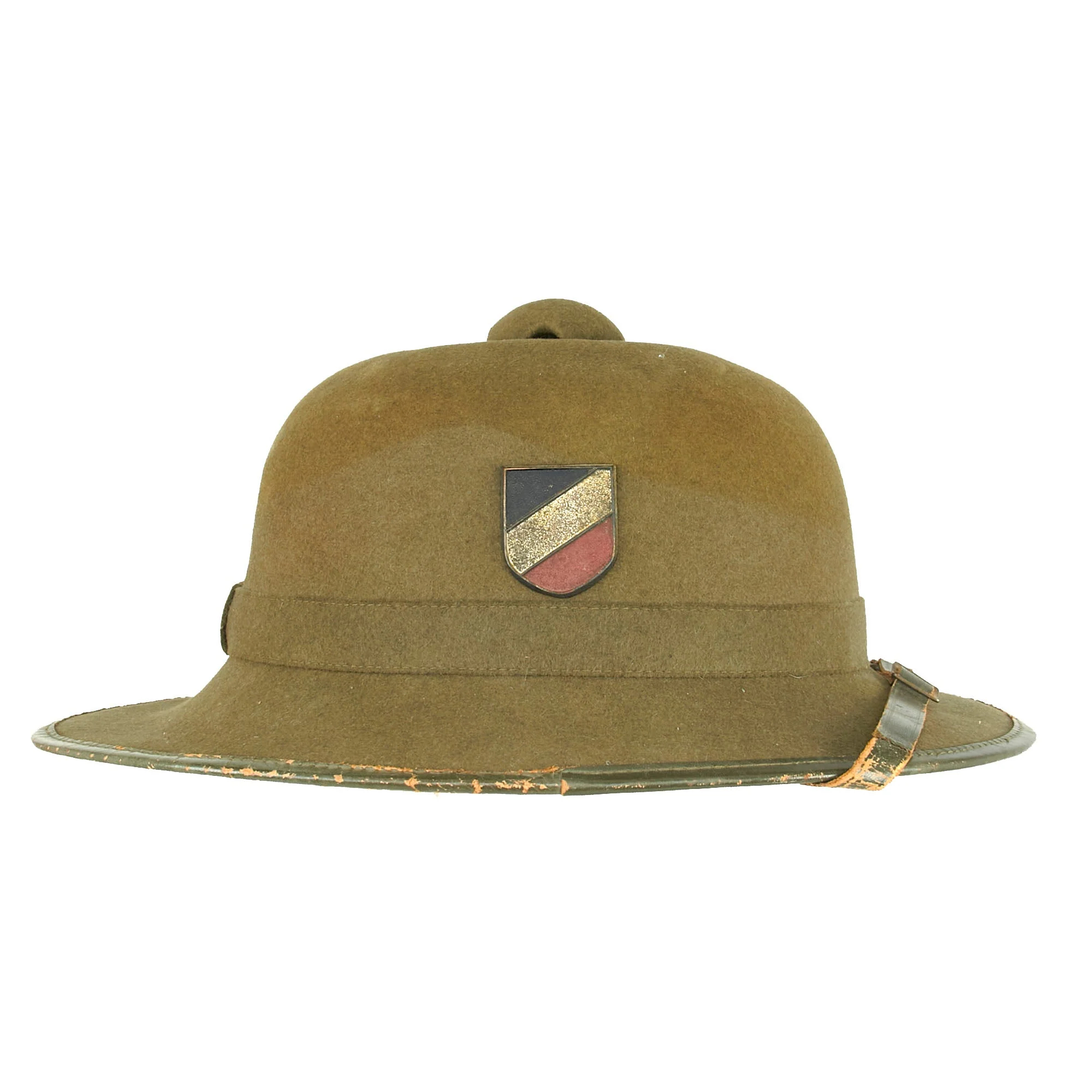
Original Item: Only One Available. This is a lovely 1936 Officers pattern Tschako, made by Robert Lubstein under their very desirable EREL brand, a top class maker of headwear during the war. They manufactured many police shakos before the war, and this the later pattern police green wool body and brown leather trim, which replaced the original all leather style. This particular shako has some great markings, and is in a nice large 59cm size, which we rarely see!
The brown leather chin strap is still present and in very nice shape, showing cracking and wear from use and age. It has a very fine quality police officer aluminum eagle wappen (front plate) with aluminum Feldzeichen cockade (often missing), which is marked on the back the at the bottom with manufacture date 1940 over the maker initials J.F.S., for Josef Feix & Söhne of Gablonz. This city was part of the so-called "Sudetenland" during WWII. Today it is known as Jablonec nad Nisou in the Czech Rebublic. A great Polizei helmet (shako) as used by the rural police! We rarely gets examples from the Rural police!
The interior is in very good used condition, showing only light wear to the leather, and the original top tie still present. There is some staining around the forehead areas, but it's really a great example that looks to have seen light use over the third reich period. We checked under the liner, and there is a large faint 1939 stamped under the right side.
The inside of top of the shako still retains a nearly complete maker marking:
59
Robert Lubſtein
Berlin NW 21, Alt Moabit 105
GES. GESCH.
FABRIKMARKE
(EREL Logo)
BERLIN
FIBER-TSCHAKO
The mesh vents are in very good condition, with the sliding closures still present and functional on both sides. With both the Maker and Retailer located in Berlin, we can probably assume that this was issued to a Police Officer in one of the rural areas outside of Berlin.
Overall condition is very good, showing moderate wear and overall exterior deterioration due to age and storage. The brown finished areas show crazing and checking due to the enamel degrading slightly over the decades, and the top crown has some cracking due to age. The colors are still spot on, and there is little to no mothing we can see to the blue/green felt covering. It has a fantastic aged look that really looks great!
A very nice example from one of Germany's best manufactures of the time! Ready to display!
History of the shako-
The word shako originated from the Hungarian name csákós süveg ("peaked cap"), which was a part of the uniform of the Hungarian hussar of the 18th century. Other spellings include chako, czako, schako and tschako.
From 1800 on the shako became a common military headdress, worn by the majority of regiments in the armies of Europe and the Americas. Replacing in most instances the light bicorne, the shako was initially considered an improvement. Made of heavy felt and leather, it retained its shape and provided some protection for the soldier's skull, while its visor shaded his eyes. The shako retained this pre-eminence until the mid-19th century, when spiked helmets began to appear in the armies of the various German States, and the more practical kepi replaced it for all but parade wear in the French Army. The Imperial Russian Army substituted a spiked helmet for the shako in 1844-45 but returned to the latter headdress in 1855, before adopting a form of kepi in 1864. Following the Franco-Prussian War of 1870, military fashions changed and cloth or leather helmets based on the German headdress began to supersede the shako in many armies.
Although the mid-nineteenth century shako was impressive in appearance and added to the height of the wearer, it was also heavy and by itself provided little protection against bad weather as most models were made of cloth or felt material over a leather body and peak. Many armies countered this by utilizing specially designed oilskin covers to protect the shako and the wearer from heavy rain while on campaign. The shako provided little protection from enemy action as the most it could offer was in giving partial shielding of the skull from enemy cavalry sabers.

Details & Craftsmanship
Every detail has been carefully considered to bring you the perfect product.

Details & Craftsmanship
Every detail has been carefully considered to bring you the perfect product.

Details & Craftsmanship
Every detail has been carefully considered to bring you the perfect product.

Details & Craftsmanship
Every detail has been carefully considered to bring you the perfect product.

Details & Craftsmanship
Every detail has been carefully considered to bring you the perfect product.

Details & Craftsmanship
Every detail has been carefully considered to bring you the perfect product.

Details & Craftsmanship
Every detail has been carefully considered to bring you the perfect product.

Details & Craftsmanship
Every detail has been carefully considered to bring you the perfect product.

Details & Craftsmanship
Every detail has been carefully considered to bring you the perfect product.

Details & Craftsmanship
Every detail has been carefully considered to bring you the perfect product.

Details & Craftsmanship
Every detail has been carefully considered to bring you the perfect product.

Details & Craftsmanship
Every detail has been carefully considered to bring you the perfect product.

Details & Craftsmanship
Every detail has been carefully considered to bring you the perfect product.
Description
Original Item: Only One Available. This is a lovely 1936 Officers pattern Tschako, made by Robert Lubstein under their very desirable EREL brand, a top class maker of headwear during the war. They manufactured many police shakos before the war, and this the later pattern police green wool body and brown leather trim, which replaced the original all leather style. This particular shako has some great markings, and is in a nice large 59cm size, which we rarely see!
The brown leather chin strap is still present and in very nice shape, showing cracking and wear from use and age. It has a very fine quality police officer aluminum eagle wappen (front plate) with aluminum Feldzeichen cockade (often missing), which is marked on the back the at the bottom with manufacture date 1940 over the maker initials J.F.S., for Josef Feix & Söhne of Gablonz. This city was part of the so-called "Sudetenland" during WWII. Today it is known as Jablonec nad Nisou in the Czech Rebublic. A great Polizei helmet (shako) as used by the rural police! We rarely gets examples from the Rural police!
The interior is in very good used condition, showing only light wear to the leather, and the original top tie still present. There is some staining around the forehead areas, but it's really a great example that looks to have seen light use over the third reich period. We checked under the liner, and there is a large faint 1939 stamped under the right side.
The inside of top of the shako still retains a nearly complete maker marking:
59
Robert Lubſtein
Berlin NW 21, Alt Moabit 105
GES. GESCH.
FABRIKMARKE
(EREL Logo)
BERLIN
FIBER-TSCHAKO
The mesh vents are in very good condition, with the sliding closures still present and functional on both sides. With both the Maker and Retailer located in Berlin, we can probably assume that this was issued to a Police Officer in one of the rural areas outside of Berlin.
Overall condition is very good, showing moderate wear and overall exterior deterioration due to age and storage. The brown finished areas show crazing and checking due to the enamel degrading slightly over the decades, and the top crown has some cracking due to age. The colors are still spot on, and there is little to no mothing we can see to the blue/green felt covering. It has a fantastic aged look that really looks great!
A very nice example from one of Germany's best manufactures of the time! Ready to display!
History of the shako-
The word shako originated from the Hungarian name csákós süveg ("peaked cap"), which was a part of the uniform of the Hungarian hussar of the 18th century. Other spellings include chako, czako, schako and tschako.
From 1800 on the shako became a common military headdress, worn by the majority of regiments in the armies of Europe and the Americas. Replacing in most instances the light bicorne, the shako was initially considered an improvement. Made of heavy felt and leather, it retained its shape and provided some protection for the soldier's skull, while its visor shaded his eyes. The shako retained this pre-eminence until the mid-19th century, when spiked helmets began to appear in the armies of the various German States, and the more practical kepi replaced it for all but parade wear in the French Army. The Imperial Russian Army substituted a spiked helmet for the shako in 1844-45 but returned to the latter headdress in 1855, before adopting a form of kepi in 1864. Following the Franco-Prussian War of 1870, military fashions changed and cloth or leather helmets based on the German headdress began to supersede the shako in many armies.
Although the mid-nineteenth century shako was impressive in appearance and added to the height of the wearer, it was also heavy and by itself provided little protection against bad weather as most models were made of cloth or felt material over a leather body and peak. Many armies countered this by utilizing specially designed oilskin covers to protect the shako and the wearer from heavy rain while on campaign. The shako provided little protection from enemy action as the most it could offer was in giving partial shielding of the skull from enemy cavalry sabers.