
Original: $595.00
-70%$595.00
$178.50The Story
Original Item: Only One Available. The severe cold encountered on the Russian front in the winter of 1941-42 found the Germans completely unprepared not only in heat retaining cold weather garments but also snow camouflage garments. This resulted in numerous, hastily improvised and makeshift heat retaining and snow camouflage items being utilized including everything from civilian winter clothing to white bed sheets. After the winter of 1941/42 the Oberkommando des Wehrmacht (High Command of the Armed Forces) recognized the need for heavier winter clothing and testing began in the spring of 1942 to develop suitable garments.
In April 1942 AH approved the chosen design, and the first models were issued in the autumn of that year, included assorted winter Pelzmützen (fur caps). The caps were a standard issue item and were distributed to all EM/NCO’s for the winter season, (September 15TH to April 15TH), with other winter garments and were to be returned to the units storage depot at the end of the season for storage, repair and cleaning to be reissued the following September.
Originally Officers and senior NCO’s responsible for purchasing their own uniforms and headgear were required to purchase the new winter garments until regulations of December 1942 extended the issue winter clothing to all ranks in the colder theaters of operation. Although there was no official standard model of the fur cap the most commonly encountered type followed the basic pattern of the Mountain and M43 caps with fold down back and side panels designed to protect the wearer's ears and neck.
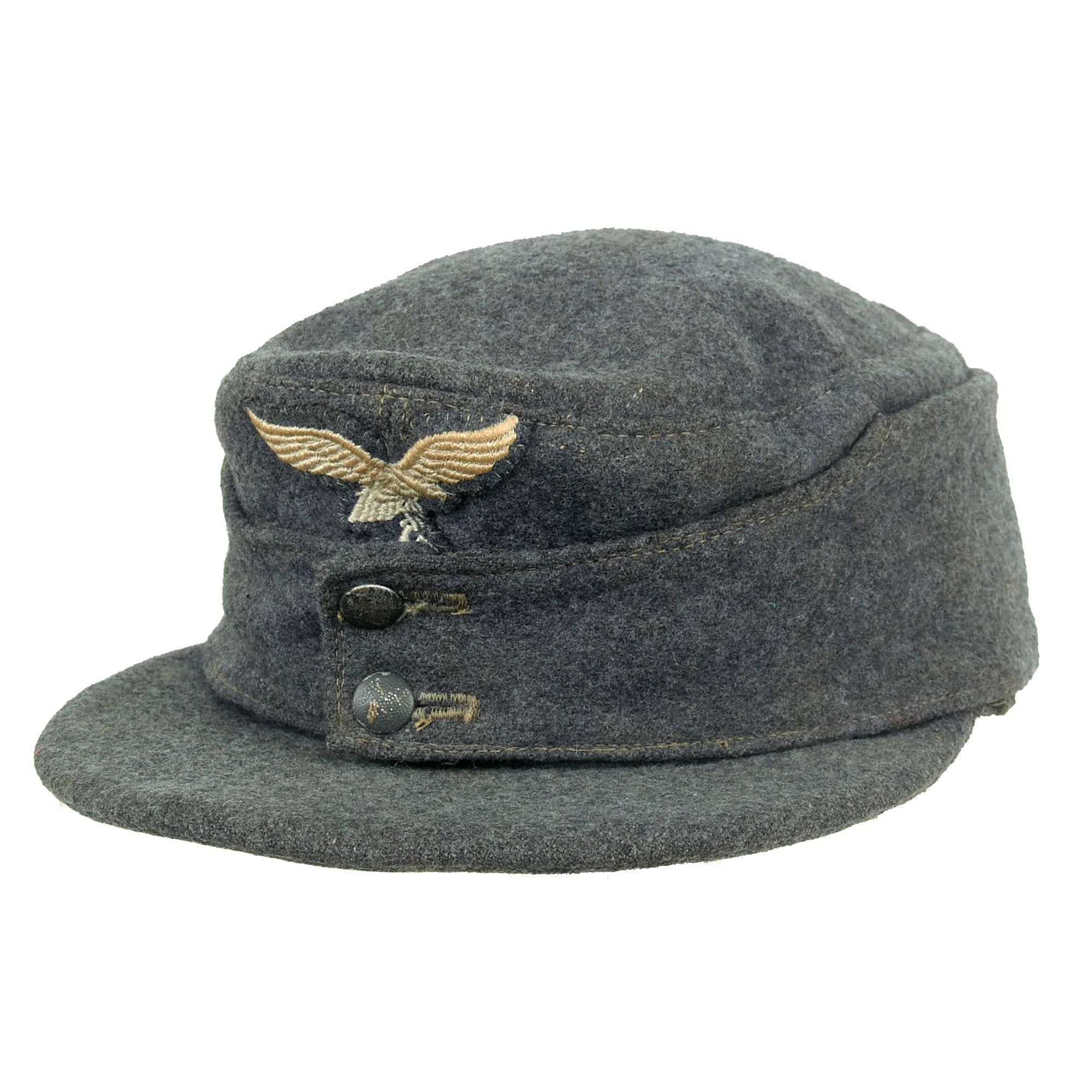
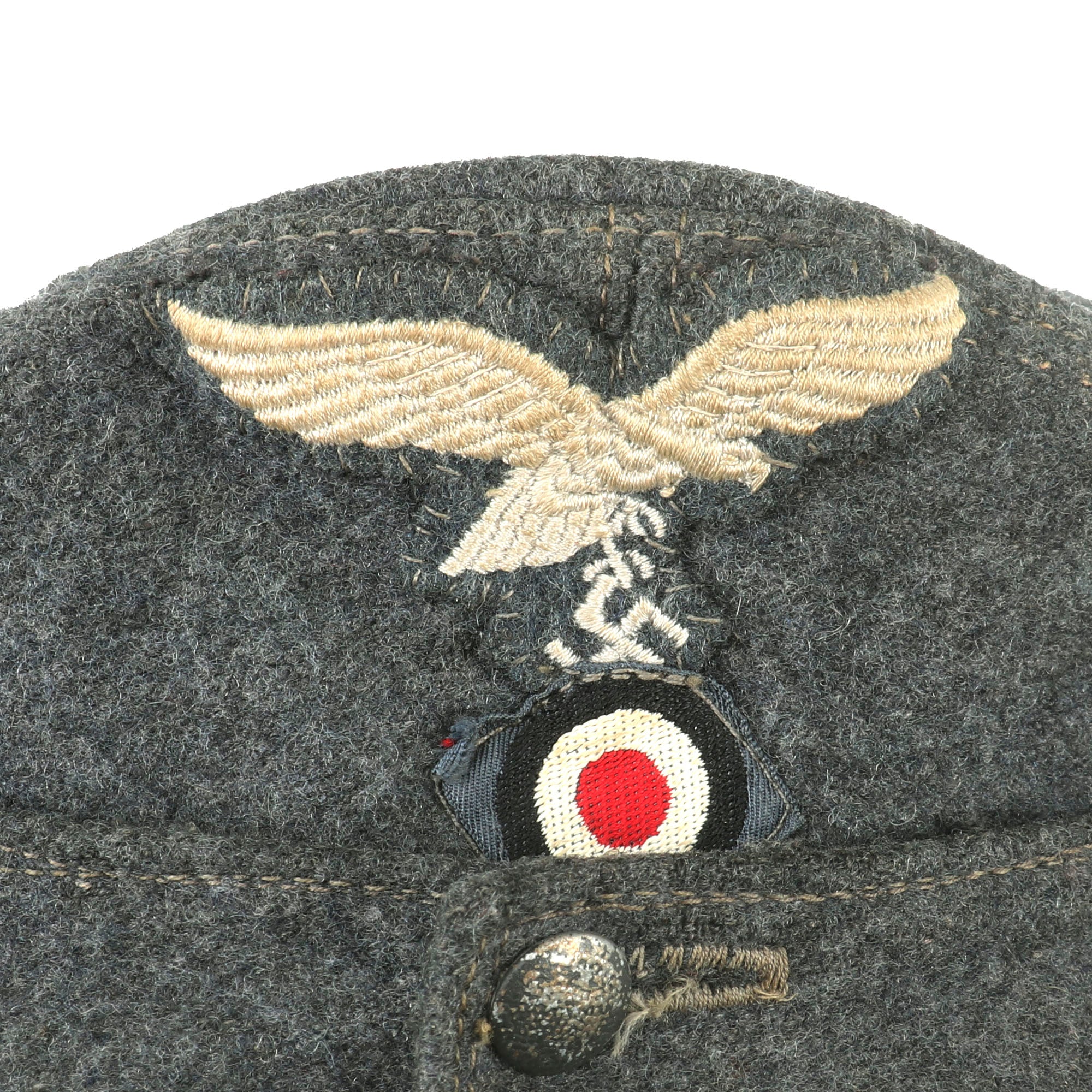
This example is an excellent quality, multi-panel, patch work, whitened sheepskin construction winter cap with the natural hide to the exterior and sheep’s wool to the interior. The front center of the cap has a second pattern, machine embroidered, Luftwaffe eagle in light grey threads on a cut-out Luftwaffe blue/grey wool base with a separate machine embroidered, padded national tri-color cockade situated just below eagle. These have however unfortunately suffered moth damage, resulting in virtually all of the wool base on the eagle being removed, which has also resulted in it partly detaching from the cap.
The cap features fold down side and back panels with the panels, held in position at the top of the cap by a thread loop and a corresponding button, which is still present on this example, unlike most we see. When the side and back panels are in the upright position the sheep’s wool is visible to the exterior. The back and side panels were designed to be folded down to protect the wearer’s ears and neck and the panels could be secured closed under the wearer’s chin as required with the button and either the fabric loop or eyelet in the left flap.
The fold down side panels each have a small circular cut-out with a corresponding, overlapping, horizontal, "U" shaped closure panel with a single, brown painted, sheet metal PRYM / 6 closure snap to each. The side panels also have an additional male snap enabling the horizontal, "U" shaped closure panels to be secured in the open position as required. The snaps are all present but show oxidation, so should be opened with care to avoid tearing the cap. The front inner seam of the cap has an original white makers tag, indicating it was made by BEROLINA of BERLIN in 1942, in size 56. As is usually seen, there is a bit of a crease in the middle of the brim, which happens when they are put into long term storage, however this is definitely better than most we see.
Overall condition is wonderful with light wear exhibited. Aside from the damage to the insignia, there is some flaking of the exterior lightweight hide, as well as a few small tears. A very nice example of a German WWII Eastern Front winter cap, ready to display!

Details & Craftsmanship
Every detail has been carefully considered to bring you the perfect product.

Details & Craftsmanship
Every detail has been carefully considered to bring you the perfect product.

Details & Craftsmanship
Every detail has been carefully considered to bring you the perfect product.

Details & Craftsmanship
Every detail has been carefully considered to bring you the perfect product.

Details & Craftsmanship
Every detail has been carefully considered to bring you the perfect product.

Details & Craftsmanship
Every detail has been carefully considered to bring you the perfect product.

Details & Craftsmanship
Every detail has been carefully considered to bring you the perfect product.

Details & Craftsmanship
Every detail has been carefully considered to bring you the perfect product.

Details & Craftsmanship
Every detail has been carefully considered to bring you the perfect product.

Details & Craftsmanship
Every detail has been carefully considered to bring you the perfect product.

Details & Craftsmanship
Every detail has been carefully considered to bring you the perfect product.

Details & Craftsmanship
Every detail has been carefully considered to bring you the perfect product.
Description
Original Item: Only One Available. The severe cold encountered on the Russian front in the winter of 1941-42 found the Germans completely unprepared not only in heat retaining cold weather garments but also snow camouflage garments. This resulted in numerous, hastily improvised and makeshift heat retaining and snow camouflage items being utilized including everything from civilian winter clothing to white bed sheets. After the winter of 1941/42 the Oberkommando des Wehrmacht (High Command of the Armed Forces) recognized the need for heavier winter clothing and testing began in the spring of 1942 to develop suitable garments.
In April 1942 AH approved the chosen design, and the first models were issued in the autumn of that year, included assorted winter Pelzmützen (fur caps). The caps were a standard issue item and were distributed to all EM/NCO’s for the winter season, (September 15TH to April 15TH), with other winter garments and were to be returned to the units storage depot at the end of the season for storage, repair and cleaning to be reissued the following September.
Originally Officers and senior NCO’s responsible for purchasing their own uniforms and headgear were required to purchase the new winter garments until regulations of December 1942 extended the issue winter clothing to all ranks in the colder theaters of operation. Although there was no official standard model of the fur cap the most commonly encountered type followed the basic pattern of the Mountain and M43 caps with fold down back and side panels designed to protect the wearer's ears and neck.
This example is an excellent quality, multi-panel, patch work, whitened sheepskin construction winter cap with the natural hide to the exterior and sheep’s wool to the interior. The front center of the cap has a second pattern, machine embroidered, Luftwaffe eagle in light grey threads on a cut-out Luftwaffe blue/grey wool base with a separate machine embroidered, padded national tri-color cockade situated just below eagle. These have however unfortunately suffered moth damage, resulting in virtually all of the wool base on the eagle being removed, which has also resulted in it partly detaching from the cap.
The cap features fold down side and back panels with the panels, held in position at the top of the cap by a thread loop and a corresponding button, which is still present on this example, unlike most we see. When the side and back panels are in the upright position the sheep’s wool is visible to the exterior. The back and side panels were designed to be folded down to protect the wearer’s ears and neck and the panels could be secured closed under the wearer’s chin as required with the button and either the fabric loop or eyelet in the left flap.
The fold down side panels each have a small circular cut-out with a corresponding, overlapping, horizontal, "U" shaped closure panel with a single, brown painted, sheet metal PRYM / 6 closure snap to each. The side panels also have an additional male snap enabling the horizontal, "U" shaped closure panels to be secured in the open position as required. The snaps are all present but show oxidation, so should be opened with care to avoid tearing the cap. The front inner seam of the cap has an original white makers tag, indicating it was made by BEROLINA of BERLIN in 1942, in size 56. As is usually seen, there is a bit of a crease in the middle of the brim, which happens when they are put into long term storage, however this is definitely better than most we see.
Overall condition is wonderful with light wear exhibited. Aside from the damage to the insignia, there is some flaking of the exterior lightweight hide, as well as a few small tears. A very nice example of a German WWII Eastern Front winter cap, ready to display!