
The Story
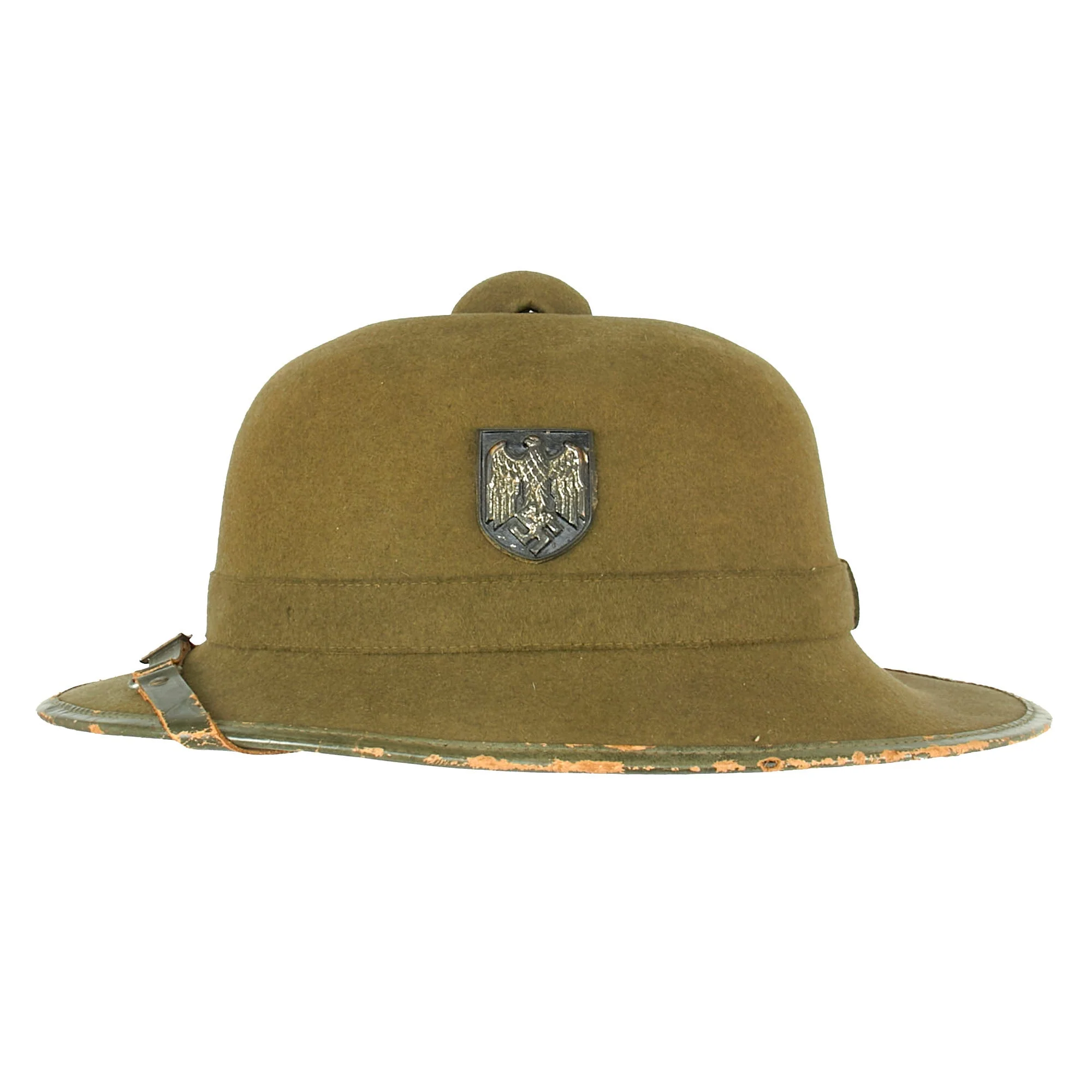
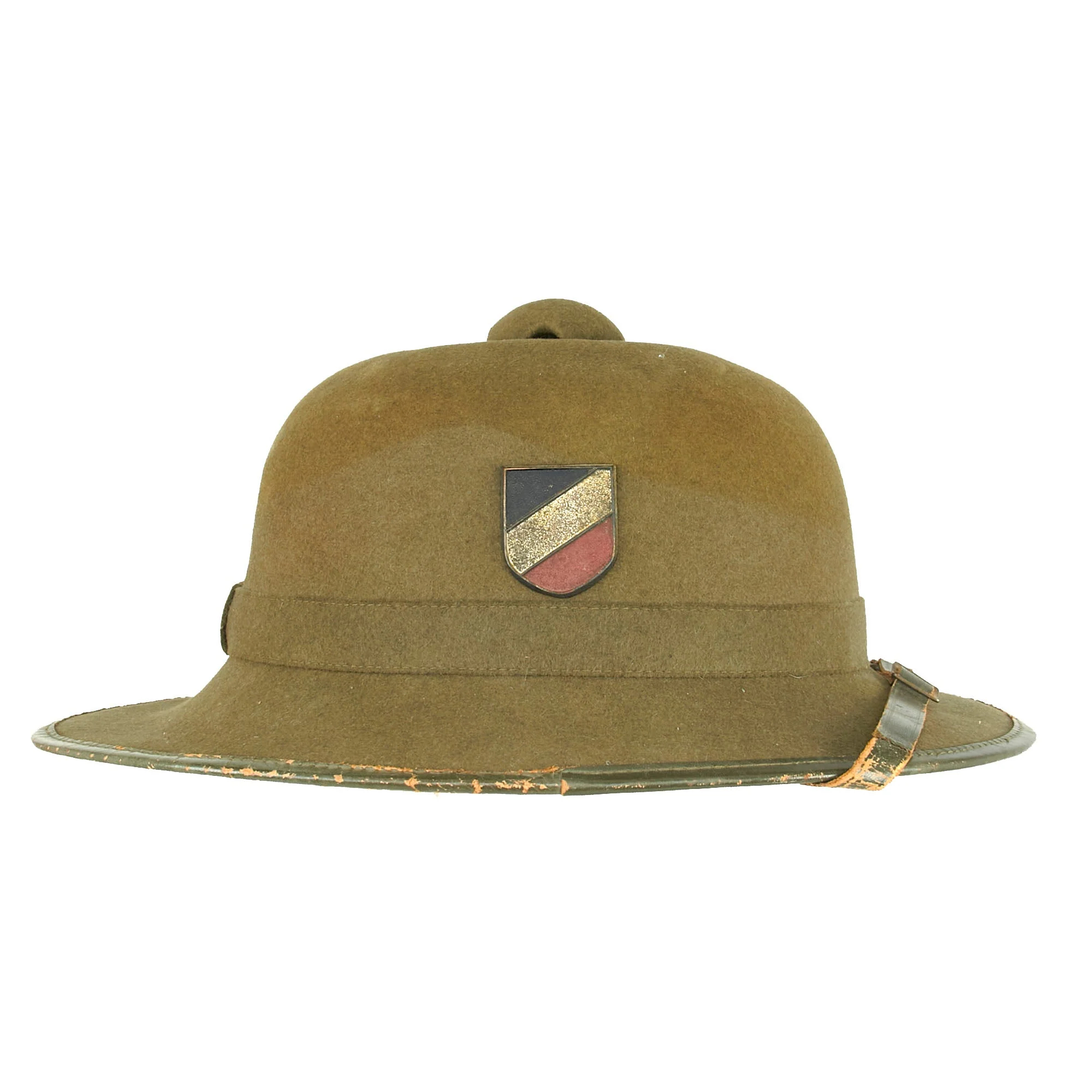
Original Item: Only One Available. This is a fantastic all original example of a Model 1935 German WWII helmet as issued to the Heer (Army), with a great service worn look. It was originally equipped with very desirable "Double Decals", with a Heer Eagle Decal on the left side and a "National Colors" on the right. The use of the second decal was discontinued in 1940, and in 1943 it was ordered that helmets with the national colors have them removed. The decal on this helmet however escaped that fate, so it still has both decals.
However, it was then overpainted with a lovely period applied tan, brown, and green camouflage paint job, which is the very desirable "Normandy Pattern"! This was most likely applied over the original worn panzergrau (armor gray) paint, and period wear has given it a great patinated look that is simply impossible to duplicate! It is also possible that the helmet was originally Apfelgrün (apple green), which was then repainted sometime during the early war period, before the camouflage was applied. This helmet then had the camouflage paint cleaned away from on top of the decals in order to properly identify it, while the rest of the camouflage was left intact. Definitely a great helmet with some fantastic display potential!
The reverse, interior, neck guard apron is batch number stamped 3332, and the interior, left side, apron has a stamped manufacturer's code and size, Q66. The markings are a bit hard to read due to the repaint, and indicate it was manufactured by F.W. Quist G.m.b.H in Esslingen, Germany in size 66. This is a nice large size that can accommodate size 58cm and 59cm liners, or 7 1/4 - 7 3/8 US. Shells of this large size are harder to find, and more valuable to a collector.
All three liner retaining pins are intact, with much of their original camouflage paint as well. The interior of the helmet still has an original M31 leather liner with all eight fingers still present and mostly intact, as well as an original top tie. These were made from long pieces of leather with the fingers already added, which is why there is a ninth partial finger at the very rear. The leather has a lovely color and worn look, so this is definitely a liner that saw real use in the field. The liner band is aluminum, with square aluminum chin strap loops attached to single ply sides. This is the earliest pattern seen in the war, and would later be have reinforcements added to the sides to prevent the soft aluminum from bending. The left side exterior of the galvanized steel liner band is marked 66 n.A / 59, indicating that it is a size 59 liner for a size 66 shell. The right side displays the full manufacture information, as well as a date:
D. R. P.
SCHUBERTH-WERK
K.-G.
Braunschweig
1937
This is a VERY early production liner and helmet, made with plenty of time to have seen service in multiple campaigns during the war. The attached chinstrap is a late war type with steel hardware, and it still retains all thirteen adjustment holes. The leather definitely does show stretching and wear, and is in a bit delicate condition. It is marked on the end with gfg / 1943, for 1943 manufacture by Carl Hepting & Co., located in Stuttgart-Feuerbach. This is a known maker of P.08 and other service pistol holsters, as well as ammunition pouches and other leather goods, according to GERMAN MILITARY LETTER CODES 1939-1945 by John Walter.
Overall a stunning Normandy Camouflage Heer M35 Double Decal Helmet offered in fantastic condition! Completely honest and with no signs of being messed with! We do not get helmets like these very often at all, and it is sure to appreciate in value in the coming years. Ready to display!
German WWII "Normandy" Camouflage:
Some of the most unique German helmets of WWII were worn during the Battle for Normandy. The terrain of thick green hedgerows, rolling green meadows, golden fields and orchards created diverse but deadly battlefields; one that necessitated good helmet camouflage for survival. To help their helmets blend into this environment, German soldiers at Normandy used a wide range of paint, wire, cloth covers and other devices to this end. These men were often hardened, experienced combat veteran with experience in campaigns in Poland, France, Africa and the USSR. They knew from experience what worked and what didn’t, and the helmet they wore during the Normandy campaign reflected that.
One effective, although more permanent method of concealing the helmet was the use of camouflage paint. It is up to some debate exactly when this method began among German soldiers but by the time of the Normandy campaign it was widespread. In mid 1943 the German high command ordered that a three color camouflaged scheme of tan, green and brown be used in the painting of vehicles and other equipment. These same paints were used to camouflage helmets as well. While the high command did order specific color codes be used for consistency, the hues of tan, green, and brown can vary on original examples significantly. The mix of these tan, green, and brown colors were used by German troops at Normandy with such frequency that today collectors call almost any German helmet with a mix of these three colors “Normandy Camo”.
It should be clear that while the use of these three colors for camouflaging helmets was common, there was never a directive from the German military high command to paint helmets in this manor. No officially sanctioned “Normandy camo” existed. The collector term, Normandy camo can still be justified to a large degree. Photos from the battle as well as surviving original example with Normandy providence would indicate this particular camo pattern was a favorite of Germans during the campaign. The mix of the three colors was certainly a good choice for Normandy as the countryside does exhibit those same colors. That being said with much of Western Europe’s terrain looking so similar this same pattern would see action in other battles as well.
The camouflage paints used at Normandy do not confine themselves to distinct hues of tan, brown and green. Some helmets were painted with two colors or just one and sometimes with non-standard military paints that were probably locally sourced. Further complicating the matter, captured British, Soviet, French and Italian paints were all used to camouflage helmets at Normandy. The hue of these colors often deviate from the standard German military colors. The German soldiers who camouflaged their helmets were well aware of their surroundings and certainly were aware of what colors and patterns would blend into the terrain they would soon be fighting in. It is logical they would have chosen colored paint based the local area which would account for the variation.
The German Stahlhelm Steel Helmet
The first "modern" steel helmets were introduced by the French army in early 1915 and were shortly followed by the British army later that year. With plans on the drawing board, experimental helmets in the field, ("Gaede" helmet), and some captured French and British helmets the German army began tests for their own steel helmet at the Kummersdorf Proving Grounds in November, and in the field in December 1915. An acceptable pattern was developed and approved and production began at Eisen-und Hüttenwerke, AG Thale/Harz, (Iron and Foundry Works), in the spring of 1916.
These first modern M16 helmets evolved into the M18 helmets by the end of WWI. The M16 and M18 helmets remained in usage through-out the Weimar Reichswehr, (National Defence Force, Circa 1919-1933), era and on into the early years of the Third Reich until the development of the smaller, lighter M35 style helmet in June 1935.
The Luftwaffe pattern national eagle was originally introduced for wear by Fliegerschaft, (Pilot Base), personnel of the DLV, Deutscher Luftsportsverband, (German Air Sports Association), the clandestine, civilian, forerunner of the Luftwaffe on August 18TH 1934, and adopted for wear by the Luftwaffe on March 1ST 1935 along with the national tri-color shield for wear on the helmet.
The first pattern national eagle was utilized until a modified second pattern eagle was introduced in late 1936 or early 1937. Regulations of June 12TH 1940 discontinued the use of the national tri-color decal and further regulations of August 28TH 1943 abolished the national eagle decal and dictated that it was also to be removed from all helmets although the directives were not completely adhered to.

Details & Craftsmanship
Every detail has been carefully considered to bring you the perfect product.

Details & Craftsmanship
Every detail has been carefully considered to bring you the perfect product.

Details & Craftsmanship
Every detail has been carefully considered to bring you the perfect product.

Details & Craftsmanship
Every detail has been carefully considered to bring you the perfect product.

Details & Craftsmanship
Every detail has been carefully considered to bring you the perfect product.

Details & Craftsmanship
Every detail has been carefully considered to bring you the perfect product.

Details & Craftsmanship
Every detail has been carefully considered to bring you the perfect product.

Details & Craftsmanship
Every detail has been carefully considered to bring you the perfect product.

Details & Craftsmanship
Every detail has been carefully considered to bring you the perfect product.

Details & Craftsmanship
Every detail has been carefully considered to bring you the perfect product.

Details & Craftsmanship
Every detail has been carefully considered to bring you the perfect product.

Details & Craftsmanship
Every detail has been carefully considered to bring you the perfect product.

Details & Craftsmanship
Every detail has been carefully considered to bring you the perfect product.

Details & Craftsmanship
Every detail has been carefully considered to bring you the perfect product.

Details & Craftsmanship
Every detail has been carefully considered to bring you the perfect product.
Description
Original Item: Only One Available. This is a fantastic all original example of a Model 1935 German WWII helmet as issued to the Heer (Army), with a great service worn look. It was originally equipped with very desirable "Double Decals", with a Heer Eagle Decal on the left side and a "National Colors" on the right. The use of the second decal was discontinued in 1940, and in 1943 it was ordered that helmets with the national colors have them removed. The decal on this helmet however escaped that fate, so it still has both decals.
However, it was then overpainted with a lovely period applied tan, brown, and green camouflage paint job, which is the very desirable "Normandy Pattern"! This was most likely applied over the original worn panzergrau (armor gray) paint, and period wear has given it a great patinated look that is simply impossible to duplicate! It is also possible that the helmet was originally Apfelgrün (apple green), which was then repainted sometime during the early war period, before the camouflage was applied. This helmet then had the camouflage paint cleaned away from on top of the decals in order to properly identify it, while the rest of the camouflage was left intact. Definitely a great helmet with some fantastic display potential!
The reverse, interior, neck guard apron is batch number stamped 3332, and the interior, left side, apron has a stamped manufacturer's code and size, Q66. The markings are a bit hard to read due to the repaint, and indicate it was manufactured by F.W. Quist G.m.b.H in Esslingen, Germany in size 66. This is a nice large size that can accommodate size 58cm and 59cm liners, or 7 1/4 - 7 3/8 US. Shells of this large size are harder to find, and more valuable to a collector.
All three liner retaining pins are intact, with much of their original camouflage paint as well. The interior of the helmet still has an original M31 leather liner with all eight fingers still present and mostly intact, as well as an original top tie. These were made from long pieces of leather with the fingers already added, which is why there is a ninth partial finger at the very rear. The leather has a lovely color and worn look, so this is definitely a liner that saw real use in the field. The liner band is aluminum, with square aluminum chin strap loops attached to single ply sides. This is the earliest pattern seen in the war, and would later be have reinforcements added to the sides to prevent the soft aluminum from bending. The left side exterior of the galvanized steel liner band is marked 66 n.A / 59, indicating that it is a size 59 liner for a size 66 shell. The right side displays the full manufacture information, as well as a date:
D. R. P.
SCHUBERTH-WERK
K.-G.
Braunschweig
1937
This is a VERY early production liner and helmet, made with plenty of time to have seen service in multiple campaigns during the war. The attached chinstrap is a late war type with steel hardware, and it still retains all thirteen adjustment holes. The leather definitely does show stretching and wear, and is in a bit delicate condition. It is marked on the end with gfg / 1943, for 1943 manufacture by Carl Hepting & Co., located in Stuttgart-Feuerbach. This is a known maker of P.08 and other service pistol holsters, as well as ammunition pouches and other leather goods, according to GERMAN MILITARY LETTER CODES 1939-1945 by John Walter.
Overall a stunning Normandy Camouflage Heer M35 Double Decal Helmet offered in fantastic condition! Completely honest and with no signs of being messed with! We do not get helmets like these very often at all, and it is sure to appreciate in value in the coming years. Ready to display!
German WWII "Normandy" Camouflage:
Some of the most unique German helmets of WWII were worn during the Battle for Normandy. The terrain of thick green hedgerows, rolling green meadows, golden fields and orchards created diverse but deadly battlefields; one that necessitated good helmet camouflage for survival. To help their helmets blend into this environment, German soldiers at Normandy used a wide range of paint, wire, cloth covers and other devices to this end. These men were often hardened, experienced combat veteran with experience in campaigns in Poland, France, Africa and the USSR. They knew from experience what worked and what didn’t, and the helmet they wore during the Normandy campaign reflected that.
One effective, although more permanent method of concealing the helmet was the use of camouflage paint. It is up to some debate exactly when this method began among German soldiers but by the time of the Normandy campaign it was widespread. In mid 1943 the German high command ordered that a three color camouflaged scheme of tan, green and brown be used in the painting of vehicles and other equipment. These same paints were used to camouflage helmets as well. While the high command did order specific color codes be used for consistency, the hues of tan, green, and brown can vary on original examples significantly. The mix of these tan, green, and brown colors were used by German troops at Normandy with such frequency that today collectors call almost any German helmet with a mix of these three colors “Normandy Camo”.
It should be clear that while the use of these three colors for camouflaging helmets was common, there was never a directive from the German military high command to paint helmets in this manor. No officially sanctioned “Normandy camo” existed. The collector term, Normandy camo can still be justified to a large degree. Photos from the battle as well as surviving original example with Normandy providence would indicate this particular camo pattern was a favorite of Germans during the campaign. The mix of the three colors was certainly a good choice for Normandy as the countryside does exhibit those same colors. That being said with much of Western Europe’s terrain looking so similar this same pattern would see action in other battles as well.
The camouflage paints used at Normandy do not confine themselves to distinct hues of tan, brown and green. Some helmets were painted with two colors or just one and sometimes with non-standard military paints that were probably locally sourced. Further complicating the matter, captured British, Soviet, French and Italian paints were all used to camouflage helmets at Normandy. The hue of these colors often deviate from the standard German military colors. The German soldiers who camouflaged their helmets were well aware of their surroundings and certainly were aware of what colors and patterns would blend into the terrain they would soon be fighting in. It is logical they would have chosen colored paint based the local area which would account for the variation.
The German Stahlhelm Steel Helmet
The first "modern" steel helmets were introduced by the French army in early 1915 and were shortly followed by the British army later that year. With plans on the drawing board, experimental helmets in the field, ("Gaede" helmet), and some captured French and British helmets the German army began tests for their own steel helmet at the Kummersdorf Proving Grounds in November, and in the field in December 1915. An acceptable pattern was developed and approved and production began at Eisen-und Hüttenwerke, AG Thale/Harz, (Iron and Foundry Works), in the spring of 1916.
These first modern M16 helmets evolved into the M18 helmets by the end of WWI. The M16 and M18 helmets remained in usage through-out the Weimar Reichswehr, (National Defence Force, Circa 1919-1933), era and on into the early years of the Third Reich until the development of the smaller, lighter M35 style helmet in June 1935.
The Luftwaffe pattern national eagle was originally introduced for wear by Fliegerschaft, (Pilot Base), personnel of the DLV, Deutscher Luftsportsverband, (German Air Sports Association), the clandestine, civilian, forerunner of the Luftwaffe on August 18TH 1934, and adopted for wear by the Luftwaffe on March 1ST 1935 along with the national tri-color shield for wear on the helmet.
The first pattern national eagle was utilized until a modified second pattern eagle was introduced in late 1936 or early 1937. Regulations of June 12TH 1940 discontinued the use of the national tri-color decal and further regulations of August 28TH 1943 abolished the national eagle decal and dictated that it was also to be removed from all helmets although the directives were not completely adhered to.