
The Story
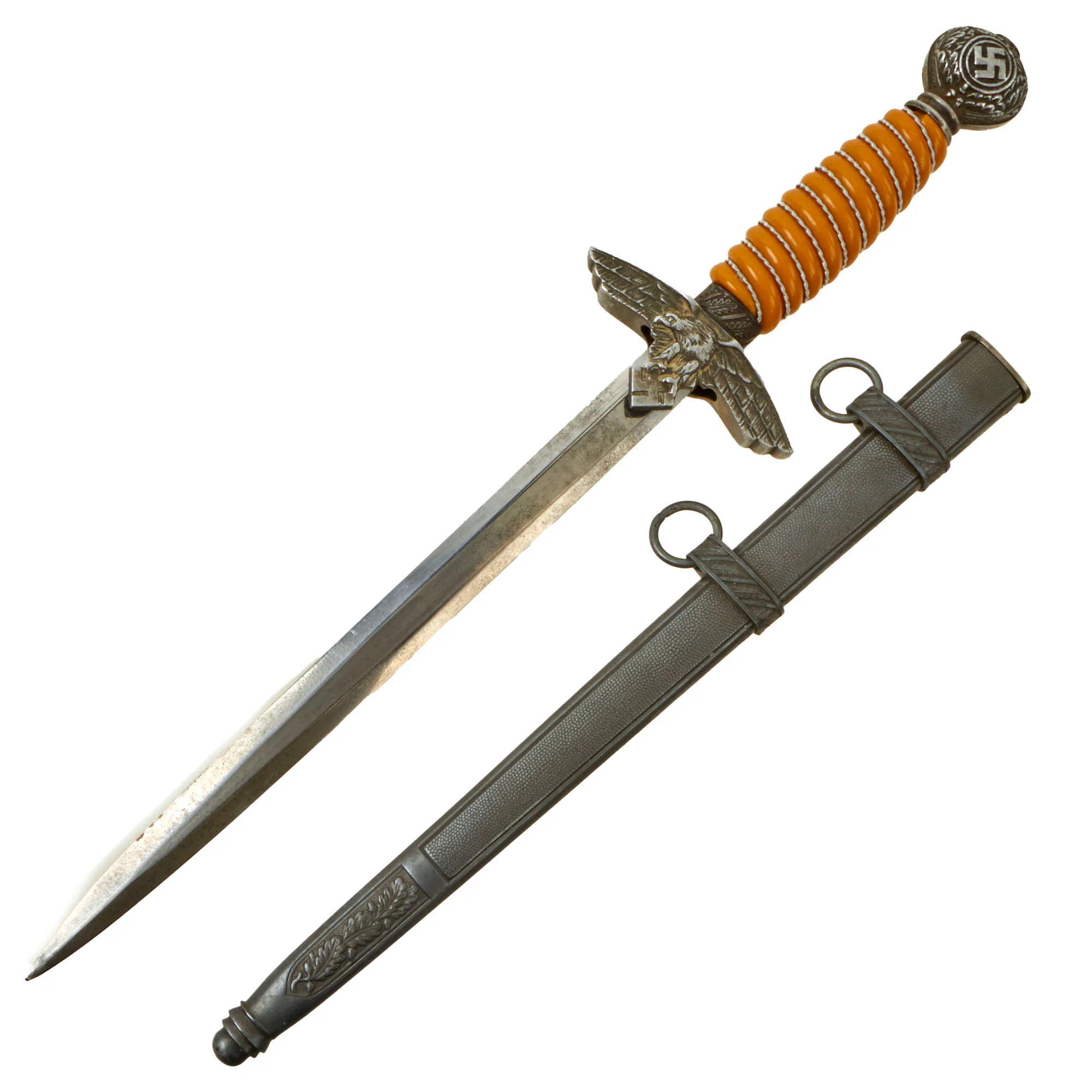
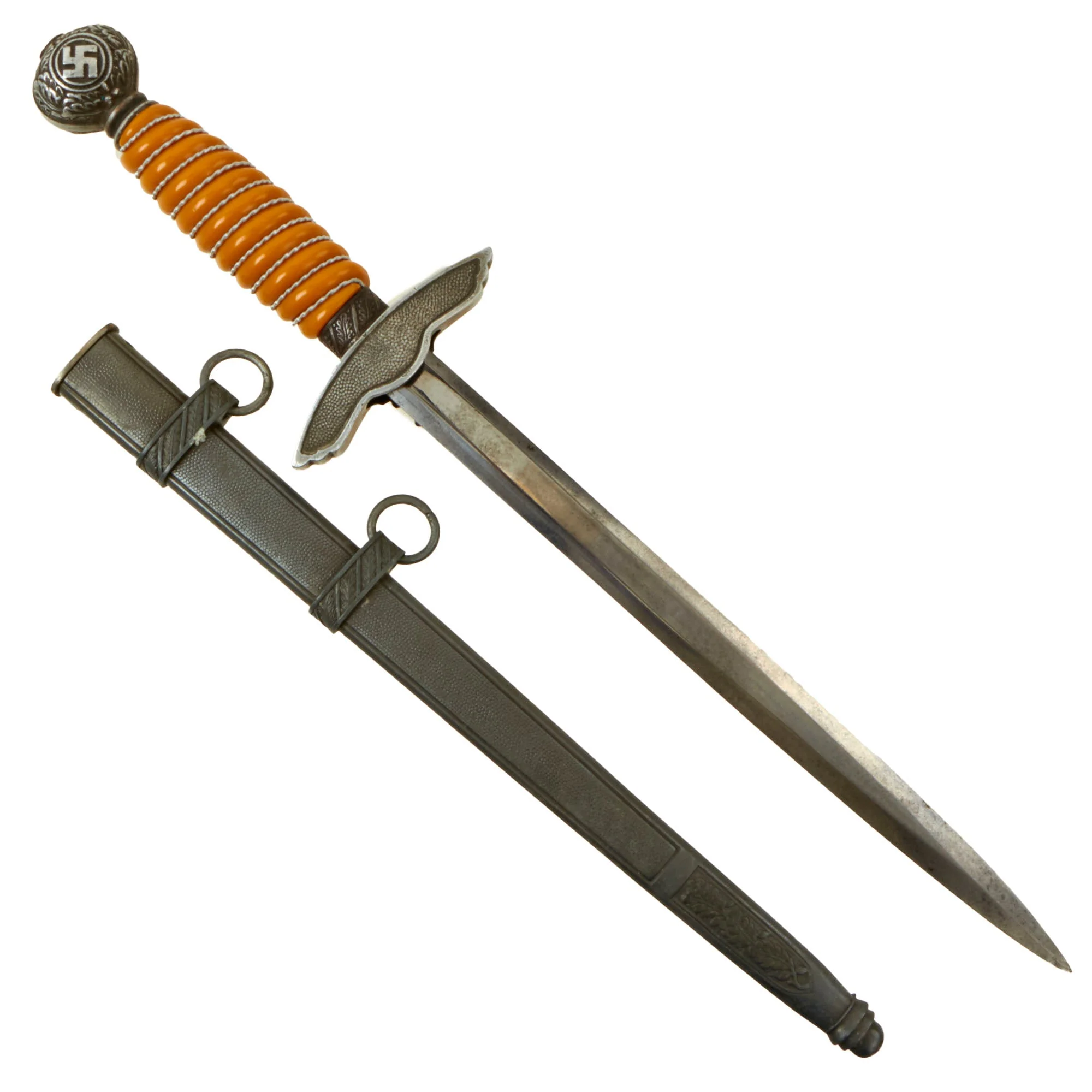
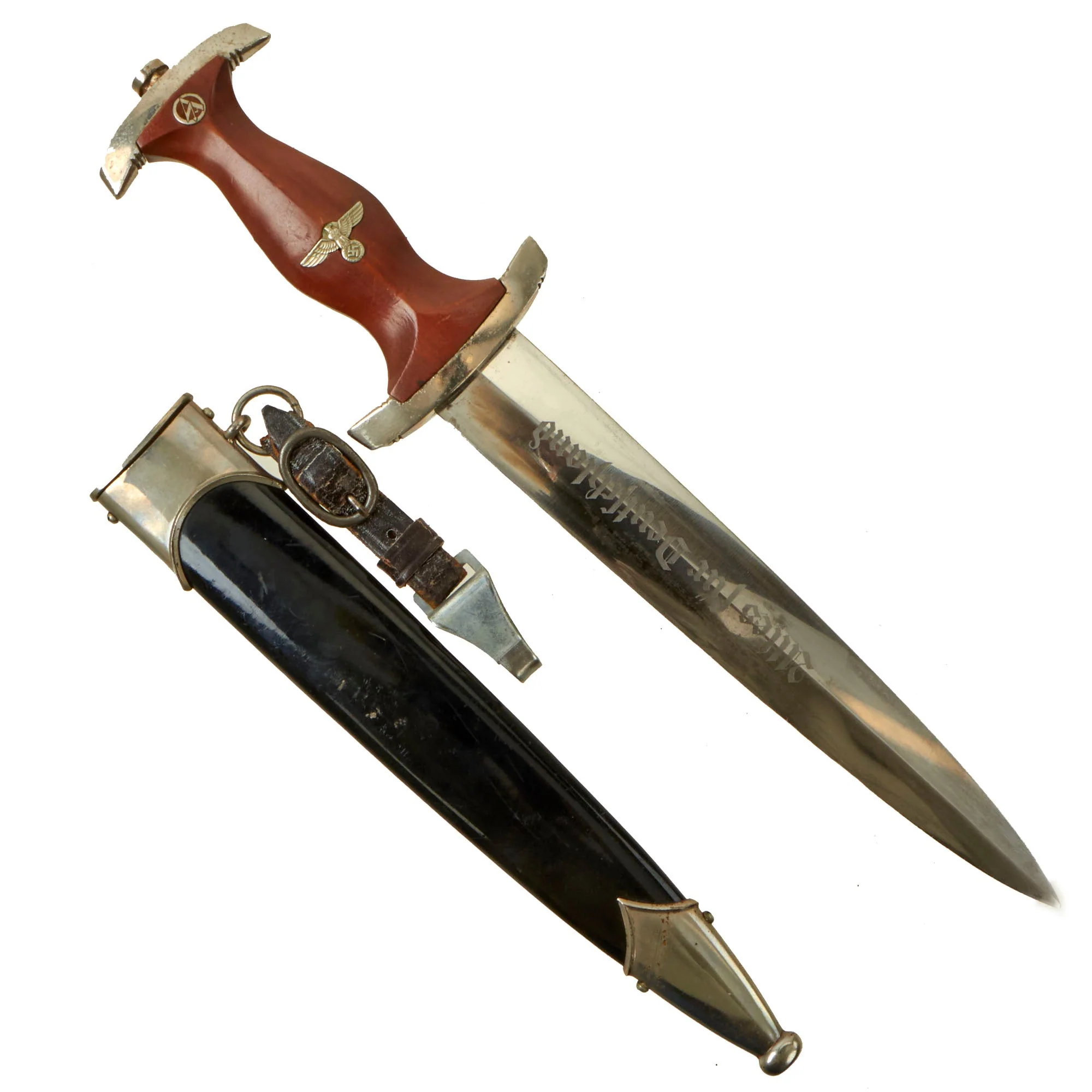
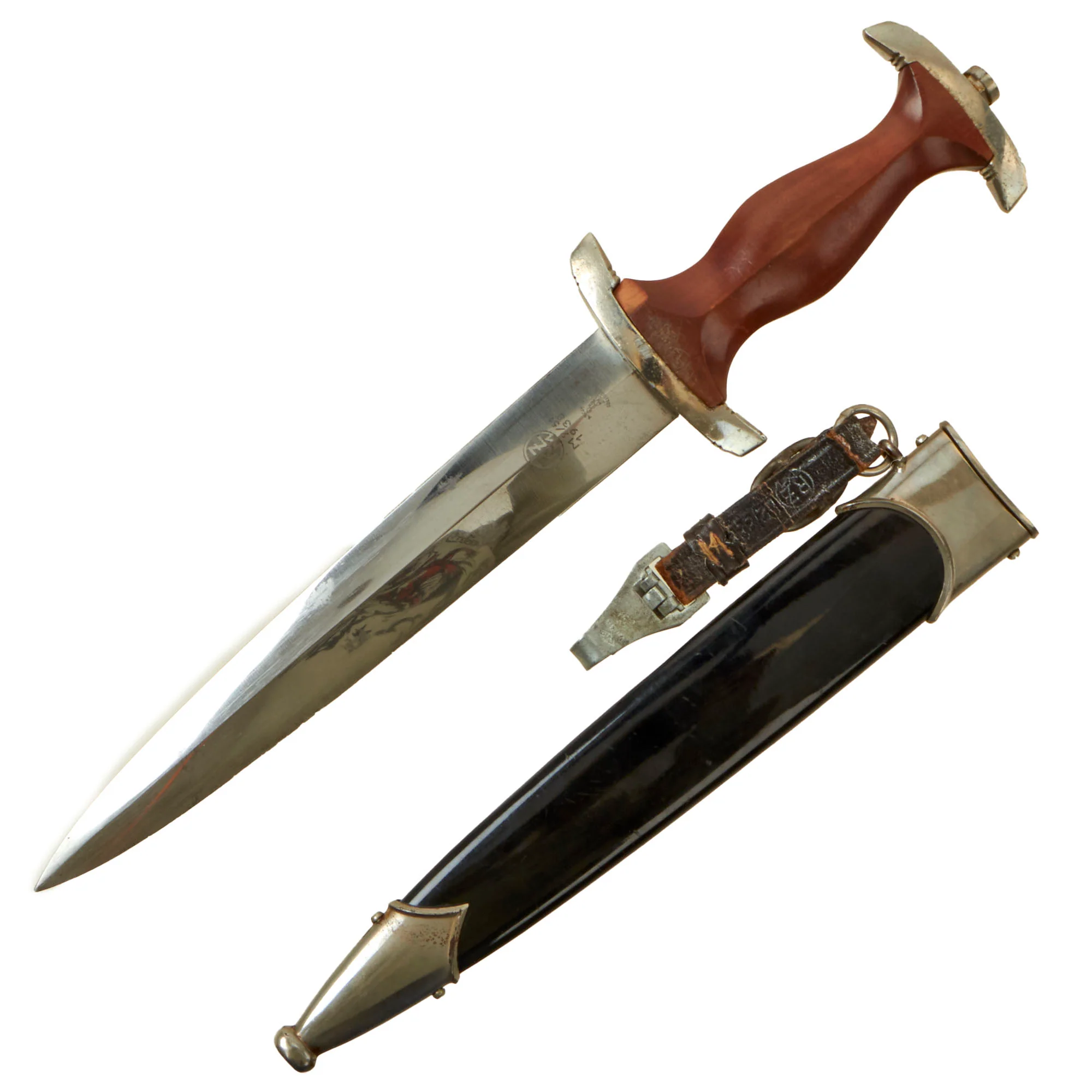
Original Item: Only One Available. This Army Dove Head Sword is a lovely example, with a long nickel plated blade and black enameled scabbard. The blade is unmarked, but the shape of the fittings definitely attributes this sword to Emil Voos of Solingen, who was known to have produced unmarked examples. Many identical design Dove's head with large langets and this eagle style have been attributed to Emil Voos of Solingen. Please see page 126 of SWORDS OF GERMANY 1900-1945 by John R. Angolia regarding the "Emil Voos" pattern of officer swords. We were able to locate a photograph from the July, 1938 Solingen Edged Weapons Industry publication “Die Klinge” that illustrates this exact model.
We previously had an example with identical fittings, however it had a custom etched blade by WKC, which can be viewed here: Emil Voos Style Sword with WKC Etched Blade. We assume that in this prior example Emil Voos supplied the fittings, which was common practice in Solingen during the war. An outfitter could have ordered from multiple sources if the customer desired. Emil Voos, Waffenfabrik, also known as a Spezialfabrik für Jagd- und Sportmesser (Special Factory for Hunting and Sporting Knives), was a Solingen-based knife maker founded in 1925. The "Serpent-and-Stump" logo next to the name and location was used on most military and police swords such as this the WWII period, per J. Anthony Carter's work GERMAN KNIFE AND SWORD MAKERS.
This piece is also a real treasure as it is not constructed from the later war aluminum, but rather is made of solid brass. It really looks magnificent, retaining much of the finely gilded finish, which has matured beautifully. The dove head and backstrap are embossed with very decorative plant and floral designs, and looks to have involved a large amount of hand enhancement and engraving. We really haven't seen this type of pattern before on one of these swords. The "flat" P guard has the classic German oak leaves and acorns motif, with a closed wing Wehrmachtadler Eagle in the center. The ferrule looks to have a laurel or beech leaf motif on it. There are lots of hand enhancing and many of the backgrounds have received pebbled decoration. The chappe/langet features a raised out Emil Voos style "open wing" National eagle, which shows excellent detail to his beak, eye, breast feathering, wing feathering, talons and mobile clutched swas. The other side is a blank shield and would often be used for the officer to add a monogram, however this example is still blank.
The grip of this example is a black celluloid over a carved wood base. The celluloid is still in very good condition, showing just a bit of degradation, and a small chip and crack at the very bottom. The grip is wrapped with a skein of 4 brass wires, with the center pair twisted together, and all still line up with the grooves correctly. The hilt and guard are still firmly attached to the tang of the blade, with no wobble we can detect.
The nickel plated blade is 36 1/4" inches long, with the original leather blade washer still present. This is definitely longer than most examples we can see, and the plating is relatively well retained. There is some bubbling and oxidation along the edge, as well as scattered throughout the blade. Sighting down the blade also shows that there are definitely some bends to the blade, which is not easy to do. The tip is still unbent, so we assume the blade was mishandled at some point.
The steel scabbard is in very good shape, showing a bit of a bend to the body, which does not interfere with sheathing the blade.The black enamel paint of this scabbard is mostly complete, but shows a lot of checking and crazing, which has caused the finish to flake off in places. This has exposed the steel of the scabbard, so there is some oxidation in places, giving it a fantastic "aged" look, which is simply impossible to duplicate. The hanger ring and loop are still intact, and have lost most of the finish, and one of the two throat retaining screws is missing.
Overall a very interesting example of an Emil Voos pattern German Army Officer Dove Head, complete with scabbard. Ready to research and display!
Specifications:
Blade Length: 36 1/4"
Blade Style: Single Edge w/ Fuller
Overall length: 40“
Guard dimensions: 5" width x 5” length
Scabbard length: 40”
The German Army (German: Heer, was the land forces component of the Wehrmacht, the German armed forces, from 1935 to 1945. The Wehrmacht also included the Kriegsmarine (Navy) and the Luftwaffe (Air Force). During World War II, a total of about 15 million soldiers served in the German Army, of whom about seven million became casualties. Separate from the army, the Waffen-SS (Armed SS) was a multi-ethnic and multi-national military force of the Third Reich. Growing from three regiments to over 38 divisions during World War II, it served alongside the army but was never formally part of it.
Only 17 months after AH announced publicly the rearmament program, the Army reached its projected goal of 36 divisions. During the autumn of 1937, two more corps were formed. In 1938, four additional corps were formed with the inclusion of the five divisions of the Austrian Army after the Anschluss in March. During the period of its expansion by Adolf AH, the German Army continued to develop concepts pioneered during World War I, combining ground (Heer) and air (Luftwaffe) assets into combined arms teams. Coupled with operational and tactical methods such as encirclements and the "battle of annihilation", the German military managed quick victories in the two initial years of World War II, prompting the use of the word Blitzkrieg (literally lightning war, meaning lightning-fast war) for the techniques used.
The German Army entered the war with a majority of its infantry formations relying on the horse for transportation. The infantry remained foot soldiers throughout the war; artillery also remained primarily horse-drawn. The motorized formations received much attention in the world press in the opening years of the war, and were cited as the main reason for the success of the German invasions of Poland (September 1939), Norway and Denmark (April 1940), Belgium, France and Netherlands (May 1940), Yugoslavia (April 1941) and the early campaigns in the Soviet Union (June 1941). However their motorized and tank formations accounted for only 20% of the Heer's capacity at their peak strength.

Details & Craftsmanship
Every detail has been carefully considered to bring you the perfect product.

Details & Craftsmanship
Every detail has been carefully considered to bring you the perfect product.

Details & Craftsmanship
Every detail has been carefully considered to bring you the perfect product.

Details & Craftsmanship
Every detail has been carefully considered to bring you the perfect product.

Details & Craftsmanship
Every detail has been carefully considered to bring you the perfect product.

Details & Craftsmanship
Every detail has been carefully considered to bring you the perfect product.

Details & Craftsmanship
Every detail has been carefully considered to bring you the perfect product.

Details & Craftsmanship
Every detail has been carefully considered to bring you the perfect product.

Details & Craftsmanship
Every detail has been carefully considered to bring you the perfect product.

Details & Craftsmanship
Every detail has been carefully considered to bring you the perfect product.

Details & Craftsmanship
Every detail has been carefully considered to bring you the perfect product.

Details & Craftsmanship
Every detail has been carefully considered to bring you the perfect product.

Details & Craftsmanship
Every detail has been carefully considered to bring you the perfect product.

Details & Craftsmanship
Every detail has been carefully considered to bring you the perfect product.
Description
Original Item: Only One Available. This Army Dove Head Sword is a lovely example, with a long nickel plated blade and black enameled scabbard. The blade is unmarked, but the shape of the fittings definitely attributes this sword to Emil Voos of Solingen, who was known to have produced unmarked examples. Many identical design Dove's head with large langets and this eagle style have been attributed to Emil Voos of Solingen. Please see page 126 of SWORDS OF GERMANY 1900-1945 by John R. Angolia regarding the "Emil Voos" pattern of officer swords. We were able to locate a photograph from the July, 1938 Solingen Edged Weapons Industry publication “Die Klinge” that illustrates this exact model.
We previously had an example with identical fittings, however it had a custom etched blade by WKC, which can be viewed here: Emil Voos Style Sword with WKC Etched Blade. We assume that in this prior example Emil Voos supplied the fittings, which was common practice in Solingen during the war. An outfitter could have ordered from multiple sources if the customer desired. Emil Voos, Waffenfabrik, also known as a Spezialfabrik für Jagd- und Sportmesser (Special Factory for Hunting and Sporting Knives), was a Solingen-based knife maker founded in 1925. The "Serpent-and-Stump" logo next to the name and location was used on most military and police swords such as this the WWII period, per J. Anthony Carter's work GERMAN KNIFE AND SWORD MAKERS.
This piece is also a real treasure as it is not constructed from the later war aluminum, but rather is made of solid brass. It really looks magnificent, retaining much of the finely gilded finish, which has matured beautifully. The dove head and backstrap are embossed with very decorative plant and floral designs, and looks to have involved a large amount of hand enhancement and engraving. We really haven't seen this type of pattern before on one of these swords. The "flat" P guard has the classic German oak leaves and acorns motif, with a closed wing Wehrmachtadler Eagle in the center. The ferrule looks to have a laurel or beech leaf motif on it. There are lots of hand enhancing and many of the backgrounds have received pebbled decoration. The chappe/langet features a raised out Emil Voos style "open wing" National eagle, which shows excellent detail to his beak, eye, breast feathering, wing feathering, talons and mobile clutched swas. The other side is a blank shield and would often be used for the officer to add a monogram, however this example is still blank.
The grip of this example is a black celluloid over a carved wood base. The celluloid is still in very good condition, showing just a bit of degradation, and a small chip and crack at the very bottom. The grip is wrapped with a skein of 4 brass wires, with the center pair twisted together, and all still line up with the grooves correctly. The hilt and guard are still firmly attached to the tang of the blade, with no wobble we can detect.
The nickel plated blade is 36 1/4" inches long, with the original leather blade washer still present. This is definitely longer than most examples we can see, and the plating is relatively well retained. There is some bubbling and oxidation along the edge, as well as scattered throughout the blade. Sighting down the blade also shows that there are definitely some bends to the blade, which is not easy to do. The tip is still unbent, so we assume the blade was mishandled at some point.
The steel scabbard is in very good shape, showing a bit of a bend to the body, which does not interfere with sheathing the blade.The black enamel paint of this scabbard is mostly complete, but shows a lot of checking and crazing, which has caused the finish to flake off in places. This has exposed the steel of the scabbard, so there is some oxidation in places, giving it a fantastic "aged" look, which is simply impossible to duplicate. The hanger ring and loop are still intact, and have lost most of the finish, and one of the two throat retaining screws is missing.
Overall a very interesting example of an Emil Voos pattern German Army Officer Dove Head, complete with scabbard. Ready to research and display!
Specifications:
Blade Length: 36 1/4"
Blade Style: Single Edge w/ Fuller
Overall length: 40“
Guard dimensions: 5" width x 5” length
Scabbard length: 40”
The German Army (German: Heer, was the land forces component of the Wehrmacht, the German armed forces, from 1935 to 1945. The Wehrmacht also included the Kriegsmarine (Navy) and the Luftwaffe (Air Force). During World War II, a total of about 15 million soldiers served in the German Army, of whom about seven million became casualties. Separate from the army, the Waffen-SS (Armed SS) was a multi-ethnic and multi-national military force of the Third Reich. Growing from three regiments to over 38 divisions during World War II, it served alongside the army but was never formally part of it.
Only 17 months after AH announced publicly the rearmament program, the Army reached its projected goal of 36 divisions. During the autumn of 1937, two more corps were formed. In 1938, four additional corps were formed with the inclusion of the five divisions of the Austrian Army after the Anschluss in March. During the period of its expansion by Adolf AH, the German Army continued to develop concepts pioneered during World War I, combining ground (Heer) and air (Luftwaffe) assets into combined arms teams. Coupled with operational and tactical methods such as encirclements and the "battle of annihilation", the German military managed quick victories in the two initial years of World War II, prompting the use of the word Blitzkrieg (literally lightning war, meaning lightning-fast war) for the techniques used.
The German Army entered the war with a majority of its infantry formations relying on the horse for transportation. The infantry remained foot soldiers throughout the war; artillery also remained primarily horse-drawn. The motorized formations received much attention in the world press in the opening years of the war, and were cited as the main reason for the success of the German invasions of Poland (September 1939), Norway and Denmark (April 1940), Belgium, France and Netherlands (May 1940), Yugoslavia (April 1941) and the early campaigns in the Soviet Union (June 1941). However their motorized and tank formations accounted for only 20% of the Heer's capacity at their peak strength.