
The Story
Original Item: Only One Available. Austria-Hungary purchased about 416,000 German helmets from November 1916 until the end of the war, and also began its own licensed production starting in May 1917. Around a million Stahlhelm of all variants were issued until the end of the war. The Austrian M17 helmet was similar to the German M16 but was colored golden-brown (known as Isonzo-braun), had a cloth chinstrap and had the chinstrap rivet located higher up on the steel shell. From May 1917 till the end of World War I 534,013 were produced, many of which were manufactured at the Krupp plant in Berndorf, Lower Austria.
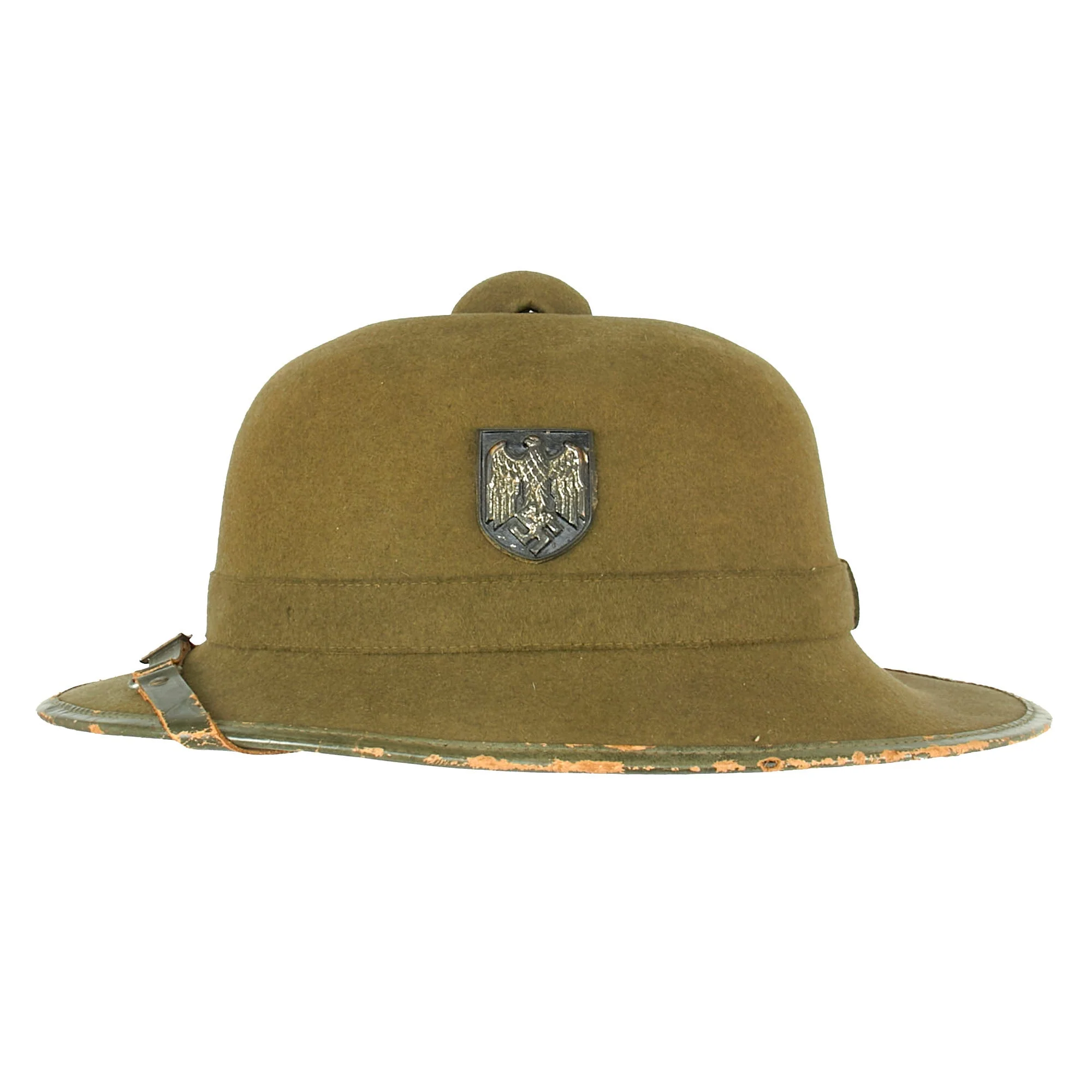
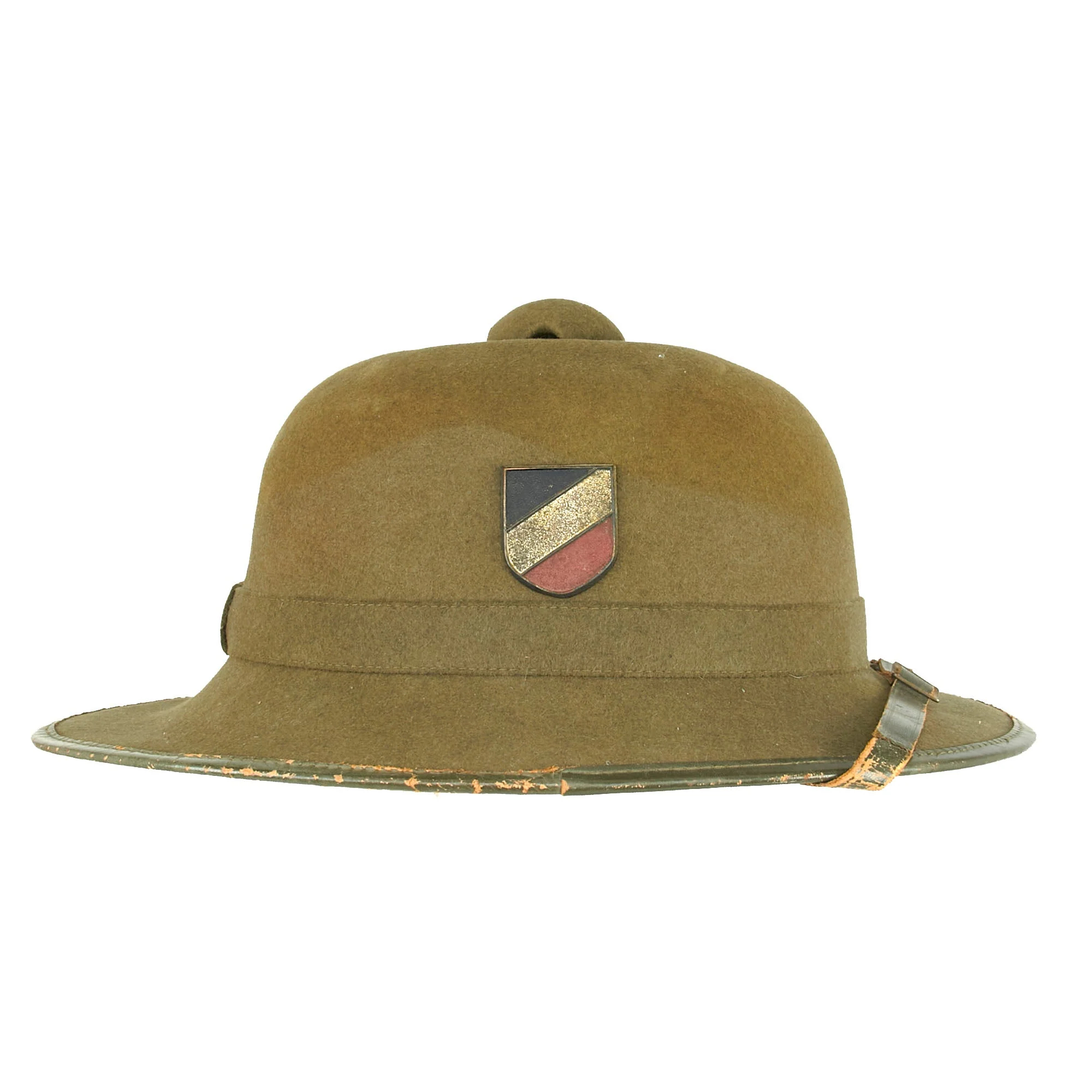
This is a lovely example of a WWI M17 Austro-Hungarian Helmet that was converted for use by the Third Reich, probably during in the 1930s before the issue of the M1935 helmet. The original "Isonzo braun" paint was removed, and then WWII early war "Apfel-grün" (Apple Green) paint was applied. The original chin strap attachment bales were removed, though the rivets were left in place. It also looks like it had the correct Heer Army "Double Decals" affixed when it was originally repainted, looking much like an early War M35 Helmet.
After that the helmet looks to have seen long service, and at some point the exterior was completely overpainted with a textured mid-war panzergrau (armor gray) finish, with a single Heer Army decal on the left side. The original early war liner was most likely swapped out at this point, and it was fitted with a new liner with a galvanized steel liner band. It saw additional service, and it also had holes added so that a twine helmet net could be affixed to the shell, which allowed for items to be attached to the helmet to increase the camouflage profile. The textured paint proved to be a lot less durable than the original repaint, and it has since worn, with the decal showing wear and partly cracking away. We also can see on the right side that the paint did not adhere well at all where the national colors decal was previously, so it may have not been fully removed before the repaint. Really a very interesting "transitional" helmet that saw service during two world wars!
We looked for markings on the inside and exterior of the shell, however due to how thick the second layer of paint is, we were not able to make out any identifying marks. As this is an Austrian M17 helmet, it is also possible that it never had any, as a significant number of manufacturers used ink stamps, which would have been removed during the original refinish. We measured around the exterior and got about 67cm, which means that this is a size 66 shell.
All three WWII type liner retaining pins are intact, with the panzergrau repaint adhered relatively well, though we can see some of the apple green where the paint has flaked. The interior of the helmet still has the original M31 liner with all eight "fingers" still intact and in very good condition. The leather has not aged very much, and is still soft and supple, showing the original natural leather color well. There is a bit of wear around the rim where it bends over the inner liner, but the leather is still solid, and there is a size 58 in a circle stamped on one of the rear fingers. The left exterior of the liner band is marked 66 n.A / 58, indicating that this is a size 58 liner for a size 66 shell, however we could not make out any markings on the right side except for "D.R.P", which would indicate a helmet by Schuberth-Werke K.-G.. Attached to the helmet is a very nice replica chinstrap with aluminum hardware, which looks to be several decades old now.
This is a lovely example of a WWII reissued Austrian M17 helmet with a long history, one of the few that we have been able to offer. Ready to fill a spot in your helmet collection!
The first "modern" steel helmets were introduced by the French army in early 1915 and were shortly followed by the British army later that year. With plans on the drawing board, experimental helmets in the field, ("Gaede" helmet), and some captured French and British helmets the German army began tests for their own steel helmet at the Kummersdorf Proving Grounds in November, and in the field in December 1915. An acceptable pattern was developed and approved and production began at Eisen-und Hüttenwerke, AG Thale/Harz, in the spring of 1916. These first modern M16 helmets evolved into the M18 helmets by the end of WWI. At the end of WWI it is estimated that Germany had produced about 8,500,000 steel helmets. As a result of the restrictions placed on the German’s by the Treaty of Versailles, which dictated a standing army of only 100,000 personnel, there was an abundant surplus of these helmets, and though they saw widespread use by Freikorps personnel, there was still a stockpile controlled by the Reichswehr.
These excess helmets underwent minor modifications in 1923 with the addition of provincial identifying shield decals and in 1931 with the development of a new chinstrap and liner system. Although helmet development was ongoing when AH came to power in 1933, the M16 and M18 helmets were still the main headgear worn by the Reichswehr. The helmets remained the same until March 1933 when the provincial shields were discontinued in favor of the national tri-color shield. In 1934 the national eagle shield was introduced, and both the tri-color and eagle shields were applied to the helmets. After the development of the new M35 helmet, the WWI helmets were still issued to second line and training troops well into WWII. The Austrian M16 was almost identical to the German version with the positioning of the chinstrap liner rivets being the most readily identifiable difference.
Austro-Hungarian Helmets
The Central Powers of Austria-Hungary used, manufactured and commissioned, variations of the World War One German Stahlhelm M16 design. The Austrian M1917 helmet was similar to the German M1916, but had a few variations including the chinstrap, chinstrap rivets located higher up on the steel shell and variations in locations of markings among others.
Early Austrian helmets were supplied by Germany, the first shells supplied as the chinstrap rivets were mounted in a lower position. The Austrians fitted their own chinstrap bales, chinstraps and liner and painted them in Austrian Isonzo braun. These modifications were carried out with German machinery at the "Adolf Westen di Cilli factory, which is now Celije, in Slovenia.
Later Austria-Hungary made their own helmets, and eventually developed a model similar to the German M18, but it did not see wide use before the end of the war, just as with German's M18. Both were an an important stepping stone towards the German helmets of WWII, which moved to chin straps attached to the liner, not the shell.
Austro-Hungarian WWI Helmets Makers-
There are only 9 known factories that produced helmets during WWI for the KUK. Unlike the Germans the Austrian pattern helmet are often found without factory stamps and heating lot codes. When the heating lot codes are present it is often on the outer top dome of the helmet instead of the inside. The following is a table of Manufactures codes of helmets produced by the Austrians. Several of these makers did not stamp the code into the shell of the helmet but rather marked them with an ink stamp. Therefore many Austrian shells will be encountered today that seem to have no maker mark as the ink stamp has worn off, but most will have rolling mill codes.
Maker Name Factory Location Maker code Sizes Model
A. Westen Cilli Celie, Slovenia AW 64 M17
Brüder Gottlieb u. Brauchbar Brunn BGB 66 M17
C. A. Scholtz,Mateocz Sloeakei CAS 66 M17
Berndorfer Metal-Warenfabrik Berndorf, Austria "Bear" logo 66,64
Bruder Lapp, Rottenman u. Warcholowsky Unknown ? M17
Nadrag,Transilvania Transylvania Unknown ? M17
Resicka, Transylvania Transylvania Unknown ? M17
Bleckmann & Poldihutte Klando Boemia Unknown x Stirnpanzer
Gebruder Bohler & Co., Kapfen Austria, Stiria GB "Star" 66 M17
Rolling Mills Marker Code
Ludwikow L
Bleckmann B
Poldi P

Details & Craftsmanship
Every detail has been carefully considered to bring you the perfect product.

Details & Craftsmanship
Every detail has been carefully considered to bring you the perfect product.

Details & Craftsmanship
Every detail has been carefully considered to bring you the perfect product.

Details & Craftsmanship
Every detail has been carefully considered to bring you the perfect product.

Details & Craftsmanship
Every detail has been carefully considered to bring you the perfect product.

Details & Craftsmanship
Every detail has been carefully considered to bring you the perfect product.

Details & Craftsmanship
Every detail has been carefully considered to bring you the perfect product.

Details & Craftsmanship
Every detail has been carefully considered to bring you the perfect product.

Details & Craftsmanship
Every detail has been carefully considered to bring you the perfect product.

Details & Craftsmanship
Every detail has been carefully considered to bring you the perfect product.

Details & Craftsmanship
Every detail has been carefully considered to bring you the perfect product.

Details & Craftsmanship
Every detail has been carefully considered to bring you the perfect product.

Details & Craftsmanship
Every detail has been carefully considered to bring you the perfect product.

Details & Craftsmanship
Every detail has been carefully considered to bring you the perfect product.

Details & Craftsmanship
Every detail has been carefully considered to bring you the perfect product.
Description
Original Item: Only One Available. Austria-Hungary purchased about 416,000 German helmets from November 1916 until the end of the war, and also began its own licensed production starting in May 1917. Around a million Stahlhelm of all variants were issued until the end of the war. The Austrian M17 helmet was similar to the German M16 but was colored golden-brown (known as Isonzo-braun), had a cloth chinstrap and had the chinstrap rivet located higher up on the steel shell. From May 1917 till the end of World War I 534,013 were produced, many of which were manufactured at the Krupp plant in Berndorf, Lower Austria.
This is a lovely example of a WWI M17 Austro-Hungarian Helmet that was converted for use by the Third Reich, probably during in the 1930s before the issue of the M1935 helmet. The original "Isonzo braun" paint was removed, and then WWII early war "Apfel-grün" (Apple Green) paint was applied. The original chin strap attachment bales were removed, though the rivets were left in place. It also looks like it had the correct Heer Army "Double Decals" affixed when it was originally repainted, looking much like an early War M35 Helmet.
After that the helmet looks to have seen long service, and at some point the exterior was completely overpainted with a textured mid-war panzergrau (armor gray) finish, with a single Heer Army decal on the left side. The original early war liner was most likely swapped out at this point, and it was fitted with a new liner with a galvanized steel liner band. It saw additional service, and it also had holes added so that a twine helmet net could be affixed to the shell, which allowed for items to be attached to the helmet to increase the camouflage profile. The textured paint proved to be a lot less durable than the original repaint, and it has since worn, with the decal showing wear and partly cracking away. We also can see on the right side that the paint did not adhere well at all where the national colors decal was previously, so it may have not been fully removed before the repaint. Really a very interesting "transitional" helmet that saw service during two world wars!
We looked for markings on the inside and exterior of the shell, however due to how thick the second layer of paint is, we were not able to make out any identifying marks. As this is an Austrian M17 helmet, it is also possible that it never had any, as a significant number of manufacturers used ink stamps, which would have been removed during the original refinish. We measured around the exterior and got about 67cm, which means that this is a size 66 shell.
All three WWII type liner retaining pins are intact, with the panzergrau repaint adhered relatively well, though we can see some of the apple green where the paint has flaked. The interior of the helmet still has the original M31 liner with all eight "fingers" still intact and in very good condition. The leather has not aged very much, and is still soft and supple, showing the original natural leather color well. There is a bit of wear around the rim where it bends over the inner liner, but the leather is still solid, and there is a size 58 in a circle stamped on one of the rear fingers. The left exterior of the liner band is marked 66 n.A / 58, indicating that this is a size 58 liner for a size 66 shell, however we could not make out any markings on the right side except for "D.R.P", which would indicate a helmet by Schuberth-Werke K.-G.. Attached to the helmet is a very nice replica chinstrap with aluminum hardware, which looks to be several decades old now.
This is a lovely example of a WWII reissued Austrian M17 helmet with a long history, one of the few that we have been able to offer. Ready to fill a spot in your helmet collection!
The first "modern" steel helmets were introduced by the French army in early 1915 and were shortly followed by the British army later that year. With plans on the drawing board, experimental helmets in the field, ("Gaede" helmet), and some captured French and British helmets the German army began tests for their own steel helmet at the Kummersdorf Proving Grounds in November, and in the field in December 1915. An acceptable pattern was developed and approved and production began at Eisen-und Hüttenwerke, AG Thale/Harz, in the spring of 1916. These first modern M16 helmets evolved into the M18 helmets by the end of WWI. At the end of WWI it is estimated that Germany had produced about 8,500,000 steel helmets. As a result of the restrictions placed on the German’s by the Treaty of Versailles, which dictated a standing army of only 100,000 personnel, there was an abundant surplus of these helmets, and though they saw widespread use by Freikorps personnel, there was still a stockpile controlled by the Reichswehr.
These excess helmets underwent minor modifications in 1923 with the addition of provincial identifying shield decals and in 1931 with the development of a new chinstrap and liner system. Although helmet development was ongoing when AH came to power in 1933, the M16 and M18 helmets were still the main headgear worn by the Reichswehr. The helmets remained the same until March 1933 when the provincial shields were discontinued in favor of the national tri-color shield. In 1934 the national eagle shield was introduced, and both the tri-color and eagle shields were applied to the helmets. After the development of the new M35 helmet, the WWI helmets were still issued to second line and training troops well into WWII. The Austrian M16 was almost identical to the German version with the positioning of the chinstrap liner rivets being the most readily identifiable difference.
Austro-Hungarian Helmets
The Central Powers of Austria-Hungary used, manufactured and commissioned, variations of the World War One German Stahlhelm M16 design. The Austrian M1917 helmet was similar to the German M1916, but had a few variations including the chinstrap, chinstrap rivets located higher up on the steel shell and variations in locations of markings among others.
Early Austrian helmets were supplied by Germany, the first shells supplied as the chinstrap rivets were mounted in a lower position. The Austrians fitted their own chinstrap bales, chinstraps and liner and painted them in Austrian Isonzo braun. These modifications were carried out with German machinery at the "Adolf Westen di Cilli factory, which is now Celije, in Slovenia.
Later Austria-Hungary made their own helmets, and eventually developed a model similar to the German M18, but it did not see wide use before the end of the war, just as with German's M18. Both were an an important stepping stone towards the German helmets of WWII, which moved to chin straps attached to the liner, not the shell.
Austro-Hungarian WWI Helmets Makers-
There are only 9 known factories that produced helmets during WWI for the KUK. Unlike the Germans the Austrian pattern helmet are often found without factory stamps and heating lot codes. When the heating lot codes are present it is often on the outer top dome of the helmet instead of the inside. The following is a table of Manufactures codes of helmets produced by the Austrians. Several of these makers did not stamp the code into the shell of the helmet but rather marked them with an ink stamp. Therefore many Austrian shells will be encountered today that seem to have no maker mark as the ink stamp has worn off, but most will have rolling mill codes.
Maker Name Factory Location Maker code Sizes Model
A. Westen Cilli Celie, Slovenia AW 64 M17
Brüder Gottlieb u. Brauchbar Brunn BGB 66 M17
C. A. Scholtz,Mateocz Sloeakei CAS 66 M17
Berndorfer Metal-Warenfabrik Berndorf, Austria "Bear" logo 66,64
Bruder Lapp, Rottenman u. Warcholowsky Unknown ? M17
Nadrag,Transilvania Transylvania Unknown ? M17
Resicka, Transylvania Transylvania Unknown ? M17
Bleckmann & Poldihutte Klando Boemia Unknown x Stirnpanzer
Gebruder Bohler & Co., Kapfen Austria, Stiria GB "Star" 66 M17
Rolling Mills Marker Code
Ludwikow L
Bleckmann B
Poldi P