
Original: $125.00
-70%$125.00
$37.50The Story
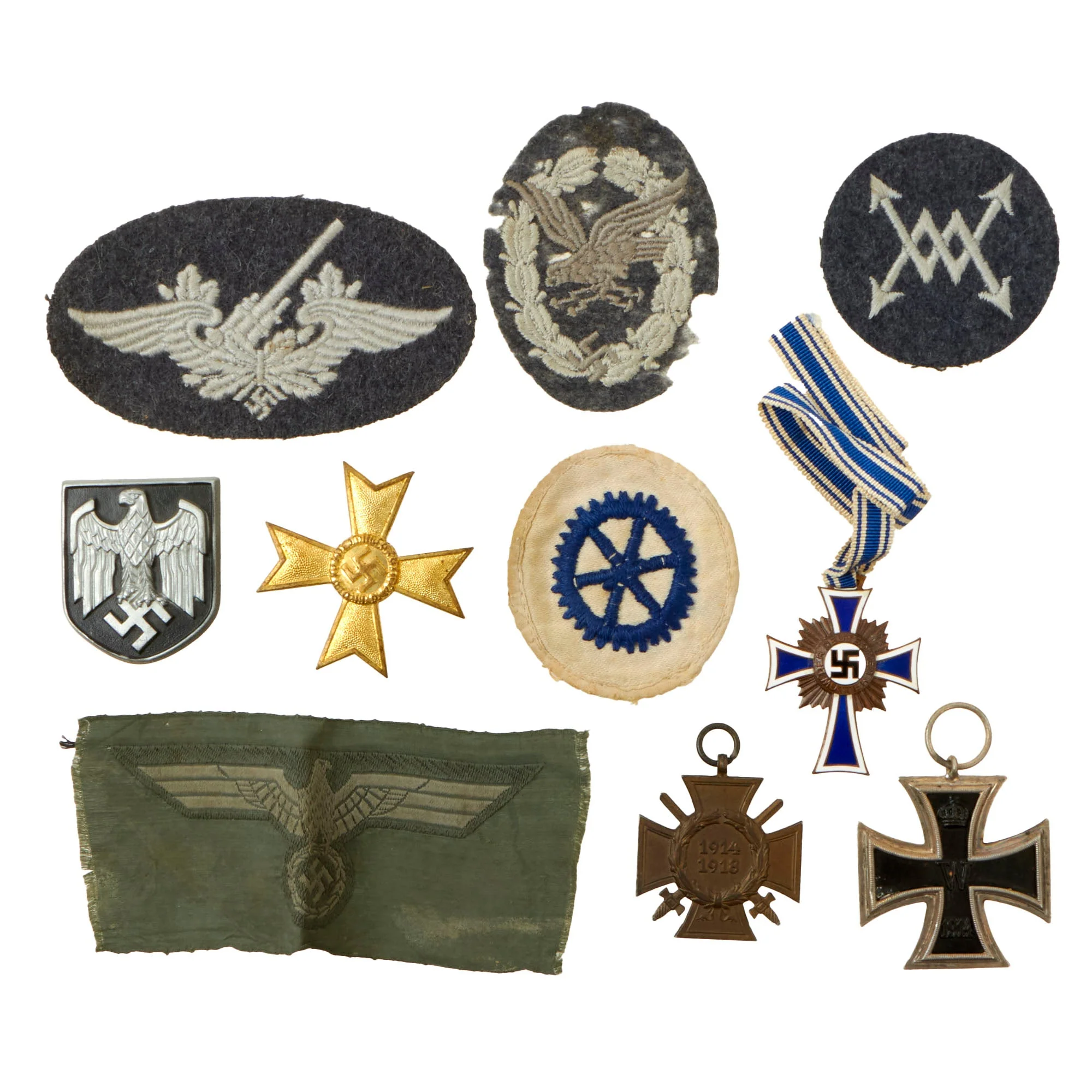
Original Items: Only One Set Available. This is a very nice collection of German WWII Awards and other items, which was brought back from the European theater by a USGI after the war was concluded. Many solders traded these on the way back, and would end up with a pocket full of various different collectible items, and this set represents the typical "haul" one might have come back with. It includes four different WWII Era awards, along with a tinnie and medal ribbon bar.
This lovely set includes:
- One German WWII War Merit Cross 2nd Class with Swords (Kriegsverdienstkreuz II Klasse mit Schwertern) without ribbon. The metal still retains much of the original bronze wash, with some overall oxidation and patination. The hanger loop is also marked with Präsidialkanzlei des Führers Lieferant (Presidential Chancellery Supplier) number 68 on the hanger ring, for maker Alfred Knobloch of Gablonz am Neckar, a known maker of the KvKII.
- One German WWII 1 October 1938 Commemorative Sudetenland Medal, without ribbon. The hanging ring is missing as well, with just the attachment loop present, and the original bronze wash is in great shape.
- One German WWII 1939 War Merit Medal (Kriegsverdienstmedaille): Comes complete with the original ribbon, in very good patinated condition. There is a bit of oxidation to both sides of the medal. The ribbon shows just a tiny bit of fraying and age toning, and looks to have had some type of sticker on the back at some point.
- One German WWII 3rd Class Black Wound Badge (Verwundetenabzeichen in Schwarz). This is wartime stamped steel example of the black wound badge, still has almost all of the original black finish, an and intact pin catch. These were awarded for 1 or 2 wounds during service.
- One German WWII 1935 SEEFAHRT IST NOT (Seafaring is necessary) Tinnie. This was given out for German Seafaring Day (TAG DER DEUTSCHEN SEEFAHRT) , May 25-26 1935. Maker marked on the back.
- One German WWII Two Award Medal Ribbon Bar. This bears the ribbons of the Iron Cross 2nd Class 1939 and the Eastern Front Medal.
A wonderful totally genuine grouping perfect for the German Medal and Insignia collector. Ready to research and display!
More information on some of the awards in this set:
"Tinnies" (Veranstaltungsabzeichen - Event Badges) are small commemorative pins or medals, acquired when one attended a specific event held in Germany. They were often made of thin stamped metal, bakelite, or even pressed paper. Many of these were given out as part of the WHW (Winterhilfswerk - Winter Help Work) Organization, which often involved Germans traveling quite a bit to help out the war effort. Many others were given for the annual Reichsparteitag (Reich Party Congress), otherwise known as the Nuremberg Rallies.
War Merit Cross 2nd Class (Kriegsverdienstkreuz) with Swords (for Combat)
This was a decoration of NSDAP Germany during the Second World War, which could be awarded to military personnel and civilians alike. By the end of the war it was issued in four degrees, and had a related civil decoration. It was created by Adolf AH in October 1939 as a successor to the non-combatant Iron Cross which was used in earlier wars. The award was graded the same as the Iron Cross: War Merit Cross Second Class, War Merit Cross First Class, and Knights Cross of the War Merit Cross. The award had two variants: with swords given to soldiers for exceptional service "not in direct connection with combat", and without swords for meritorious service to civilians in "furtherance of the war effort". As with the Iron Cross, Recipients had to have the lower grade of the award before getting the next level.
The 1 October 1938 Commemorative Medal (Die Medaille zur Erinnerung an den 1. Oktober 1938), commonly known as the Sudetenland Medal or Czech Conquest Medal, was a decoration of NSDAP Germany awarded in the interwar period. Instituted on 18 October 1938, the medal was awarded to German military personnel who participated in the occupation of Sudetenland and the occupation of Czechoslovakia in March 1939. The medal was awarded to all German (and as well Sudeten) State officials and members of the German Wehrmacht and SS who marched into Sudetenland. Later it was awarded to military personnel participating in the occupation of the remnants of Czechoslovakia on 15 March 1939. It was awarded until 31 December 1940. In all 1,162,617 medals and 134,563 bars were awarded.
The medal was similar in appearance as the Anschluss Medal, the reverse only differed in the date. It was designed by Professor Richard Klein. It is round and of the obverse there is a man standing of a podium with the Third Reich coat of arms and holding the NSDAP flag, he holding the hand and helping him get on the podium of another man who had a broken shackle on his right hand, this symbolize the joining to the Reich of Austria. On the reverse side is the inscription "1. Oktober 1938" (1 October 1938). The date is surrounded with the words "Ein Volk, Ein Reich, Ein Führer" (One People, One Empire, One Leader).
The medal was dye-struck and high in detail, with a bronze finish. The medal was suspended from a black ribbon with a red stripe in the middle, these being the colors of the Sudetenland.
The War Merit Medal (Kriegsverdienstmedaille) was a World War II German military decoration awarded to recognize outstanding service by civilians in relation to the war effort. It was instituted on 19 August 1940 and usually awarded to those workers in factories who significantly exceeded work quotas. The War Merit Medal was awarded only to Germans and non-Germans civilians, to men and women. An estimated 4.9 million medals were awarded by the end of the war in Europe. It was closely related to the War Merit Cross, which could be awarded to military personnel and civilians alike for outstanding service to the war effort.
The medal was designed by Professor Richard Klein of Munich. It was a circular bronze award bearing the design of the War Merit Cross on the front (obverse), and the inscription "For War Merit 1939" (Für Kriegsverdienst 1939) on the reverse side. It was suspended from a ribbon colored similar to the War Merit Cross, except for a thin red vertical strip added to the center of the black portion. When worn, it was either as a medal ribbon bar above the left breast pocket (soldiers who had earned the medal as civilians could wear it on their uniform), or with the ribbon only through the second buttonhole of a jacket. Since this was a non-combat award, the medal never incorporated swords. After 15 May, 1943, the award of this medal to foreigners was superseded by the Medal of Merit of the Order of the German Eagle.

Details & Craftsmanship
Every detail has been carefully considered to bring you the perfect product.

Details & Craftsmanship
Every detail has been carefully considered to bring you the perfect product.

Details & Craftsmanship
Every detail has been carefully considered to bring you the perfect product.

Details & Craftsmanship
Every detail has been carefully considered to bring you the perfect product.

Details & Craftsmanship
Every detail has been carefully considered to bring you the perfect product.

Details & Craftsmanship
Every detail has been carefully considered to bring you the perfect product.
Description
Original Items: Only One Set Available. This is a very nice collection of German WWII Awards and other items, which was brought back from the European theater by a USGI after the war was concluded. Many solders traded these on the way back, and would end up with a pocket full of various different collectible items, and this set represents the typical "haul" one might have come back with. It includes four different WWII Era awards, along with a tinnie and medal ribbon bar.
This lovely set includes:
- One German WWII War Merit Cross 2nd Class with Swords (Kriegsverdienstkreuz II Klasse mit Schwertern) without ribbon. The metal still retains much of the original bronze wash, with some overall oxidation and patination. The hanger loop is also marked with Präsidialkanzlei des Führers Lieferant (Presidential Chancellery Supplier) number 68 on the hanger ring, for maker Alfred Knobloch of Gablonz am Neckar, a known maker of the KvKII.
- One German WWII 1 October 1938 Commemorative Sudetenland Medal, without ribbon. The hanging ring is missing as well, with just the attachment loop present, and the original bronze wash is in great shape.
- One German WWII 1939 War Merit Medal (Kriegsverdienstmedaille): Comes complete with the original ribbon, in very good patinated condition. There is a bit of oxidation to both sides of the medal. The ribbon shows just a tiny bit of fraying and age toning, and looks to have had some type of sticker on the back at some point.
- One German WWII 3rd Class Black Wound Badge (Verwundetenabzeichen in Schwarz). This is wartime stamped steel example of the black wound badge, still has almost all of the original black finish, an and intact pin catch. These were awarded for 1 or 2 wounds during service.
- One German WWII 1935 SEEFAHRT IST NOT (Seafaring is necessary) Tinnie. This was given out for German Seafaring Day (TAG DER DEUTSCHEN SEEFAHRT) , May 25-26 1935. Maker marked on the back.
- One German WWII Two Award Medal Ribbon Bar. This bears the ribbons of the Iron Cross 2nd Class 1939 and the Eastern Front Medal.
A wonderful totally genuine grouping perfect for the German Medal and Insignia collector. Ready to research and display!
More information on some of the awards in this set:
"Tinnies" (Veranstaltungsabzeichen - Event Badges) are small commemorative pins or medals, acquired when one attended a specific event held in Germany. They were often made of thin stamped metal, bakelite, or even pressed paper. Many of these were given out as part of the WHW (Winterhilfswerk - Winter Help Work) Organization, which often involved Germans traveling quite a bit to help out the war effort. Many others were given for the annual Reichsparteitag (Reich Party Congress), otherwise known as the Nuremberg Rallies.
War Merit Cross 2nd Class (Kriegsverdienstkreuz) with Swords (for Combat)
This was a decoration of NSDAP Germany during the Second World War, which could be awarded to military personnel and civilians alike. By the end of the war it was issued in four degrees, and had a related civil decoration. It was created by Adolf AH in October 1939 as a successor to the non-combatant Iron Cross which was used in earlier wars. The award was graded the same as the Iron Cross: War Merit Cross Second Class, War Merit Cross First Class, and Knights Cross of the War Merit Cross. The award had two variants: with swords given to soldiers for exceptional service "not in direct connection with combat", and without swords for meritorious service to civilians in "furtherance of the war effort". As with the Iron Cross, Recipients had to have the lower grade of the award before getting the next level.
The 1 October 1938 Commemorative Medal (Die Medaille zur Erinnerung an den 1. Oktober 1938), commonly known as the Sudetenland Medal or Czech Conquest Medal, was a decoration of NSDAP Germany awarded in the interwar period. Instituted on 18 October 1938, the medal was awarded to German military personnel who participated in the occupation of Sudetenland and the occupation of Czechoslovakia in March 1939. The medal was awarded to all German (and as well Sudeten) State officials and members of the German Wehrmacht and SS who marched into Sudetenland. Later it was awarded to military personnel participating in the occupation of the remnants of Czechoslovakia on 15 March 1939. It was awarded until 31 December 1940. In all 1,162,617 medals and 134,563 bars were awarded.
The medal was similar in appearance as the Anschluss Medal, the reverse only differed in the date. It was designed by Professor Richard Klein. It is round and of the obverse there is a man standing of a podium with the Third Reich coat of arms and holding the NSDAP flag, he holding the hand and helping him get on the podium of another man who had a broken shackle on his right hand, this symbolize the joining to the Reich of Austria. On the reverse side is the inscription "1. Oktober 1938" (1 October 1938). The date is surrounded with the words "Ein Volk, Ein Reich, Ein Führer" (One People, One Empire, One Leader).
The medal was dye-struck and high in detail, with a bronze finish. The medal was suspended from a black ribbon with a red stripe in the middle, these being the colors of the Sudetenland.
The War Merit Medal (Kriegsverdienstmedaille) was a World War II German military decoration awarded to recognize outstanding service by civilians in relation to the war effort. It was instituted on 19 August 1940 and usually awarded to those workers in factories who significantly exceeded work quotas. The War Merit Medal was awarded only to Germans and non-Germans civilians, to men and women. An estimated 4.9 million medals were awarded by the end of the war in Europe. It was closely related to the War Merit Cross, which could be awarded to military personnel and civilians alike for outstanding service to the war effort.
The medal was designed by Professor Richard Klein of Munich. It was a circular bronze award bearing the design of the War Merit Cross on the front (obverse), and the inscription "For War Merit 1939" (Für Kriegsverdienst 1939) on the reverse side. It was suspended from a ribbon colored similar to the War Merit Cross, except for a thin red vertical strip added to the center of the black portion. When worn, it was either as a medal ribbon bar above the left breast pocket (soldiers who had earned the medal as civilians could wear it on their uniform), or with the ribbon only through the second buttonhole of a jacket. Since this was a non-combat award, the medal never incorporated swords. After 15 May, 1943, the award of this medal to foreigners was superseded by the Medal of Merit of the Order of the German Eagle.