
Original: $795.00
-70%$795.00
$238.50The Story
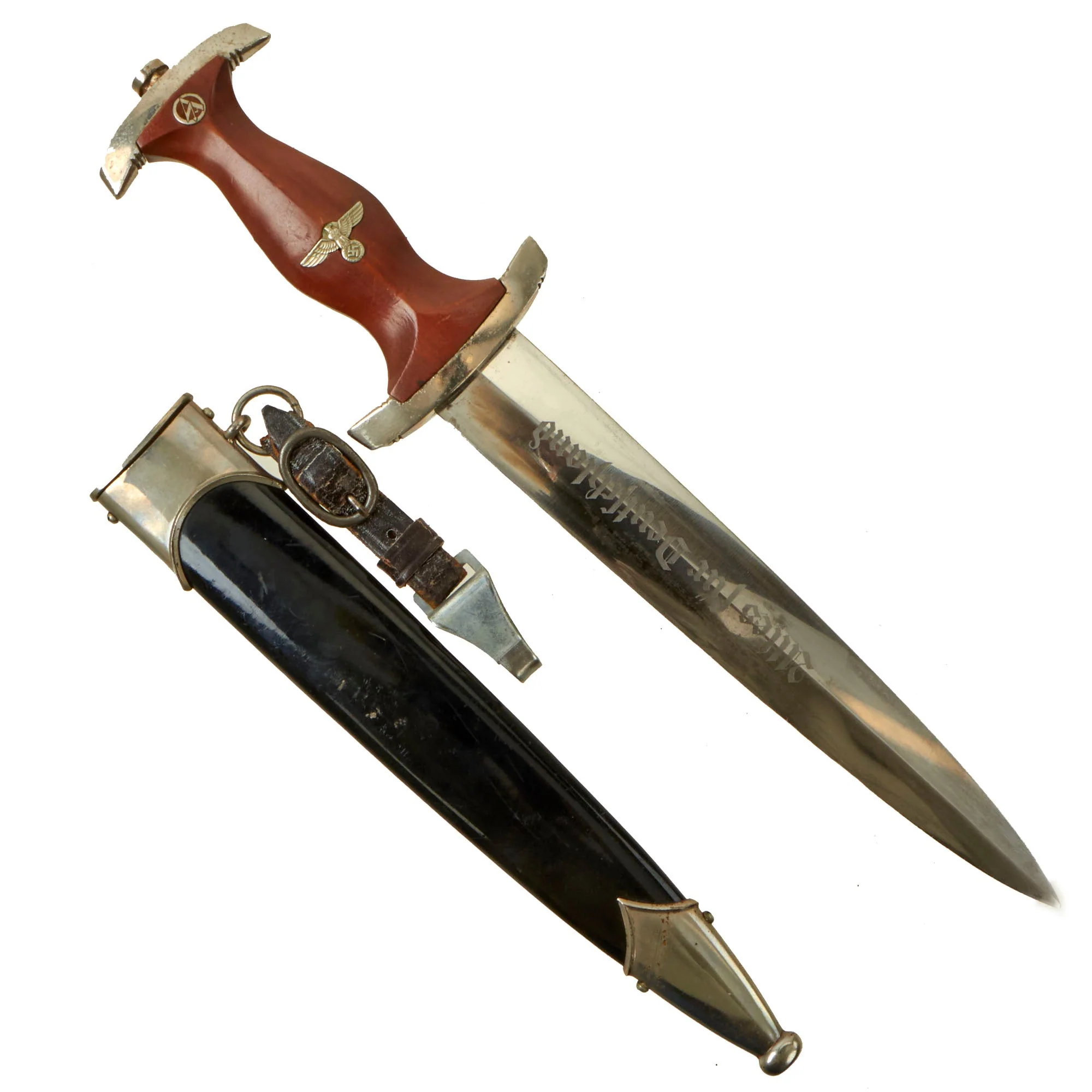
Original Item: Only One Available. This is a very nice condition early HJ Fahrtenmesser (trip knife), marked on the blade by the rare maker Anton Wingen Jr, Stahlwarenfabrik of Solingen. This early HJ Knife is a solid example of the type, with a handle that is nickel-plated over a steel base. The plating still remains in very good condition, retained at over 90% with light overall wear and just a few areas of missing plating.
The Bakelite grip plates are closely checkered and in very good condition, retained by solid nickel alloy rivets with dressed obverse heads. The HJ insignia is in good condition, with the translucent red enamel on one of the panels is mostly missing. The bakelite grips have shrunk over the decades, which caused the insignia to stick out a bit, allowing it to suffer damage, but also confirming authenticity. There is now some space between the grip scales and the guards due to shrinkage.
The blade of this example shows light to moderate use, and is typical of the early period up until 1936. It has a thinner blade with no raised ricasso, and also no RZM codes. It looks like the surface had some staining and peppering on it in the past, which was then cleaned away. It is now nice and bright, however the cleaning has made the original factory final grind crossgrain faint over most of the blade. This texture is iconic, and is the definitive identifying characteristic for a real WWII German Blade. The acid-etched motto Blut und Ehre! (Blood and Honor!) is present and easy to see, however the cleaning has removed the factory darkening. The blade edge is now somewhat dull, and the original leather blade buffer is missing.
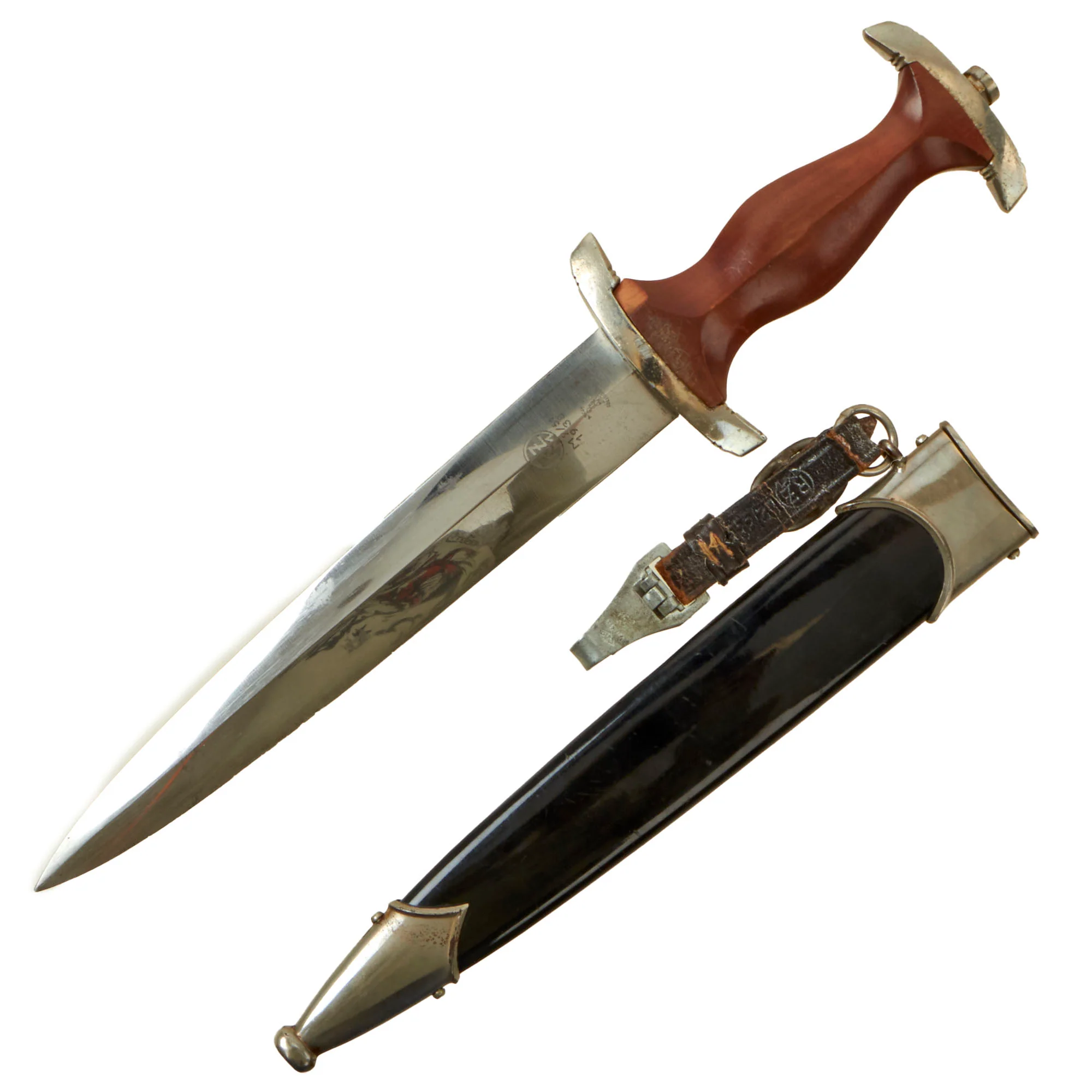
The reverse of the blade is stamped with the Anton Wingen Jr. "Standing Knight" trademark logo:
A. W. JR
(Trademark)
SOLINGEN
Anton Wingen Jun., Stahlwarenfabrik was a cutler and metalsmith company first founded in Solingen, Germany in 1888, and was formally registered in late 1901. They first came to prominence during WWI with their high quality hunting and combat knives, which were popular with troops. They acquired the "Knight" logo from Clauberg in 1920, and continued using it through the Third Reich period. This particular trademark was the style of logo they used on smaller knives, such as the HJ knife, per J. Anthony Carter's work GERMAN KNIFE AND SWORD MAKERS. The company continued operation well after the war, finally closing in 1997.
The design of the knife is registered with the German trademark office, indicated by the GES. GESCHÜTZT stamped under the trademark logo, which is short for Gesetzlich Geschützt (Protected by Law).
The scabbard shell is the typical tapered steel example, which only retains about 25% of the original black enamel finish. It looks like most has chipped away from wear, and the steel body only shows light oxidation. The remaining finish shows scratching, crazing, and checking in the enamel due to age. The leather belt loop is present with an intact securing strap, and is still supple.
A very nice HJ Knife with an early pattern blade in good collectible condition!
Approximate Measurements:
Blade Length: 5 3/8"
Blade Style: Single Edged Knife.
Overall length: 9 1/2”
Crossguard: 2”
Scabbard Length: 5 3/4”
AH believed German youth to be the future of his 3rd Reich. The HJ (AH Jugend) was formed officially in 1935, and with the exception of NSDAP ideology indoctrination was very similar to the Boy Scouts. Beginning at about the age of ten years, both boys (AH Jugend) and girls (Bund Deutscher Mädel) were enlisted in the Party-run organization. The boys only were given HJ Knives after having passed minor exams. The knives had nickeled hilts with black checkered grip plates. The obverse plate was fitted with an enameled HJ swas insignia. Through 1937, these knives were etched with the motto of the organization, Blut und Ehre! (Blood and Honor!). Examples produced after this date were made with plain blades usually bearing an RZM marking.
The HJ Leaders were professionals in charge of the training and NSDAP education of the German Youth. They wore a special dagger consisting of silvered hilt fittings with blue-black leather-covered scabbard. The grip was composed of tightly wrapped silver wire, over a wood base. The pommel cap featured an HJ diamond on top, complete with swas. The upper scabbard fitting portrayed an open-winged HJ eagle with swas cut into the bird's chest. The blade was etched with the HJ motto, Blut und Ehre!

Details & Craftsmanship
Every detail has been carefully considered to bring you the perfect product.

Details & Craftsmanship
Every detail has been carefully considered to bring you the perfect product.

Details & Craftsmanship
Every detail has been carefully considered to bring you the perfect product.

Details & Craftsmanship
Every detail has been carefully considered to bring you the perfect product.

Details & Craftsmanship
Every detail has been carefully considered to bring you the perfect product.

Details & Craftsmanship
Every detail has been carefully considered to bring you the perfect product.

Details & Craftsmanship
Every detail has been carefully considered to bring you the perfect product.

Details & Craftsmanship
Every detail has been carefully considered to bring you the perfect product.

Details & Craftsmanship
Every detail has been carefully considered to bring you the perfect product.

Details & Craftsmanship
Every detail has been carefully considered to bring you the perfect product.

Details & Craftsmanship
Every detail has been carefully considered to bring you the perfect product.

Details & Craftsmanship
Every detail has been carefully considered to bring you the perfect product.

Details & Craftsmanship
Every detail has been carefully considered to bring you the perfect product.

Details & Craftsmanship
Every detail has been carefully considered to bring you the perfect product.

Details & Craftsmanship
Every detail has been carefully considered to bring you the perfect product.
Description
Original Item: Only One Available. This is a very nice condition early HJ Fahrtenmesser (trip knife), marked on the blade by the rare maker Anton Wingen Jr, Stahlwarenfabrik of Solingen. This early HJ Knife is a solid example of the type, with a handle that is nickel-plated over a steel base. The plating still remains in very good condition, retained at over 90% with light overall wear and just a few areas of missing plating.
The Bakelite grip plates are closely checkered and in very good condition, retained by solid nickel alloy rivets with dressed obverse heads. The HJ insignia is in good condition, with the translucent red enamel on one of the panels is mostly missing. The bakelite grips have shrunk over the decades, which caused the insignia to stick out a bit, allowing it to suffer damage, but also confirming authenticity. There is now some space between the grip scales and the guards due to shrinkage.
The blade of this example shows light to moderate use, and is typical of the early period up until 1936. It has a thinner blade with no raised ricasso, and also no RZM codes. It looks like the surface had some staining and peppering on it in the past, which was then cleaned away. It is now nice and bright, however the cleaning has made the original factory final grind crossgrain faint over most of the blade. This texture is iconic, and is the definitive identifying characteristic for a real WWII German Blade. The acid-etched motto Blut und Ehre! (Blood and Honor!) is present and easy to see, however the cleaning has removed the factory darkening. The blade edge is now somewhat dull, and the original leather blade buffer is missing.
The reverse of the blade is stamped with the Anton Wingen Jr. "Standing Knight" trademark logo:
A. W. JR
(Trademark)
SOLINGEN
Anton Wingen Jun., Stahlwarenfabrik was a cutler and metalsmith company first founded in Solingen, Germany in 1888, and was formally registered in late 1901. They first came to prominence during WWI with their high quality hunting and combat knives, which were popular with troops. They acquired the "Knight" logo from Clauberg in 1920, and continued using it through the Third Reich period. This particular trademark was the style of logo they used on smaller knives, such as the HJ knife, per J. Anthony Carter's work GERMAN KNIFE AND SWORD MAKERS. The company continued operation well after the war, finally closing in 1997.
The design of the knife is registered with the German trademark office, indicated by the GES. GESCHÜTZT stamped under the trademark logo, which is short for Gesetzlich Geschützt (Protected by Law).
The scabbard shell is the typical tapered steel example, which only retains about 25% of the original black enamel finish. It looks like most has chipped away from wear, and the steel body only shows light oxidation. The remaining finish shows scratching, crazing, and checking in the enamel due to age. The leather belt loop is present with an intact securing strap, and is still supple.
A very nice HJ Knife with an early pattern blade in good collectible condition!
Approximate Measurements:
Blade Length: 5 3/8"
Blade Style: Single Edged Knife.
Overall length: 9 1/2”
Crossguard: 2”
Scabbard Length: 5 3/4”
AH believed German youth to be the future of his 3rd Reich. The HJ (AH Jugend) was formed officially in 1935, and with the exception of NSDAP ideology indoctrination was very similar to the Boy Scouts. Beginning at about the age of ten years, both boys (AH Jugend) and girls (Bund Deutscher Mädel) were enlisted in the Party-run organization. The boys only were given HJ Knives after having passed minor exams. The knives had nickeled hilts with black checkered grip plates. The obverse plate was fitted with an enameled HJ swas insignia. Through 1937, these knives were etched with the motto of the organization, Blut und Ehre! (Blood and Honor!). Examples produced after this date were made with plain blades usually bearing an RZM marking.
The HJ Leaders were professionals in charge of the training and NSDAP education of the German Youth. They wore a special dagger consisting of silvered hilt fittings with blue-black leather-covered scabbard. The grip was composed of tightly wrapped silver wire, over a wood base. The pommel cap featured an HJ diamond on top, complete with swas. The upper scabbard fitting portrayed an open-winged HJ eagle with swas cut into the bird's chest. The blade was etched with the HJ motto, Blut und Ehre!