
Original: $1,295.00
-70%$1,295.00
$388.50The Story
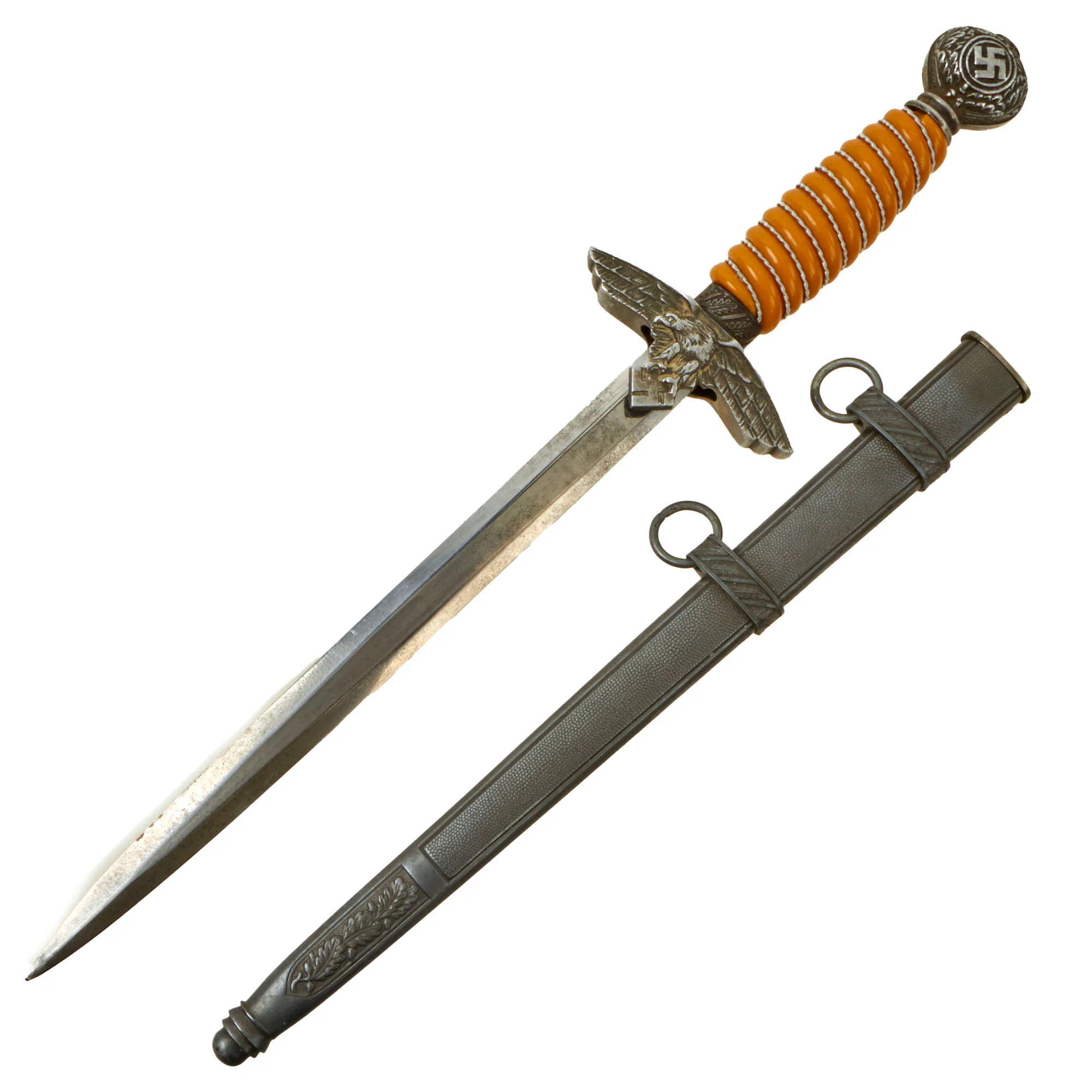
Original Item: Only One Available. Prior to his "unmasking" as a traitor, Ernst Röhm was the leader of the SA. In 1934, he distributed NSKK daggers with his personal inscription on the reverse blade. These daggers were to honor individuals who had served with the NSKK prior to December, 1931. Other than the inscription, these pieces were identical to the standard M1933 NSKK dagger. After the Röhm purge, the inscription was ordered to be removed. Some were simply ground in the field by whatever means were available. Many other examples, as we suspect this is one of, were returned to the factory for grinding and refinishing. Examples will occasionally be encountered with remnants of the original inscription remaining on the blade, but mostly none will remain. Some blades exist with an intact inscription, exhibiting only the removal of the Röhm signature. Very, very rarely is an example seen with a full, untouched inscription, as the holder would have surely risked a charge of treason.
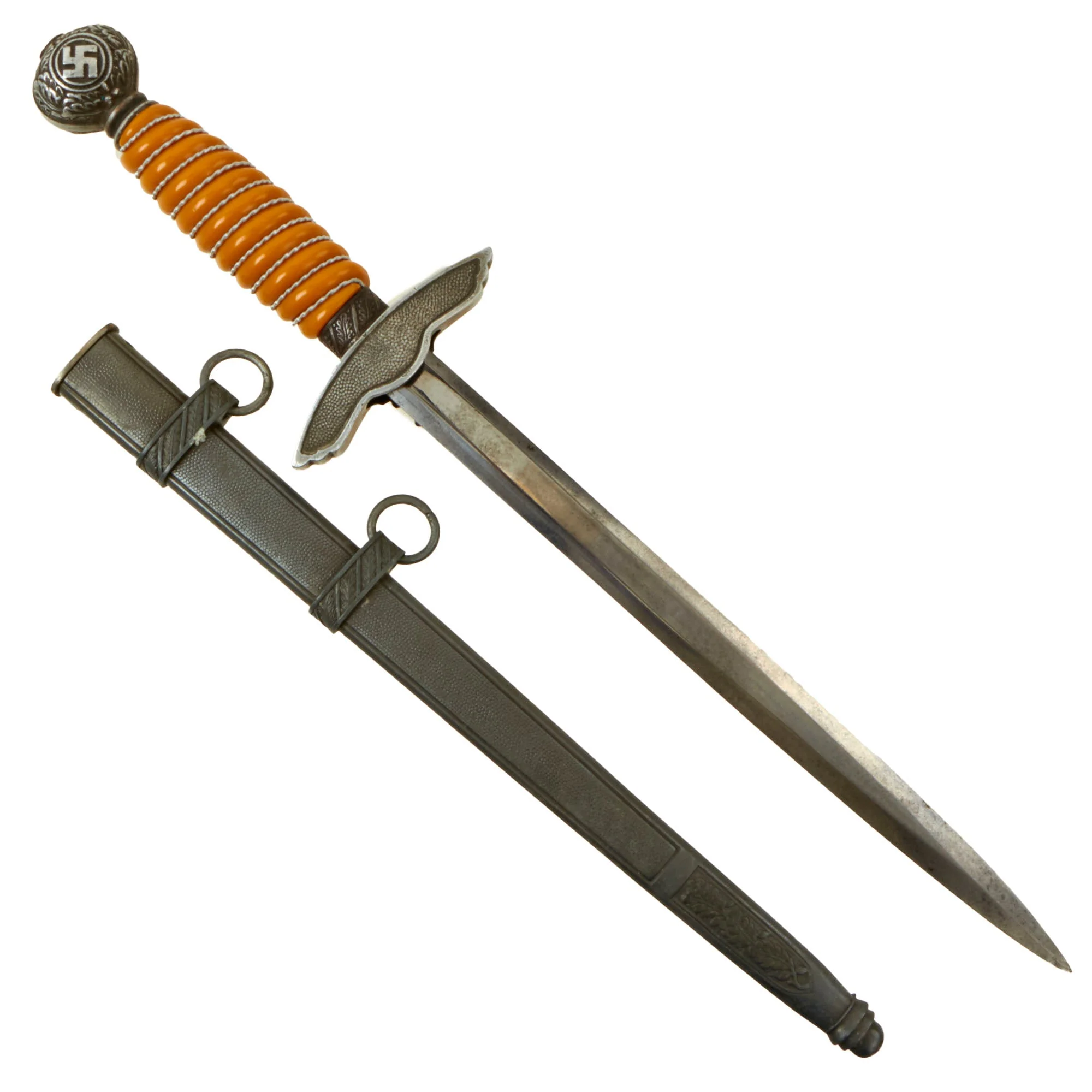
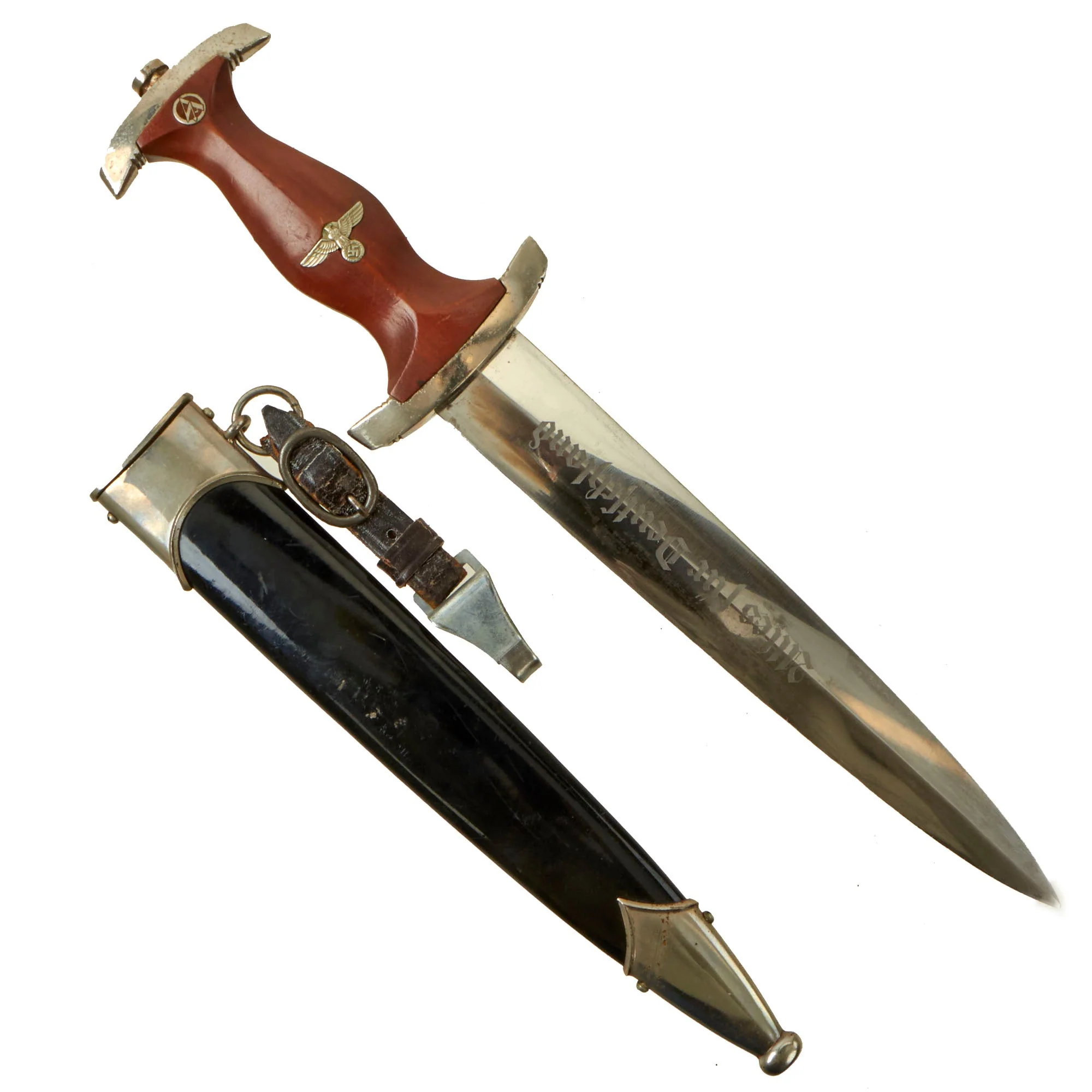
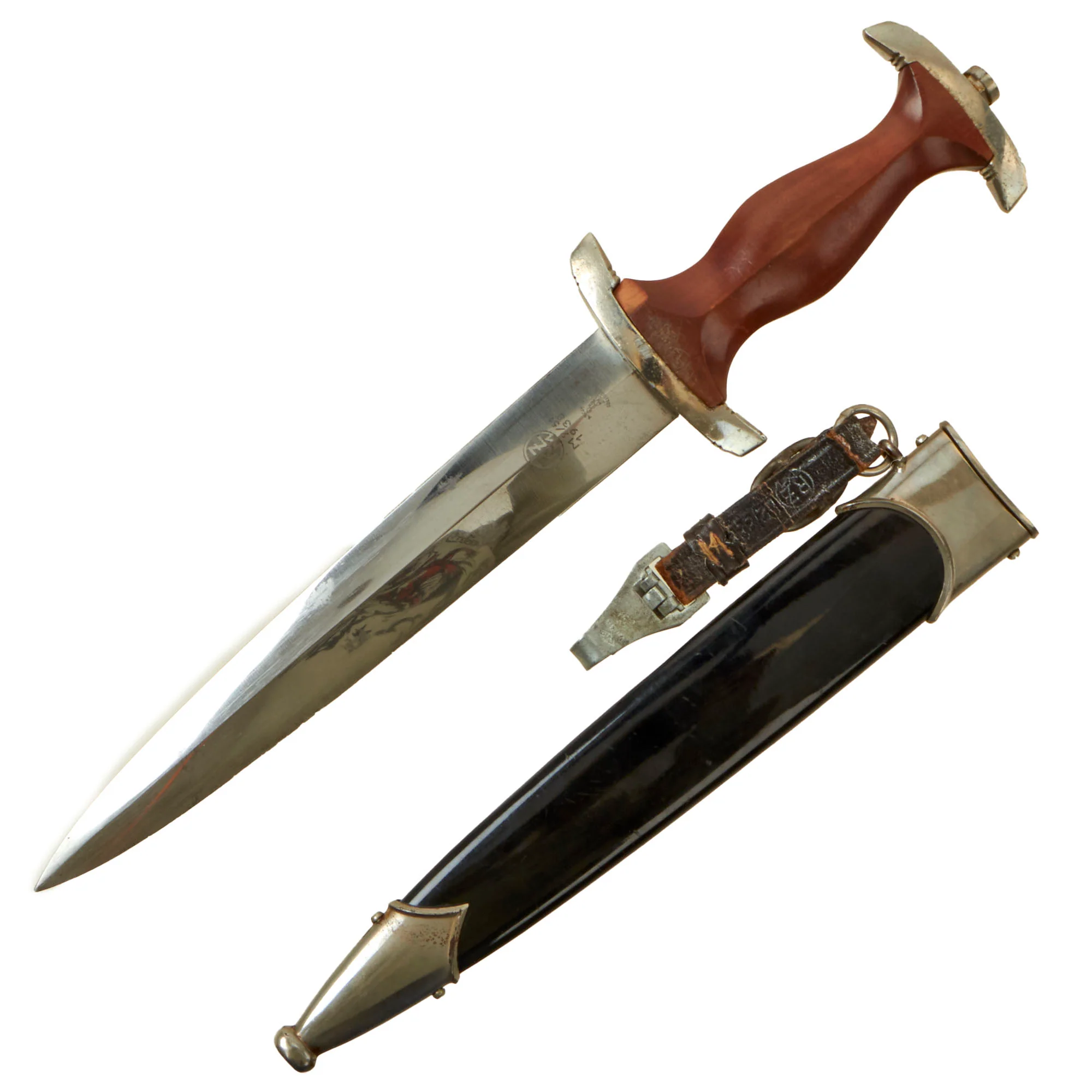
This is a great looking early NSKK Dagger, which believe originally had a Röhm inscription. It looks to have been sent back to the factory or a cutler, where the rear of the dagger was mostly resurfaced and re-polished. This has not removed any of the trademark logo, however it does appear to have removed most or all of the acid etched script In herzlicher kameradschaft Ernst Röhm (In cordial companionship Ernst Röhm) inscription, as well as some of the blade material. We can’t make out any parts of the original signature minus a couple minute spots along the rear spine just above the trademark logo
The front side of this blade is in excellent condition, showing the original factory final polish grind cross grain clearly throughout. This texture is iconic, and is the definitive identifying characteristic for a real WWII German Blade. There is a bit of runner wear and swirl marks from cleaning, as well as some very minor specks of oxidation staining, but otherwise it is nearly untouched. The acid etched Alles für Deutschland motto is beautifully executed, and still shows much of the original factory darkening, and the original factory edge is intact, with just a small bend at the tip. The rear of the blade looks to have been almost totally factory resurfaced, which has left only very minor traces of the original signature. The cross grain is rougher, but definitely still present, so this was not a field level resurface, and it may well have been sent back to the manufacturer.
The ricasso is marked with the clear etched trademark logo of Aesculap-Werke AG of Tuttlingen in Württemberg, a company that still exists today as a major maker of surgical instruments. Their logo is the well-known "S-form" serpent coiled around a ball-headed staff, the "Rod of Aesculapius", the Greek God of medicine, under a crown. This trademark is on the back of the blade, surrounded by:
AESCULAP
(CROWN)
+ (Rod of Aesculapius) +
TUTTLINGEN
Per J. Anthony Carter's book GERMAN KNIFE AND SWORD MAKERS, this firm was originally founded by Gottfried Jetter in 1867, and in 1887 he partnered with the Scheerer brothers to form Jetter & Scheerer. By 1895, they recognized the limitations of a family business, and formally incorporated. They built a new factory and registered the trademark Aesculap. The company used this particular "round" trademark on very early SA and NSKK daggers, which they made only made a small number of. They were a known maker of the Röhm daggers, and we can see a few spots of the original signature on the spine just above the trademark logo.
The brown hardwood grip has no chips or major damage, just the usual wear to the finish from age and use, and is also stamped with a number 2. The wood is a bit darker than we usually see, which seems to be typical for Aesculap examples. As a real rarity, there are no chips or cracks that we can see in the wood. The solid nickel-silver eagle is crisp with a perfect fit, and just a bit of oxidation. The SA roundel also has a good fit, though it is worn and missing a bit of the enamel. The pommel and cross guard are fine solid nickel silver examples, still tight to the grip, with the expected wear from age and service. The pommel nut does not show some evidence of tightening. The lower reverse guard is Gruppe/Gau marked Sw ,for Sudwest (South West) a district in far South West Germany, with the principal city being Stuttgart. This feature was only seen on daggers produced 1935 and prior.
The scabbard shell is straight throughout and is the early-war style, which were produced with an "anodized" finish on the steel, which was then lacquered. This example looks to have had the body totally refinished with black enamel paint during the WWII period, which is still well retained, though it does show degradation in areas. The reverse has some areas of chipping, and we noticed that one chip in particularly near the throat shows the original anodized finish underneath, which is BROWN. This scabbard, and probably the dagger as well, were owned by one of the members of the SA who split off into the NSKK after the purge, and then had their dagger repainted the correct color to match the move. It's rare that we can confirm that a scabbard has been repainted like this!
As is correct, the upper and lower fittings are solid nickel silver, with a great look and some dents and scratches showing typical wear. The chape end ball is dented in and split, somewhat common due to how soft the nickel alloy is. The throat nicely matches the crossguards, and all fittings have their original dome headed screws.
Attached to the scabbard is a very nice leather belt hanger clip, which is the correct early style with solid nickel alloy fittings. The leather shows a lovely dark brown / black color, with some cracking and wrinkling to the finish, as well as wear around the edges.
A very interesting early NSKK dagger by a rare maker, most likely "sanitized" after the Night of the Long Knives! Complete with scabbard and a lovely belt loop hanger, this dagger is more than ready to add to your collection and display!
Specifications:
Blade Length: 8 3/4"
Overall length: 13 3/4”
Crossguard: 3”
Scabbard Length: 10”
History of the SA & NSKK-
The SA or Brown Shirts, were a private political formation which Adolf AH and the NSDAP used to maintain order at organized Party meetings and demonstrations. The group was formed in 1921, and grew to a huge force of nearly 3,000,000 men by the later 1930's. To instill esprit de corps, as well as create employment for the Blade City of Solingen, it was decided each SA man would carry a dagger with his Brown Shirt uniform. Huge quantities needed to be produced to accommodate the demand. The dagger initially was produced of hand-fitted nickel mounts with attractive finished wood grip and brown anodized (a bluing process) finished scabbard.
The blade was etched with the SA motto, Alles für Deutschland. Examples produced prior to 1935 were stamped with the German sector of the SA group on reverse lower crossguard. Later examples underwent standardization through the RZM ministry. These pieces were produced of cheaper plated zinc-base fittings and scabbards were simply painted brown.
After the "Night of the Long Knives" which purged Ernst Röhm, the NSKK, which had been a part of the SA, was split off into a separate organization. They retained the same daggers as the SA, however now used a black painted scabbard, and their officer's daggers had a few differences as well. Many already had SA daggers, so these had the scabbards painted black over the original brown anodized finish.
The Night of the Long Knives, in June 1934, saw the wiping out of the SA’s leadership and others who had angered AH in the recent past in NSDAP Germany. After this date, the SS lead by Heinrich Himmler was to become far more powerful in NSDAP Germany. For all the power the Enabling Act gave AH, he still felt threatened by some in the NSDAP Party. He was also worried that the regular army had not given an oath of allegiance. AH knew that the army hierarchy held him in disdain as he was ‘only ‘ a corporal in their eyes. The Night of the Long Knives not only removed the SA leaders but also got AH the army’s oath that he so needed.
By the summer of 1934, the SA’s numbers had swollen to 2 million men. They were under the control of Ernst Röhm, a loyal follower of AH since the early days of the NSDAP Party. The SA had given the NSDAP’s an iron fist with which to disrupt other political parties meetings before January 1933. The SA was also used to enforce law after AH became Chancellor in January 1933. To all intents, they were the enforcers of the NSDAP Party and there is no evidence that Röhm was ever planning anything against AH. However, Röhm had made enemies within the NSDAP Party – Himmler, Goering and Goebbels were angered by the power he had gained and convinced AH that this was a threat to his position. By June 1934, the regular army hierarchy also saw the SA as a threat to their authority. The SA outnumbered the army by 1934 and Röhm had openly spoken about taking over the regular army by absorbing it into the SA. Such talk alarmed the army’s leaders.
By the summer of 1934, AH had decided that Röhm was a ‘threat’ and he made a pact with the army. If Röhm and the other SA leaders were removed, the rank and file SA men would come under the control of the army but the army would have to swear an oath of loyalty to AH. The army agreed and Röhm’s fate was sealed. On the night of June 29th – June 30th 1934, units of the SS arrested the leaders of the SA and other political opponents. Men such as Gregor Strasser, von Schleicher and von Bredow were arrested and none of them had any connection with Röhm. The arrests carried on for 2 more nights. Seventy seven men were executed on charges of treason though historians tend to think the figure is higher. The SA was brought to heel and placed under the command of the army. AH received an oath of allegiance from all those who served in the army. Röhm was shot. Others were bludgeoned to death. The first the public officially knew about the event was on July 13th 1934, when AH told the Reichstag that met in the Kroll Opera House, Berlin, that for the duration of the arrests that he and he alone was the judge in Germany and that the SS carried out his orders. From that time on the SS became a feared force in NSDAP Germany lead by Heinrich Himmler. The efficiency with which the SS had carried out its orders greatly impressed AH and Himmler was to acquire huge power within NSDAP Germany.

Details & Craftsmanship
Every detail has been carefully considered to bring you the perfect product.

Details & Craftsmanship
Every detail has been carefully considered to bring you the perfect product.

Details & Craftsmanship
Every detail has been carefully considered to bring you the perfect product.

Details & Craftsmanship
Every detail has been carefully considered to bring you the perfect product.

Details & Craftsmanship
Every detail has been carefully considered to bring you the perfect product.

Details & Craftsmanship
Every detail has been carefully considered to bring you the perfect product.

Details & Craftsmanship
Every detail has been carefully considered to bring you the perfect product.

Details & Craftsmanship
Every detail has been carefully considered to bring you the perfect product.

Details & Craftsmanship
Every detail has been carefully considered to bring you the perfect product.

Details & Craftsmanship
Every detail has been carefully considered to bring you the perfect product.

Details & Craftsmanship
Every detail has been carefully considered to bring you the perfect product.

Details & Craftsmanship
Every detail has been carefully considered to bring you the perfect product.

Details & Craftsmanship
Every detail has been carefully considered to bring you the perfect product.

Details & Craftsmanship
Every detail has been carefully considered to bring you the perfect product.

Details & Craftsmanship
Every detail has been carefully considered to bring you the perfect product.

Details & Craftsmanship
Every detail has been carefully considered to bring you the perfect product.
Description
Original Item: Only One Available. Prior to his "unmasking" as a traitor, Ernst Röhm was the leader of the SA. In 1934, he distributed NSKK daggers with his personal inscription on the reverse blade. These daggers were to honor individuals who had served with the NSKK prior to December, 1931. Other than the inscription, these pieces were identical to the standard M1933 NSKK dagger. After the Röhm purge, the inscription was ordered to be removed. Some were simply ground in the field by whatever means were available. Many other examples, as we suspect this is one of, were returned to the factory for grinding and refinishing. Examples will occasionally be encountered with remnants of the original inscription remaining on the blade, but mostly none will remain. Some blades exist with an intact inscription, exhibiting only the removal of the Röhm signature. Very, very rarely is an example seen with a full, untouched inscription, as the holder would have surely risked a charge of treason.
This is a great looking early NSKK Dagger, which believe originally had a Röhm inscription. It looks to have been sent back to the factory or a cutler, where the rear of the dagger was mostly resurfaced and re-polished. This has not removed any of the trademark logo, however it does appear to have removed most or all of the acid etched script In herzlicher kameradschaft Ernst Röhm (In cordial companionship Ernst Röhm) inscription, as well as some of the blade material. We can’t make out any parts of the original signature minus a couple minute spots along the rear spine just above the trademark logo
The front side of this blade is in excellent condition, showing the original factory final polish grind cross grain clearly throughout. This texture is iconic, and is the definitive identifying characteristic for a real WWII German Blade. There is a bit of runner wear and swirl marks from cleaning, as well as some very minor specks of oxidation staining, but otherwise it is nearly untouched. The acid etched Alles für Deutschland motto is beautifully executed, and still shows much of the original factory darkening, and the original factory edge is intact, with just a small bend at the tip. The rear of the blade looks to have been almost totally factory resurfaced, which has left only very minor traces of the original signature. The cross grain is rougher, but definitely still present, so this was not a field level resurface, and it may well have been sent back to the manufacturer.
The ricasso is marked with the clear etched trademark logo of Aesculap-Werke AG of Tuttlingen in Württemberg, a company that still exists today as a major maker of surgical instruments. Their logo is the well-known "S-form" serpent coiled around a ball-headed staff, the "Rod of Aesculapius", the Greek God of medicine, under a crown. This trademark is on the back of the blade, surrounded by:
AESCULAP
(CROWN)
+ (Rod of Aesculapius) +
TUTTLINGEN
Per J. Anthony Carter's book GERMAN KNIFE AND SWORD MAKERS, this firm was originally founded by Gottfried Jetter in 1867, and in 1887 he partnered with the Scheerer brothers to form Jetter & Scheerer. By 1895, they recognized the limitations of a family business, and formally incorporated. They built a new factory and registered the trademark Aesculap. The company used this particular "round" trademark on very early SA and NSKK daggers, which they made only made a small number of. They were a known maker of the Röhm daggers, and we can see a few spots of the original signature on the spine just above the trademark logo.
The brown hardwood grip has no chips or major damage, just the usual wear to the finish from age and use, and is also stamped with a number 2. The wood is a bit darker than we usually see, which seems to be typical for Aesculap examples. As a real rarity, there are no chips or cracks that we can see in the wood. The solid nickel-silver eagle is crisp with a perfect fit, and just a bit of oxidation. The SA roundel also has a good fit, though it is worn and missing a bit of the enamel. The pommel and cross guard are fine solid nickel silver examples, still tight to the grip, with the expected wear from age and service. The pommel nut does not show some evidence of tightening. The lower reverse guard is Gruppe/Gau marked Sw ,for Sudwest (South West) a district in far South West Germany, with the principal city being Stuttgart. This feature was only seen on daggers produced 1935 and prior.
The scabbard shell is straight throughout and is the early-war style, which were produced with an "anodized" finish on the steel, which was then lacquered. This example looks to have had the body totally refinished with black enamel paint during the WWII period, which is still well retained, though it does show degradation in areas. The reverse has some areas of chipping, and we noticed that one chip in particularly near the throat shows the original anodized finish underneath, which is BROWN. This scabbard, and probably the dagger as well, were owned by one of the members of the SA who split off into the NSKK after the purge, and then had their dagger repainted the correct color to match the move. It's rare that we can confirm that a scabbard has been repainted like this!
As is correct, the upper and lower fittings are solid nickel silver, with a great look and some dents and scratches showing typical wear. The chape end ball is dented in and split, somewhat common due to how soft the nickel alloy is. The throat nicely matches the crossguards, and all fittings have their original dome headed screws.
Attached to the scabbard is a very nice leather belt hanger clip, which is the correct early style with solid nickel alloy fittings. The leather shows a lovely dark brown / black color, with some cracking and wrinkling to the finish, as well as wear around the edges.
A very interesting early NSKK dagger by a rare maker, most likely "sanitized" after the Night of the Long Knives! Complete with scabbard and a lovely belt loop hanger, this dagger is more than ready to add to your collection and display!
Specifications:
Blade Length: 8 3/4"
Overall length: 13 3/4”
Crossguard: 3”
Scabbard Length: 10”
History of the SA & NSKK-
The SA or Brown Shirts, were a private political formation which Adolf AH and the NSDAP used to maintain order at organized Party meetings and demonstrations. The group was formed in 1921, and grew to a huge force of nearly 3,000,000 men by the later 1930's. To instill esprit de corps, as well as create employment for the Blade City of Solingen, it was decided each SA man would carry a dagger with his Brown Shirt uniform. Huge quantities needed to be produced to accommodate the demand. The dagger initially was produced of hand-fitted nickel mounts with attractive finished wood grip and brown anodized (a bluing process) finished scabbard.
The blade was etched with the SA motto, Alles für Deutschland. Examples produced prior to 1935 were stamped with the German sector of the SA group on reverse lower crossguard. Later examples underwent standardization through the RZM ministry. These pieces were produced of cheaper plated zinc-base fittings and scabbards were simply painted brown.
After the "Night of the Long Knives" which purged Ernst Röhm, the NSKK, which had been a part of the SA, was split off into a separate organization. They retained the same daggers as the SA, however now used a black painted scabbard, and their officer's daggers had a few differences as well. Many already had SA daggers, so these had the scabbards painted black over the original brown anodized finish.
The Night of the Long Knives, in June 1934, saw the wiping out of the SA’s leadership and others who had angered AH in the recent past in NSDAP Germany. After this date, the SS lead by Heinrich Himmler was to become far more powerful in NSDAP Germany. For all the power the Enabling Act gave AH, he still felt threatened by some in the NSDAP Party. He was also worried that the regular army had not given an oath of allegiance. AH knew that the army hierarchy held him in disdain as he was ‘only ‘ a corporal in their eyes. The Night of the Long Knives not only removed the SA leaders but also got AH the army’s oath that he so needed.
By the summer of 1934, the SA’s numbers had swollen to 2 million men. They were under the control of Ernst Röhm, a loyal follower of AH since the early days of the NSDAP Party. The SA had given the NSDAP’s an iron fist with which to disrupt other political parties meetings before January 1933. The SA was also used to enforce law after AH became Chancellor in January 1933. To all intents, they were the enforcers of the NSDAP Party and there is no evidence that Röhm was ever planning anything against AH. However, Röhm had made enemies within the NSDAP Party – Himmler, Goering and Goebbels were angered by the power he had gained and convinced AH that this was a threat to his position. By June 1934, the regular army hierarchy also saw the SA as a threat to their authority. The SA outnumbered the army by 1934 and Röhm had openly spoken about taking over the regular army by absorbing it into the SA. Such talk alarmed the army’s leaders.
By the summer of 1934, AH had decided that Röhm was a ‘threat’ and he made a pact with the army. If Röhm and the other SA leaders were removed, the rank and file SA men would come under the control of the army but the army would have to swear an oath of loyalty to AH. The army agreed and Röhm’s fate was sealed. On the night of June 29th – June 30th 1934, units of the SS arrested the leaders of the SA and other political opponents. Men such as Gregor Strasser, von Schleicher and von Bredow were arrested and none of them had any connection with Röhm. The arrests carried on for 2 more nights. Seventy seven men were executed on charges of treason though historians tend to think the figure is higher. The SA was brought to heel and placed under the command of the army. AH received an oath of allegiance from all those who served in the army. Röhm was shot. Others were bludgeoned to death. The first the public officially knew about the event was on July 13th 1934, when AH told the Reichstag that met in the Kroll Opera House, Berlin, that for the duration of the arrests that he and he alone was the judge in Germany and that the SS carried out his orders. From that time on the SS became a feared force in NSDAP Germany lead by Heinrich Himmler. The efficiency with which the SS had carried out its orders greatly impressed AH and Himmler was to acquire huge power within NSDAP Germany.