
Original: $595.00
-70%$595.00
$178.50The Story
Original Item: Only One Available. Now THIS is an offering for someone who really appreciates PATINA! This is a wonderful "Battlefield Dug Up" German WWII MP 40 inert submachine gun parts set, dug up from the Falaise Pocket area. This is where the decisive battle during the Battle of Normandy took place, when German Army Group B was encircled by Allied forces, resulting in the destruction of the formation west of the River Seine. The liberation of Paris followed soon afterwards.
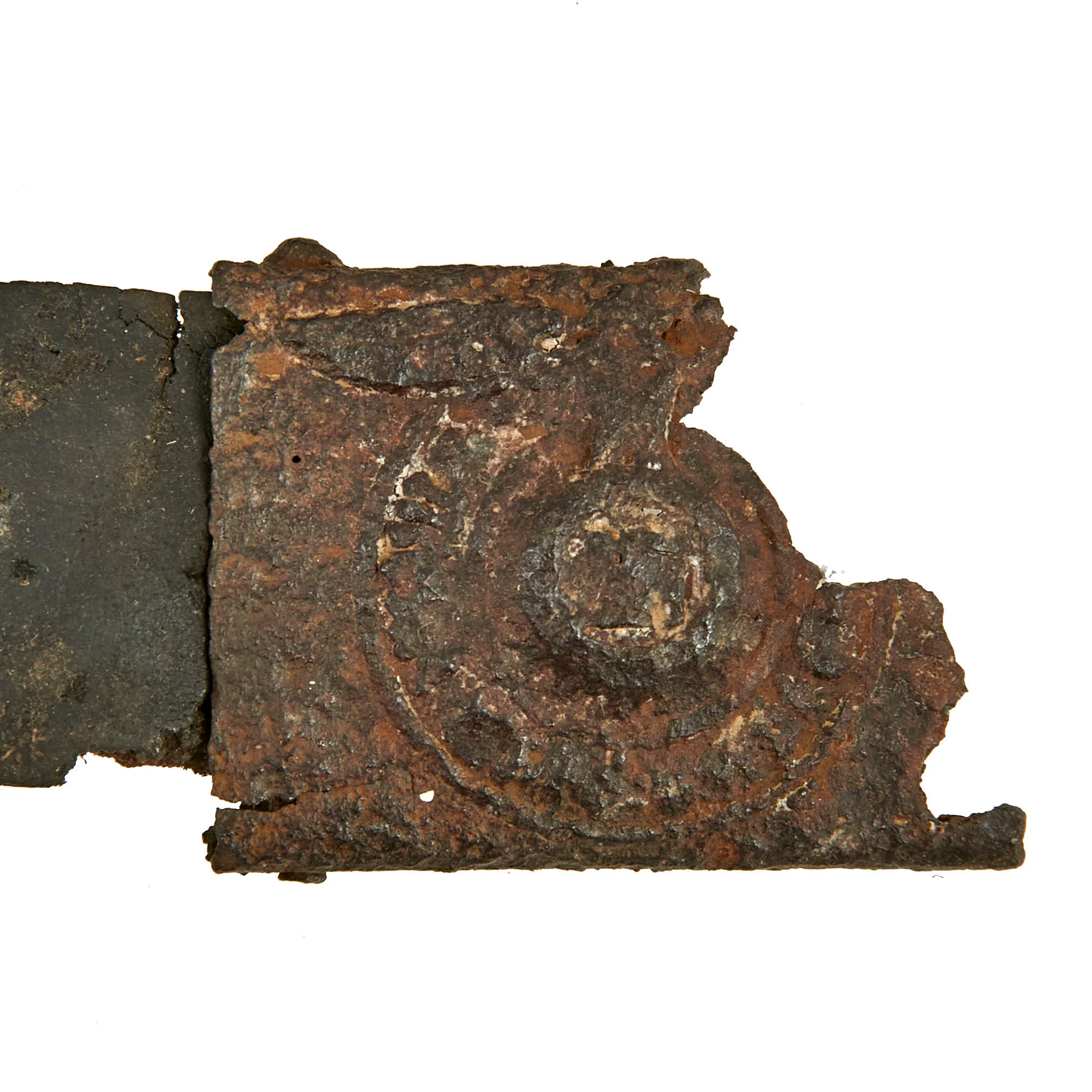
The relic has been demilitarized to BATF specifications, with the front receiver / barrel bushing cut off and removed, and was originally cut with a flame torch in several locations, which were later saw cut through, so a good part of the original receiver is missing. The lower frame is also included, as is the bakelite housing that surrounds the lower frame. There is part of the grip frame included, though a good portion has been saw cut off, along with the entire shoulder stock assembly. The parts set has definitely been cleaned, and we assume it has had treatment applied to stabilize the metal, though we do not know what type of treatment was used or how long ago. Please examine the 2000x2000 photos to see exactly what you will receiver. The set also comes with a letter from when it was purchased from Great War Relics in 2012 originally.
In spite of the past rusting, we actually can still make out the original maker information from the end cup of the lower frame, which reads:
MP 40
ayf 42
cos
The letter code "ayf" stands for maker ERMA-Erfurter Maschinenfabrik B Geipel GmbH, Erfurt, the company that developed the MP38 and MP40. There is also a faint serial number on the left side, however it is too degraded to read. "cos" is the code for Gebrüder Merz, Merz-Werke, Frankfurt, Main, a known maker of small arms components throughout the war.
If you were looking for a fantastic conversation piece to be part of your WWII collection, this is it! This is a true collector's piece that will only appreciate in value over the years to come!
History of the MP40-
The Maschinenpistole 40 ("Machine pistol 40") descended from its predecessor the MP 38, which was in turn based on the MP 36, a prototype made of machined steel. The MP 36 was developed independently by Erma Werke's Berthold Geipel with funding from the German Army. It took design elements from Heinrich Vollmer's VPM 1930 and EMP. Vollmer then worked on Berthold Geipel's MP 36 and in 1938 submitted a prototype to answer a request from the Heereswaffenamt (Army Weapons Office) for a new submachine gun, which was adopted as MP 38. The MP 38 was a simplification of the MP 36, and the MP 40 was a further simplification of the MP 38, with certain cost-saving alterations, most notably in the more extensive use of stamped steel rather than machined parts.
The MP 40 was often called the "Schmeisser" by the Allies, after the weapon designer Hugo Schmeisser. Schmeisser had designed the MP 18, which was the first mass-produced submachine gun in the world, and carried some resemblance to the MP 40. He did not, however, have anything to do with the design or development of the MP 40, although he held a patent on the magazine.
The M.P. 38 submachine gun started its life under requirements from German Heereswaffenamt (HWA, Army Weapons Office), which saw the need for a compact submachine gun, suitable for use by armored vehicles crews and paratroopers. German arms-making company Erfurter Maschinenfabrik Gmbh,better known under its trade name Erma, began the development of a new weapon under HWA specifications. It must be noted that a new submachine gun was not built from the scratch; instead, it was just an evolution of a rarely known prototype weapon, provisionally known as Erma MP-36. MP-36 was a compact version of the better known Erma EMP submachine gun, but fitted with now-familiar underfolding metallic shoulder stock and bottom-feed magazine, which was slightly canted forward to accommodate EMP magazines. MP-36 was a selective-fired weapon, and in fact the improved MP-38 was a simplified version of its little known predecessor, adapted for different magazine. Therefore, it took only few months before the new weapon was ready for official adoption and mass production. Manufacture of a new submachine gun, designated as MP-38, commenced in summer of 1938, at Erma, and later on also at C.G. Haenel.
The gun was manufactured for just 2 years, when it was replaced in production by externally similar, but less expensive MP-40, which used more stamped parts instead of machined parts, found in MP-38. There also were minor variations in design of MP-38, such as shape of cocking handle etc. MP-40 was also produced in a number of variations, which differed in shape of certain parts; also, toward the end of the war, several production shortcuts were introduced to save the costs of manufacturing. probably the most interesting variation of the MP-40 were the MP-40-II and MP-40-II. These guns featured dual magazine housings which hold two magazines in a laterally sliding bracket. This increase the total ammunition capacity "in the gun" to 64 rounds, in a desperate attempt to catch up with 71-round magazine capacity of Soviet PPSh-41. The later variant, MP-40-II, was made in limited numbers, but turned out to be a failure - sliding dual-magazine housing was a constant source of jams and failures, and was very sensitive to dirt and fouling.
Nevertheless, MP-38 and especially MP-40 submachine guns were of good design, and set the pattern for so called "second generation" of submachine guns ("first generation" being represented by the wood-stocked and carefully machined MP-18, MP-28 and the like). The second generation weapons usually were of compact design, and made using mostly steel stampings and pressings, or castings.
Both MP-38 and MP-40 submachine guns are blowback operated weapons that fired from open bolt. Both weapons were full-automatic only, but relatively slow rate of fire permitted for single shots with short trigger pulls. The proprietary bolt system with telescoped return spring guide served as a pneumatic recoil buffer, helping to decrease rate of fire to a very manageable level. The bolt handle was permanently attached to the bolt on early MP-38's; on late production MP-38's and MP-40's bolt handle was made as a separate part and also served as a safety- pushing the head of bolt handle inward locked the bolt either in cocked or forward position. Lack of such feature on early MP-38's resulted in field expedients such as leather harnesses with small loop, used to hold the bolt in forward position. One unusual feature on most MP-38 and MP-40 submachine guns was an aluminum or plastic rail under the barrel, which served as a barrel support /protector when firing over the board of armored personnel carrier. The short handguard was made from plastic and was located between magazine housing and pistol grip; barrel lacked any heat insulation, which often caused burns for supporting hand. Folding shoulder stock resulted for compact weapon when folded, but it was insufficiently durable for combat use and hand-to-hand combat. Single-feed, double-row box magazine was another weak point of the design; it was hard to load without additional help, and often caused jams.
Characteristics:
Caliber: 9x19mm Luger/Para
Weight: 4,7 kg loaded, 4,03 kg empty
Length (stock closed/open): 630/833 mm
Barrel length: mm
Rate of fire: 500 rounds per minute
Magazine capacity: 32 rounds
Effective range: ca. 100 meters

Details & Craftsmanship
Every detail has been carefully considered to bring you the perfect product.

Details & Craftsmanship
Every detail has been carefully considered to bring you the perfect product.

Details & Craftsmanship
Every detail has been carefully considered to bring you the perfect product.

Details & Craftsmanship
Every detail has been carefully considered to bring you the perfect product.

Details & Craftsmanship
Every detail has been carefully considered to bring you the perfect product.

Details & Craftsmanship
Every detail has been carefully considered to bring you the perfect product.

Details & Craftsmanship
Every detail has been carefully considered to bring you the perfect product.

Details & Craftsmanship
Every detail has been carefully considered to bring you the perfect product.

Details & Craftsmanship
Every detail has been carefully considered to bring you the perfect product.
Description
Original Item: Only One Available. Now THIS is an offering for someone who really appreciates PATINA! This is a wonderful "Battlefield Dug Up" German WWII MP 40 inert submachine gun parts set, dug up from the Falaise Pocket area. This is where the decisive battle during the Battle of Normandy took place, when German Army Group B was encircled by Allied forces, resulting in the destruction of the formation west of the River Seine. The liberation of Paris followed soon afterwards.
The relic has been demilitarized to BATF specifications, with the front receiver / barrel bushing cut off and removed, and was originally cut with a flame torch in several locations, which were later saw cut through, so a good part of the original receiver is missing. The lower frame is also included, as is the bakelite housing that surrounds the lower frame. There is part of the grip frame included, though a good portion has been saw cut off, along with the entire shoulder stock assembly. The parts set has definitely been cleaned, and we assume it has had treatment applied to stabilize the metal, though we do not know what type of treatment was used or how long ago. Please examine the 2000x2000 photos to see exactly what you will receiver. The set also comes with a letter from when it was purchased from Great War Relics in 2012 originally.
In spite of the past rusting, we actually can still make out the original maker information from the end cup of the lower frame, which reads:
MP 40
ayf 42
cos
The letter code "ayf" stands for maker ERMA-Erfurter Maschinenfabrik B Geipel GmbH, Erfurt, the company that developed the MP38 and MP40. There is also a faint serial number on the left side, however it is too degraded to read. "cos" is the code for Gebrüder Merz, Merz-Werke, Frankfurt, Main, a known maker of small arms components throughout the war.
If you were looking for a fantastic conversation piece to be part of your WWII collection, this is it! This is a true collector's piece that will only appreciate in value over the years to come!
History of the MP40-
The Maschinenpistole 40 ("Machine pistol 40") descended from its predecessor the MP 38, which was in turn based on the MP 36, a prototype made of machined steel. The MP 36 was developed independently by Erma Werke's Berthold Geipel with funding from the German Army. It took design elements from Heinrich Vollmer's VPM 1930 and EMP. Vollmer then worked on Berthold Geipel's MP 36 and in 1938 submitted a prototype to answer a request from the Heereswaffenamt (Army Weapons Office) for a new submachine gun, which was adopted as MP 38. The MP 38 was a simplification of the MP 36, and the MP 40 was a further simplification of the MP 38, with certain cost-saving alterations, most notably in the more extensive use of stamped steel rather than machined parts.
The MP 40 was often called the "Schmeisser" by the Allies, after the weapon designer Hugo Schmeisser. Schmeisser had designed the MP 18, which was the first mass-produced submachine gun in the world, and carried some resemblance to the MP 40. He did not, however, have anything to do with the design or development of the MP 40, although he held a patent on the magazine.
The M.P. 38 submachine gun started its life under requirements from German Heereswaffenamt (HWA, Army Weapons Office), which saw the need for a compact submachine gun, suitable for use by armored vehicles crews and paratroopers. German arms-making company Erfurter Maschinenfabrik Gmbh,better known under its trade name Erma, began the development of a new weapon under HWA specifications. It must be noted that a new submachine gun was not built from the scratch; instead, it was just an evolution of a rarely known prototype weapon, provisionally known as Erma MP-36. MP-36 was a compact version of the better known Erma EMP submachine gun, but fitted with now-familiar underfolding metallic shoulder stock and bottom-feed magazine, which was slightly canted forward to accommodate EMP magazines. MP-36 was a selective-fired weapon, and in fact the improved MP-38 was a simplified version of its little known predecessor, adapted for different magazine. Therefore, it took only few months before the new weapon was ready for official adoption and mass production. Manufacture of a new submachine gun, designated as MP-38, commenced in summer of 1938, at Erma, and later on also at C.G. Haenel.
The gun was manufactured for just 2 years, when it was replaced in production by externally similar, but less expensive MP-40, which used more stamped parts instead of machined parts, found in MP-38. There also were minor variations in design of MP-38, such as shape of cocking handle etc. MP-40 was also produced in a number of variations, which differed in shape of certain parts; also, toward the end of the war, several production shortcuts were introduced to save the costs of manufacturing. probably the most interesting variation of the MP-40 were the MP-40-II and MP-40-II. These guns featured dual magazine housings which hold two magazines in a laterally sliding bracket. This increase the total ammunition capacity "in the gun" to 64 rounds, in a desperate attempt to catch up with 71-round magazine capacity of Soviet PPSh-41. The later variant, MP-40-II, was made in limited numbers, but turned out to be a failure - sliding dual-magazine housing was a constant source of jams and failures, and was very sensitive to dirt and fouling.
Nevertheless, MP-38 and especially MP-40 submachine guns were of good design, and set the pattern for so called "second generation" of submachine guns ("first generation" being represented by the wood-stocked and carefully machined MP-18, MP-28 and the like). The second generation weapons usually were of compact design, and made using mostly steel stampings and pressings, or castings.
Both MP-38 and MP-40 submachine guns are blowback operated weapons that fired from open bolt. Both weapons were full-automatic only, but relatively slow rate of fire permitted for single shots with short trigger pulls. The proprietary bolt system with telescoped return spring guide served as a pneumatic recoil buffer, helping to decrease rate of fire to a very manageable level. The bolt handle was permanently attached to the bolt on early MP-38's; on late production MP-38's and MP-40's bolt handle was made as a separate part and also served as a safety- pushing the head of bolt handle inward locked the bolt either in cocked or forward position. Lack of such feature on early MP-38's resulted in field expedients such as leather harnesses with small loop, used to hold the bolt in forward position. One unusual feature on most MP-38 and MP-40 submachine guns was an aluminum or plastic rail under the barrel, which served as a barrel support /protector when firing over the board of armored personnel carrier. The short handguard was made from plastic and was located between magazine housing and pistol grip; barrel lacked any heat insulation, which often caused burns for supporting hand. Folding shoulder stock resulted for compact weapon when folded, but it was insufficiently durable for combat use and hand-to-hand combat. Single-feed, double-row box magazine was another weak point of the design; it was hard to load without additional help, and often caused jams.
Characteristics:
Caliber: 9x19mm Luger/Para
Weight: 4,7 kg loaded, 4,03 kg empty
Length (stock closed/open): 630/833 mm
Barrel length: mm
Rate of fire: 500 rounds per minute
Magazine capacity: 32 rounds
Effective range: ca. 100 meters