
Original: $695.00
-70%$695.00
$208.50The Story
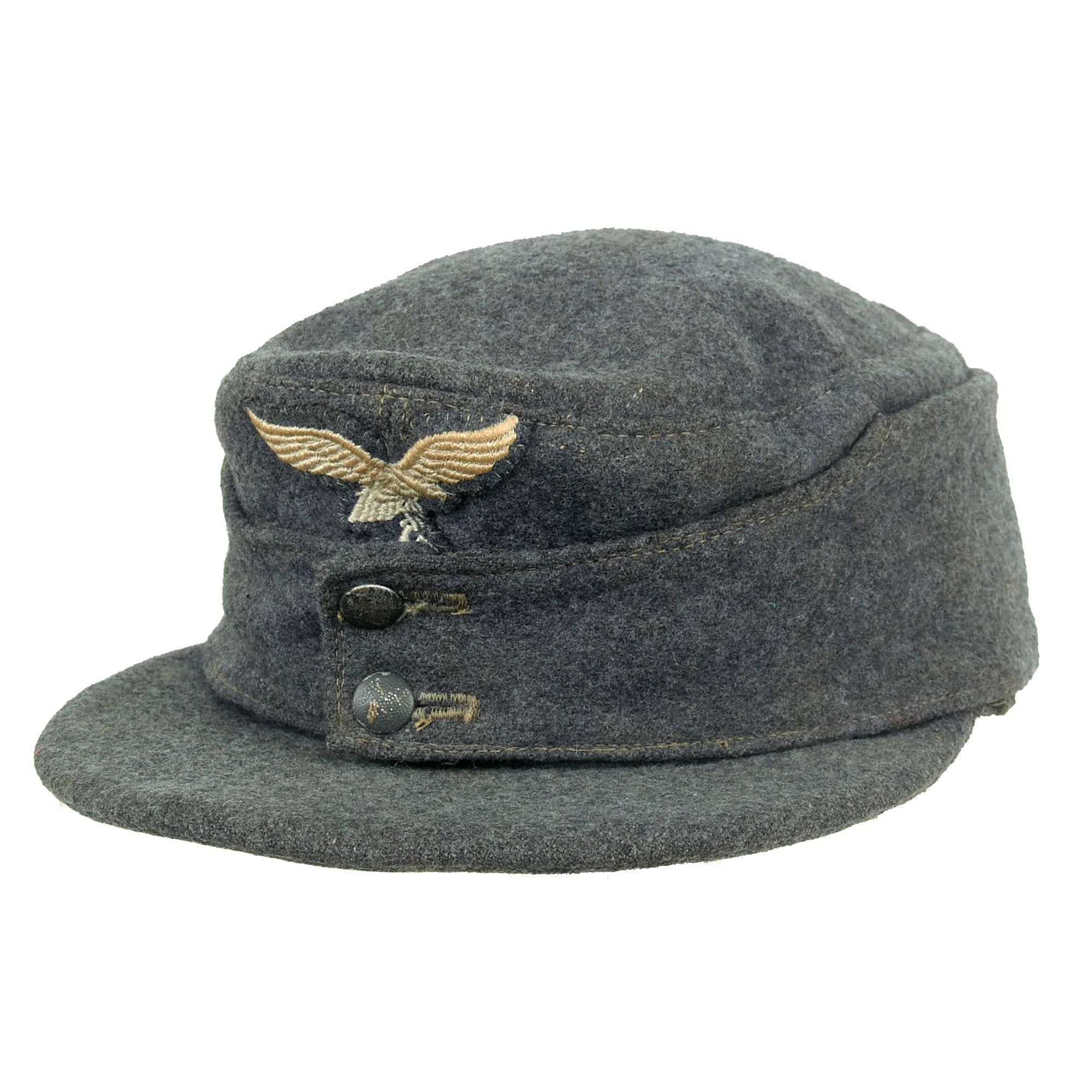
Original Item: Only One Available. This is a great looking German WWII M43 Flakhelferin Female Flak Helper Feldmütze (Field Cap), marked with Size 58 and dated 1944. These were the standard headgear for women who were attached to the Luftwaffe as auxiliaries, and who manned anti-aircraft Flak cannons in the defense of the Third Reich as the war drew to a close. These are identical to the caps used by the H J National Youth Organization in the same function, except they have a Luftwaffe Eagle on the front, and not the H J Diamond.
It is constructed of Luftwaffe bluish gray worsted wool gabardine cloth, with fold-down panels with rounded scallops to the front and forward sides, covering the entire neck on the sides and rear when in use. When not in use, the panels are raised with their ends resting upon the visor, being joined together by a single pebbled aluminum button, which is painted Luftwaffe blue. The visor is reinforced with cardboard, and covered in matching gabardine cloth.
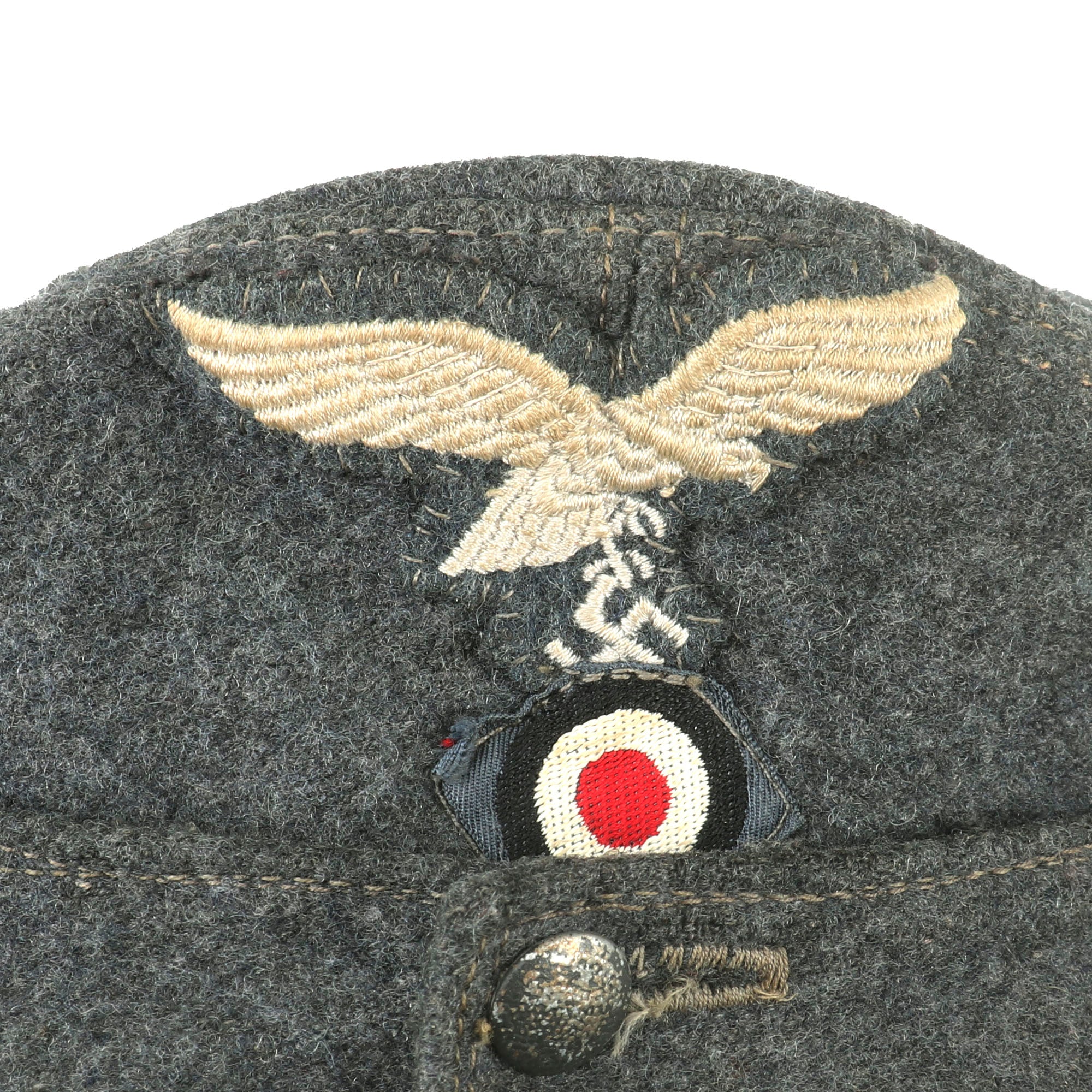
Sewn in place in the front of the cap is a machine embroidered Luftwaffe Eagle, with silver gray threading on a slate blue background. This patch is original to the cap and is machine sewn only to the outer fabric. The patch is in very clean crisp condition with no major damage, showing light wear and a bit of mothing to the badge cloth base material.
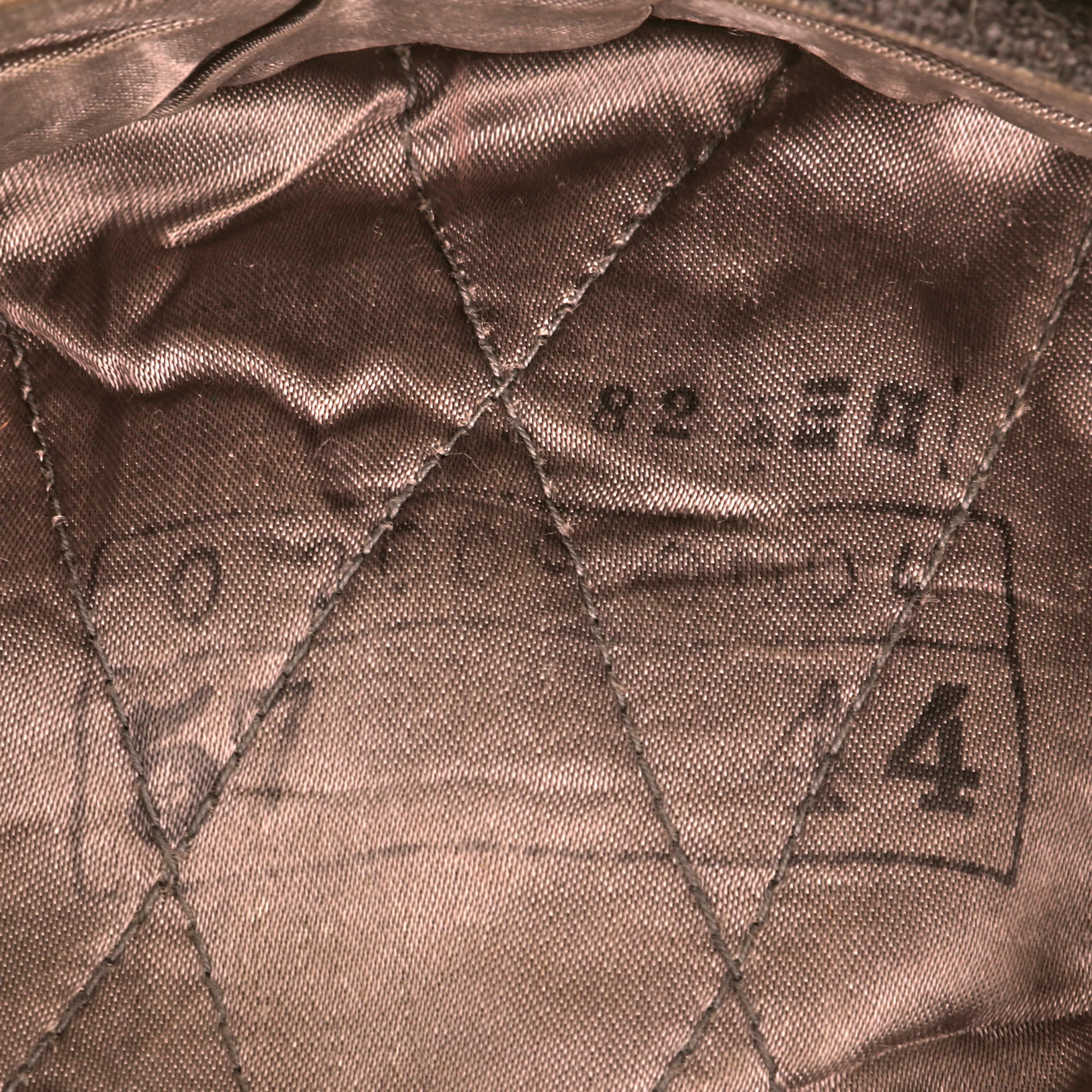
The interior of the cap is lined with gray blue rayon, which has very minor sweat staining around the contact areas but is in very good condition overall, save for a torn seam on the inner front crown. There is a faint RBNr. stamp on the crown, which looks to read 0 / 2009 / 0004, and below this is 57, and to the right 44. These are inside a rectangle, the usual way markings are on these caps, and there is the number 82 with some symbols above. The visor is still quite well shaped, with a nice bend, though it does feel like there is a crack / bend at one location.
Overall, this is a great looking wartime used Flakhelferin M43 field cap!
A Luftwaffenhelfer, also commonly known as a Flakhelfer, was any member of the auxiliary staff of the German Luftwaffe during World War II. Such terms often implied students conscripted as child soldiers.
Luftwaffenhelfer (literally, "air force assistants") were established on January 22, 1943, following implementation of the decree Kriegshilfseinsatz der Jugend bei der Luftwaffe ("Youth War Assistance Service in the Air Force"). The order called for drafting whole school classes of male students born in 1926 and 1927 into a military corps, supervised by HJ and Luftwaffe personnel. The draft was later extended to include 1928 and 1929 births, as well as female children. Deployment included ideological indoctrination by the HJ, military duties and limited continuation of the normal school curriculum, often by the original teachers.
While the official term was Luftwaffenhelfer (HJ), the term more commonly used is Flakhelfer (female: Flakhelferin) (Flak-helper). The 1926–1929 births are commonly referred to as the "Flakhelfer-Generation". In German culture, the phrase is associated with the collective and incisive experience of being torn out of conventional adolescent life through circumstances of total war and being thrown into strict military service and extreme peril; in the final phase of the war, the antiaircraft batteries became preferred targets of Allied aircraft.
In August 1944, some 660,000 regular male soldiers and 450,000 female helpers (anti-aircraft personnel) in all departments served with the Luftwaffe within the 'auxiliary antiaircraft defense'. Many of the girls came from the Bund Deutscher Mädel (BDM), although they had to officially join the Wehrmacht because it was forbidden for BDM members to do armed duty. In 1945, "Flakhelferinnen" and other female assistants were trained and allowed to carry weapons to defend themselves.
The M43 Feldmütze (Field Cap) is a variety of "Ski Cap" and was based on the Bergmütze (Mountain Hat) used by Austrian and German Gebirgsjäger (Mountain Troops) during WWI. Germany had adopted it in 1915, and after the war it spread throughout the military.
The skirt that surrounds the cap is made in the same wool as the cap, and can be folded down over the ears, though this was rarely done outside of the Mountain troops, which had a double-thickness skirt. The skirt has a small dip in the front quarter with a divide secured by one aluminum button which is covered by an embroidered cockade. The small section in the front quarter was built shorter to show the insignia, and cover the wearer's chin or mouth, without disturbing breathing by covering the nose. There were also later M43 caps, such as those used by the DAK, that omitted the skirt entirely, as it had little use in the desert heat.

Details & Craftsmanship
Every detail has been carefully considered to bring you the perfect product.

Details & Craftsmanship
Every detail has been carefully considered to bring you the perfect product.

Details & Craftsmanship
Every detail has been carefully considered to bring you the perfect product.
Details & Craftsmanship
Every detail has been carefully considered to bring you the perfect product.

Details & Craftsmanship
Every detail has been carefully considered to bring you the perfect product.

Details & Craftsmanship
Every detail has been carefully considered to bring you the perfect product.

Details & Craftsmanship
Every detail has been carefully considered to bring you the perfect product.

Details & Craftsmanship
Every detail has been carefully considered to bring you the perfect product.

Details & Craftsmanship
Every detail has been carefully considered to bring you the perfect product.

Details & Craftsmanship
Every detail has been carefully considered to bring you the perfect product.

Details & Craftsmanship
Every detail has been carefully considered to bring you the perfect product.

Details & Craftsmanship
Every detail has been carefully considered to bring you the perfect product.

Details & Craftsmanship
Every detail has been carefully considered to bring you the perfect product.
Description
Original Item: Only One Available. This is a great looking German WWII M43 Flakhelferin Female Flak Helper Feldmütze (Field Cap), marked with Size 58 and dated 1944. These were the standard headgear for women who were attached to the Luftwaffe as auxiliaries, and who manned anti-aircraft Flak cannons in the defense of the Third Reich as the war drew to a close. These are identical to the caps used by the H J National Youth Organization in the same function, except they have a Luftwaffe Eagle on the front, and not the H J Diamond.
It is constructed of Luftwaffe bluish gray worsted wool gabardine cloth, with fold-down panels with rounded scallops to the front and forward sides, covering the entire neck on the sides and rear when in use. When not in use, the panels are raised with their ends resting upon the visor, being joined together by a single pebbled aluminum button, which is painted Luftwaffe blue. The visor is reinforced with cardboard, and covered in matching gabardine cloth.
Sewn in place in the front of the cap is a machine embroidered Luftwaffe Eagle, with silver gray threading on a slate blue background. This patch is original to the cap and is machine sewn only to the outer fabric. The patch is in very clean crisp condition with no major damage, showing light wear and a bit of mothing to the badge cloth base material.
The interior of the cap is lined with gray blue rayon, which has very minor sweat staining around the contact areas but is in very good condition overall, save for a torn seam on the inner front crown. There is a faint RBNr. stamp on the crown, which looks to read 0 / 2009 / 0004, and below this is 57, and to the right 44. These are inside a rectangle, the usual way markings are on these caps, and there is the number 82 with some symbols above. The visor is still quite well shaped, with a nice bend, though it does feel like there is a crack / bend at one location.
Overall, this is a great looking wartime used Flakhelferin M43 field cap!
A Luftwaffenhelfer, also commonly known as a Flakhelfer, was any member of the auxiliary staff of the German Luftwaffe during World War II. Such terms often implied students conscripted as child soldiers.
Luftwaffenhelfer (literally, "air force assistants") were established on January 22, 1943, following implementation of the decree Kriegshilfseinsatz der Jugend bei der Luftwaffe ("Youth War Assistance Service in the Air Force"). The order called for drafting whole school classes of male students born in 1926 and 1927 into a military corps, supervised by HJ and Luftwaffe personnel. The draft was later extended to include 1928 and 1929 births, as well as female children. Deployment included ideological indoctrination by the HJ, military duties and limited continuation of the normal school curriculum, often by the original teachers.
While the official term was Luftwaffenhelfer (HJ), the term more commonly used is Flakhelfer (female: Flakhelferin) (Flak-helper). The 1926–1929 births are commonly referred to as the "Flakhelfer-Generation". In German culture, the phrase is associated with the collective and incisive experience of being torn out of conventional adolescent life through circumstances of total war and being thrown into strict military service and extreme peril; in the final phase of the war, the antiaircraft batteries became preferred targets of Allied aircraft.
In August 1944, some 660,000 regular male soldiers and 450,000 female helpers (anti-aircraft personnel) in all departments served with the Luftwaffe within the 'auxiliary antiaircraft defense'. Many of the girls came from the Bund Deutscher Mädel (BDM), although they had to officially join the Wehrmacht because it was forbidden for BDM members to do armed duty. In 1945, "Flakhelferinnen" and other female assistants were trained and allowed to carry weapons to defend themselves.
The M43 Feldmütze (Field Cap) is a variety of "Ski Cap" and was based on the Bergmütze (Mountain Hat) used by Austrian and German Gebirgsjäger (Mountain Troops) during WWI. Germany had adopted it in 1915, and after the war it spread throughout the military.
The skirt that surrounds the cap is made in the same wool as the cap, and can be folded down over the ears, though this was rarely done outside of the Mountain troops, which had a double-thickness skirt. The skirt has a small dip in the front quarter with a divide secured by one aluminum button which is covered by an embroidered cockade. The small section in the front quarter was built shorter to show the insignia, and cover the wearer's chin or mouth, without disturbing breathing by covering the nose. There were also later M43 caps, such as those used by the DAK, that omitted the skirt entirely, as it had little use in the desert heat.