
Original: $1,995.00
-70%$1,995.00
$598.50The Story
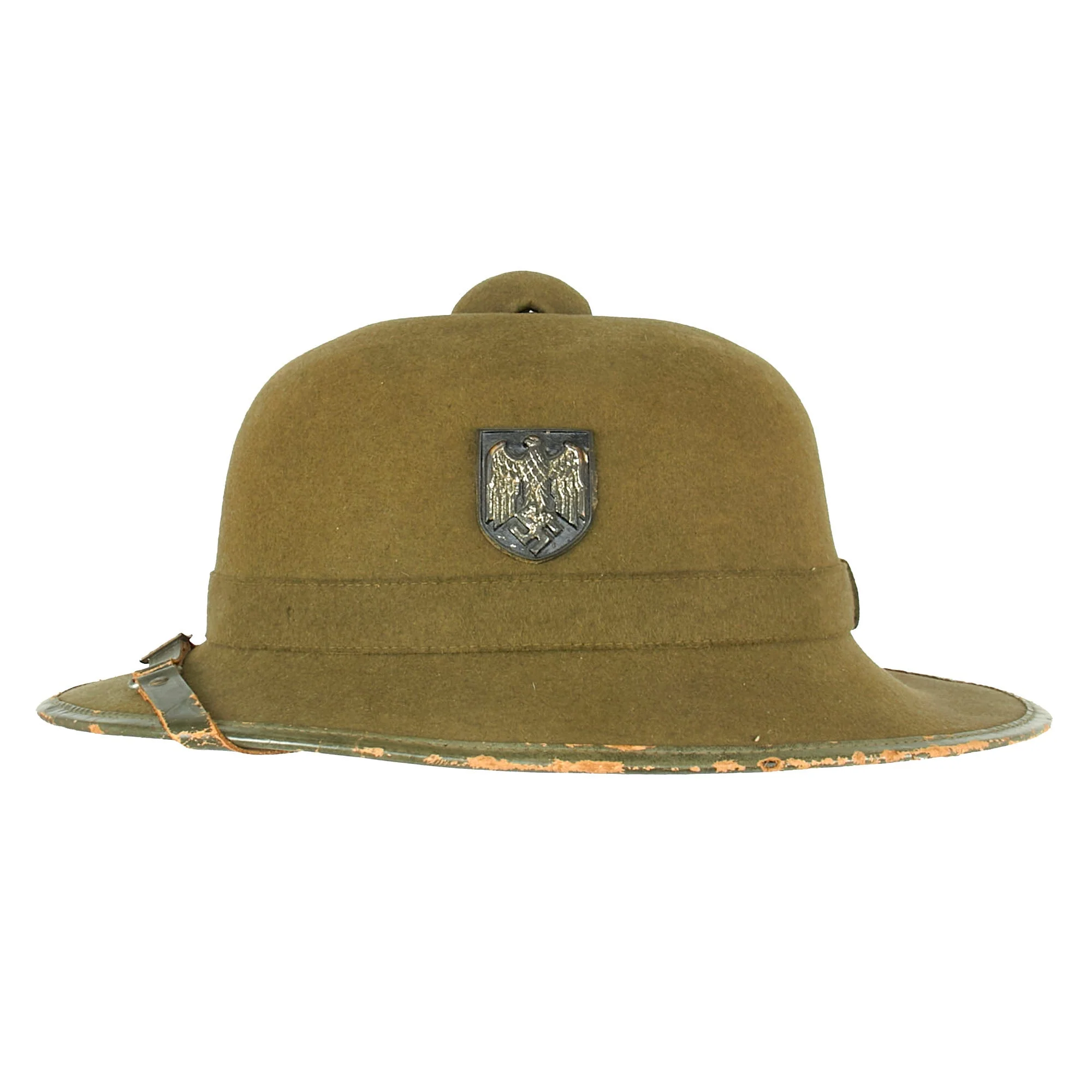
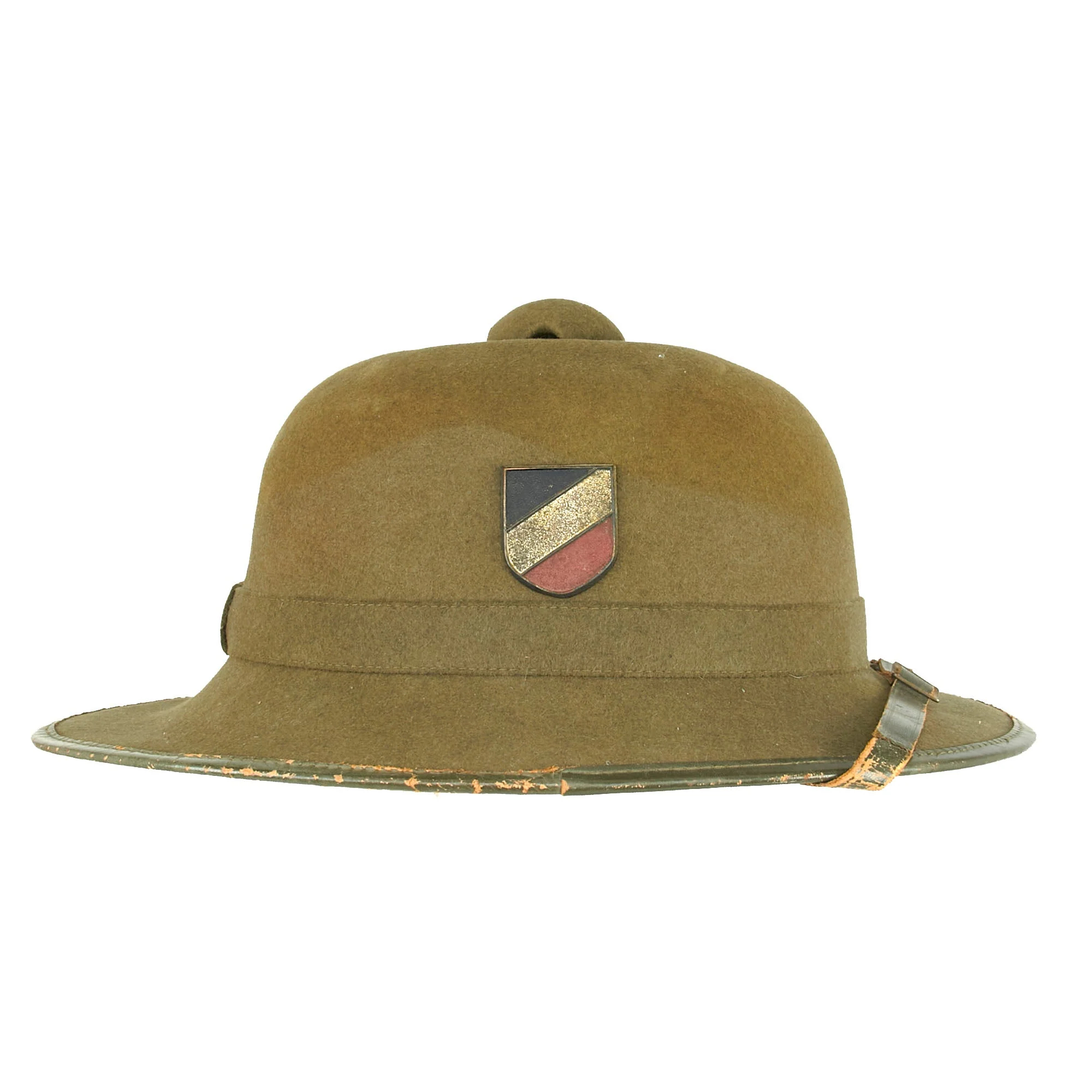
Original Item: Only One Available. This is a very good condition all original example of a German WWII M35 helmet shell, as issued to the Heer (Army), with very desirable "Double Decals". This stamped sheet steel construction helmet still retains the early war smooth Apfel-grün (apple green) paint, which is retained at over 80%, making it a really great example of a Pre-War produced helmet. There is overall wear and oxidation, however there is no major damage or denting we can see. It does look like it was lacquered in the past to protect it, commonly done during the mid 20th century, however much of the lacquer is worn away now.
The use of the second decal was discontinued in 1940, and in 1943 it was ordered that helmets with the national colors have them removed. The decal on this helmet does look to have possibly been overpainted at one point, however it is now definitely uncovered and visible. The left side of the helmet features a lovely Heer eagle decal, which is retained about 80%, with some small areas chipped away but still looking great, well protected by the lacquer. The right side of the helmet features a national colors decal, which is retained about 60%, showing overall wear and checking, as well as discoloration. Definitely lots of history here!
The reverse, interior, neck guard apron is lot number stamped D.225 and the interior, left side, apron has the stamped manufacturer's code and size NS64, indicating that it was manufactured by Vereinigte Deutsche Nikelwerke, of Schwerte, Germany. Size 64 is a nice medium size that can accommodate liners from 56cm to 57cm or US 7 to 7 1/8. Size 64 shells are harder to find and are therefore more valuable to a collector.
All three of the original liner split pins are present, with the original paint retained almost completely. The interior of the helmet still has the original M31 leather liner with all eight of its fingers fully intact, complete with the top securing strap, which is untied. The leather has a lovely chestnut brown color, and is still supple, with no tearing, just some splitting around the bottom edge. The liner band is aluminum, with square aluminum chin strap loops attached to reinforced sides. This is the last pattern before the move to galvanized steel bands, as aluminum was scarce. The left exterior liner band over the left ear is marked 64 n.A / 57, indicating that this is a size 57 liner for a size 64 shell. There is also a very faint 57 in a circle on one of the rear fingers. The right side displays the full manufacture information, as well as a date:
SCHUBERTH-WERKE K.-G.
D. R. P.
1939
BRAUNSCHWEIG
The helmet still has a very nice early pattern chinstrap installed, which has the correct aluminum buckle, and attachment studs. The leather is still mostly solid, and the longer section still has all thirteen of the length adjustment holes. The leather is a bit stiff, showing wear, but we do not see any tears or repairs. It is maker marked and dated on the end with RAHM & KAMPMANN/ WUPPERTAL / 1938.
Overall a fantastic 100% genuine M35 Double Decal Heer Army helmet with loads of history and a complete liner with chinstrap! This is an item that will only continue to appreciate in value over time!
The first "modern" steel helmets were introduced by the French army in early 1915 and were shortly followed by the British army later that year. With plans on the drawing board, experimental helmets in the field, ("Gaede" helmet), and some captured French and British helmets the German army began tests for their own steel helmet at the Kummersdorf Proving Grounds in November, and in the field in December 1915. An acceptable pattern was developed and approved and production began at Eisen-und Hüttenwerke, AG Thale/Harz, (Iron and Foundry Works), in the spring of 1916.
These first modern M16 helmets evolved into the M18 helmets by the end of WWI. The M16 and M18 helmets remained in usage through-out the Weimar Reichswehr, (National Defence Force, Circa 1919-1933), era and on into the early years of the Third Reich until the development of the smaller, lighter M35 style helmet in June 1935.
The Luftwaffe pattern national eagle was originally introduced for wear by Fliegerschaft, (Pilot Base), personnel of the DLV, Deutscher Luftsportsverband, (German Air Sports Association), the clandestine, civilian, forerunner of the Luftwaffe on August 18TH 1934, and adopted for wear by the Luftwaffe on March 1ST 1935 along with the national tri-color shield for wear on the helmet.
The first pattern national eagle was utilized until a modified second pattern eagle was introduced in late 1936 or early 1937. Regulations of June 12TH 1940 discontinued the use of the national tri-color decal and further regulations of August 28TH 1943 abolished the national eagle decal and dictated that it was also to be removed from all helmets although the directives were not completely adhered to.

Details & Craftsmanship
Every detail has been carefully considered to bring you the perfect product.

Details & Craftsmanship
Every detail has been carefully considered to bring you the perfect product.

Details & Craftsmanship
Every detail has been carefully considered to bring you the perfect product.

Details & Craftsmanship
Every detail has been carefully considered to bring you the perfect product.

Details & Craftsmanship
Every detail has been carefully considered to bring you the perfect product.

Details & Craftsmanship
Every detail has been carefully considered to bring you the perfect product.

Details & Craftsmanship
Every detail has been carefully considered to bring you the perfect product.

Details & Craftsmanship
Every detail has been carefully considered to bring you the perfect product.

Details & Craftsmanship
Every detail has been carefully considered to bring you the perfect product.

Details & Craftsmanship
Every detail has been carefully considered to bring you the perfect product.

Details & Craftsmanship
Every detail has been carefully considered to bring you the perfect product.

Details & Craftsmanship
Every detail has been carefully considered to bring you the perfect product.

Details & Craftsmanship
Every detail has been carefully considered to bring you the perfect product.

Details & Craftsmanship
Every detail has been carefully considered to bring you the perfect product.

Details & Craftsmanship
Every detail has been carefully considered to bring you the perfect product.
Description
Original Item: Only One Available. This is a very good condition all original example of a German WWII M35 helmet shell, as issued to the Heer (Army), with very desirable "Double Decals". This stamped sheet steel construction helmet still retains the early war smooth Apfel-grün (apple green) paint, which is retained at over 80%, making it a really great example of a Pre-War produced helmet. There is overall wear and oxidation, however there is no major damage or denting we can see. It does look like it was lacquered in the past to protect it, commonly done during the mid 20th century, however much of the lacquer is worn away now.
The use of the second decal was discontinued in 1940, and in 1943 it was ordered that helmets with the national colors have them removed. The decal on this helmet does look to have possibly been overpainted at one point, however it is now definitely uncovered and visible. The left side of the helmet features a lovely Heer eagle decal, which is retained about 80%, with some small areas chipped away but still looking great, well protected by the lacquer. The right side of the helmet features a national colors decal, which is retained about 60%, showing overall wear and checking, as well as discoloration. Definitely lots of history here!
The reverse, interior, neck guard apron is lot number stamped D.225 and the interior, left side, apron has the stamped manufacturer's code and size NS64, indicating that it was manufactured by Vereinigte Deutsche Nikelwerke, of Schwerte, Germany. Size 64 is a nice medium size that can accommodate liners from 56cm to 57cm or US 7 to 7 1/8. Size 64 shells are harder to find and are therefore more valuable to a collector.
All three of the original liner split pins are present, with the original paint retained almost completely. The interior of the helmet still has the original M31 leather liner with all eight of its fingers fully intact, complete with the top securing strap, which is untied. The leather has a lovely chestnut brown color, and is still supple, with no tearing, just some splitting around the bottom edge. The liner band is aluminum, with square aluminum chin strap loops attached to reinforced sides. This is the last pattern before the move to galvanized steel bands, as aluminum was scarce. The left exterior liner band over the left ear is marked 64 n.A / 57, indicating that this is a size 57 liner for a size 64 shell. There is also a very faint 57 in a circle on one of the rear fingers. The right side displays the full manufacture information, as well as a date:
SCHUBERTH-WERKE K.-G.
D. R. P.
1939
BRAUNSCHWEIG
The helmet still has a very nice early pattern chinstrap installed, which has the correct aluminum buckle, and attachment studs. The leather is still mostly solid, and the longer section still has all thirteen of the length adjustment holes. The leather is a bit stiff, showing wear, but we do not see any tears or repairs. It is maker marked and dated on the end with RAHM & KAMPMANN/ WUPPERTAL / 1938.
Overall a fantastic 100% genuine M35 Double Decal Heer Army helmet with loads of history and a complete liner with chinstrap! This is an item that will only continue to appreciate in value over time!
The first "modern" steel helmets were introduced by the French army in early 1915 and were shortly followed by the British army later that year. With plans on the drawing board, experimental helmets in the field, ("Gaede" helmet), and some captured French and British helmets the German army began tests for their own steel helmet at the Kummersdorf Proving Grounds in November, and in the field in December 1915. An acceptable pattern was developed and approved and production began at Eisen-und Hüttenwerke, AG Thale/Harz, (Iron and Foundry Works), in the spring of 1916.
These first modern M16 helmets evolved into the M18 helmets by the end of WWI. The M16 and M18 helmets remained in usage through-out the Weimar Reichswehr, (National Defence Force, Circa 1919-1933), era and on into the early years of the Third Reich until the development of the smaller, lighter M35 style helmet in June 1935.
The Luftwaffe pattern national eagle was originally introduced for wear by Fliegerschaft, (Pilot Base), personnel of the DLV, Deutscher Luftsportsverband, (German Air Sports Association), the clandestine, civilian, forerunner of the Luftwaffe on August 18TH 1934, and adopted for wear by the Luftwaffe on March 1ST 1935 along with the national tri-color shield for wear on the helmet.
The first pattern national eagle was utilized until a modified second pattern eagle was introduced in late 1936 or early 1937. Regulations of June 12TH 1940 discontinued the use of the national tri-color decal and further regulations of August 28TH 1943 abolished the national eagle decal and dictated that it was also to be removed from all helmets although the directives were not completely adhered to.