
Original: $350.00
-70%$350.00
$105.00The Story
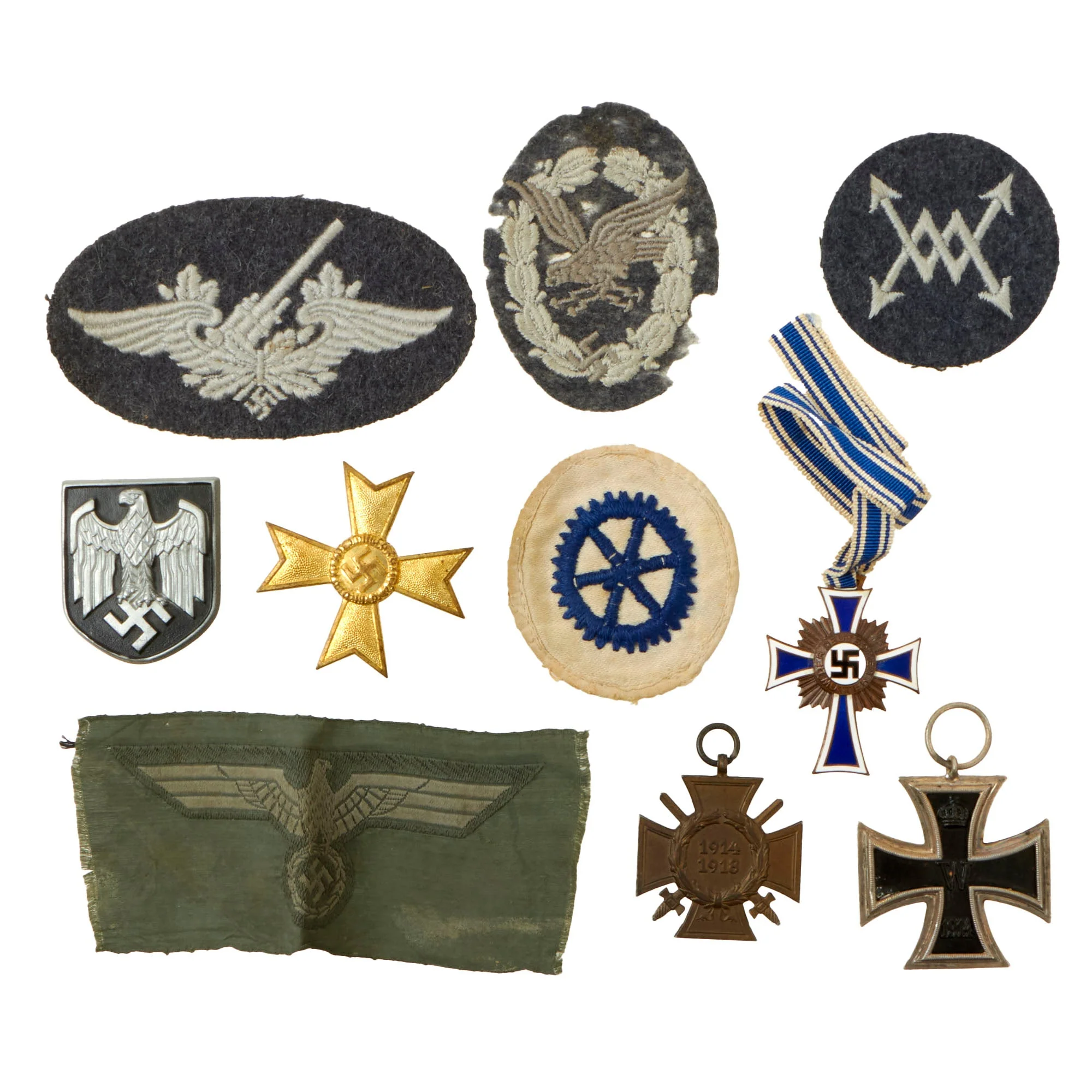
Original Items: Only One Set Available. This is a very nice collection of German WWII Insignia & Awards, which was brought back from the European theater by a USGI after the war was concluded. Many solders traded these on the way back, and would end up with a pocket full of various different collectible items, and this set represents the typical "haul" one might have come back with. It includes a good variety of medals and insignia, including a War Merit Crosses, an Eastern medal, a KvKII, and more!
This lovely set includes the following items we were able to identify:-
- One German WWII War Merit Cross 2nd Class with Swords (Kriegsverdienstkreuz II Klasse mit Schwertern). The award has lost the original ribbon as well as the ring and attachment loop on the top, and now displays an overall oxidized patina.
- One German WWII Eastern Front Medal (Ostmedaille) without ribbon. The medal still retains the top hanger ring, and it shows a lovely oxidized patina on both sides.
- One German WWII Civil Service Faithful Service Medal 2nd Class with "Austrian" style ribbon mount. The second class award for 25 years of service was a silver cross, with a silver wreath and a black enameled swas in the center of the cross. The medal is in great shape, showing just a bit of wear and oxidation. The color on the ribbon mount is well retained and the rear pin fully functional.
- 2nd Pattern National Socialist Women’s Organization Orts Level Membership Badge: The "National Socialist Frauenschaft" (National Socialist Women’s-organization) was formed by absorbing the earlier "Deutsches Frauenwerk" (German Women’s-welfare-organization), and the "Deutscher Frauenorden" (German Women’s-order), into a single national organization. The first pattern Frauenschaft member’s badge followed the design of the earlier "Deutscher Frauenorden" badge as introduced in the mid-1920s, with minor variations. In 1938 the first pattern badge was replaced with a modified second pattern member’s badge, which followed the design of the earlier "Deutsches Frauenwerk" badge. The alloy badge takes the form of a 30mm tall inverted triangle with a 29mm wide top edge. It features a black enamel central field, edged in blue enamel and silver, upon which is a silver national eagle above a silver "Leben-rune" (Life-rune).The badge features the silver Gothic script "NS.- Frauenschaft." To the reverse, to either side of its crimped and soldered vertical pin-back device, is an embossed RZM logo and ‘M1/34' for Karl Wurster, Markneukirchen. The blue border represents the ‘Orts’ (District) group level.
- One German WWII Feuerschutzpolizei (Fire Protection Police) NCO Sleeve Eagle, Pink on a dark Navy Blue Background. This insignia is specially for Werkfeuerwehr (Factory Fire Brigade) issue, responsible for putting out fires at factories. It is in good condition, showing wear and moth damage.
- One German WWII Kriegsmarine Navy Embroidered Breast Eagle. It is in very good condition, showing some wear and moth damage to the dark navy blue background.
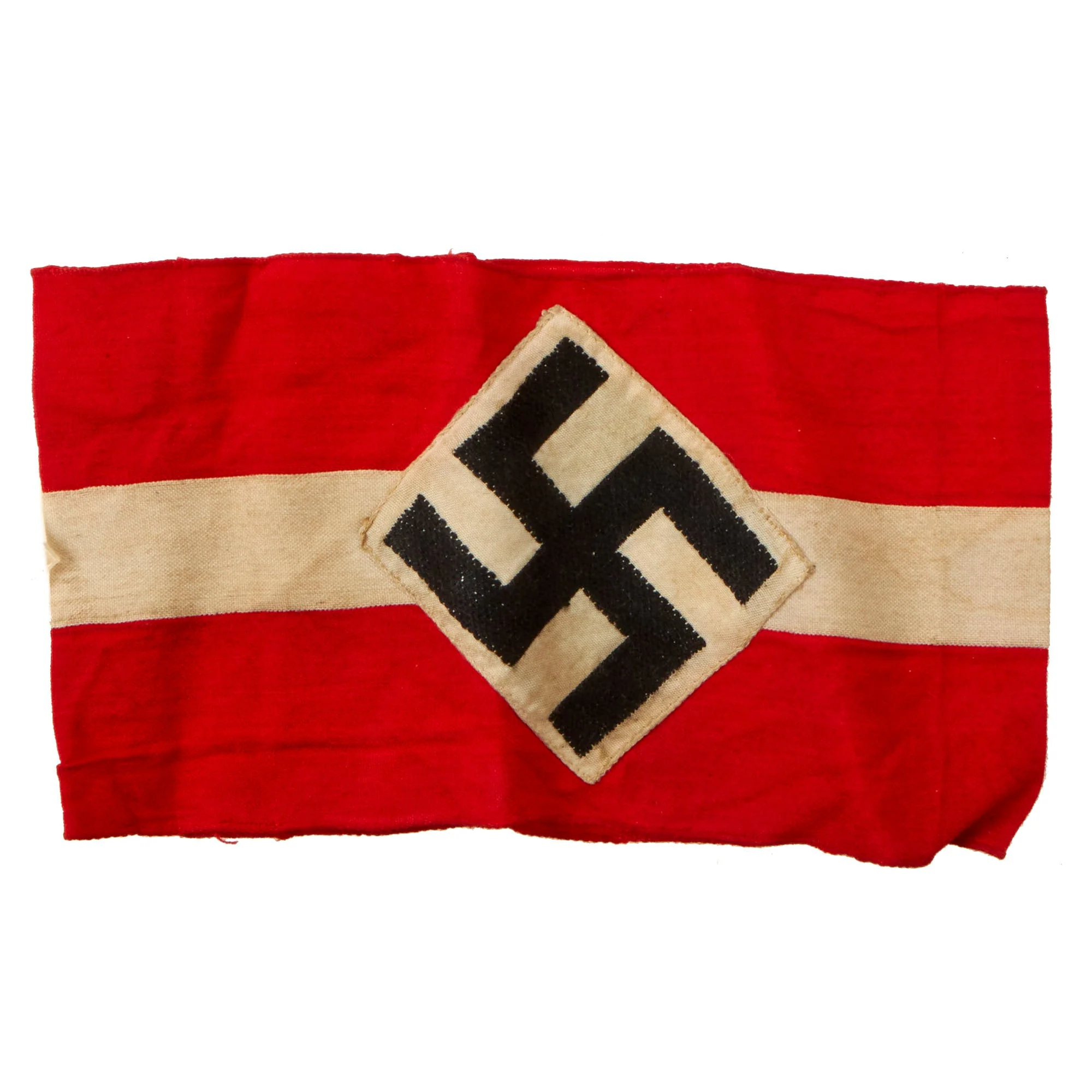
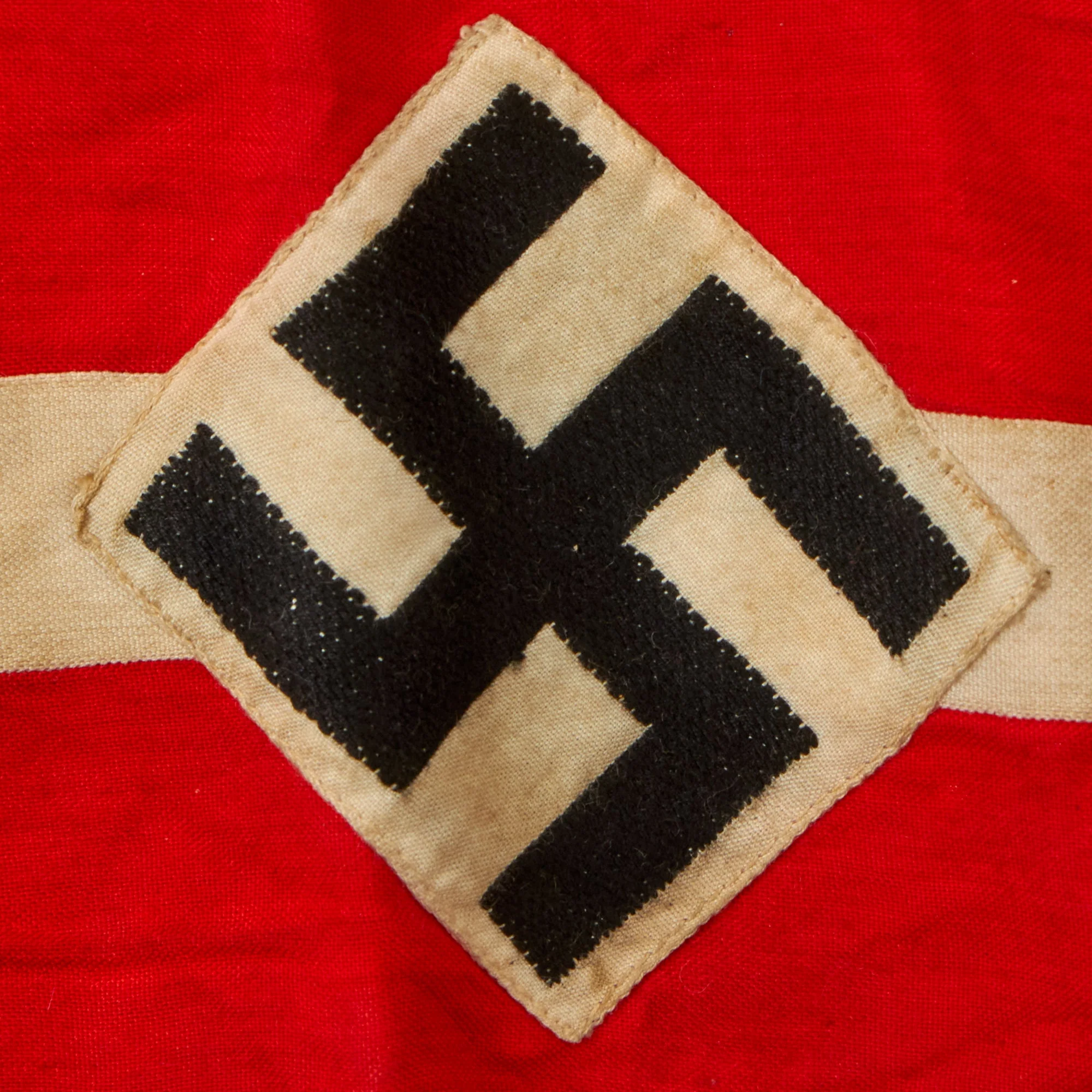
- One German WWII Era HJ National Youth Organization BeVo Embroidered Armband Insignia - Unissued with RZM Tag. This is in great shape, just as it was when cut off the strip of insignia that came out of the machine.
- One German WWII Heer Army BeVo Embroidered Breast Wehrmachtadler Eagle. It is the 1940 pattern, with grey threading on a light green background, and has not been installed on a uniform.
- One Small German WWII Pioneer Standard Flag Pin. Made from plastic, these were used to show support for specific types of units.
- One Small German WWII Führer-Begleit-Battalion (FBB) Standard Flag Pin. Made from plastic, this shows support to the personal bodyguard of Adolf H.
- One German WWII NSRL/DRL Bevo Embroidered Bronze Sports Badge. The design is a round badge with a golden "closed wing" eagle in the middle, surmounted with a Swas. These were awarded in bronze and silver grades, and later examples also had a date.
- One German WWII Small DAF German Labor Front pin.
- One German WWII Civic Police Aluminum Cap Eagle Insignia. It is missing one of the two prongs that hold it to the cap.
- One German WWII Luftwaffe Air Force Silvered Zinc Cap Eagle Insignia. It is missing one of the two prongs that hold it to the cap.
- One German WWII Deutsches Jugendfest 1935 (German Youth Festival 1935) DJ & HJ Tinnie
- TWO German WWII Era Deutsches Reich Postage Stamps with Adolf H Profile. These are for the 15 Pfennig and 50 Pfennig values, and look to be from 1941. There were several different colors use for each value of the Adolf H series stamps, which was different each year. They both appear to have been used.
There were two tinnies that we were unfortunately not able to easily identify, and leave them as great research projects for the future owner.
A wonderful totally genuine grouping perfect for the German militaria and memorabilia collector. Ready to research and display!
More Details on some of the Items in this set:
"Tinnies" (Veranstaltungsabzeichen - Event Badges) are small commemorative pins or medals, acquired when one attended a specific event held in Germany. They were often made of thin stamped metal, bakelite, or even pressed paper. Many of these were given out as part of the WHW (Winterhilfswerk - Winter Help Work) Organization, which often involved Germans traveling quite a bit to help out the war effort. Many others were given for the annual Reichsparteitag (Reich Party Congress), otherwise known as the Nuremberg Rallies.
War Merit Cross 2nd Class (Kriegsverdienstkreuz) with Swords (for Combat)
This was a decoration of NSDAP Germany during the Second World War, which could be awarded to military personnel and civilians alike. By the end of the war it was issued in four degrees, and had a related civil decoration. It was created by Adolf AH in October 1939 as a successor to the non-combatant Iron Cross which was used in earlier wars. The award was graded the same as the Iron Cross: War Merit Cross Second Class, War Merit Cross First Class, and Knights Cross of the War Merit Cross. The award had two variants: with swords given to soldiers for exceptional service "not in direct connection with combat", and without swords for meritorious service to civilians in "furtherance of the war effort". As with the Iron Cross, Recipients had to have the lower grade of the award before getting the next level.
The Eastern Medal (Ostmedaille), officially the Winter Battle in the East 1941–42 Medal (Medaille Winterschlacht im Osten 1941/42), was a military award of the Wehrmacht which was created by ordinance of Adolf H on 26 May 1942.
The Eastern Medal was awarded to any member of the Wehrmacht and Waffen-SS "in recognition of experience in the struggle against the Bolshevik enemy and the Russian winter within the period from 15 November 1941 to 15 April 1942." It was also awarded posthumously to any service member who died in the line of duty within the Soviet Union. It was wryly called the Frozen Meat Medal or the "Order of the Frozen Flesh" (Gefrierfleischorden).
The Infantry Assault Badge (Infanterie-Sturmabzeichen) was a German war badge awarded to Waffen-SS and Wehrmacht Heer soldiers during the Second World War. This decoration was instituted on 20 December 1939 by the Commander-in-Chief of the German Army, Generalfeldmarschall Walther von Brauchitsch. It could be awarded to members of non-motorized Infantry units and units of the Gebirgsjäger that had participated in infantry assaults, with light infantry weapons, on at least three separate days of battle in the front line on or after 1 January 1940. When a counter offensive led to fighting, it could also apply. Award of the Infantry Assault Badge was authorized at regimental command level.
Faithful Civil Service Decoration First Class Cross for 25 Years of Service - A fullsize frosted silver with an oak leaf wreath and black enameled Swas (hook cross) on original ribbon. The Civil Service Faithful Service Medal (Treudienst-Ehrenzeichen für Beamte Angestellte und Arbeiter im öffentlichen Dienst) was a NSDAP Germany medal of honor that was founded on 30 January 1938, in two grades, to reward civilians and military in the employ of the German public services for long and faithful service.
All officials, employees, and laborers at any level of the public service (local, regional or national) who complete 25 or 40 years service were eligible. The second class award was for 25 years of service was a silver cross, with a silver wreath and a black enameled swas in the center of the cross. The first class award was for 40 years of service was a gold cross, with a gold wreath and a black enameled swas in the center of the cross.
The reverse of both classes was stamped with Für treue Dienste (For faithful Services). in German black letter typeface. The ribbon for the medal is cornflower blue.
The Social Welfare Decoration (German: Ehrenzeichen für deutsche Volkspflege) was a German Civil Award created by Adolf AH on 1 May 1939 for services in the social sector. The decoration was issued in three classes and was awarded for a wide variety of service, in the social sector, to the German state. Qualifying service would have been with Winterhilfswerk, National Socialist People's Welfare, medical and rescue work, or care of foreign and ethnic Germans. As a replacement for the German Red Cross Decoration, it was conferred in four classes consisting of a white-enameled gold Balkenkreuz with Reich eagle and swas. A "Medal for Social Welfare" was also issued for lesser degrees of service, not warranting the higher presentation of a class award.
The main requirement for the award was that the service rendered should be to the benefit of the civil population. Reinhard Heydrich was awarded the decoration for his running of the Gestapo in the 1930s and for providing "security" to the German people. The infamous Doctor Josef Mengele was also awarded the decoration in 1941, for providing medical services to wounded soldiers and civilians alike on the battlefields of the Eastern Front.

Details & Craftsmanship
Every detail has been carefully considered to bring you the perfect product.

Details & Craftsmanship
Every detail has been carefully considered to bring you the perfect product.

Details & Craftsmanship
Every detail has been carefully considered to bring you the perfect product.

Details & Craftsmanship
Every detail has been carefully considered to bring you the perfect product.

Details & Craftsmanship
Every detail has been carefully considered to bring you the perfect product.

Details & Craftsmanship
Every detail has been carefully considered to bring you the perfect product.

Details & Craftsmanship
Every detail has been carefully considered to bring you the perfect product.

Details & Craftsmanship
Every detail has been carefully considered to bring you the perfect product.

Details & Craftsmanship
Every detail has been carefully considered to bring you the perfect product.

Details & Craftsmanship
Every detail has been carefully considered to bring you the perfect product.
Description
Original Items: Only One Set Available. This is a very nice collection of German WWII Insignia & Awards, which was brought back from the European theater by a USGI after the war was concluded. Many solders traded these on the way back, and would end up with a pocket full of various different collectible items, and this set represents the typical "haul" one might have come back with. It includes a good variety of medals and insignia, including a War Merit Crosses, an Eastern medal, a KvKII, and more!
This lovely set includes the following items we were able to identify:-
- One German WWII War Merit Cross 2nd Class with Swords (Kriegsverdienstkreuz II Klasse mit Schwertern). The award has lost the original ribbon as well as the ring and attachment loop on the top, and now displays an overall oxidized patina.
- One German WWII Eastern Front Medal (Ostmedaille) without ribbon. The medal still retains the top hanger ring, and it shows a lovely oxidized patina on both sides.
- One German WWII Civil Service Faithful Service Medal 2nd Class with "Austrian" style ribbon mount. The second class award for 25 years of service was a silver cross, with a silver wreath and a black enameled swas in the center of the cross. The medal is in great shape, showing just a bit of wear and oxidation. The color on the ribbon mount is well retained and the rear pin fully functional.
- 2nd Pattern National Socialist Women’s Organization Orts Level Membership Badge: The "National Socialist Frauenschaft" (National Socialist Women’s-organization) was formed by absorbing the earlier "Deutsches Frauenwerk" (German Women’s-welfare-organization), and the "Deutscher Frauenorden" (German Women’s-order), into a single national organization. The first pattern Frauenschaft member’s badge followed the design of the earlier "Deutscher Frauenorden" badge as introduced in the mid-1920s, with minor variations. In 1938 the first pattern badge was replaced with a modified second pattern member’s badge, which followed the design of the earlier "Deutsches Frauenwerk" badge. The alloy badge takes the form of a 30mm tall inverted triangle with a 29mm wide top edge. It features a black enamel central field, edged in blue enamel and silver, upon which is a silver national eagle above a silver "Leben-rune" (Life-rune).The badge features the silver Gothic script "NS.- Frauenschaft." To the reverse, to either side of its crimped and soldered vertical pin-back device, is an embossed RZM logo and ‘M1/34' for Karl Wurster, Markneukirchen. The blue border represents the ‘Orts’ (District) group level.
- One German WWII Feuerschutzpolizei (Fire Protection Police) NCO Sleeve Eagle, Pink on a dark Navy Blue Background. This insignia is specially for Werkfeuerwehr (Factory Fire Brigade) issue, responsible for putting out fires at factories. It is in good condition, showing wear and moth damage.
- One German WWII Kriegsmarine Navy Embroidered Breast Eagle. It is in very good condition, showing some wear and moth damage to the dark navy blue background.
- One German WWII Era HJ National Youth Organization BeVo Embroidered Armband Insignia - Unissued with RZM Tag. This is in great shape, just as it was when cut off the strip of insignia that came out of the machine.
- One German WWII Heer Army BeVo Embroidered Breast Wehrmachtadler Eagle. It is the 1940 pattern, with grey threading on a light green background, and has not been installed on a uniform.
- One Small German WWII Pioneer Standard Flag Pin. Made from plastic, these were used to show support for specific types of units.
- One Small German WWII Führer-Begleit-Battalion (FBB) Standard Flag Pin. Made from plastic, this shows support to the personal bodyguard of Adolf H.
- One German WWII NSRL/DRL Bevo Embroidered Bronze Sports Badge. The design is a round badge with a golden "closed wing" eagle in the middle, surmounted with a Swas. These were awarded in bronze and silver grades, and later examples also had a date.
- One German WWII Small DAF German Labor Front pin.
- One German WWII Civic Police Aluminum Cap Eagle Insignia. It is missing one of the two prongs that hold it to the cap.
- One German WWII Luftwaffe Air Force Silvered Zinc Cap Eagle Insignia. It is missing one of the two prongs that hold it to the cap.
- One German WWII Deutsches Jugendfest 1935 (German Youth Festival 1935) DJ & HJ Tinnie
- TWO German WWII Era Deutsches Reich Postage Stamps with Adolf H Profile. These are for the 15 Pfennig and 50 Pfennig values, and look to be from 1941. There were several different colors use for each value of the Adolf H series stamps, which was different each year. They both appear to have been used.
There were two tinnies that we were unfortunately not able to easily identify, and leave them as great research projects for the future owner.
A wonderful totally genuine grouping perfect for the German militaria and memorabilia collector. Ready to research and display!
More Details on some of the Items in this set:
"Tinnies" (Veranstaltungsabzeichen - Event Badges) are small commemorative pins or medals, acquired when one attended a specific event held in Germany. They were often made of thin stamped metal, bakelite, or even pressed paper. Many of these were given out as part of the WHW (Winterhilfswerk - Winter Help Work) Organization, which often involved Germans traveling quite a bit to help out the war effort. Many others were given for the annual Reichsparteitag (Reich Party Congress), otherwise known as the Nuremberg Rallies.
War Merit Cross 2nd Class (Kriegsverdienstkreuz) with Swords (for Combat)
This was a decoration of NSDAP Germany during the Second World War, which could be awarded to military personnel and civilians alike. By the end of the war it was issued in four degrees, and had a related civil decoration. It was created by Adolf AH in October 1939 as a successor to the non-combatant Iron Cross which was used in earlier wars. The award was graded the same as the Iron Cross: War Merit Cross Second Class, War Merit Cross First Class, and Knights Cross of the War Merit Cross. The award had two variants: with swords given to soldiers for exceptional service "not in direct connection with combat", and without swords for meritorious service to civilians in "furtherance of the war effort". As with the Iron Cross, Recipients had to have the lower grade of the award before getting the next level.
The Eastern Medal (Ostmedaille), officially the Winter Battle in the East 1941–42 Medal (Medaille Winterschlacht im Osten 1941/42), was a military award of the Wehrmacht which was created by ordinance of Adolf H on 26 May 1942.
The Eastern Medal was awarded to any member of the Wehrmacht and Waffen-SS "in recognition of experience in the struggle against the Bolshevik enemy and the Russian winter within the period from 15 November 1941 to 15 April 1942." It was also awarded posthumously to any service member who died in the line of duty within the Soviet Union. It was wryly called the Frozen Meat Medal or the "Order of the Frozen Flesh" (Gefrierfleischorden).
The Infantry Assault Badge (Infanterie-Sturmabzeichen) was a German war badge awarded to Waffen-SS and Wehrmacht Heer soldiers during the Second World War. This decoration was instituted on 20 December 1939 by the Commander-in-Chief of the German Army, Generalfeldmarschall Walther von Brauchitsch. It could be awarded to members of non-motorized Infantry units and units of the Gebirgsjäger that had participated in infantry assaults, with light infantry weapons, on at least three separate days of battle in the front line on or after 1 January 1940. When a counter offensive led to fighting, it could also apply. Award of the Infantry Assault Badge was authorized at regimental command level.
Faithful Civil Service Decoration First Class Cross for 25 Years of Service - A fullsize frosted silver with an oak leaf wreath and black enameled Swas (hook cross) on original ribbon. The Civil Service Faithful Service Medal (Treudienst-Ehrenzeichen für Beamte Angestellte und Arbeiter im öffentlichen Dienst) was a NSDAP Germany medal of honor that was founded on 30 January 1938, in two grades, to reward civilians and military in the employ of the German public services for long and faithful service.
All officials, employees, and laborers at any level of the public service (local, regional or national) who complete 25 or 40 years service were eligible. The second class award was for 25 years of service was a silver cross, with a silver wreath and a black enameled swas in the center of the cross. The first class award was for 40 years of service was a gold cross, with a gold wreath and a black enameled swas in the center of the cross.
The reverse of both classes was stamped with Für treue Dienste (For faithful Services). in German black letter typeface. The ribbon for the medal is cornflower blue.
The Social Welfare Decoration (German: Ehrenzeichen für deutsche Volkspflege) was a German Civil Award created by Adolf AH on 1 May 1939 for services in the social sector. The decoration was issued in three classes and was awarded for a wide variety of service, in the social sector, to the German state. Qualifying service would have been with Winterhilfswerk, National Socialist People's Welfare, medical and rescue work, or care of foreign and ethnic Germans. As a replacement for the German Red Cross Decoration, it was conferred in four classes consisting of a white-enameled gold Balkenkreuz with Reich eagle and swas. A "Medal for Social Welfare" was also issued for lesser degrees of service, not warranting the higher presentation of a class award.
The main requirement for the award was that the service rendered should be to the benefit of the civil population. Reinhard Heydrich was awarded the decoration for his running of the Gestapo in the 1930s and for providing "security" to the German people. The infamous Doctor Josef Mengele was also awarded the decoration in 1941, for providing medical services to wounded soldiers and civilians alike on the battlefields of the Eastern Front.