
Original: $995.00
-70%$995.00
$298.50The Story
Original Items: Only One Set Available. German Naval uniforms and headgear were based on the traditional designs that date back to the creation of the Prussian Navy in 1848. The uniforms and headgear did evolve during the interim years, many items used during the Third Reich era would still have been quite recognizable to the Imperial sailor.
The Reefer jacket was a basic uniform item intended for all ranks, with minor variations, and followed the basic design of the Imperial German Navy Reefer jacket. Officers and certain senior NCO ranks were responsible for purchasing their own uniforms and headgear and as a result, were allotted a clothing allowance through the Offizier Kleiderkasse der Kriegsmarine, (Officer’s Clothing Account of the Navy). Although enlisted personnel were issued their uniforms and headgear from government supplies, they were also permitted to purchase privately tailored items, but the price may have been restrictive. Generally speaking officers bought nicer quality, private purchase uniform items, but they could also choose to buy their uniforms directly from the military clothing depots.
This is a lovely Named Kriegsmarine Waffenoffizier für Sperrwaffen (Weapons Officer for Blocking Weapons) Oberleutnant zur See Officer's Uniform Set, consisting of the standard Navy Blue "Reefer" jacket and Trousers.
The jacket in the set is a very good condition high quality private purchase three quarter length Officer's Reefer Jacket, with navy blue "whipcord weave" wool construction. The double breasted style jacket features fold back, peak lapels and a lay down collar and has two, vertical parallel rows of five Kriegsmarine "Anchor" front closure buttons with corresponding button eyelets on both the left and right front panels. The top button on each side is ornamental and not functional. Most are maker marked, and also indicate that they were "fire gilt", the correct process used at the time. The jacket has two, horizontal slash, front hip pockets with straight edged flaps.
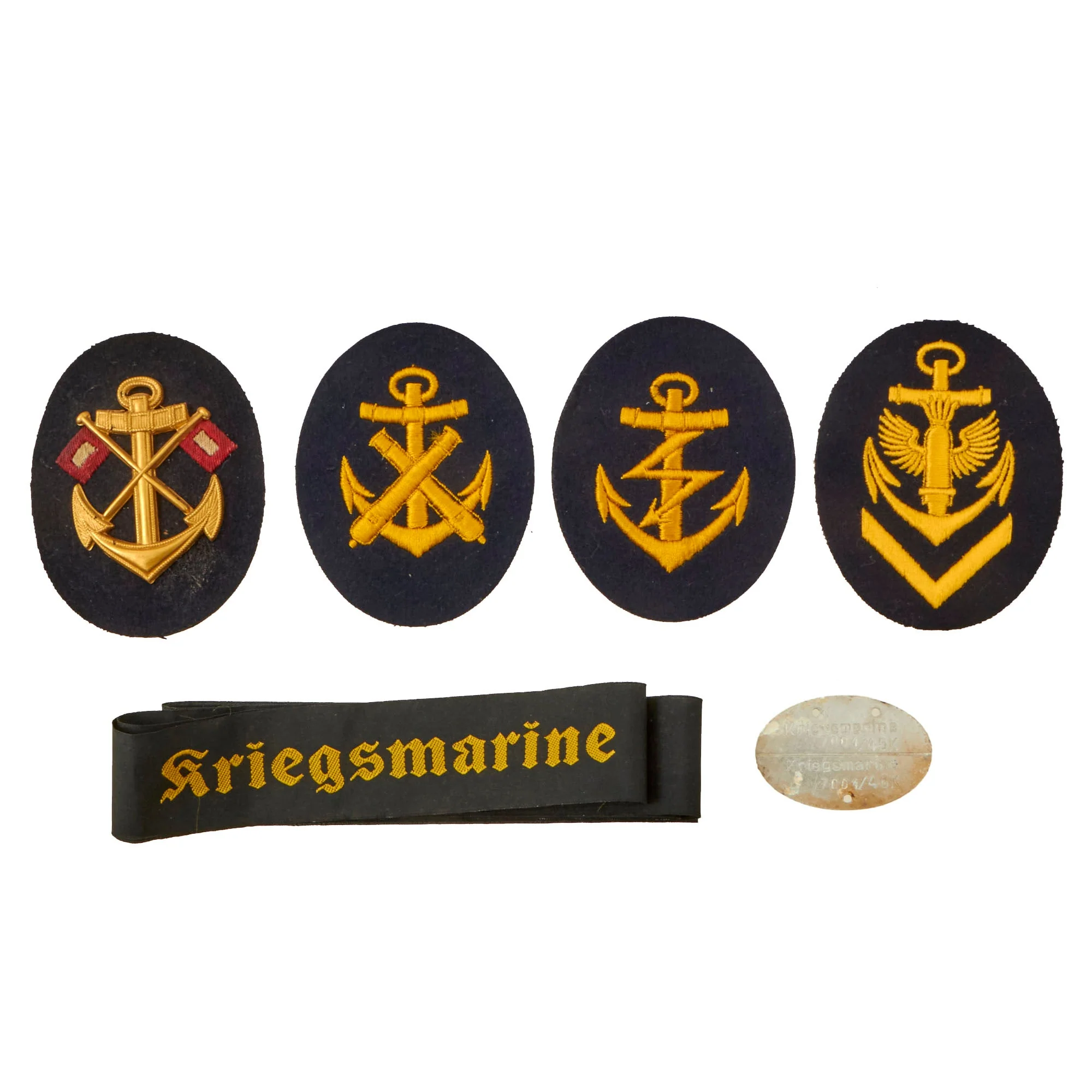
The right breast has a hand embroidered national breast eagle in gilt wire threads with gold colored retaining threads, mounted on a cut-out, navy blue wool base. The eagle is neatly hand stitched to the jacket, and is correctly only sewn to the outer layer of fabric. The sleeves have straight cut, non-adjustable cuffs and each sleeve has two horizontally ribbed, woven gilt wire horizontal rank tresse sleeve lace strips. These features two raised horizontal bars and a recessed crosshatch pattern. The tress strips are machine stitched in position and would been applied at the time the jacket was manufactured as they are inserted into the reverse sleeve seam. Two medium width strips indicate the line officer rank of Oberleutnant zur See (Senior Lieutenant at See), equivalent to a U.S. Navy Lieutenant (Junior Grade). As is relatively standard there are no shoulder boards, which were often not used on this type of jacket, as the sleeve insignia made them redundant. Above the tresse strips there are also small hand embroidered naval mine devices on both sides. These are correct for "Blocking Weapons", and indicates the owner was a Weapons officer involved in sea mines and other defensive weaponry.
The interior of the jacket is fully lined in black brushed cotton with white and blue striped cotton sleeves. The lining has horizontal slash pockets to both the left and right front breast panels. The only marking on the interior is on the rear of the neck, which has a tag reading OFFIZIERKLIEDERKASSE KIEL, or "Officers Clothing Cash Officer, Kiel", which would was located in the major port city of Kiel. Condition is very good, showing light wear from service and no major damage such as tears, holes, and so forth. The insignia is all in great shape, with the expected oxidation to the bullion tress loops on the sleeves.
The trousers are relatively standard, and look to be bespoke, as we were not able to locate any maker markings on the interior. They are made from lovely navy blue :whipcord weave" wool, and feature two vertical slash pockets on the sides of the waist, as well as two horizontal slash pockets on the seat. The front closure features a four button fly with one side button, and a hook and loop fastener at the very top. The interior shows some white cotton reinforcement around the waist, and the pockets liners are made from the same material. There were originally 6 buttons on the inner waist for suspenders, however three are missing. All of the buttons are plastic bakelite, and overall the trousers are in lovely condition, with no major deficiencies.
This is a wonderful example of a WWII German Kriegsmarine Officer's Reefer Jacket, complete with the correct trousers. Comes more than ready for further research and display!"
Approximate Measurements:-
Collar to shoulder: 10"
Shoulder to sleeve: 24.5”
Shoulder to shoulder: 15.5"
Chest width: 21”
Waist: 18"
Hip: 18"
Front length: 28.5"
Pants:-
Waist: 13"
Inseam: 28"
Oberleutnant zur See (OLt zS or OLZS in the German Navy, Oblt.z.S. in the Kriegsmarine) is traditionally the highest rank of Lieutenant in the German Navy. The rank was introduced in the Imperial German Navy by renaming the former rank of Premier Lieutenant in 1890. Within the navy, officers of this rank were simply addressed as Herr Oberleutnant. To distinguish naval officers from those of the army, the suffix zur See (at sea) was added in official communications, sometimes shortened to z.S. (Oblt.z.S.). The rank has since been used by the Reichsmarine, Kriegsmarine, and Bundesmarine. In the Volksmarine, the rank was originally used in the same way until the suffix zur See was dropped. In the Kriegsmarine, engineers (Ingenieur – Ing.) of the same rank were distinguished as Oberleutnant (Ing.).
The Kriegsmarine was the navy of NSDAP Germany from 1935 to 1945. It superseded the Imperial German Navy of the German Empire (1871–1918) and the inter-war Reichsmarine (1919–1935) of the Weimar Republic. The Kriegsmarine was one of three official branches, along with the Heer and the Luftwaffe, of the Wehrmacht, the German armed forces from 1935 to 1945.
In violation of the Treaty of Versailles, the Kriegsmarine grew rapidly during German naval rearmament in the 1930s. The 1919 treaty had limited the size of the German navy and prohibited the building of submarines.
Kriegsmarine ships were deployed to the waters around Spain during the Spanish Civil War (1936–1939) under the guise of enforcing non-intervention, but in reality supported the Nationalists against the Spanish Republicans.
In January 1939, Plan Z, a massive shipbuilding program, was ordered, calling for surface naval parity with the British Royal Navy by 1944. When World War II broke out in September 1939, Plan Z was shelved in favor of a crash building program for submarines (U-boats) instead of capital surface warships, and land and air forces were given priority of strategic resources.
The Commander-in-Chief of the Kriegsmarine (as for all branches of armed forces during the period of absolute NSDAP power) was Adolf H, who exercised his authority through the Oberkommando der Marine ("High Command of the Navy").
The Kriegsmarine's most significant ships were the U-boats, most of which were constructed after Plan Z was abandoned at the beginning of World War II. Wolfpacks were rapidly assembled groups of submarines which attacked British convoys during the first half of the Battle of the Atlantic but this tactic was largely abandoned by May 1943 when U-boat losses mounted. Along with the U-boats, surface commerce raiders (including auxiliary cruisers) were used to disrupt Allied shipping in the early years of the war, the most famous of these being the heavy cruisers Admiral Graf Spee and Admiral Scheer and the battleship Bismarck. However, the adoption of convoy escorts, especially in the Atlantic, greatly reduced the effectiveness of surface commerce raiders against convoys.
Following the end of World War II in 1945, the Kriegsmarine's remaining ships were divided up among the Allied powers and were used for various purposes including minesweeping. Some were loaded with superfluous chemical weapons and scuttled.

Details & Craftsmanship
Every detail has been carefully considered to bring you the perfect product.

Details & Craftsmanship
Every detail has been carefully considered to bring you the perfect product.

Details & Craftsmanship
Every detail has been carefully considered to bring you the perfect product.

Details & Craftsmanship
Every detail has been carefully considered to bring you the perfect product.

Details & Craftsmanship
Every detail has been carefully considered to bring you the perfect product.

Details & Craftsmanship
Every detail has been carefully considered to bring you the perfect product.

Details & Craftsmanship
Every detail has been carefully considered to bring you the perfect product.

Details & Craftsmanship
Every detail has been carefully considered to bring you the perfect product.

Details & Craftsmanship
Every detail has been carefully considered to bring you the perfect product.

Details & Craftsmanship
Every detail has been carefully considered to bring you the perfect product.

Details & Craftsmanship
Every detail has been carefully considered to bring you the perfect product.

Details & Craftsmanship
Every detail has been carefully considered to bring you the perfect product.

Details & Craftsmanship
Every detail has been carefully considered to bring you the perfect product.

Details & Craftsmanship
Every detail has been carefully considered to bring you the perfect product.
Description
Original Items: Only One Set Available. German Naval uniforms and headgear were based on the traditional designs that date back to the creation of the Prussian Navy in 1848. The uniforms and headgear did evolve during the interim years, many items used during the Third Reich era would still have been quite recognizable to the Imperial sailor.
The Reefer jacket was a basic uniform item intended for all ranks, with minor variations, and followed the basic design of the Imperial German Navy Reefer jacket. Officers and certain senior NCO ranks were responsible for purchasing their own uniforms and headgear and as a result, were allotted a clothing allowance through the Offizier Kleiderkasse der Kriegsmarine, (Officer’s Clothing Account of the Navy). Although enlisted personnel were issued their uniforms and headgear from government supplies, they were also permitted to purchase privately tailored items, but the price may have been restrictive. Generally speaking officers bought nicer quality, private purchase uniform items, but they could also choose to buy their uniforms directly from the military clothing depots.
This is a lovely Named Kriegsmarine Waffenoffizier für Sperrwaffen (Weapons Officer for Blocking Weapons) Oberleutnant zur See Officer's Uniform Set, consisting of the standard Navy Blue "Reefer" jacket and Trousers.
The jacket in the set is a very good condition high quality private purchase three quarter length Officer's Reefer Jacket, with navy blue "whipcord weave" wool construction. The double breasted style jacket features fold back, peak lapels and a lay down collar and has two, vertical parallel rows of five Kriegsmarine "Anchor" front closure buttons with corresponding button eyelets on both the left and right front panels. The top button on each side is ornamental and not functional. Most are maker marked, and also indicate that they were "fire gilt", the correct process used at the time. The jacket has two, horizontal slash, front hip pockets with straight edged flaps.
The right breast has a hand embroidered national breast eagle in gilt wire threads with gold colored retaining threads, mounted on a cut-out, navy blue wool base. The eagle is neatly hand stitched to the jacket, and is correctly only sewn to the outer layer of fabric. The sleeves have straight cut, non-adjustable cuffs and each sleeve has two horizontally ribbed, woven gilt wire horizontal rank tresse sleeve lace strips. These features two raised horizontal bars and a recessed crosshatch pattern. The tress strips are machine stitched in position and would been applied at the time the jacket was manufactured as they are inserted into the reverse sleeve seam. Two medium width strips indicate the line officer rank of Oberleutnant zur See (Senior Lieutenant at See), equivalent to a U.S. Navy Lieutenant (Junior Grade). As is relatively standard there are no shoulder boards, which were often not used on this type of jacket, as the sleeve insignia made them redundant. Above the tresse strips there are also small hand embroidered naval mine devices on both sides. These are correct for "Blocking Weapons", and indicates the owner was a Weapons officer involved in sea mines and other defensive weaponry.
The interior of the jacket is fully lined in black brushed cotton with white and blue striped cotton sleeves. The lining has horizontal slash pockets to both the left and right front breast panels. The only marking on the interior is on the rear of the neck, which has a tag reading OFFIZIERKLIEDERKASSE KIEL, or "Officers Clothing Cash Officer, Kiel", which would was located in the major port city of Kiel. Condition is very good, showing light wear from service and no major damage such as tears, holes, and so forth. The insignia is all in great shape, with the expected oxidation to the bullion tress loops on the sleeves.
The trousers are relatively standard, and look to be bespoke, as we were not able to locate any maker markings on the interior. They are made from lovely navy blue :whipcord weave" wool, and feature two vertical slash pockets on the sides of the waist, as well as two horizontal slash pockets on the seat. The front closure features a four button fly with one side button, and a hook and loop fastener at the very top. The interior shows some white cotton reinforcement around the waist, and the pockets liners are made from the same material. There were originally 6 buttons on the inner waist for suspenders, however three are missing. All of the buttons are plastic bakelite, and overall the trousers are in lovely condition, with no major deficiencies.
This is a wonderful example of a WWII German Kriegsmarine Officer's Reefer Jacket, complete with the correct trousers. Comes more than ready for further research and display!"
Approximate Measurements:-
Collar to shoulder: 10"
Shoulder to sleeve: 24.5”
Shoulder to shoulder: 15.5"
Chest width: 21”
Waist: 18"
Hip: 18"
Front length: 28.5"
Pants:-
Waist: 13"
Inseam: 28"
Oberleutnant zur See (OLt zS or OLZS in the German Navy, Oblt.z.S. in the Kriegsmarine) is traditionally the highest rank of Lieutenant in the German Navy. The rank was introduced in the Imperial German Navy by renaming the former rank of Premier Lieutenant in 1890. Within the navy, officers of this rank were simply addressed as Herr Oberleutnant. To distinguish naval officers from those of the army, the suffix zur See (at sea) was added in official communications, sometimes shortened to z.S. (Oblt.z.S.). The rank has since been used by the Reichsmarine, Kriegsmarine, and Bundesmarine. In the Volksmarine, the rank was originally used in the same way until the suffix zur See was dropped. In the Kriegsmarine, engineers (Ingenieur – Ing.) of the same rank were distinguished as Oberleutnant (Ing.).
The Kriegsmarine was the navy of NSDAP Germany from 1935 to 1945. It superseded the Imperial German Navy of the German Empire (1871–1918) and the inter-war Reichsmarine (1919–1935) of the Weimar Republic. The Kriegsmarine was one of three official branches, along with the Heer and the Luftwaffe, of the Wehrmacht, the German armed forces from 1935 to 1945.
In violation of the Treaty of Versailles, the Kriegsmarine grew rapidly during German naval rearmament in the 1930s. The 1919 treaty had limited the size of the German navy and prohibited the building of submarines.
Kriegsmarine ships were deployed to the waters around Spain during the Spanish Civil War (1936–1939) under the guise of enforcing non-intervention, but in reality supported the Nationalists against the Spanish Republicans.
In January 1939, Plan Z, a massive shipbuilding program, was ordered, calling for surface naval parity with the British Royal Navy by 1944. When World War II broke out in September 1939, Plan Z was shelved in favor of a crash building program for submarines (U-boats) instead of capital surface warships, and land and air forces were given priority of strategic resources.
The Commander-in-Chief of the Kriegsmarine (as for all branches of armed forces during the period of absolute NSDAP power) was Adolf H, who exercised his authority through the Oberkommando der Marine ("High Command of the Navy").
The Kriegsmarine's most significant ships were the U-boats, most of which were constructed after Plan Z was abandoned at the beginning of World War II. Wolfpacks were rapidly assembled groups of submarines which attacked British convoys during the first half of the Battle of the Atlantic but this tactic was largely abandoned by May 1943 when U-boat losses mounted. Along with the U-boats, surface commerce raiders (including auxiliary cruisers) were used to disrupt Allied shipping in the early years of the war, the most famous of these being the heavy cruisers Admiral Graf Spee and Admiral Scheer and the battleship Bismarck. However, the adoption of convoy escorts, especially in the Atlantic, greatly reduced the effectiveness of surface commerce raiders against convoys.
Following the end of World War II in 1945, the Kriegsmarine's remaining ships were divided up among the Allied powers and were used for various purposes including minesweeping. Some were loaded with superfluous chemical weapons and scuttled.