
Original: $695.00
-70%$695.00
$208.50The Story
Original Item. Only One Available. This is a lovely Kriegsmarine Navy Blue Wool Jumper & Trousers Uniform set belonging to a petty officer who worked as a Signalman's Mate 3rd Class, or Signalgastmaat, as indicated by the insignia on the left sleeve. The Kriegsmarine was the navy of NSDAP Germany from 1935 to 1945. It superseded the Imperial German Navy of the German Empire (1871–1918) and the inter-war Reichsmarine (1919–1935) of the Weimar Republic. The Kriegsmarine was one of three official branches, along with the Heer and the Luftwaffe, of the Wehrmacht, the German armed forces from 1935 to 1945.
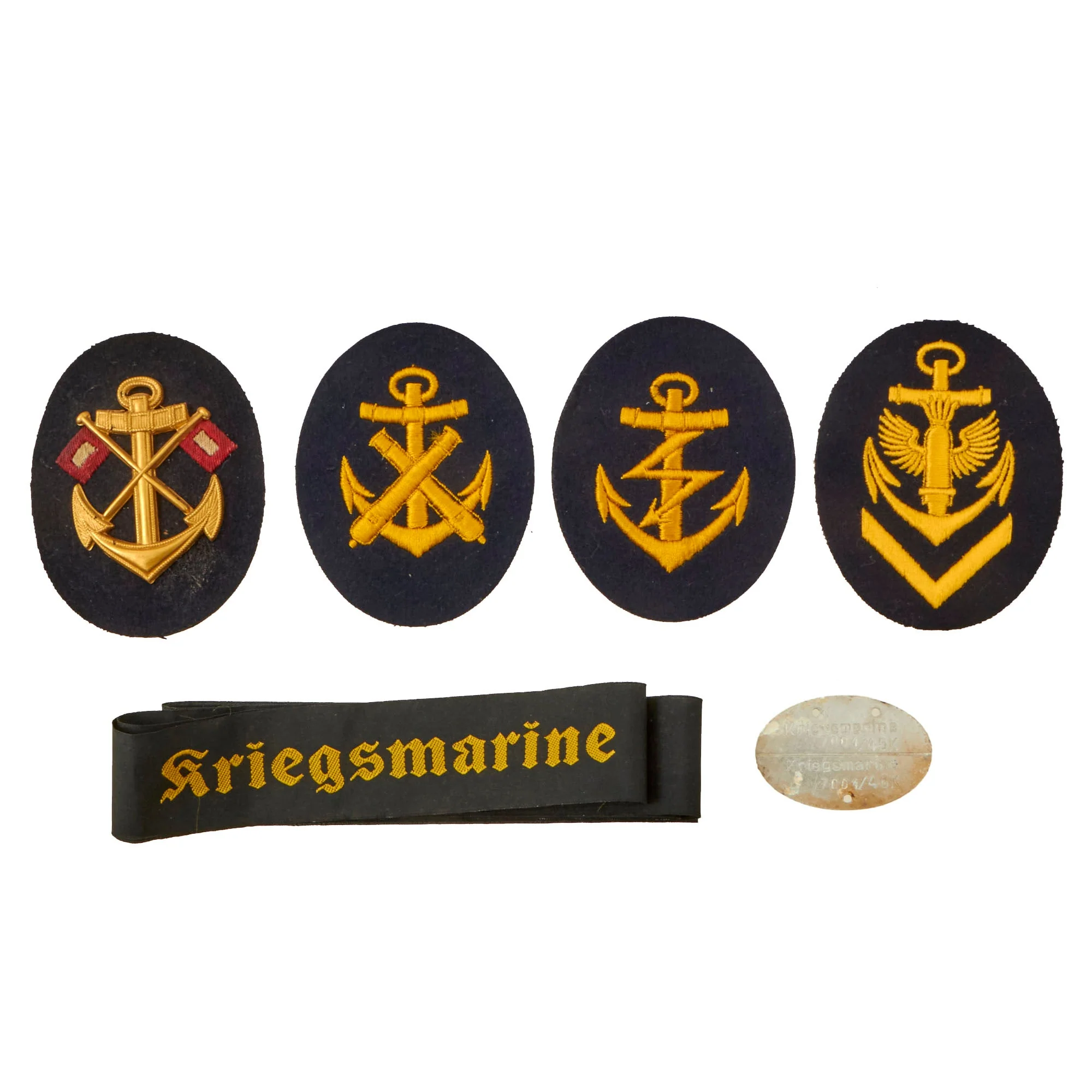
This beautiful Navy Blue Wool Kriegsmarine jumper belonged to a Signalgastmaat, or “Signalmans Mate 3rd Class” which is the direct translation. In this case their rating is Signalgast, and rank Maat, an NCO equivalent to a U.S. Navy Petty Officer, third class, and is indicated by the Laufbahnabzeichen (Career Badge) on the left sleeve. This shows a "Fouled Anchor" overlaid on crossed semaphore flags, the career insignia of the Signalgast (Signals). The patch is of wool construction and appears to have been hand stitched on, with the anchor badge placed directly on top of it, so it may be that they simply added the anchor when they were promoted from Signalgefreite to Signalgastmaat. There is minor mothing present on the insignia. On the right breast of the jumper there is the correct Kriegsmarine Wehrmachtadler Eagle, embroidered in gold yellow on a navy blue background, which was then sewn to the jumper. The insignia shows no sign of being added later and is all of the period.
We checked the inside of the jumper, but we were not able to locate any type of manufacturing markings. It is in very good condition, with the navy blue "whipcord weave" wool showing only light wear, though there is some scattered mothing present. The "tar flap" on the rear is still present, and the jumper retains the button for fastening the collar closed. These uniforms were usually worn in colder weather, so buttoning up the color was definitely a plus. Both cuffs retain two buttons each. There is an interior left breast pocket in good shape. The right armpit shows some period field stitch repairs. The bottom edge of the jumper has a small stitched nametag reading Jörtz.
The included navy blue trousers are in very nice shape, featuring an internal waist band that the front then buttons to. The buttons are all present, although it appears some may have been restitched later, and the size adjustment straps on the sides are functional as well. There is moderate wear, and there definitely is some mothing present.
This is a lovely uniform set that doesn’t often come up together like this. Ready to display!
Approximate Measurements:-
Collar to shoulder: 8"
Shoulder to sleeve: 23”
Shoulder to shoulder: 18"
Chest width: 18”
Waist: 15"
Hip: 15"
Front length: 30"
More on the Kriegsmarine
In violation of the Treaty of Versailles, the Kriegsmarine grew rapidly during German naval rearmament in the 1930s. The 1919 treaty had limited the size of the German navy and prohibited the building of submarines
Kriegsmarine ships were deployed to the waters around Spain during the Spanish Civil War (1936–1939) under the guise of enforcing non-intervention, but in reality supported the Nationalists against the Spanish Republicans.
In January 1939, Plan Z, a massive ship-building program, was ordered, calling for surface naval parity with the British Royal Navy by 1944. When World War II broke out in September 1939, Plan Z was shelved in favour of a crash building program for submarines (U-boats) instead of capital surface warships, and land and air forces were given priority of strategic resources.
The Commander-in-Chief of the Kriegsmarine (as for all branches of armed forces during the period of absolute NSDAP power) was AH, who exercised his authority through the Oberkommando der Marine ("High Command of the Navy").
The Kriegsmarine's most significant ships were the U-boats, most of which were constructed after Plan Z was abandoned at the beginning of World War II. Wolfpacks were rapidly assembled groups of submarines which attacked British convoys during the first half of the Battle of the Atlantic but this tactic was largely abandoned by May 1943 when U-boat losses mounted. Along with the U-boats, surface commerce raiders (including auxiliary cruisers) were used to disrupt Allied shipping in the early years of the war, the most famous of these being the heavy cruisers Admiral Graf Spee and Admiral Scheer and the battleship Bismarck. However, the adoption of convoy escorts, especially in the Atlantic, greatly reduced the effectiveness of surface commerce raiders against convoys.
Following the end of World War II in 1945, the Kriegsmarine's remaining ships were divided up among the Allied powers and were used for various purposes including minesweeping. Some were loaded with superfluous chemical weapons and scuttled.

Details & Craftsmanship
Every detail has been carefully considered to bring you the perfect product.

Details & Craftsmanship
Every detail has been carefully considered to bring you the perfect product.

Details & Craftsmanship
Every detail has been carefully considered to bring you the perfect product.

Details & Craftsmanship
Every detail has been carefully considered to bring you the perfect product.

Details & Craftsmanship
Every detail has been carefully considered to bring you the perfect product.

Details & Craftsmanship
Every detail has been carefully considered to bring you the perfect product.

Details & Craftsmanship
Every detail has been carefully considered to bring you the perfect product.

Details & Craftsmanship
Every detail has been carefully considered to bring you the perfect product.

Details & Craftsmanship
Every detail has been carefully considered to bring you the perfect product.

Details & Craftsmanship
Every detail has been carefully considered to bring you the perfect product.

Details & Craftsmanship
Every detail has been carefully considered to bring you the perfect product.

Details & Craftsmanship
Every detail has been carefully considered to bring you the perfect product.
Description
Original Item. Only One Available. This is a lovely Kriegsmarine Navy Blue Wool Jumper & Trousers Uniform set belonging to a petty officer who worked as a Signalman's Mate 3rd Class, or Signalgastmaat, as indicated by the insignia on the left sleeve. The Kriegsmarine was the navy of NSDAP Germany from 1935 to 1945. It superseded the Imperial German Navy of the German Empire (1871–1918) and the inter-war Reichsmarine (1919–1935) of the Weimar Republic. The Kriegsmarine was one of three official branches, along with the Heer and the Luftwaffe, of the Wehrmacht, the German armed forces from 1935 to 1945.
This beautiful Navy Blue Wool Kriegsmarine jumper belonged to a Signalgastmaat, or “Signalmans Mate 3rd Class” which is the direct translation. In this case their rating is Signalgast, and rank Maat, an NCO equivalent to a U.S. Navy Petty Officer, third class, and is indicated by the Laufbahnabzeichen (Career Badge) on the left sleeve. This shows a "Fouled Anchor" overlaid on crossed semaphore flags, the career insignia of the Signalgast (Signals). The patch is of wool construction and appears to have been hand stitched on, with the anchor badge placed directly on top of it, so it may be that they simply added the anchor when they were promoted from Signalgefreite to Signalgastmaat. There is minor mothing present on the insignia. On the right breast of the jumper there is the correct Kriegsmarine Wehrmachtadler Eagle, embroidered in gold yellow on a navy blue background, which was then sewn to the jumper. The insignia shows no sign of being added later and is all of the period.
We checked the inside of the jumper, but we were not able to locate any type of manufacturing markings. It is in very good condition, with the navy blue "whipcord weave" wool showing only light wear, though there is some scattered mothing present. The "tar flap" on the rear is still present, and the jumper retains the button for fastening the collar closed. These uniforms were usually worn in colder weather, so buttoning up the color was definitely a plus. Both cuffs retain two buttons each. There is an interior left breast pocket in good shape. The right armpit shows some period field stitch repairs. The bottom edge of the jumper has a small stitched nametag reading Jörtz.
The included navy blue trousers are in very nice shape, featuring an internal waist band that the front then buttons to. The buttons are all present, although it appears some may have been restitched later, and the size adjustment straps on the sides are functional as well. There is moderate wear, and there definitely is some mothing present.
This is a lovely uniform set that doesn’t often come up together like this. Ready to display!
Approximate Measurements:-
Collar to shoulder: 8"
Shoulder to sleeve: 23”
Shoulder to shoulder: 18"
Chest width: 18”
Waist: 15"
Hip: 15"
Front length: 30"
More on the Kriegsmarine
In violation of the Treaty of Versailles, the Kriegsmarine grew rapidly during German naval rearmament in the 1930s. The 1919 treaty had limited the size of the German navy and prohibited the building of submarines
Kriegsmarine ships were deployed to the waters around Spain during the Spanish Civil War (1936–1939) under the guise of enforcing non-intervention, but in reality supported the Nationalists against the Spanish Republicans.
In January 1939, Plan Z, a massive ship-building program, was ordered, calling for surface naval parity with the British Royal Navy by 1944. When World War II broke out in September 1939, Plan Z was shelved in favour of a crash building program for submarines (U-boats) instead of capital surface warships, and land and air forces were given priority of strategic resources.
The Commander-in-Chief of the Kriegsmarine (as for all branches of armed forces during the period of absolute NSDAP power) was AH, who exercised his authority through the Oberkommando der Marine ("High Command of the Navy").
The Kriegsmarine's most significant ships were the U-boats, most of which were constructed after Plan Z was abandoned at the beginning of World War II. Wolfpacks were rapidly assembled groups of submarines which attacked British convoys during the first half of the Battle of the Atlantic but this tactic was largely abandoned by May 1943 when U-boat losses mounted. Along with the U-boats, surface commerce raiders (including auxiliary cruisers) were used to disrupt Allied shipping in the early years of the war, the most famous of these being the heavy cruisers Admiral Graf Spee and Admiral Scheer and the battleship Bismarck. However, the adoption of convoy escorts, especially in the Atlantic, greatly reduced the effectiveness of surface commerce raiders against convoys.
Following the end of World War II in 1945, the Kriegsmarine's remaining ships were divided up among the Allied powers and were used for various purposes including minesweeping. Some were loaded with superfluous chemical weapons and scuttled.