
The Story
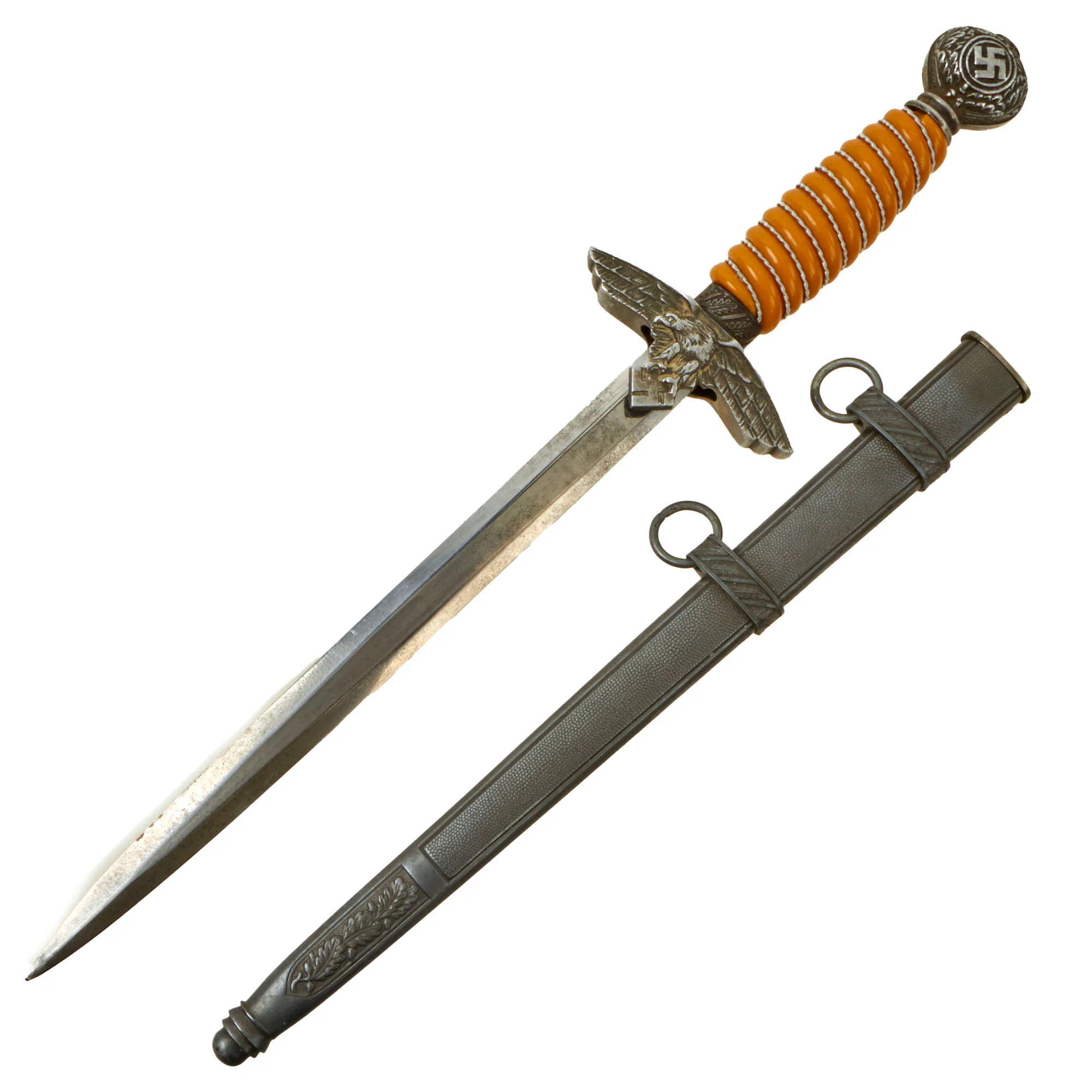
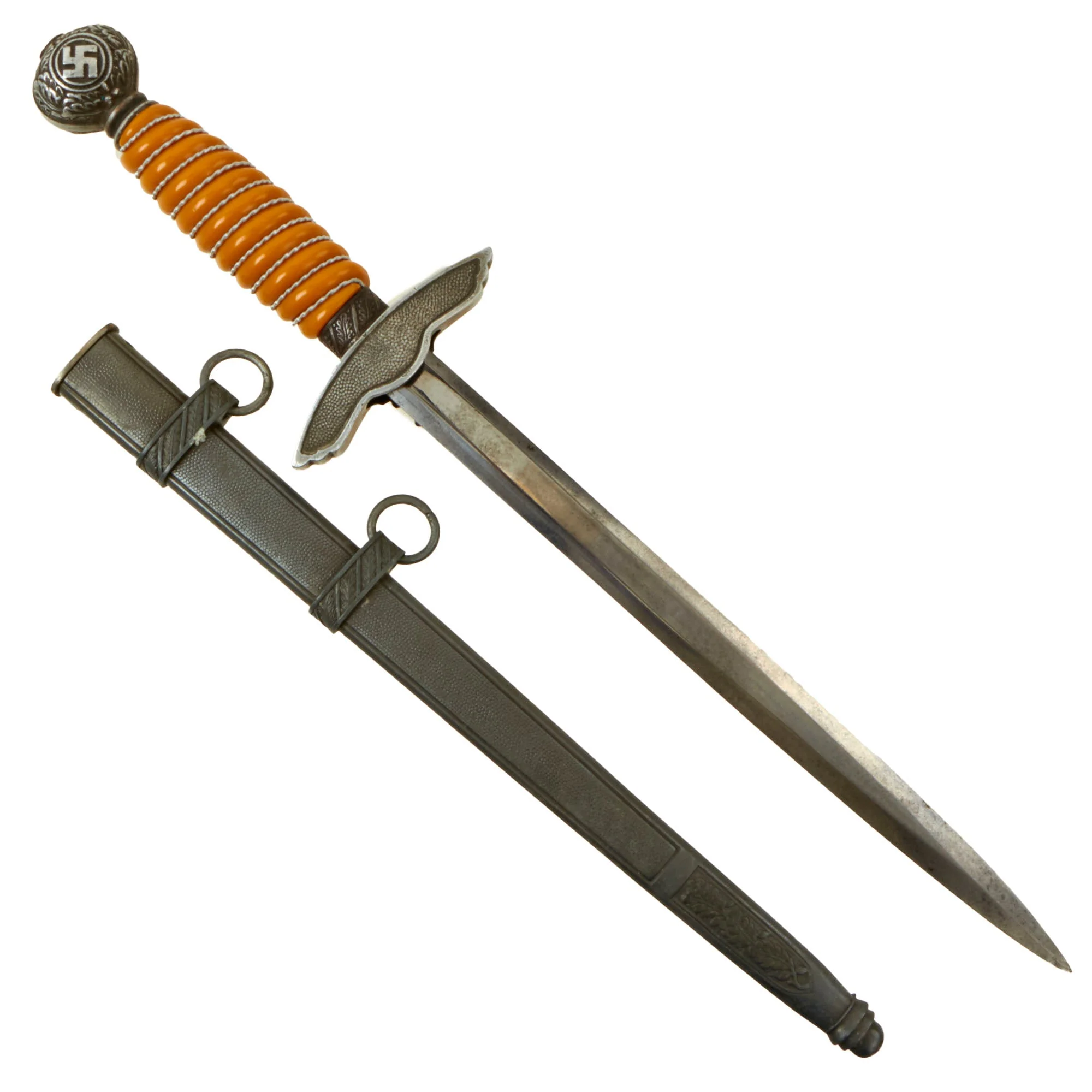
Original Item: Only One Available. This is a lovely example of a rare Kriegsmarine Navy Lion Head Officer's Sword, made by the firm E. & F. Hörster of Solingen, the legendary "City of Blades" in Western Germany. We have very seldom had examples of naval officer swords, as they often went down with the ships, and also were not something that would be picked up on the battlefield or during a surrender. The navy also took a lot longer to adopt NSDAP symbols, which meant that their swords and other items could be displayed and kept much more easily. This lovely example features a lovely triple etched nickel-plated "Pipeback" blade, also called a "quillback", which are quite decorative, and comes complete with an original brass fitted leather scabbard. This is really the full setup, and would be very hard to improve upon!
The hilt on this example is the classic gilt brass alloy, not the later war plated aluminum, and unlike most we see, the gilding still looks to be over 90% intact, with just some light patination on the exposed brass where it has worn away. Some areas have matured to a darker patina, but this is really a great hilt. It has a fold down "clamshell" portion on the outer side, which has a fouled anchor, and the other side has a small area that folds down as well, locking onto the small tab on the scabbard throat. The "Lion" on the pommel has a mane that extends down the entire length of the back strap, and features lovely "jewels" in both eyes. Of note is that the right eye is green and the left eye is red, the universal naval colors for starboard (right) and port (left) when dealing with ships. The grip ferrule has the classic German oak leaves and acorns motif on it. The rest of the guard shows some lovely foliate and floral motifs. There are lots of hand enhancing visible, especially on the cross guard area.
As this is a naval sword, the grip of this example is a ivory white celluloid over a carved wood base, instead of the black seen on the army swords. The celluloid is still in great shape, showing just a bit of light staining, and there is no cracking or other damage to the covering. The grip is wrapped with a 3 pairs of twisted brass wire, with the center pair being a bit thicker. The wires are mostly in place, showing just a bit of looseness in areas. The hilt is still tight on the blade, with no wobble we can detect.
The nickel plated blade is 33 inches long, made of high quality spring steel, and is a fantastic TRIPLE ETCHED example! The plating is in fantastic shape, with no oxidation to see, and the etched designs are crisp and beautiful. The spine of the blade shows a repeating foliate motif, while both sides show lovely naval themed panels. There are ships at the bottom of both sides, while one has a "fouled anchor" panel in the middle, while the other has a panel showing a trident under a crossed oar and harpoon. There are additional foliate designs and stands of arms in the etching. The tip of the blade is perfect, and the edge is correctly unsharpened, and shows no dents or other damage to the edge. A truly remarkable example that would be almost impossible to improve upon!
The left ricasso of the sword blade is stamped by maker E. & F. HÖRSTER / SOLINGEN in an oval "lozenge" around the company's trademark downward pointing sword piercing interlocking HHS initials. E. & F. Hörster & Co Gmbh, Waffenfabrik (weapons factory), is a well-known maker from Solingen, the famous "City of Blades" in Western Germany, which marketed many fine edged weapons. The firm lasted long after WWII, finally being declared insolvent in 1996. For more information please see GERMAN KNIFE AND SWORD MAKERS by J. Anthony Carter.
The included gilt brass mounted leather scabbard is still in very good condition, with the gilding very well retained on the fittings. The body of the scabbard is made from thick leather without any type of wood or metal reinforcement, and it does have a bend about halfway down, however it is not cracked and is well supported by the blade. There is some wear to the leather finish, showing the original brown color of the leather, but the seam is still fully intact. The throat and middle fitting have brass hanger rings in serrated ferrules, and are held in place by flush mount screws, both of which are still intact. The leather body has shrunk a bit over the past 80+ years, so the fittings are bit loose and the scabbard does require some effort to fit into the blade. The lock on the top is fully functional.
Overall a fantastic example of a rare German Kriegsmarine Navy Officer Lion Head sword by a desirable maker, with a fantastic triple etched blade and leather scabbard. This would be very hard to improve upon! Ready to display!
Specifications:
Blade Length: 30"
Blade Style: Single Edge w/ Fuller
Overall length: 35 1/8“
Guard dimensions: 4" width x 5” length
Scabbard length: 31”
WWII Kriegsmarine
In violation of the Treaty of Versailles, the Kriegsmarine grew rapidly during German naval rearmament in the 1930s. The 1919 treaty had limited the size of the German navy and prohibited the building of submarines
Kriegsmarine ships were deployed to the waters around Spain during the Spanish Civil War (1936–1939) under the guise of enforcing non-intervention, but in reality supported the Nationalists against the Spanish Republicans.
In January 1939, Plan Z, a massive ship-building program, was ordered, calling for surface naval parity with the British Royal Navy by 1944. When World War II broke out in September 1939, Plan Z was shelved in favour of a crash building program for submarines (U-boats) instead of capital surface warships, and land and air forces were given priority of strategic resources.
The Commander-in-Chief of the Kriegsmarine (as for all branches of armed forces during the period of absolute NSDAP power) was AH, who exercised his authority through the Oberkommando der Marine ("High Command of the Navy").
The Kriegsmarine's most significant ships were the U-boats, most of which were constructed after Plan Z was abandoned at the beginning of World War II. Wolfpacks were rapidly assembled groups of submarines which attacked British convoys during the first half of the Battle of the Atlantic but this tactic was largely abandoned by May 1943 when U-boat losses mounted. Along with the U-boats, surface commerce raiders (including auxiliary cruisers) were used to disrupt Allied shipping in the early years of the war, the most famous of these being the heavy cruisers Admiral Graf Spee and Admiral Scheer and the battleship Bismarck. However, the adoption of convoy escorts, especially in the Atlantic, greatly reduced the effectiveness of surface commerce raiders against convoys.
Following the end of World War II in 1945, the Kriegsmarine's remaining ships were divided up among the Allied powers and were used for various purposes including minesweeping. Some were loaded with superfluous chemical weapons and scuttled.

Details & Craftsmanship
Every detail has been carefully considered to bring you the perfect product.

Details & Craftsmanship
Every detail has been carefully considered to bring you the perfect product.

Details & Craftsmanship
Every detail has been carefully considered to bring you the perfect product.

Details & Craftsmanship
Every detail has been carefully considered to bring you the perfect product.

Details & Craftsmanship
Every detail has been carefully considered to bring you the perfect product.

Details & Craftsmanship
Every detail has been carefully considered to bring you the perfect product.

Details & Craftsmanship
Every detail has been carefully considered to bring you the perfect product.

Details & Craftsmanship
Every detail has been carefully considered to bring you the perfect product.

Details & Craftsmanship
Every detail has been carefully considered to bring you the perfect product.

Details & Craftsmanship
Every detail has been carefully considered to bring you the perfect product.

Details & Craftsmanship
Every detail has been carefully considered to bring you the perfect product.

Details & Craftsmanship
Every detail has been carefully considered to bring you the perfect product.

Details & Craftsmanship
Every detail has been carefully considered to bring you the perfect product.

Details & Craftsmanship
Every detail has been carefully considered to bring you the perfect product.

Details & Craftsmanship
Every detail has been carefully considered to bring you the perfect product.

Details & Craftsmanship
Every detail has been carefully considered to bring you the perfect product.

Details & Craftsmanship
Every detail has been carefully considered to bring you the perfect product.

Details & Craftsmanship
Every detail has been carefully considered to bring you the perfect product.
Description
Original Item: Only One Available. This is a lovely example of a rare Kriegsmarine Navy Lion Head Officer's Sword, made by the firm E. & F. Hörster of Solingen, the legendary "City of Blades" in Western Germany. We have very seldom had examples of naval officer swords, as they often went down with the ships, and also were not something that would be picked up on the battlefield or during a surrender. The navy also took a lot longer to adopt NSDAP symbols, which meant that their swords and other items could be displayed and kept much more easily. This lovely example features a lovely triple etched nickel-plated "Pipeback" blade, also called a "quillback", which are quite decorative, and comes complete with an original brass fitted leather scabbard. This is really the full setup, and would be very hard to improve upon!
The hilt on this example is the classic gilt brass alloy, not the later war plated aluminum, and unlike most we see, the gilding still looks to be over 90% intact, with just some light patination on the exposed brass where it has worn away. Some areas have matured to a darker patina, but this is really a great hilt. It has a fold down "clamshell" portion on the outer side, which has a fouled anchor, and the other side has a small area that folds down as well, locking onto the small tab on the scabbard throat. The "Lion" on the pommel has a mane that extends down the entire length of the back strap, and features lovely "jewels" in both eyes. Of note is that the right eye is green and the left eye is red, the universal naval colors for starboard (right) and port (left) when dealing with ships. The grip ferrule has the classic German oak leaves and acorns motif on it. The rest of the guard shows some lovely foliate and floral motifs. There are lots of hand enhancing visible, especially on the cross guard area.
As this is a naval sword, the grip of this example is a ivory white celluloid over a carved wood base, instead of the black seen on the army swords. The celluloid is still in great shape, showing just a bit of light staining, and there is no cracking or other damage to the covering. The grip is wrapped with a 3 pairs of twisted brass wire, with the center pair being a bit thicker. The wires are mostly in place, showing just a bit of looseness in areas. The hilt is still tight on the blade, with no wobble we can detect.
The nickel plated blade is 33 inches long, made of high quality spring steel, and is a fantastic TRIPLE ETCHED example! The plating is in fantastic shape, with no oxidation to see, and the etched designs are crisp and beautiful. The spine of the blade shows a repeating foliate motif, while both sides show lovely naval themed panels. There are ships at the bottom of both sides, while one has a "fouled anchor" panel in the middle, while the other has a panel showing a trident under a crossed oar and harpoon. There are additional foliate designs and stands of arms in the etching. The tip of the blade is perfect, and the edge is correctly unsharpened, and shows no dents or other damage to the edge. A truly remarkable example that would be almost impossible to improve upon!
The left ricasso of the sword blade is stamped by maker E. & F. HÖRSTER / SOLINGEN in an oval "lozenge" around the company's trademark downward pointing sword piercing interlocking HHS initials. E. & F. Hörster & Co Gmbh, Waffenfabrik (weapons factory), is a well-known maker from Solingen, the famous "City of Blades" in Western Germany, which marketed many fine edged weapons. The firm lasted long after WWII, finally being declared insolvent in 1996. For more information please see GERMAN KNIFE AND SWORD MAKERS by J. Anthony Carter.
The included gilt brass mounted leather scabbard is still in very good condition, with the gilding very well retained on the fittings. The body of the scabbard is made from thick leather without any type of wood or metal reinforcement, and it does have a bend about halfway down, however it is not cracked and is well supported by the blade. There is some wear to the leather finish, showing the original brown color of the leather, but the seam is still fully intact. The throat and middle fitting have brass hanger rings in serrated ferrules, and are held in place by flush mount screws, both of which are still intact. The leather body has shrunk a bit over the past 80+ years, so the fittings are bit loose and the scabbard does require some effort to fit into the blade. The lock on the top is fully functional.
Overall a fantastic example of a rare German Kriegsmarine Navy Officer Lion Head sword by a desirable maker, with a fantastic triple etched blade and leather scabbard. This would be very hard to improve upon! Ready to display!
Specifications:
Blade Length: 30"
Blade Style: Single Edge w/ Fuller
Overall length: 35 1/8“
Guard dimensions: 4" width x 5” length
Scabbard length: 31”
WWII Kriegsmarine
In violation of the Treaty of Versailles, the Kriegsmarine grew rapidly during German naval rearmament in the 1930s. The 1919 treaty had limited the size of the German navy and prohibited the building of submarines
Kriegsmarine ships were deployed to the waters around Spain during the Spanish Civil War (1936–1939) under the guise of enforcing non-intervention, but in reality supported the Nationalists against the Spanish Republicans.
In January 1939, Plan Z, a massive ship-building program, was ordered, calling for surface naval parity with the British Royal Navy by 1944. When World War II broke out in September 1939, Plan Z was shelved in favour of a crash building program for submarines (U-boats) instead of capital surface warships, and land and air forces were given priority of strategic resources.
The Commander-in-Chief of the Kriegsmarine (as for all branches of armed forces during the period of absolute NSDAP power) was AH, who exercised his authority through the Oberkommando der Marine ("High Command of the Navy").
The Kriegsmarine's most significant ships were the U-boats, most of which were constructed after Plan Z was abandoned at the beginning of World War II. Wolfpacks were rapidly assembled groups of submarines which attacked British convoys during the first half of the Battle of the Atlantic but this tactic was largely abandoned by May 1943 when U-boat losses mounted. Along with the U-boats, surface commerce raiders (including auxiliary cruisers) were used to disrupt Allied shipping in the early years of the war, the most famous of these being the heavy cruisers Admiral Graf Spee and Admiral Scheer and the battleship Bismarck. However, the adoption of convoy escorts, especially in the Atlantic, greatly reduced the effectiveness of surface commerce raiders against convoys.
Following the end of World War II in 1945, the Kriegsmarine's remaining ships were divided up among the Allied powers and were used for various purposes including minesweeping. Some were loaded with superfluous chemical weapons and scuttled.