
Original: $895.00
-70%$895.00
$268.50The Story
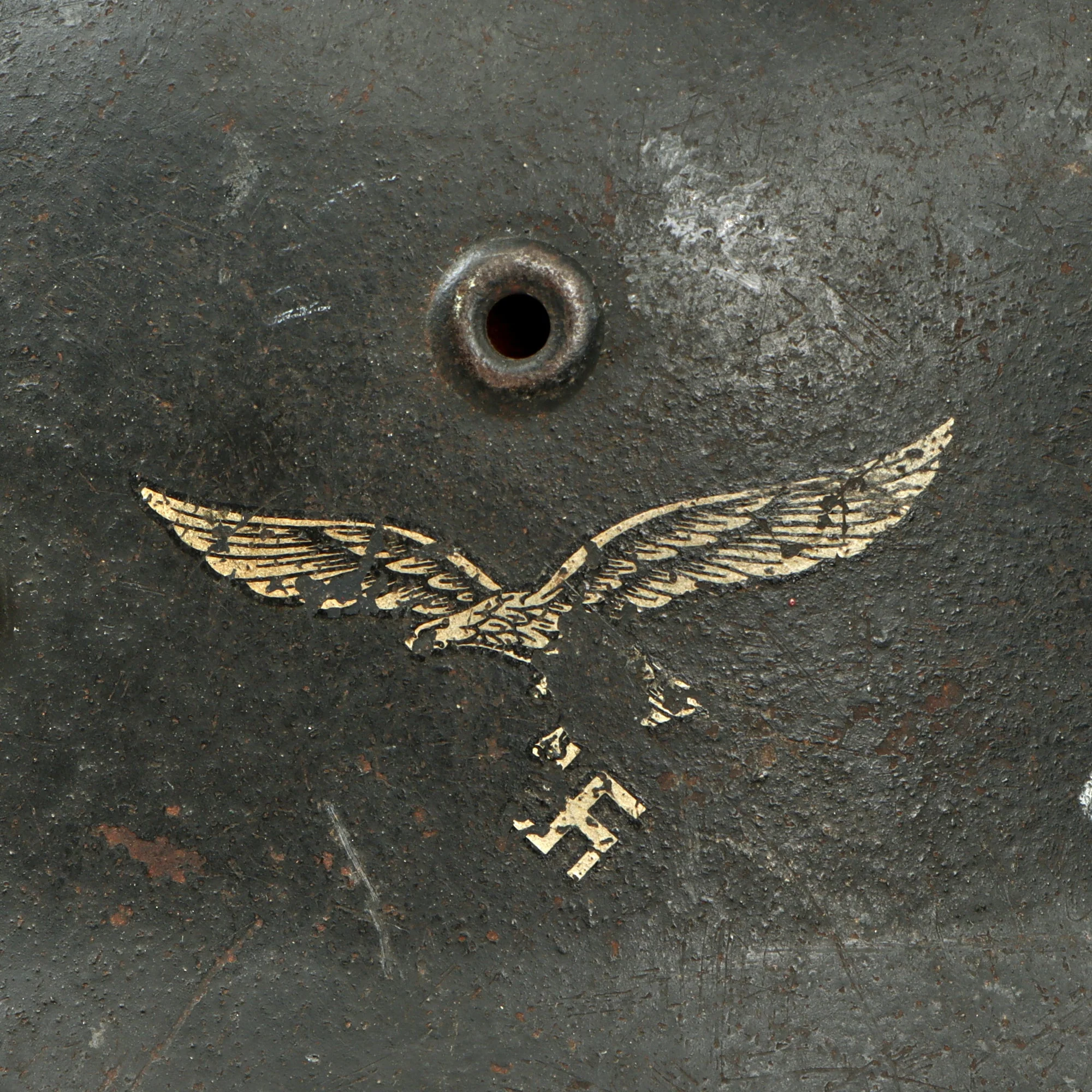
Original Item: Only One Available. This is a lovely all original example Model 1940 German WWII helmet with a single Luftwaffe Eagle decal and 1941 dated size 55cm liner, as well as a chinstrap, though it is in VERY delicate condition. This stamped sheet steel construction helmet still retains most of the original lightly textured Luftwaffe Fliegerblau (flyer's blue) paint, which utilized aluminum oxide as a texturing agent. There is scuffing to the paint, particularly on the top of the helmet, but there is no major damage out of line with light wear from service and storage. The interior paint is very well retained, with just a bit of oxidation in areas. The original Luftwaffe eagle decal does show wear, and is probably retained at about 60%, with some areas worn and chipped away, which gives it a great "been there" look.
The reverse, interior, neck guard apron is heat lot number stamped 6782 and the interior, left side, apron has the stamped manufacturer's code and size, SE62 indicating that it was manufactured by Sächsische Emaillier und Stanzwerke A.G. of Lauter, Germany. Size 62 is a nice smaller size that can accommodate liners from 54cm to 55cm or US 6 3/4 to 6 5/8.
All three original liner retaining pins are intact and in good condition, having lost much of their paint and oxidized. It looks like they may have been zinc plated, which can interfere with the paint adhering, after which the zinc itself wore away. The interior of the helmet still has its original leather liner with all 8 fingers fully intact, though the top tie is missing. The leather has a lovely chestnut brown color, and there is a bit of splitting and dry rot where it is bent over the inner liner band. The outer side of the galvanized steel liner band over the left ear is marked 62 n.A / 55, indicating that this is a size 55 liner for a size 62 shell, and the leather is stamped 55 as well. It is also maker marked and dated on the other side, though the top and bottom lines are VERY faint, with the date easily visible:-
Metallwarenfabrik
1941
F.W.M.
This indicates 1941 production by F.W. Müller Jr. in Berlin, which fits right into the period. The included chinstrap is an early war version, with all aluminum fittings, and it retains all thirteen length adjustment holes. Unfortunately the leather is cracked and dry rotted, now in very delicate condition and partially torn through in several places. There is not really any way to stop or repair this progression, so it will eventually tear through completely and should be handled with a great amount of care.
Overall great genuine complete M40 Single Decal Luftwaffe helmet, with great service used look! This is an item that will only continue to appreciate in value over time.
The first "modern" steel helmets were introduced by the French army in early 1915 and were shortly followed by the British army later that year. With plans on the drawing board, experimental helmets in the field, ("Gaede" helmet), and some captured French and British helmets the German army began tests for their own steel helmet at the Kummersdorf Proving Grounds in November, and in the field in December 1915. An acceptable pattern was developed and approved and production began at Eisen-und Hüttenwerke, AG Thale/Harz, (Iron and Foundry Works), in the spring of 1916.
These first modern M16 helmets evolved into the M18 helmets by the end of WWI. The M16 and M18 helmets remained in usage through-out the Weimar Reichswehr, (National Defence Force, Circa 1919-1933), era and on into the early years of the Third Reich until the development of the smaller, lighter M35 style helmet in June 1935.
In 1934 tests began on an improved Stahlhelm, whose design was a development of World War I models. The Eisenhüttenwerke company of Thale carried out prototype design and testing, with Dr. Friedrich Schwerd once again taking a hand.
The new helmet was pressed from sheets of molybdenum steel in several stages. The size of the flared visor and skirt was reduced, and the large projecting lugs for the obsolete armor shield were eliminated. The ventilator holes were retained, but were set in smaller hollow rivets mounted to the helmet's shell. The edges of the shell were rolled over, creating a smooth edge along the helmet. Finally, a completely new leather suspension, or liner, was incorporated that greatly improved the helmet's safety, adjustability, and comfort for each wearer. These improvements made the new M1935 helmet lighter, more compact, and more comfortable to wear than the previous designs.
The Army's Supreme Command officially accepted the new helmet on June 25, 1935 and it was intended to replace all other helmets in service.
The M1935 design was slightly modified in 1940 to simplify its construction, the manufacturing process now incorporating more automated stamping methods. The principal change was to stamp the ventilator hole mounts directly onto the shell, rather than utilizing separate fittings. In other respects, the M1940 helmet was identical to the M1935. The Germans still referred to the M1940 as the M1935, while the M1940 designation were given by collectors.
Details & Craftsmanship
Every detail has been carefully considered to bring you the perfect product.

Details & Craftsmanship
Every detail has been carefully considered to bring you the perfect product.

Details & Craftsmanship
Every detail has been carefully considered to bring you the perfect product.

Details & Craftsmanship
Every detail has been carefully considered to bring you the perfect product.

Details & Craftsmanship
Every detail has been carefully considered to bring you the perfect product.

Details & Craftsmanship
Every detail has been carefully considered to bring you the perfect product.

Details & Craftsmanship
Every detail has been carefully considered to bring you the perfect product.

Details & Craftsmanship
Every detail has been carefully considered to bring you the perfect product.

Details & Craftsmanship
Every detail has been carefully considered to bring you the perfect product.

Details & Craftsmanship
Every detail has been carefully considered to bring you the perfect product.

Details & Craftsmanship
Every detail has been carefully considered to bring you the perfect product.

Details & Craftsmanship
Every detail has been carefully considered to bring you the perfect product.

Details & Craftsmanship
Every detail has been carefully considered to bring you the perfect product.

Details & Craftsmanship
Every detail has been carefully considered to bring you the perfect product.
Description
Original Item: Only One Available. This is a lovely all original example Model 1940 German WWII helmet with a single Luftwaffe Eagle decal and 1941 dated size 55cm liner, as well as a chinstrap, though it is in VERY delicate condition. This stamped sheet steel construction helmet still retains most of the original lightly textured Luftwaffe Fliegerblau (flyer's blue) paint, which utilized aluminum oxide as a texturing agent. There is scuffing to the paint, particularly on the top of the helmet, but there is no major damage out of line with light wear from service and storage. The interior paint is very well retained, with just a bit of oxidation in areas. The original Luftwaffe eagle decal does show wear, and is probably retained at about 60%, with some areas worn and chipped away, which gives it a great "been there" look.
The reverse, interior, neck guard apron is heat lot number stamped 6782 and the interior, left side, apron has the stamped manufacturer's code and size, SE62 indicating that it was manufactured by Sächsische Emaillier und Stanzwerke A.G. of Lauter, Germany. Size 62 is a nice smaller size that can accommodate liners from 54cm to 55cm or US 6 3/4 to 6 5/8.
All three original liner retaining pins are intact and in good condition, having lost much of their paint and oxidized. It looks like they may have been zinc plated, which can interfere with the paint adhering, after which the zinc itself wore away. The interior of the helmet still has its original leather liner with all 8 fingers fully intact, though the top tie is missing. The leather has a lovely chestnut brown color, and there is a bit of splitting and dry rot where it is bent over the inner liner band. The outer side of the galvanized steel liner band over the left ear is marked 62 n.A / 55, indicating that this is a size 55 liner for a size 62 shell, and the leather is stamped 55 as well. It is also maker marked and dated on the other side, though the top and bottom lines are VERY faint, with the date easily visible:-
Metallwarenfabrik
1941
F.W.M.
This indicates 1941 production by F.W. Müller Jr. in Berlin, which fits right into the period. The included chinstrap is an early war version, with all aluminum fittings, and it retains all thirteen length adjustment holes. Unfortunately the leather is cracked and dry rotted, now in very delicate condition and partially torn through in several places. There is not really any way to stop or repair this progression, so it will eventually tear through completely and should be handled with a great amount of care.
Overall great genuine complete M40 Single Decal Luftwaffe helmet, with great service used look! This is an item that will only continue to appreciate in value over time.
The first "modern" steel helmets were introduced by the French army in early 1915 and were shortly followed by the British army later that year. With plans on the drawing board, experimental helmets in the field, ("Gaede" helmet), and some captured French and British helmets the German army began tests for their own steel helmet at the Kummersdorf Proving Grounds in November, and in the field in December 1915. An acceptable pattern was developed and approved and production began at Eisen-und Hüttenwerke, AG Thale/Harz, (Iron and Foundry Works), in the spring of 1916.
These first modern M16 helmets evolved into the M18 helmets by the end of WWI. The M16 and M18 helmets remained in usage through-out the Weimar Reichswehr, (National Defence Force, Circa 1919-1933), era and on into the early years of the Third Reich until the development of the smaller, lighter M35 style helmet in June 1935.
In 1934 tests began on an improved Stahlhelm, whose design was a development of World War I models. The Eisenhüttenwerke company of Thale carried out prototype design and testing, with Dr. Friedrich Schwerd once again taking a hand.
The new helmet was pressed from sheets of molybdenum steel in several stages. The size of the flared visor and skirt was reduced, and the large projecting lugs for the obsolete armor shield were eliminated. The ventilator holes were retained, but were set in smaller hollow rivets mounted to the helmet's shell. The edges of the shell were rolled over, creating a smooth edge along the helmet. Finally, a completely new leather suspension, or liner, was incorporated that greatly improved the helmet's safety, adjustability, and comfort for each wearer. These improvements made the new M1935 helmet lighter, more compact, and more comfortable to wear than the previous designs.
The Army's Supreme Command officially accepted the new helmet on June 25, 1935 and it was intended to replace all other helmets in service.
The M1935 design was slightly modified in 1940 to simplify its construction, the manufacturing process now incorporating more automated stamping methods. The principal change was to stamp the ventilator hole mounts directly onto the shell, rather than utilizing separate fittings. In other respects, the M1940 helmet was identical to the M1935. The Germans still referred to the M1940 as the M1935, while the M1940 designation were given by collectors.