Original: $1,395.00
-70%$1,395.00
$418.50The Story
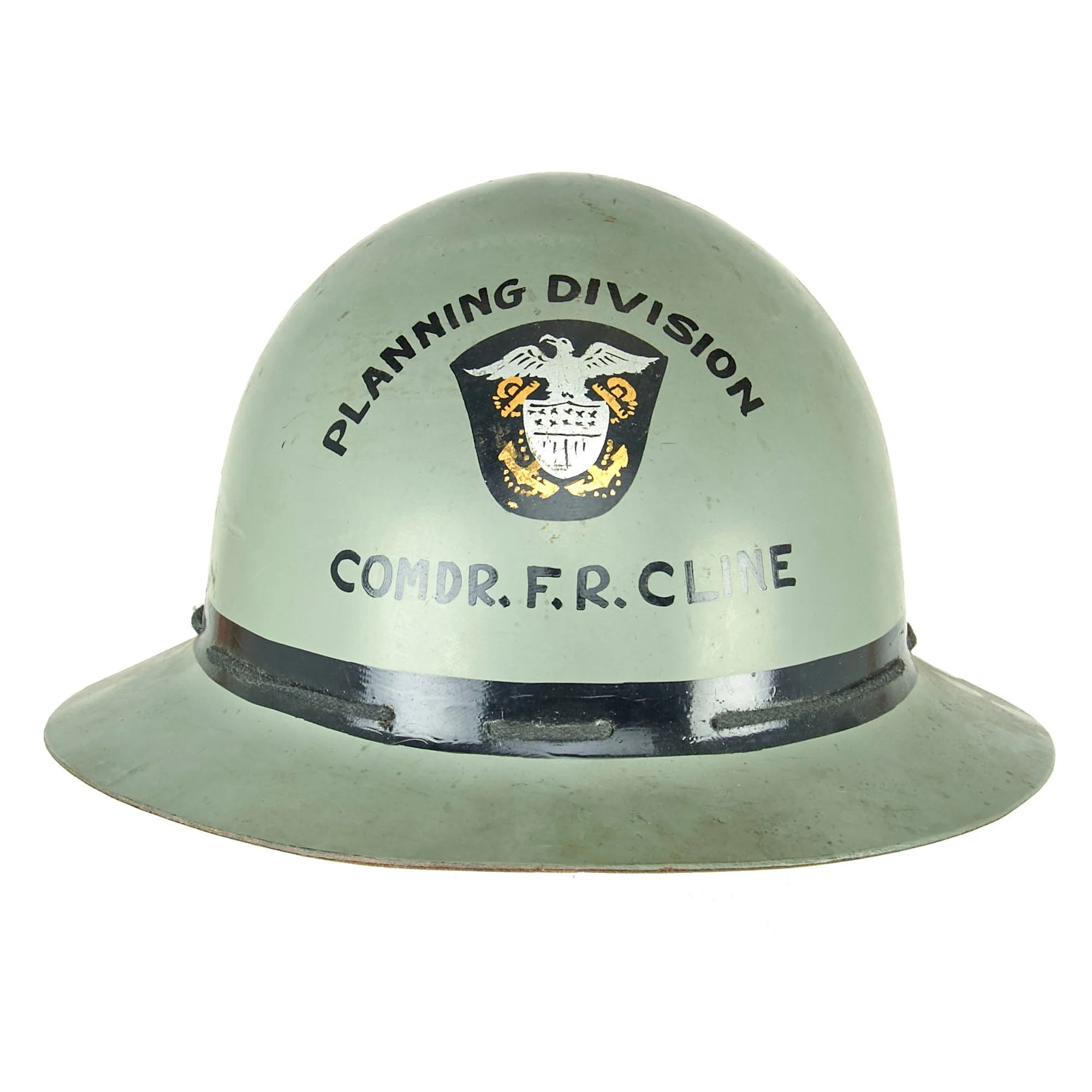
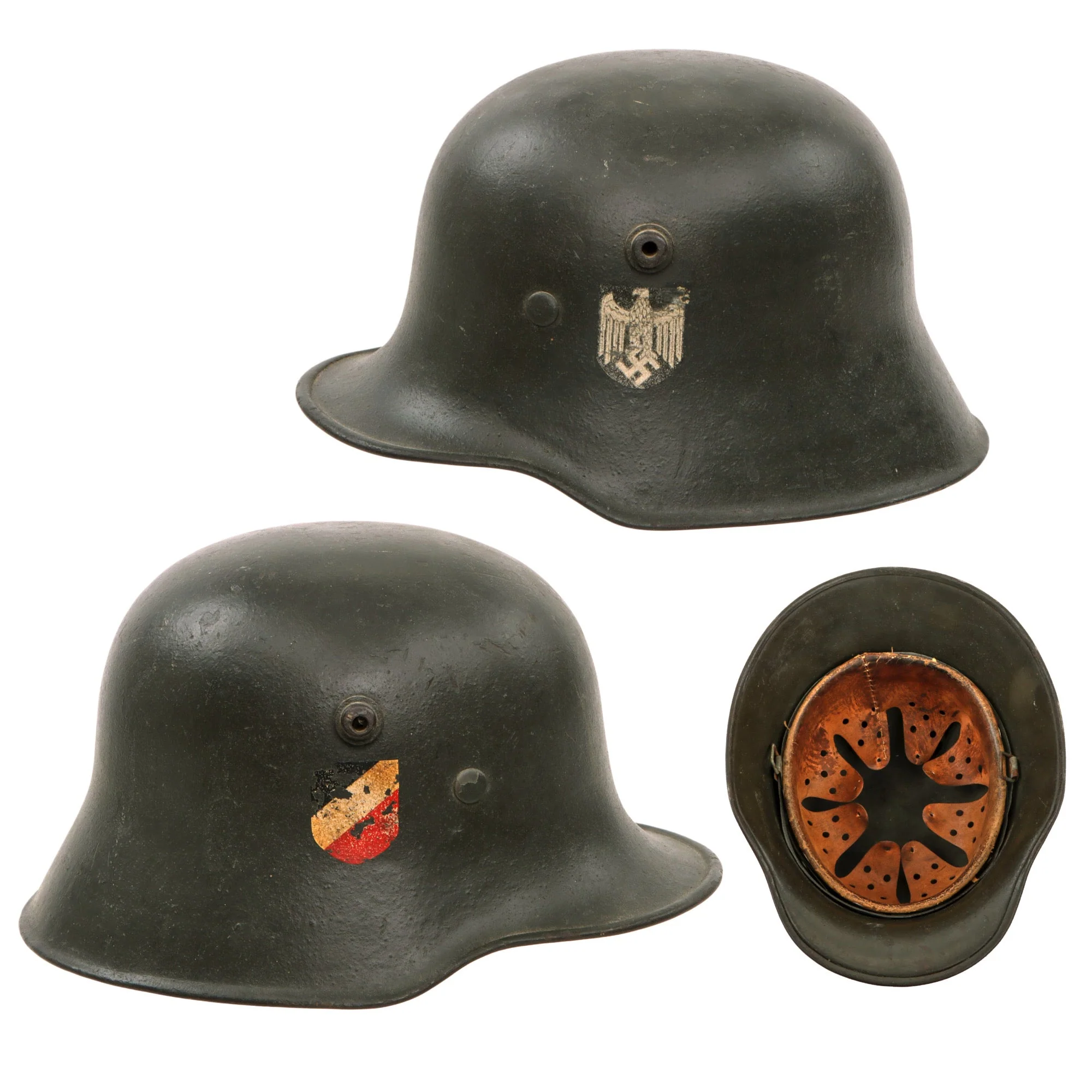
Original Item: Only One Available. This is a lovely example of a WWI M18 helmet, which was converted for use by the Third Reich in the 1930s before the widespread issue of the M1935 helmet. This would involve repainting, and the helmet was then fitted with a pre-war M-31 Leather liner, with the correct WWII pattern split pins. This example looks to have been in service for some time, and was originally finished in WWII early war "Apfel-grün" (Apple Green). After that it saw long use, and was overpainted with lightly textured panzergrau (armor gray) paint during the early war period, and had new decals applied on top of this. After that it saw additional use, leaving a fantastic lightly aged patina.
The shell was originally outfit with the "National Colors" and "Heer Eagle" decals, which are still both present and were not painted over! The use of the second decal was discontinued in 1940, and in 1943 it was ordered that helmets with the national colors have them removed, so finding a helmet with both still intact is a real treat! Both decals show age and wear, with the "National Colors" showing about 25% having flaked off, while the Eagle is better retained, but shows more overall wear. Definitely an interesting example with a great look!
Above the left ear, the interior of the apron of the shell has a stamped manufacturer's code and size Si. 62, for the maker Eisenhuette Silesia, Paruschowitz Oberschlesien. This is a relatively uncommon maker to find, as they only produced shells in sizes 62 and 66. Size 62 is a smaller size that can accommodate liners from 54cm to 56cm or US 6 3/4 to 7. There is a faint rolling mill mark dome stamp of B i 975, indicating that Bismarckhutte in Oberschlesien made the steel. This is the usual dome stamp for an "Si" marked helmet. As this is an M18 helmet, there are no attachment points on the shell for the WWI type chinstrap. However the shell still retains both of the extended ventilation side lugs, which are the correct longer step version for size 62 shells. This would ensure proper installation of a Stirnpanzer brow plate regardless of shell size.
All three original liner retaining pins are intact and have most of the original paint on the ends, with several layers showing on the tops. The interior of the helmet still has an original M31 leather liner with all eight fingers present and in good shape, showing a nice chestnut brown color, and there is some splitting over the rim. The top securing string is missing, and there is no tear through on the ends of the fingers. The left side of the galvanized steel liner band is marked 62n.A. / 55, indicating a size 58 liner for a size 66 shell. The other side is too close to the shell to read, so we cannot see any of the maker markings. There is no chinstrap installed.
A beautiful, solid example of WWII Heer Army Reissued M18 helmet with "Double Decals" and a lightly worn look! Comes ready to research and display!
The first "modern" steel helmets were introduced by the French army in early 1915 and were shortly followed by the British army later that year. With plans on the drawing board, experimental helmets in the field, ("Gaede" helmet), and some captured French and British helmets the German army began tests for their own steel helmet at the Kummersdorf Proving Grounds in November, and in the field in December 1915. An acceptable pattern was developed and approved and production began at Eisen-und Hüttenwerke, AG Thale/Harz, in the spring of 1916. These first modern M16 helmets evolved into the M18 helmets by the end of WWI. At the end of WWI it is estimated that Germany had produced about 8,500,000 steel helmets. As a result of the restrictions placed on the German’s by the Treaty of Versailles, which dictated a standing army of only 100,000 personnel, there was an abundant surplus of these helmets, and though they saw widespread use by Freikorps personnel, there was still a stockpile controlled by the Reichswehr.
These excess helmets underwent minor modifications in 1923 with the addition of provincial identifying shield decals and in 1931 with the development of a new chinstrap and liner system. Although helmet development was ongoing when AH came to power in 1933, the M16 and M18 helmets were still the main headgear worn by the Reichswehr. The helmets remained the same until March 1933 when the provincial shields were discontinued in favour of the national tri-color shield. In 1934 the national eagle shield was introduced, and both the tri-color and eagle shields were applied to the helmets. After the development of the new M35 helmet, the WWI helmets were still issued to second line and training troops well into WWII. The Austrian M16 was almost identical to the German version with the positioning of the chinstrap liner rivets being the most readily identifiable difference.

Details & Craftsmanship
Every detail has been carefully considered to bring you the perfect product.

Details & Craftsmanship
Every detail has been carefully considered to bring you the perfect product.

Details & Craftsmanship
Every detail has been carefully considered to bring you the perfect product.

Details & Craftsmanship
Every detail has been carefully considered to bring you the perfect product.

Details & Craftsmanship
Every detail has been carefully considered to bring you the perfect product.

Details & Craftsmanship
Every detail has been carefully considered to bring you the perfect product.

Details & Craftsmanship
Every detail has been carefully considered to bring you the perfect product.

Details & Craftsmanship
Every detail has been carefully considered to bring you the perfect product.

Details & Craftsmanship
Every detail has been carefully considered to bring you the perfect product.

Details & Craftsmanship
Every detail has been carefully considered to bring you the perfect product.

Details & Craftsmanship
Every detail has been carefully considered to bring you the perfect product.

Details & Craftsmanship
Every detail has been carefully considered to bring you the perfect product.

Details & Craftsmanship
Every detail has been carefully considered to bring you the perfect product.

Details & Craftsmanship
Every detail has been carefully considered to bring you the perfect product.
Description
Original Item: Only One Available. This is a lovely example of a WWI M18 helmet, which was converted for use by the Third Reich in the 1930s before the widespread issue of the M1935 helmet. This would involve repainting, and the helmet was then fitted with a pre-war M-31 Leather liner, with the correct WWII pattern split pins. This example looks to have been in service for some time, and was originally finished in WWII early war "Apfel-grün" (Apple Green). After that it saw long use, and was overpainted with lightly textured panzergrau (armor gray) paint during the early war period, and had new decals applied on top of this. After that it saw additional use, leaving a fantastic lightly aged patina.
The shell was originally outfit with the "National Colors" and "Heer Eagle" decals, which are still both present and were not painted over! The use of the second decal was discontinued in 1940, and in 1943 it was ordered that helmets with the national colors have them removed, so finding a helmet with both still intact is a real treat! Both decals show age and wear, with the "National Colors" showing about 25% having flaked off, while the Eagle is better retained, but shows more overall wear. Definitely an interesting example with a great look!
Above the left ear, the interior of the apron of the shell has a stamped manufacturer's code and size Si. 62, for the maker Eisenhuette Silesia, Paruschowitz Oberschlesien. This is a relatively uncommon maker to find, as they only produced shells in sizes 62 and 66. Size 62 is a smaller size that can accommodate liners from 54cm to 56cm or US 6 3/4 to 7. There is a faint rolling mill mark dome stamp of B i 975, indicating that Bismarckhutte in Oberschlesien made the steel. This is the usual dome stamp for an "Si" marked helmet. As this is an M18 helmet, there are no attachment points on the shell for the WWI type chinstrap. However the shell still retains both of the extended ventilation side lugs, which are the correct longer step version for size 62 shells. This would ensure proper installation of a Stirnpanzer brow plate regardless of shell size.
All three original liner retaining pins are intact and have most of the original paint on the ends, with several layers showing on the tops. The interior of the helmet still has an original M31 leather liner with all eight fingers present and in good shape, showing a nice chestnut brown color, and there is some splitting over the rim. The top securing string is missing, and there is no tear through on the ends of the fingers. The left side of the galvanized steel liner band is marked 62n.A. / 55, indicating a size 58 liner for a size 66 shell. The other side is too close to the shell to read, so we cannot see any of the maker markings. There is no chinstrap installed.
A beautiful, solid example of WWII Heer Army Reissued M18 helmet with "Double Decals" and a lightly worn look! Comes ready to research and display!
The first "modern" steel helmets were introduced by the French army in early 1915 and were shortly followed by the British army later that year. With plans on the drawing board, experimental helmets in the field, ("Gaede" helmet), and some captured French and British helmets the German army began tests for their own steel helmet at the Kummersdorf Proving Grounds in November, and in the field in December 1915. An acceptable pattern was developed and approved and production began at Eisen-und Hüttenwerke, AG Thale/Harz, in the spring of 1916. These first modern M16 helmets evolved into the M18 helmets by the end of WWI. At the end of WWI it is estimated that Germany had produced about 8,500,000 steel helmets. As a result of the restrictions placed on the German’s by the Treaty of Versailles, which dictated a standing army of only 100,000 personnel, there was an abundant surplus of these helmets, and though they saw widespread use by Freikorps personnel, there was still a stockpile controlled by the Reichswehr.
These excess helmets underwent minor modifications in 1923 with the addition of provincial identifying shield decals and in 1931 with the development of a new chinstrap and liner system. Although helmet development was ongoing when AH came to power in 1933, the M16 and M18 helmets were still the main headgear worn by the Reichswehr. The helmets remained the same until March 1933 when the provincial shields were discontinued in favour of the national tri-color shield. In 1934 the national eagle shield was introduced, and both the tri-color and eagle shields were applied to the helmets. After the development of the new M35 helmet, the WWI helmets were still issued to second line and training troops well into WWII. The Austrian M16 was almost identical to the German version with the positioning of the chinstrap liner rivets being the most readily identifiable difference.