
Original German WWII MP44 STG 44 Sturmgewehr Demilled Receiver Display Gun Dated 1944 - Matching Serial 3179 q - Claimed Battle of the Bulge Battlefield Pickup
Original German WWII MP44 STG 44 Sturmgewehr Demilled Receiver Display Gun Dated 1944 - Matching Serial 3179 q - Claimed Battle of the Bulge Battlefield Pickup
Original: $9,995.00
-70%$9,995.00
$2,998.50The Story
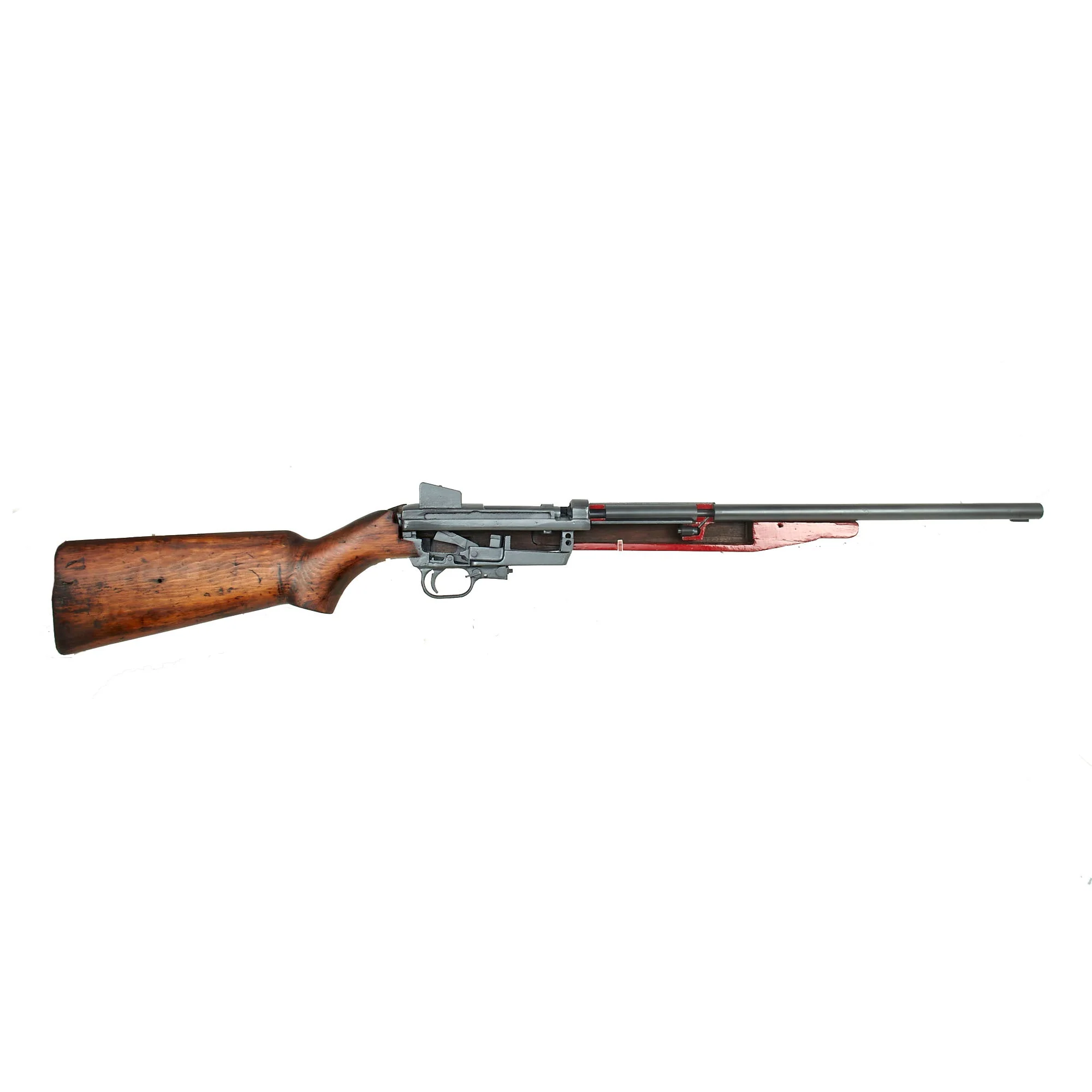
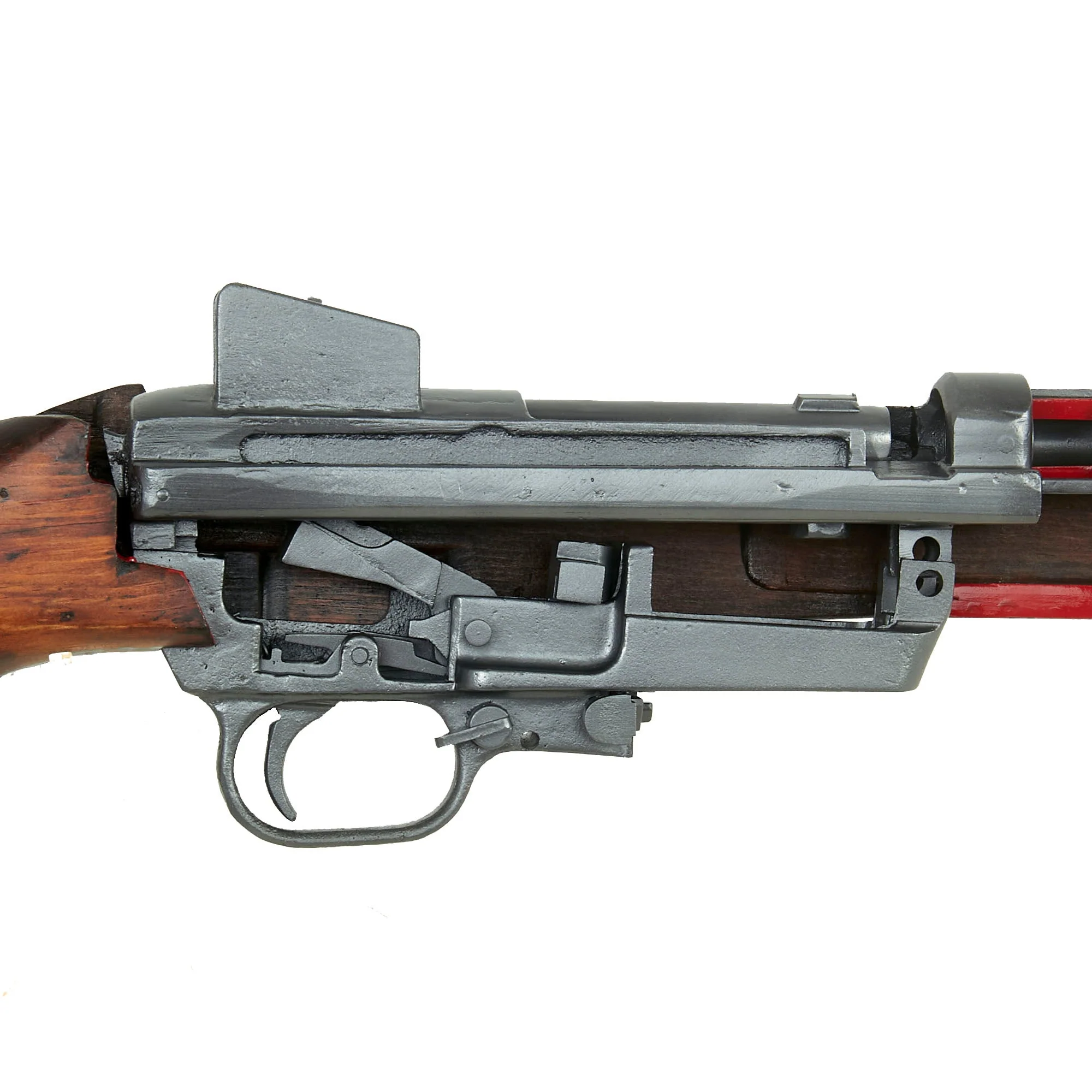
Original Item: Only One Available. This is an exceptional German WWII MP44 / STG 44 display gun built from all original German WWII parts on an original BATF compliant non-firing display receiver, making this a 100% legal Display Machine gun. This receiver was constructed using portions of the original torch-cut receiver, including the barrel bushing, combined with newly manufactured solid steel sections. During the process, approximately 33% of the receiver’s total length was completely replaced with solid steel bar stock. As a result, a full third-length section of the display receiver is now solid steel, rendering the receiver permanently inactive. Because of this substantial replacement with solid steel, the receiver is legally classified as a non-firing display piece and may be owned without any license or firearms paperwork. Every part on this display gun is original WWII manufacture other than 33% of the receiver replaced by solid steel (as required by BATF).
Called the SturmGewehr (Storm / Assault Rifle) 44, it was considered by many to be the original pattern for the modern assault rifle. The MP 44 was developed to give German troops fighting in Russia a means of delivering large volumes of fire at the seemingly endless supply of Soviet troops.
This example originated from an American WWII veteran who captured it and brought it back from Europe as a trophy of war, and per the story we received with the gun it was picked up off the battle field after the Battle of the Bulge / Ardennes Offensive, which took place 16 December 1944 – 28 January 1945. We unfortunately do not have any further information regarding who picked it up or exactly where, as the front was definitely not small. It looks to have suffered damage to the left side of the action during battle, which tore through the stamped steel.
This display gun is in very good battlefield used condition, and was constructed using an original ALL MATCHING SERIAL NUMBERS MP 44 Parts set! It bears original serial number 3179 q / 44 above the magazine well, indicating that it was produced in 1944. The rear of the trigger group under the butt stock cup, the butt stuck cup itself, and other components are all marked with the same number, or a shortened version. The parts set came with the internal components as well as some receiver sections not used during construction, and the gas piston is also marked 3179 q. One of the receiver sections is also marked with a fully legible MP44 marking, so this is an example made before the official nomenclature change to the StG 44.
Also included is a lovely magazine, which has all the correct markings. It features an early pattern solid wood butt stock with some nice service wear and a no repairs we can see. Constructed by one of our own precision-minded master-craftsman gunsmiths, this display gun was built from the ground up with exacting detail and looks fantastic. There are multiple German Three Letter maker codes as well as Waffenamt inspection codes on various parts of the gun. The barrel chamber was welded / brazed closed long ago, most likely when it was brought back home.
The underside of the barrel bushing is marked with German three letter maker code cos, for Merz-Werke Gebr. Merz, in Frankfurt am Main, Rheinland. This maker manufactured many small arms components during the war, as well as complete guns. However it is also marked with fxo, for the legendary maker C.G. Haenel of Suhl, Thuringia, and has the Waffenamt Eagle / 37 stamping used in Suhl. It may be that it was made under contract for Haenel, and inspected after receiving. There is an additional Waffenamt WaAA44 marking, usually associated with AutoUnion, but also often seen on MP44 components.
The underside of the hand guard is marked with aqr, for Lux, R. u. O., Metallwaren- und Maschinenfabrik A.-G., located in Marienthal-Bad Liebenstein/Thuringen. This was another known maker of MP44 parts. The trigger group does not have any maker code, however the left front side of the trigger group is marked with Waffenamt WaA21, which is a known inspection stamp seen on MP44 / STG44 trigger groups, but has not been identified. We have seen this same marking on many other trigger groups. The gas piston adjustment fitting is marked with a Waffenamt EAGLE / 869 inspection stamp, which is partly oxidized, while the barrel unfortunately suffered enough oxidation that we can no longer read the proofs. The top of the hand guard has maker code bpp, which is not one that has been identified.
The stock cup does not look to have any maker markings we can see aside from the matching serial number, and the fittings also do not have any markings left due to oxidation and cleaning. The stock is solid wood, not the later laminated type, and is in lovely condition. We even noticed a faint fxo stamp on the left side for C.G. Haenel of Suhl. The large number of different makers involved with making this gun shows just how important it was to the war effort.
Included with the display gun is an lovely original MP44 marked magazine in very good used condition, maker marked gqm, for Loch und Hartenberger in Idar-Oberstein. This maker made various small arms components as well as magazines for the MP40 and MP 44. It also bears the correct Waffenamt WaAA98 code (faintly struck) for this maker, stamped under the maker code. The floor plate does not have any additional markings, so it was probably not contractor manufactured. It fits easily into the original magazine well, locking in place. Magazine will have the spring and follower removed if shipped to a state that prohibits high capacity magazines.
Condition is just great, and the great "battlefield pickup" look is impossible to duplicate. With an original receiver and matching serial numbers, this is a true collector's piece that will only appreciate in value over the years to come!
History of the MP44-
The StG 44 (Sturmgewehr 44, literally "storm rifle" model of 1944 was an assault rifle developed in NSDAP Germany during World War II that was the first of its kind to see major deployment and is considered by many historians to be the first modern assault rifle. It is also known under the designations MP 43 and MP 44 (Maschinenpistole 43, Maschinenpistole 44 respectively), which denote earlier development versions of the same weapon with some differences like a different butt end, muzzle nut, shape of the front sight base or with an unstepped barrel, all only visible with close inspection.
MP 43, MP 44, and StG 44 were different designations for what was essentially the same rifle, with minor updates in production. The variety in nomenclatures resulted from the complicated bureaucracy in NSDAP Germany. Developed from the Mkb 42(H) "machine carbine", the StG44 combined the characteristics of a carbine, submachine gun and automatic rifle. StG is an abbreviation of Sturmgewehr. The name was chosen for propaganda reasons and literally means "storm rifle" as in "to storm (i.e. "assault") an enemy position". After the adoption of the StG 44, the English translation "assault rifle" became the accepted designation for this type of infantry small arm.
The rifle was chambered for the 7.92×33mm Kurz cartridge. This shorter version of the German standard (7.92x57mm) rifle round, in combination with the weapon's selective-fire design, provided a compromise between the controllable firepower of a submachine gun at close quarters with the accuracy and power of a Karabiner 98k bolt action rifle at intermediate ranges. While the StG44 had less range and power than the more powerful infantry rifles of the day, Wehrmacht studies had shown that most combat engagements occurred at less than 300 m, with the majority within 200 m. Full-power rifle cartridges were excessive for the vast majority of uses for the average soldier. Only a trained specialist, such as a sniper, could make full use of the standard rifle round's range and power.
The StG 44's receiver was made of heavy stamped and welded steel as were other contemporary arms such as the MP 40 and MG 42. This made for a fairly heavy rifle, especially one firing an intermediate-power cartridge. Difficulties with fabrication, the need to use available non-priority steels, and the exigencies of war resulted in a heavy receiver. U.S. military intelligence criticized the weight of the weapon along with the inclusion of the fully automatic feature which it considered "ineffectual for all practical purposes", convinced that full automatic fire with StG 44 was permitted in emergencies only. This was a misinterpretation of the manual however, as the German manual states that automatic fire was "advised only in emergencies", this was mainly to make sure that the regular soldier didn't unnecessarily waste his ammunition spraying at targets, but instead fired in short accurate bursts to achieve maximum accuracy and effect; the StG could easily and safely be used in full automatic mode. The British were also critical saying that the receiver could be bent and the bolt locked up by the mere act of knocking a leaning rifle onto a hard floor. Many of these criticisms are more a testimonial of the Allied aversion rather than an accurate view of the weapon's characteristics that were proven highly effective during combat in the war.
To its credit, it was the first successful weapon of its class, and the concept had a major impact on modern infantry small arms development. By all accounts, the StG 44 fulfilled its role admirably, particularly on the Eastern Front, offering a greatly increased volume of fire compared to standard infantry rifles. In the end, it came too late to have a significant effect on the outcome of the war.

Details & Craftsmanship
Every detail has been carefully considered to bring you the perfect product.

Details & Craftsmanship
Every detail has been carefully considered to bring you the perfect product.

Details & Craftsmanship
Every detail has been carefully considered to bring you the perfect product.

Details & Craftsmanship
Every detail has been carefully considered to bring you the perfect product.

Details & Craftsmanship
Every detail has been carefully considered to bring you the perfect product.

Details & Craftsmanship
Every detail has been carefully considered to bring you the perfect product.

Details & Craftsmanship
Every detail has been carefully considered to bring you the perfect product.

Details & Craftsmanship
Every detail has been carefully considered to bring you the perfect product.

Details & Craftsmanship
Every detail has been carefully considered to bring you the perfect product.

Details & Craftsmanship
Every detail has been carefully considered to bring you the perfect product.

Details & Craftsmanship
Every detail has been carefully considered to bring you the perfect product.

Details & Craftsmanship
Every detail has been carefully considered to bring you the perfect product.

Details & Craftsmanship
Every detail has been carefully considered to bring you the perfect product.

Details & Craftsmanship
Every detail has been carefully considered to bring you the perfect product.

Details & Craftsmanship
Every detail has been carefully considered to bring you the perfect product.

Details & Craftsmanship
Every detail has been carefully considered to bring you the perfect product.

Details & Craftsmanship
Every detail has been carefully considered to bring you the perfect product.

Details & Craftsmanship
Every detail has been carefully considered to bring you the perfect product.

Details & Craftsmanship
Every detail has been carefully considered to bring you the perfect product.

Details & Craftsmanship
Every detail has been carefully considered to bring you the perfect product.

Details & Craftsmanship
Every detail has been carefully considered to bring you the perfect product.

Details & Craftsmanship
Every detail has been carefully considered to bring you the perfect product.

Details & Craftsmanship
Every detail has been carefully considered to bring you the perfect product.

Details & Craftsmanship
Every detail has been carefully considered to bring you the perfect product.

Details & Craftsmanship
Every detail has been carefully considered to bring you the perfect product.

Details & Craftsmanship
Every detail has been carefully considered to bring you the perfect product.

Details & Craftsmanship
Every detail has been carefully considered to bring you the perfect product.

Details & Craftsmanship
Every detail has been carefully considered to bring you the perfect product.

Details & Craftsmanship
Every detail has been carefully considered to bring you the perfect product.

Details & Craftsmanship
Every detail has been carefully considered to bring you the perfect product.

Details & Craftsmanship
Every detail has been carefully considered to bring you the perfect product.
Description
Original Item: Only One Available. This is an exceptional German WWII MP44 / STG 44 display gun built from all original German WWII parts on an original BATF compliant non-firing display receiver, making this a 100% legal Display Machine gun. This receiver was constructed using portions of the original torch-cut receiver, including the barrel bushing, combined with newly manufactured solid steel sections. During the process, approximately 33% of the receiver’s total length was completely replaced with solid steel bar stock. As a result, a full third-length section of the display receiver is now solid steel, rendering the receiver permanently inactive. Because of this substantial replacement with solid steel, the receiver is legally classified as a non-firing display piece and may be owned without any license or firearms paperwork. Every part on this display gun is original WWII manufacture other than 33% of the receiver replaced by solid steel (as required by BATF).
Called the SturmGewehr (Storm / Assault Rifle) 44, it was considered by many to be the original pattern for the modern assault rifle. The MP 44 was developed to give German troops fighting in Russia a means of delivering large volumes of fire at the seemingly endless supply of Soviet troops.
This example originated from an American WWII veteran who captured it and brought it back from Europe as a trophy of war, and per the story we received with the gun it was picked up off the battle field after the Battle of the Bulge / Ardennes Offensive, which took place 16 December 1944 – 28 January 1945. We unfortunately do not have any further information regarding who picked it up or exactly where, as the front was definitely not small. It looks to have suffered damage to the left side of the action during battle, which tore through the stamped steel.
This display gun is in very good battlefield used condition, and was constructed using an original ALL MATCHING SERIAL NUMBERS MP 44 Parts set! It bears original serial number 3179 q / 44 above the magazine well, indicating that it was produced in 1944. The rear of the trigger group under the butt stock cup, the butt stuck cup itself, and other components are all marked with the same number, or a shortened version. The parts set came with the internal components as well as some receiver sections not used during construction, and the gas piston is also marked 3179 q. One of the receiver sections is also marked with a fully legible MP44 marking, so this is an example made before the official nomenclature change to the StG 44.
Also included is a lovely magazine, which has all the correct markings. It features an early pattern solid wood butt stock with some nice service wear and a no repairs we can see. Constructed by one of our own precision-minded master-craftsman gunsmiths, this display gun was built from the ground up with exacting detail and looks fantastic. There are multiple German Three Letter maker codes as well as Waffenamt inspection codes on various parts of the gun. The barrel chamber was welded / brazed closed long ago, most likely when it was brought back home.
The underside of the barrel bushing is marked with German three letter maker code cos, for Merz-Werke Gebr. Merz, in Frankfurt am Main, Rheinland. This maker manufactured many small arms components during the war, as well as complete guns. However it is also marked with fxo, for the legendary maker C.G. Haenel of Suhl, Thuringia, and has the Waffenamt Eagle / 37 stamping used in Suhl. It may be that it was made under contract for Haenel, and inspected after receiving. There is an additional Waffenamt WaAA44 marking, usually associated with AutoUnion, but also often seen on MP44 components.
The underside of the hand guard is marked with aqr, for Lux, R. u. O., Metallwaren- und Maschinenfabrik A.-G., located in Marienthal-Bad Liebenstein/Thuringen. This was another known maker of MP44 parts. The trigger group does not have any maker code, however the left front side of the trigger group is marked with Waffenamt WaA21, which is a known inspection stamp seen on MP44 / STG44 trigger groups, but has not been identified. We have seen this same marking on many other trigger groups. The gas piston adjustment fitting is marked with a Waffenamt EAGLE / 869 inspection stamp, which is partly oxidized, while the barrel unfortunately suffered enough oxidation that we can no longer read the proofs. The top of the hand guard has maker code bpp, which is not one that has been identified.
The stock cup does not look to have any maker markings we can see aside from the matching serial number, and the fittings also do not have any markings left due to oxidation and cleaning. The stock is solid wood, not the later laminated type, and is in lovely condition. We even noticed a faint fxo stamp on the left side for C.G. Haenel of Suhl. The large number of different makers involved with making this gun shows just how important it was to the war effort.
Included with the display gun is an lovely original MP44 marked magazine in very good used condition, maker marked gqm, for Loch und Hartenberger in Idar-Oberstein. This maker made various small arms components as well as magazines for the MP40 and MP 44. It also bears the correct Waffenamt WaAA98 code (faintly struck) for this maker, stamped under the maker code. The floor plate does not have any additional markings, so it was probably not contractor manufactured. It fits easily into the original magazine well, locking in place. Magazine will have the spring and follower removed if shipped to a state that prohibits high capacity magazines.
Condition is just great, and the great "battlefield pickup" look is impossible to duplicate. With an original receiver and matching serial numbers, this is a true collector's piece that will only appreciate in value over the years to come!
History of the MP44-
The StG 44 (Sturmgewehr 44, literally "storm rifle" model of 1944 was an assault rifle developed in NSDAP Germany during World War II that was the first of its kind to see major deployment and is considered by many historians to be the first modern assault rifle. It is also known under the designations MP 43 and MP 44 (Maschinenpistole 43, Maschinenpistole 44 respectively), which denote earlier development versions of the same weapon with some differences like a different butt end, muzzle nut, shape of the front sight base or with an unstepped barrel, all only visible with close inspection.
MP 43, MP 44, and StG 44 were different designations for what was essentially the same rifle, with minor updates in production. The variety in nomenclatures resulted from the complicated bureaucracy in NSDAP Germany. Developed from the Mkb 42(H) "machine carbine", the StG44 combined the characteristics of a carbine, submachine gun and automatic rifle. StG is an abbreviation of Sturmgewehr. The name was chosen for propaganda reasons and literally means "storm rifle" as in "to storm (i.e. "assault") an enemy position". After the adoption of the StG 44, the English translation "assault rifle" became the accepted designation for this type of infantry small arm.
The rifle was chambered for the 7.92×33mm Kurz cartridge. This shorter version of the German standard (7.92x57mm) rifle round, in combination with the weapon's selective-fire design, provided a compromise between the controllable firepower of a submachine gun at close quarters with the accuracy and power of a Karabiner 98k bolt action rifle at intermediate ranges. While the StG44 had less range and power than the more powerful infantry rifles of the day, Wehrmacht studies had shown that most combat engagements occurred at less than 300 m, with the majority within 200 m. Full-power rifle cartridges were excessive for the vast majority of uses for the average soldier. Only a trained specialist, such as a sniper, could make full use of the standard rifle round's range and power.
The StG 44's receiver was made of heavy stamped and welded steel as were other contemporary arms such as the MP 40 and MG 42. This made for a fairly heavy rifle, especially one firing an intermediate-power cartridge. Difficulties with fabrication, the need to use available non-priority steels, and the exigencies of war resulted in a heavy receiver. U.S. military intelligence criticized the weight of the weapon along with the inclusion of the fully automatic feature which it considered "ineffectual for all practical purposes", convinced that full automatic fire with StG 44 was permitted in emergencies only. This was a misinterpretation of the manual however, as the German manual states that automatic fire was "advised only in emergencies", this was mainly to make sure that the regular soldier didn't unnecessarily waste his ammunition spraying at targets, but instead fired in short accurate bursts to achieve maximum accuracy and effect; the StG could easily and safely be used in full automatic mode. The British were also critical saying that the receiver could be bent and the bolt locked up by the mere act of knocking a leaning rifle onto a hard floor. Many of these criticisms are more a testimonial of the Allied aversion rather than an accurate view of the weapon's characteristics that were proven highly effective during combat in the war.
To its credit, it was the first successful weapon of its class, and the concept had a major impact on modern infantry small arms development. By all accounts, the StG 44 fulfilled its role admirably, particularly on the Eastern Front, offering a greatly increased volume of fire compared to standard infantry rifles. In the end, it came too late to have a significant effect on the outcome of the war.