
The Story
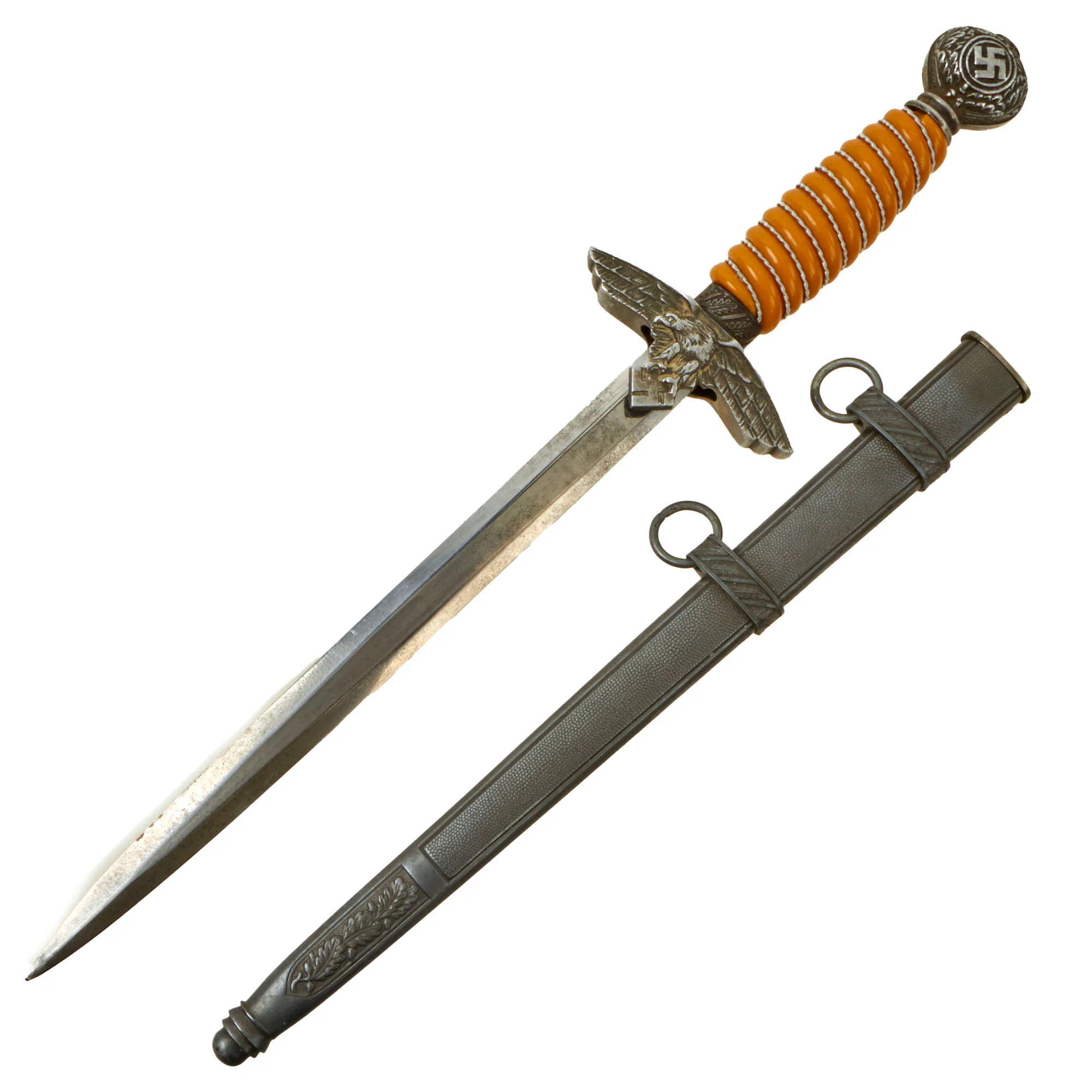
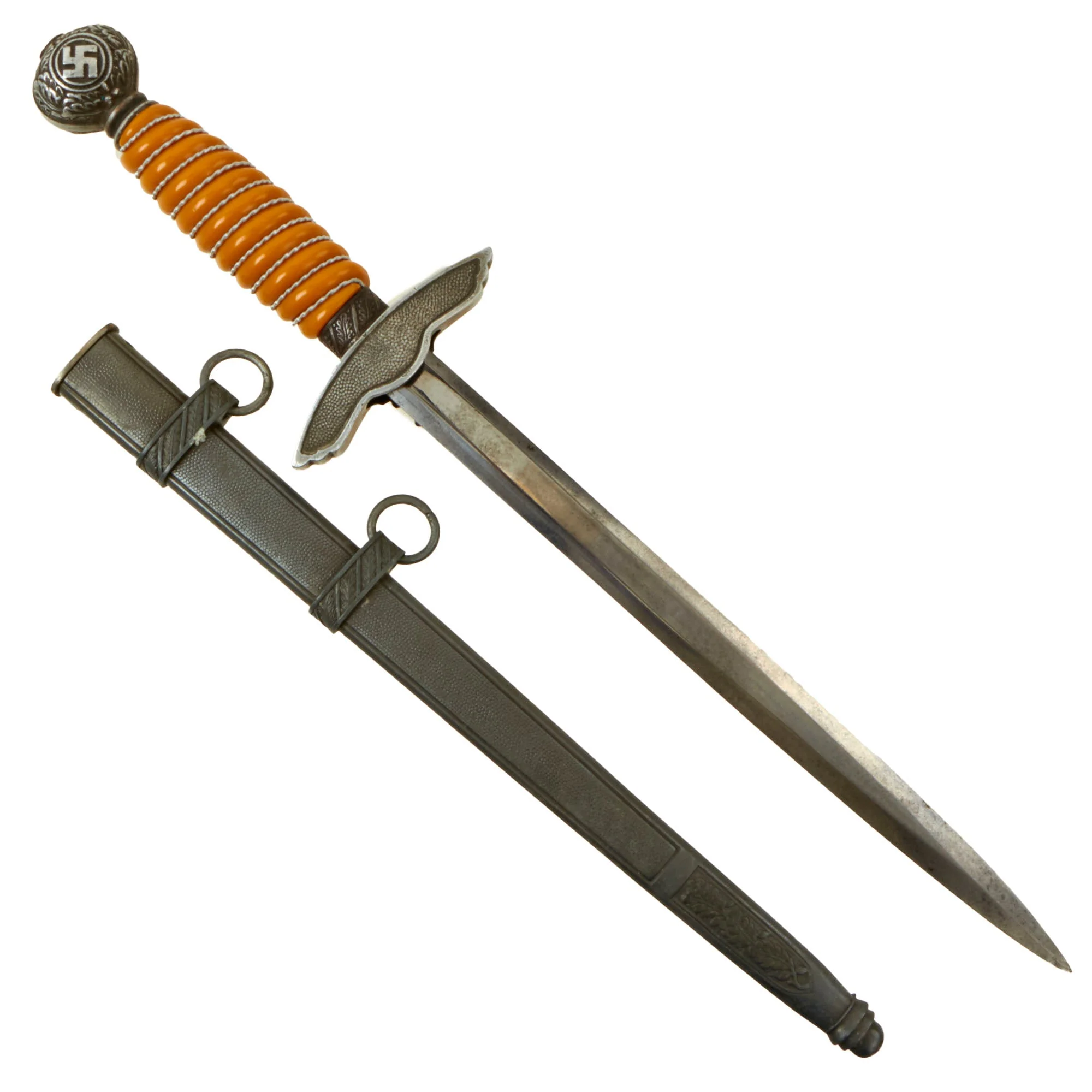
Original Item: Only One Available. This is a lovely example of a rare 2nd Model RLB Leader's Dagger, complete with the correct scabbard and leather belt hanger. The second pattern dagger differs from the earlier first pattern mainly due to the emblem on the grip, which was originally an RLB over a Swas (hook cross) on a starburst. The 2nd pattern has a much simpler starburst bearing only a large Swas, however it also introduced a more ornate scabbard for the leader's dagger only, which previously had used the same one as the subordinate dagger.
This new design has a "central ramp" and a two strap leather hanger similar to those used by the military and other paramilitary daggers. This is only the fourth example of an RLB Leader's Dagger that we have had, though like most it unfortunately no longer has the leather hanger.
The hilt mounts on look to be bright aluminum alloy with satin finish, which does not look to originally have any type of plating on it, though there are some dark accents in the recessed areas. The pommel is in the characteristic RLB Officer's flattened shape with an equatorial band and has some wear around the edge. The crossguard features a stubby-winged Art Deco-style eagle clutching a smooth wreath and swas. Unlike the EM/NCO dagger, the crossguard on the officer's dagger is longer and ends with slightly angled cuts, giving a much more "boxy" look.
The grip is a fine example, which retains a lovely black grained "Moroccan Leather" covering. There is light wear and finish loss overall, with the side seam still fully glued down, and we do not see major damage of any kind. The insignia is the second pattern with a black enamel swas (hook cross) superimposed over over a background eight pointed sunburst. The black enamel shows just a bit of wear, and the starburst has lost much of the original plating, now showing the copper base metal on the raised areas.
The blade of this dagger is in excellent condition, retaining the original factory crossgrain throughout the blade surface. This texture is iconic, and is the definitive identifying characteristic for a real WWII German Blade. There is a bit of runner wear and scuffing, as well as some faint staining towards the middle of the blade, but this is definitely one of the the best blades we have sever seen on an RLB dagger. The maker logo on the back is completely legible.
This great example is marked with on the back with the "KRONECK" trademark address logo of Ernst Erich Witte, Stahlwarenfabrik (Steelware Factory) of Solingen, the legendary "City of Blades" in western Germany. This features "a crown on a triangle above KRONECK" marking within a diamond above a large letter W:
(Crown On Triangle)
KRONECK
W
ERNST ERICH WITTE
S O L I N G E N
Per J. Anthony Carter's fine work GERMAN SWORD AND KNIFE MAKERS, this company was founded in 1914 and registered with Solingen authorities in 1920. It produced edged weapons during the Third Reich period, including SA and RLB daggers marked with the trademark above the firms name and address marking. They also made RAD officer's daggers, and the company survived WWII, eventually closing in 1963.
The scabbard shell is straight throughout, with no major dents or other damage. It is covered in Moroccan leather having the same color and grain as the grip, and this leather is also in very good condition. There is some scuffing and bruising, however the seam is still securely glued down. The central "ramp" has moved a bit, damaging the leather near it. The locket and chape looks to be made from plated steel, while the ramp is non-magnetic alloy of some type, and all show a lightly worn patina, with some oxidation on the steel parts. They are retained by flush mount side screws, which show no turning or deformation, including the single screw on the central ramp.
A fantastic example of the rare RLB Officer's dagger by a rare maker, complete with a lovely original scabbard! Always hard to find in such nice condition!
Specifications:
Blade Length: 9 5/8"
Blade Style: Spear Point Dagger
Overall length: 14 1/2“
Crossguard: 4”
Scabbard Length: 10 1/2"
The Reichsluftschutzbund (RLB) (National Air Raid Protection League) was an organization in NSDAP Germany in charge of air raid precautions in residential areas and among smaller businesses. The RLB was organized by Hermann Göring in 1933 as a voluntary association. Existing volunteer air raid precaution associations were forced to merge with RLB. In 1939 the RLB became a Körperschaft des öffentlichen Rechts (quasi-autonomous non-governmental organization), while in 1944 it became an affiliated organization of the NSDAP Party. RLB was dissolved by the Allied Powers after the end of World War II. Its successor in the Federal Republic of Germany was the Bundesverband für den Selbstschutz.
The RLB was in charge of educating and training ordinary German men and women in civil defence procedures necessary for the basic level of local self-help of the civil population against air raids. The local level was formed around air raid wardens and operated in small first intervention squads. The training include fire fighting, protection against chemical weapons, communication procedures and preparation of houses and apartments against air raids.
In 1939 the RLB had about 15 million members, 820 000 volunteer functionaries (of which 280,000 women) and 75,000 local units. The membership was trained at 3,800 civil defense schools with 28,000 instructors.
- RLB was led by a Präsidium, whose president, and vice president and chief of staff, were active duty general officers of the Luftwaffe. The presidium was in itself a department immediately subordinated to the Ministry of Aviation.
- Coterminous with each Luftgaukommando (air district command) was a RLB-Gruppe (RLB-group) under a leader aided by 46 full-time staff members.
- For each Regierungsbezirk, there was a RLB-Bezirksgruppe (regional group).
- The basic organization was the RLB-Revier, one for each police precinct in the cities, or the RLB-Gemeinde-Gruppe, one for each urban or rural municipality for the rest of the country. In the case of a city with several precincts, the citywide organization was called an RLB-Ortsgruppe (local group). Several municipal groups formed an RLB-Ortskreisgruppe, one for each Landkreis. Each Ortsgruppe and Ortskreisgruppe had a leader and a staff of nine members, of which five where full-time salaried employees.
- The basic organizations had a varied number of Untergruppen (sub-groups) divided into Blocke (blocks) under Blockwarte (block wardens) which controlled and liaised with a number of Luftschutzgemeinschafte (air raid protection communities) under Luftschutzwarte (air raid wardens). Each community consisted of an apartment building or several smaller buildings, although a large apartment complex could have several communities. In addition to the warden, the community should have an assistant warden, house fire fighters, helpers and messengers as a first intervention squad. Duty in these squads were compulsory (Notdienstpflicht) for the civilian population.

Details & Craftsmanship
Every detail has been carefully considered to bring you the perfect product.

Details & Craftsmanship
Every detail has been carefully considered to bring you the perfect product.

Details & Craftsmanship
Every detail has been carefully considered to bring you the perfect product.

Details & Craftsmanship
Every detail has been carefully considered to bring you the perfect product.

Details & Craftsmanship
Every detail has been carefully considered to bring you the perfect product.

Details & Craftsmanship
Every detail has been carefully considered to bring you the perfect product.

Details & Craftsmanship
Every detail has been carefully considered to bring you the perfect product.

Details & Craftsmanship
Every detail has been carefully considered to bring you the perfect product.

Details & Craftsmanship
Every detail has been carefully considered to bring you the perfect product.

Details & Craftsmanship
Every detail has been carefully considered to bring you the perfect product.

Details & Craftsmanship
Every detail has been carefully considered to bring you the perfect product.

Details & Craftsmanship
Every detail has been carefully considered to bring you the perfect product.

Details & Craftsmanship
Every detail has been carefully considered to bring you the perfect product.

Details & Craftsmanship
Every detail has been carefully considered to bring you the perfect product.
Description
Original Item: Only One Available. This is a lovely example of a rare 2nd Model RLB Leader's Dagger, complete with the correct scabbard and leather belt hanger. The second pattern dagger differs from the earlier first pattern mainly due to the emblem on the grip, which was originally an RLB over a Swas (hook cross) on a starburst. The 2nd pattern has a much simpler starburst bearing only a large Swas, however it also introduced a more ornate scabbard for the leader's dagger only, which previously had used the same one as the subordinate dagger.
This new design has a "central ramp" and a two strap leather hanger similar to those used by the military and other paramilitary daggers. This is only the fourth example of an RLB Leader's Dagger that we have had, though like most it unfortunately no longer has the leather hanger.
The hilt mounts on look to be bright aluminum alloy with satin finish, which does not look to originally have any type of plating on it, though there are some dark accents in the recessed areas. The pommel is in the characteristic RLB Officer's flattened shape with an equatorial band and has some wear around the edge. The crossguard features a stubby-winged Art Deco-style eagle clutching a smooth wreath and swas. Unlike the EM/NCO dagger, the crossguard on the officer's dagger is longer and ends with slightly angled cuts, giving a much more "boxy" look.
The grip is a fine example, which retains a lovely black grained "Moroccan Leather" covering. There is light wear and finish loss overall, with the side seam still fully glued down, and we do not see major damage of any kind. The insignia is the second pattern with a black enamel swas (hook cross) superimposed over over a background eight pointed sunburst. The black enamel shows just a bit of wear, and the starburst has lost much of the original plating, now showing the copper base metal on the raised areas.
The blade of this dagger is in excellent condition, retaining the original factory crossgrain throughout the blade surface. This texture is iconic, and is the definitive identifying characteristic for a real WWII German Blade. There is a bit of runner wear and scuffing, as well as some faint staining towards the middle of the blade, but this is definitely one of the the best blades we have sever seen on an RLB dagger. The maker logo on the back is completely legible.
This great example is marked with on the back with the "KRONECK" trademark address logo of Ernst Erich Witte, Stahlwarenfabrik (Steelware Factory) of Solingen, the legendary "City of Blades" in western Germany. This features "a crown on a triangle above KRONECK" marking within a diamond above a large letter W:
(Crown On Triangle)
KRONECK
W
ERNST ERICH WITTE
S O L I N G E N
Per J. Anthony Carter's fine work GERMAN SWORD AND KNIFE MAKERS, this company was founded in 1914 and registered with Solingen authorities in 1920. It produced edged weapons during the Third Reich period, including SA and RLB daggers marked with the trademark above the firms name and address marking. They also made RAD officer's daggers, and the company survived WWII, eventually closing in 1963.
The scabbard shell is straight throughout, with no major dents or other damage. It is covered in Moroccan leather having the same color and grain as the grip, and this leather is also in very good condition. There is some scuffing and bruising, however the seam is still securely glued down. The central "ramp" has moved a bit, damaging the leather near it. The locket and chape looks to be made from plated steel, while the ramp is non-magnetic alloy of some type, and all show a lightly worn patina, with some oxidation on the steel parts. They are retained by flush mount side screws, which show no turning or deformation, including the single screw on the central ramp.
A fantastic example of the rare RLB Officer's dagger by a rare maker, complete with a lovely original scabbard! Always hard to find in such nice condition!
Specifications:
Blade Length: 9 5/8"
Blade Style: Spear Point Dagger
Overall length: 14 1/2“
Crossguard: 4”
Scabbard Length: 10 1/2"
The Reichsluftschutzbund (RLB) (National Air Raid Protection League) was an organization in NSDAP Germany in charge of air raid precautions in residential areas and among smaller businesses. The RLB was organized by Hermann Göring in 1933 as a voluntary association. Existing volunteer air raid precaution associations were forced to merge with RLB. In 1939 the RLB became a Körperschaft des öffentlichen Rechts (quasi-autonomous non-governmental organization), while in 1944 it became an affiliated organization of the NSDAP Party. RLB was dissolved by the Allied Powers after the end of World War II. Its successor in the Federal Republic of Germany was the Bundesverband für den Selbstschutz.
The RLB was in charge of educating and training ordinary German men and women in civil defence procedures necessary for the basic level of local self-help of the civil population against air raids. The local level was formed around air raid wardens and operated in small first intervention squads. The training include fire fighting, protection against chemical weapons, communication procedures and preparation of houses and apartments against air raids.
In 1939 the RLB had about 15 million members, 820 000 volunteer functionaries (of which 280,000 women) and 75,000 local units. The membership was trained at 3,800 civil defense schools with 28,000 instructors.
- RLB was led by a Präsidium, whose president, and vice president and chief of staff, were active duty general officers of the Luftwaffe. The presidium was in itself a department immediately subordinated to the Ministry of Aviation.
- Coterminous with each Luftgaukommando (air district command) was a RLB-Gruppe (RLB-group) under a leader aided by 46 full-time staff members.
- For each Regierungsbezirk, there was a RLB-Bezirksgruppe (regional group).
- The basic organization was the RLB-Revier, one for each police precinct in the cities, or the RLB-Gemeinde-Gruppe, one for each urban or rural municipality for the rest of the country. In the case of a city with several precincts, the citywide organization was called an RLB-Ortsgruppe (local group). Several municipal groups formed an RLB-Ortskreisgruppe, one for each Landkreis. Each Ortsgruppe and Ortskreisgruppe had a leader and a staff of nine members, of which five where full-time salaried employees.
- The basic organizations had a varied number of Untergruppen (sub-groups) divided into Blocke (blocks) under Blockwarte (block wardens) which controlled and liaised with a number of Luftschutzgemeinschafte (air raid protection communities) under Luftschutzwarte (air raid wardens). Each community consisted of an apartment building or several smaller buildings, although a large apartment complex could have several communities. In addition to the warden, the community should have an assistant warden, house fire fighters, helpers and messengers as a first intervention squad. Duty in these squads were compulsory (Notdienstpflicht) for the civilian population.