
The Story
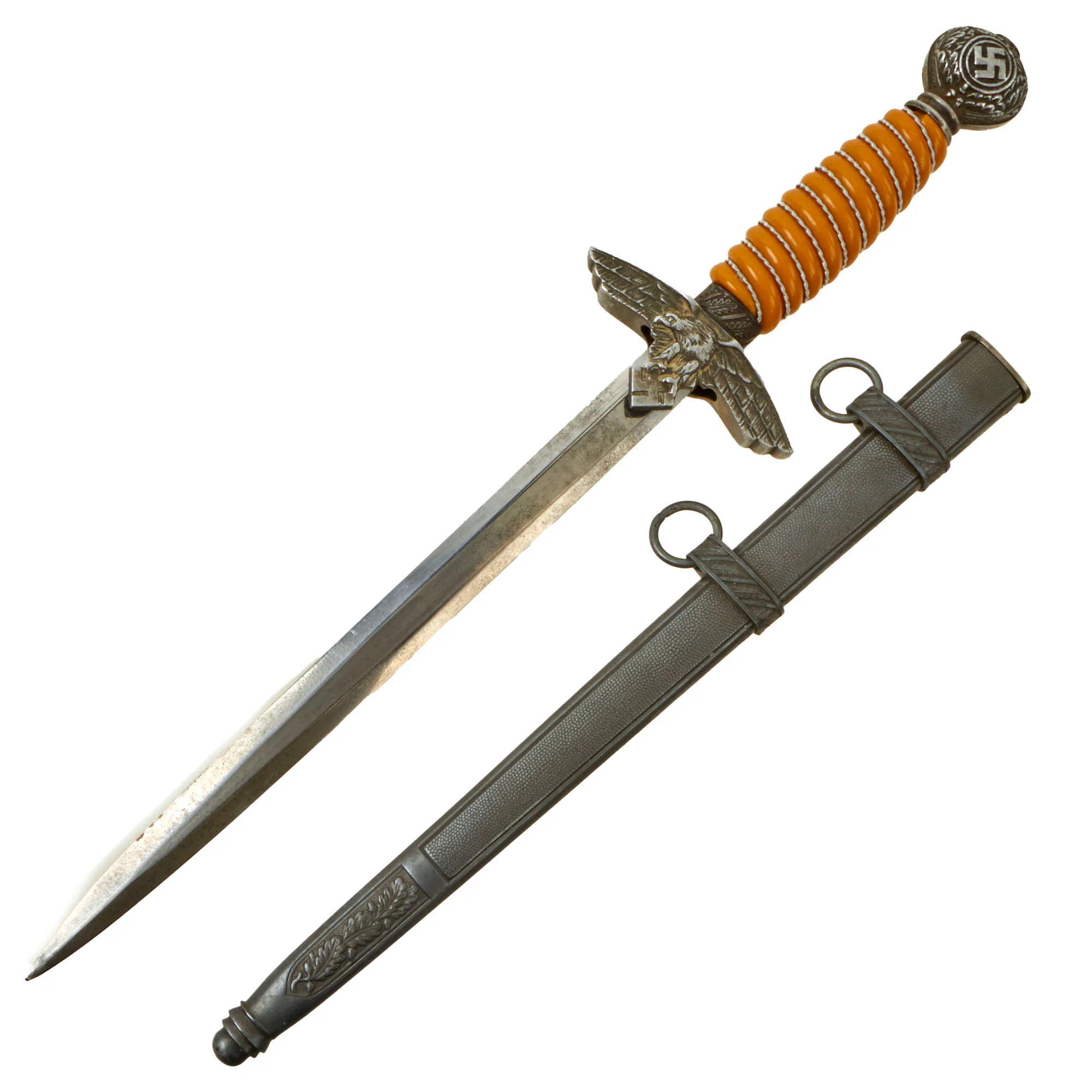
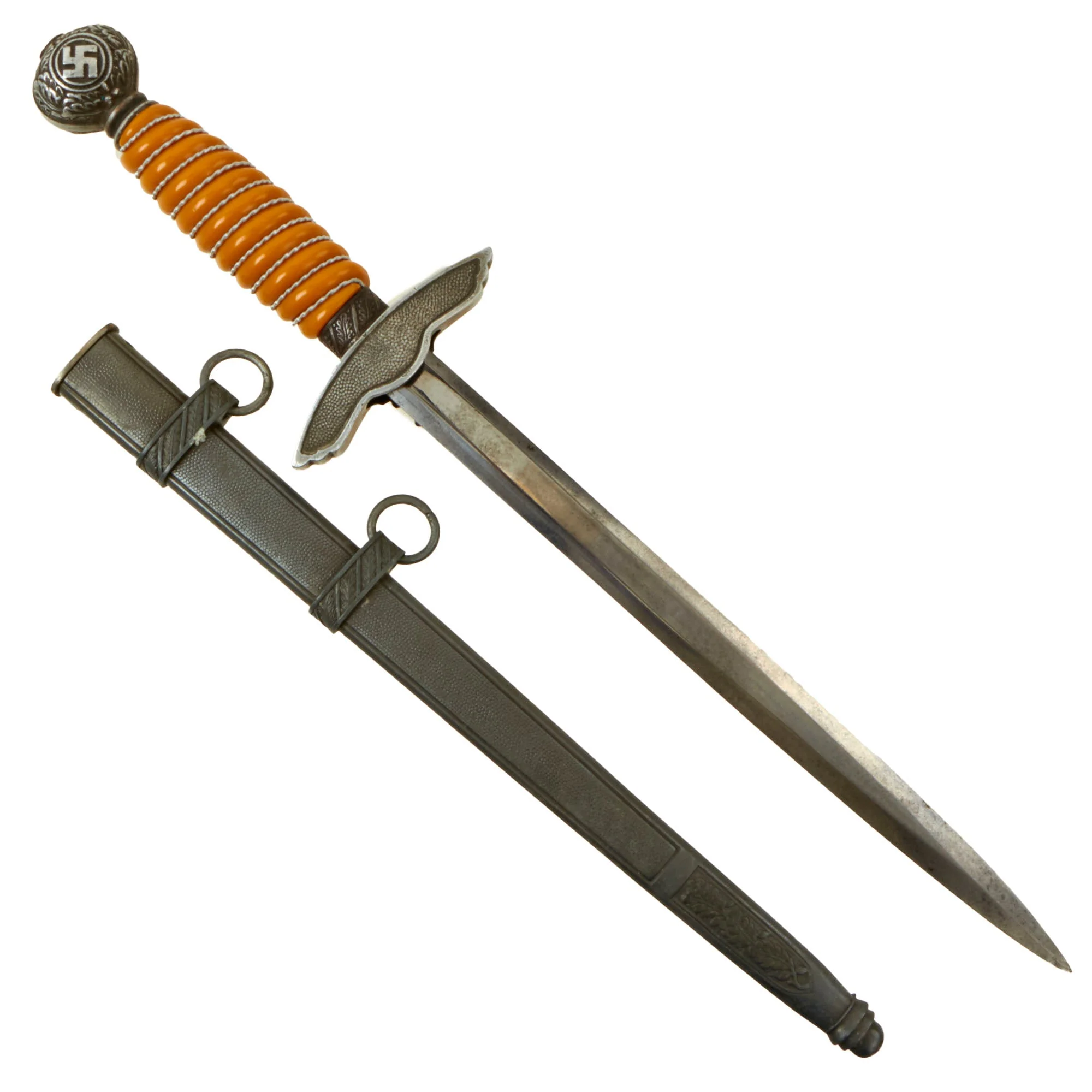
Original Item: Only One Available. This well patinated service used condition mid-late war period produced NSKK Dienstdolch (Service Dagger) has nickel-plated fittings throughout, and definitely looks to have seen a good amount of exposure to the elements. This example was made by the rare Solingen-based firm of C. Gustav Spitzer AG. It comes complete with an scabbard and belt hanger, which look to original to the knife, showing a similar patina from exposure and age.
The guards and tang nut are nickel plated alloy, probably zinc or some other "pot metal", and both show peppered loss of the plating, with subsequent oxidation of the base metal. There is also definitely some more advanced oxidation where the guards contact the grip, due to reacting with the stain in the grip. The pommel nut is steel, and has lost almost all of the plating, now showing an oxidized patina. The hilt fittings are still tight on the blade, with no signs of having been removed anytime recently.
The grip is in very good condition, having a fine brown colored chestnut tone in the surfaces and having medium center ridge construction. It shows some lovely grain, and fits the crossguards well, however we can see evidence of past moisture exposure in the way of water stains. There are not much in the way of pressure dents, however there is a chip missing on the reverse near the cross guard, and some wood missing near the pommel guard, which looks to have been eroded by oxidation from the pommel. The SA symbol button is nicely set, with intact enamel, and the plating mostly intact with a bit of verdigris around the edge. The details are still there to the inlaid aluminum eagle, including the beak, breast feathering, wing feathering, talons, wreath and mobile swas (hook cross).
The blade of this example was definitely not maintained during service, and now displays mottled staining throughout the obverse, with some areas of peppering and raised oxidation present. The reverse is definitely in better shape, and the original factory final polish grind cross grain can be seen throughout. This texture is iconic, and is the definitive identifying characteristic for a real WWII German Blade. We have made no attempts to clean the blade to avoid disturbing the patina. The acid-etched Alles für Deutschland (Everything for Germany) SA motto is still quite crisp, with the original factory darkening very well retained. The edges show no signs of sharpening, and the point is intact.
The rear is etched with the RZM contract information:
((RZM))
M7 / 80
This marking indicates the dagger was made by RZM Dagger contractor "80", which records show is the rare maker C. Gustav Spitzer AG, Stahwaren-Fabrik (Steelware Factory), of Solingen, the legendary "City of Blades" in Western Germany. According to J. Anthony Carter's book, GERMAN KNIFE AND SWORD MAKERS, this company was founded in 1863 by Carl Gustav Spitzer, and later registered in Solingen in 1883. It made pocket, sporting, and hunting knives, and by 1928 was owned by Ernst Spitzer. They manufactured several different types of knives during the war, including specifically early SA daggers bearing their lion trademark, and later daggers with their RZM number M7 / 80.
The Reichszeugmeisterei (National Quartermaster's Office), or RZM, was was based at the Brown house in Munich and NSDAP party headquarters in Berlin. The RZM ensured that the manufacturers of military items were consistent in design, quality of materials and other characteristics of the items. It also defined standards of design, manufacturing and quality and published an authoritative color chart for textiles. The M7 in the code stands for knives/daggers, contractor 80 stands for C. Gustav Spitzer AG of Solingen.
The scabbard shell is straight throughout, though there definitely is oxidation on the reverse, and areas where the paint has flaked away. We can see a small area with black paint visible inside a chip, so it is possible that the scabbard may have originally been a scabbard for an NSKK dagger, which were identical to the SA type except for the scabbard color. Other chips do not show any black color however, and overall there is a lot of checking and crazing in the brown enamel finish due to age. The scabbard shell is equipped with fine matching plated steel mounts, which show some oxidation and plating lifting, probably from moisture exposure. The bottom ball on the chape is still undented, definitely a rarity. They nicely match the crossguards and are complete with all four dome head screws, which have lost their nickel plated finish.
Attached to the hanger ring on the scabbard is a very nice patinated later pattern belt hanger, with nickel plated steel hardware and dark brown finished leather. It definitely shows signs of exposure, and the leather now shows some cracking and dry rot, while the hardware shows plating loss and oxidation. There are RZM markings on the leather, which we are not able to read due to the condition, and the spring clip is functional, but shows a lot of oxidation.
A very nice "salty" service used example of a mid to late war pattern SA dagger from a rare maker, complete with scabbard and hanger. Ready to display!
Specifications:
Blade Length: 8 3/4"
Overall length: 13 3/4”
Crossguard: 3”
Scabbard Length: 10”
History of the SA-
The SA or Brown Shirts, were a private political formation which Adolf AH and the NSDAP used to maintain order at organized Party meetings and demonstrations. The group was formed in 1921, and grew to a huge force of nearly 3,000,000 men by the later 1930's. To instill esprit de corps, as well as create employment for the Blade City of Solingen, it was decided each SA man would carry a dagger with his Brown Shirt uniform. Huge quantities needed to be produced to accommodate the demand. The dagger initially was produced of hand-fitted nickel mounts with attractive finished wood grip and brown anodized (a bluing process) finished scabbard.
The blade was etched with the SA motto, Alles für Deutschland. Examples produced prior to 1935 were stamped with the German sector of the SA group on reverse lower crossguard. Later examples underwent standardization through the RZM ministry. These pieces were produced of cheaper plated zinc-base fittings and scabbards were simply painted brown.
Prior to his "unmasking" as a traitor, Ernst Röhm was the leader of the SA. In 1934, he distributed approximately 100,000 SA daggers with his personal inscription on the reverse blade. These daggers were to honor individuals who had served with the SA prior to December, 1931. Other than the inscription, these pieces were identical to the standard M1933 SA dagger. After the Röhm purge, the inscription was ordered to be removed. Many examples were returned to the factory for grinding. Others were simply ground in the field by whatever means were available. Examples will occasionally be encountered with remnants of the original inscription remaining on the blade, but mostly none will remain. Some blades exist with an intact inscription, reflecting only the removal of the Röhm signature. Very very rarely is an example seen with a full, untouched inscription, as the holder would have surely risked a charge of treason.

Details & Craftsmanship
Every detail has been carefully considered to bring you the perfect product.

Details & Craftsmanship
Every detail has been carefully considered to bring you the perfect product.

Details & Craftsmanship
Every detail has been carefully considered to bring you the perfect product.

Details & Craftsmanship
Every detail has been carefully considered to bring you the perfect product.

Details & Craftsmanship
Every detail has been carefully considered to bring you the perfect product.

Details & Craftsmanship
Every detail has been carefully considered to bring you the perfect product.

Details & Craftsmanship
Every detail has been carefully considered to bring you the perfect product.

Details & Craftsmanship
Every detail has been carefully considered to bring you the perfect product.

Details & Craftsmanship
Every detail has been carefully considered to bring you the perfect product.

Details & Craftsmanship
Every detail has been carefully considered to bring you the perfect product.

Details & Craftsmanship
Every detail has been carefully considered to bring you the perfect product.

Details & Craftsmanship
Every detail has been carefully considered to bring you the perfect product.

Details & Craftsmanship
Every detail has been carefully considered to bring you the perfect product.

Details & Craftsmanship
Every detail has been carefully considered to bring you the perfect product.

Details & Craftsmanship
Every detail has been carefully considered to bring you the perfect product.
Description
Original Item: Only One Available. This well patinated service used condition mid-late war period produced NSKK Dienstdolch (Service Dagger) has nickel-plated fittings throughout, and definitely looks to have seen a good amount of exposure to the elements. This example was made by the rare Solingen-based firm of C. Gustav Spitzer AG. It comes complete with an scabbard and belt hanger, which look to original to the knife, showing a similar patina from exposure and age.
The guards and tang nut are nickel plated alloy, probably zinc or some other "pot metal", and both show peppered loss of the plating, with subsequent oxidation of the base metal. There is also definitely some more advanced oxidation where the guards contact the grip, due to reacting with the stain in the grip. The pommel nut is steel, and has lost almost all of the plating, now showing an oxidized patina. The hilt fittings are still tight on the blade, with no signs of having been removed anytime recently.
The grip is in very good condition, having a fine brown colored chestnut tone in the surfaces and having medium center ridge construction. It shows some lovely grain, and fits the crossguards well, however we can see evidence of past moisture exposure in the way of water stains. There are not much in the way of pressure dents, however there is a chip missing on the reverse near the cross guard, and some wood missing near the pommel guard, which looks to have been eroded by oxidation from the pommel. The SA symbol button is nicely set, with intact enamel, and the plating mostly intact with a bit of verdigris around the edge. The details are still there to the inlaid aluminum eagle, including the beak, breast feathering, wing feathering, talons, wreath and mobile swas (hook cross).
The blade of this example was definitely not maintained during service, and now displays mottled staining throughout the obverse, with some areas of peppering and raised oxidation present. The reverse is definitely in better shape, and the original factory final polish grind cross grain can be seen throughout. This texture is iconic, and is the definitive identifying characteristic for a real WWII German Blade. We have made no attempts to clean the blade to avoid disturbing the patina. The acid-etched Alles für Deutschland (Everything for Germany) SA motto is still quite crisp, with the original factory darkening very well retained. The edges show no signs of sharpening, and the point is intact.
The rear is etched with the RZM contract information:
((RZM))
M7 / 80
This marking indicates the dagger was made by RZM Dagger contractor "80", which records show is the rare maker C. Gustav Spitzer AG, Stahwaren-Fabrik (Steelware Factory), of Solingen, the legendary "City of Blades" in Western Germany. According to J. Anthony Carter's book, GERMAN KNIFE AND SWORD MAKERS, this company was founded in 1863 by Carl Gustav Spitzer, and later registered in Solingen in 1883. It made pocket, sporting, and hunting knives, and by 1928 was owned by Ernst Spitzer. They manufactured several different types of knives during the war, including specifically early SA daggers bearing their lion trademark, and later daggers with their RZM number M7 / 80.
The Reichszeugmeisterei (National Quartermaster's Office), or RZM, was was based at the Brown house in Munich and NSDAP party headquarters in Berlin. The RZM ensured that the manufacturers of military items were consistent in design, quality of materials and other characteristics of the items. It also defined standards of design, manufacturing and quality and published an authoritative color chart for textiles. The M7 in the code stands for knives/daggers, contractor 80 stands for C. Gustav Spitzer AG of Solingen.
The scabbard shell is straight throughout, though there definitely is oxidation on the reverse, and areas where the paint has flaked away. We can see a small area with black paint visible inside a chip, so it is possible that the scabbard may have originally been a scabbard for an NSKK dagger, which were identical to the SA type except for the scabbard color. Other chips do not show any black color however, and overall there is a lot of checking and crazing in the brown enamel finish due to age. The scabbard shell is equipped with fine matching plated steel mounts, which show some oxidation and plating lifting, probably from moisture exposure. The bottom ball on the chape is still undented, definitely a rarity. They nicely match the crossguards and are complete with all four dome head screws, which have lost their nickel plated finish.
Attached to the hanger ring on the scabbard is a very nice patinated later pattern belt hanger, with nickel plated steel hardware and dark brown finished leather. It definitely shows signs of exposure, and the leather now shows some cracking and dry rot, while the hardware shows plating loss and oxidation. There are RZM markings on the leather, which we are not able to read due to the condition, and the spring clip is functional, but shows a lot of oxidation.
A very nice "salty" service used example of a mid to late war pattern SA dagger from a rare maker, complete with scabbard and hanger. Ready to display!
Specifications:
Blade Length: 8 3/4"
Overall length: 13 3/4”
Crossguard: 3”
Scabbard Length: 10”
History of the SA-
The SA or Brown Shirts, were a private political formation which Adolf AH and the NSDAP used to maintain order at organized Party meetings and demonstrations. The group was formed in 1921, and grew to a huge force of nearly 3,000,000 men by the later 1930's. To instill esprit de corps, as well as create employment for the Blade City of Solingen, it was decided each SA man would carry a dagger with his Brown Shirt uniform. Huge quantities needed to be produced to accommodate the demand. The dagger initially was produced of hand-fitted nickel mounts with attractive finished wood grip and brown anodized (a bluing process) finished scabbard.
The blade was etched with the SA motto, Alles für Deutschland. Examples produced prior to 1935 were stamped with the German sector of the SA group on reverse lower crossguard. Later examples underwent standardization through the RZM ministry. These pieces were produced of cheaper plated zinc-base fittings and scabbards were simply painted brown.
Prior to his "unmasking" as a traitor, Ernst Röhm was the leader of the SA. In 1934, he distributed approximately 100,000 SA daggers with his personal inscription on the reverse blade. These daggers were to honor individuals who had served with the SA prior to December, 1931. Other than the inscription, these pieces were identical to the standard M1933 SA dagger. After the Röhm purge, the inscription was ordered to be removed. Many examples were returned to the factory for grinding. Others were simply ground in the field by whatever means were available. Examples will occasionally be encountered with remnants of the original inscription remaining on the blade, but mostly none will remain. Some blades exist with an intact inscription, reflecting only the removal of the Röhm signature. Very very rarely is an example seen with a full, untouched inscription, as the holder would have surely risked a charge of treason.