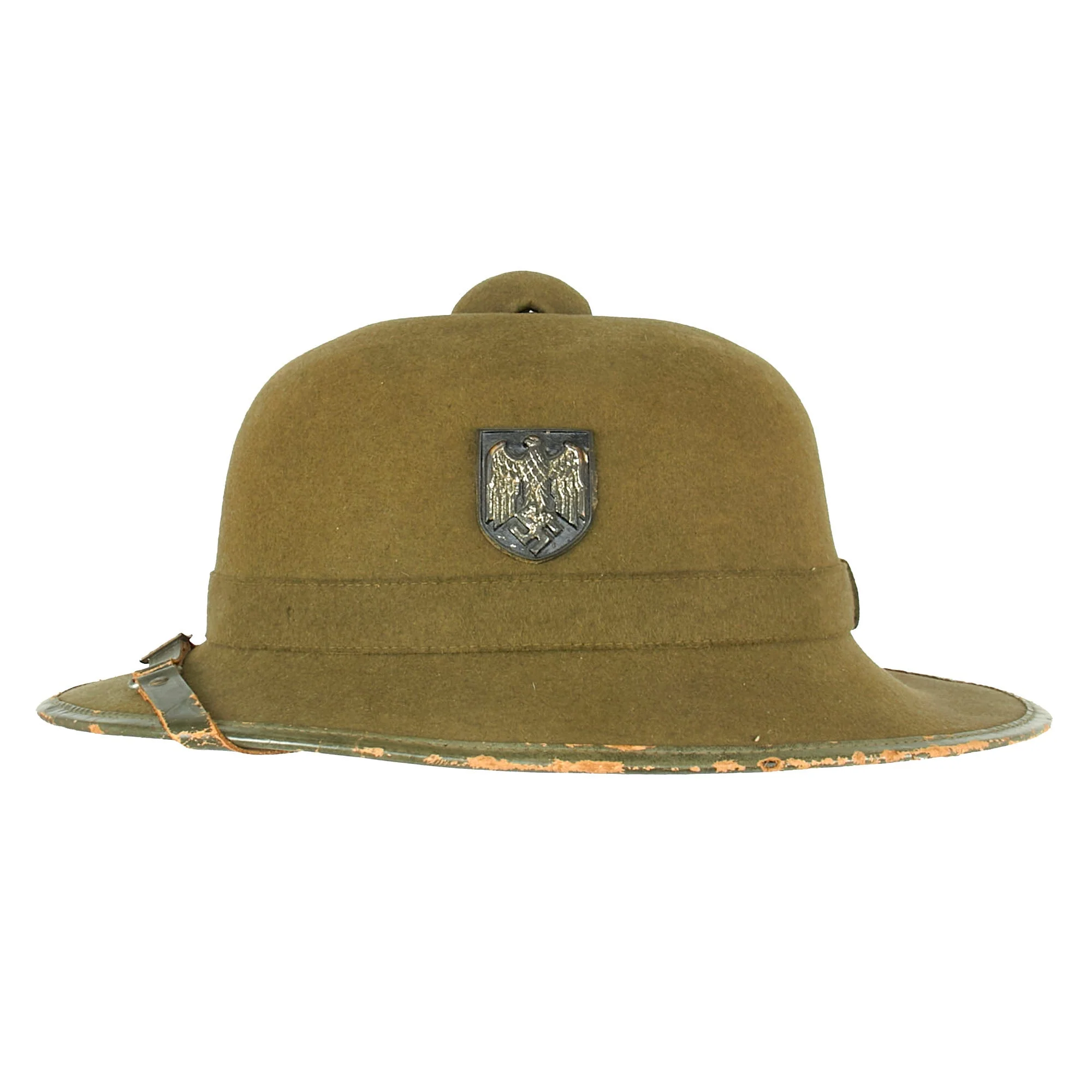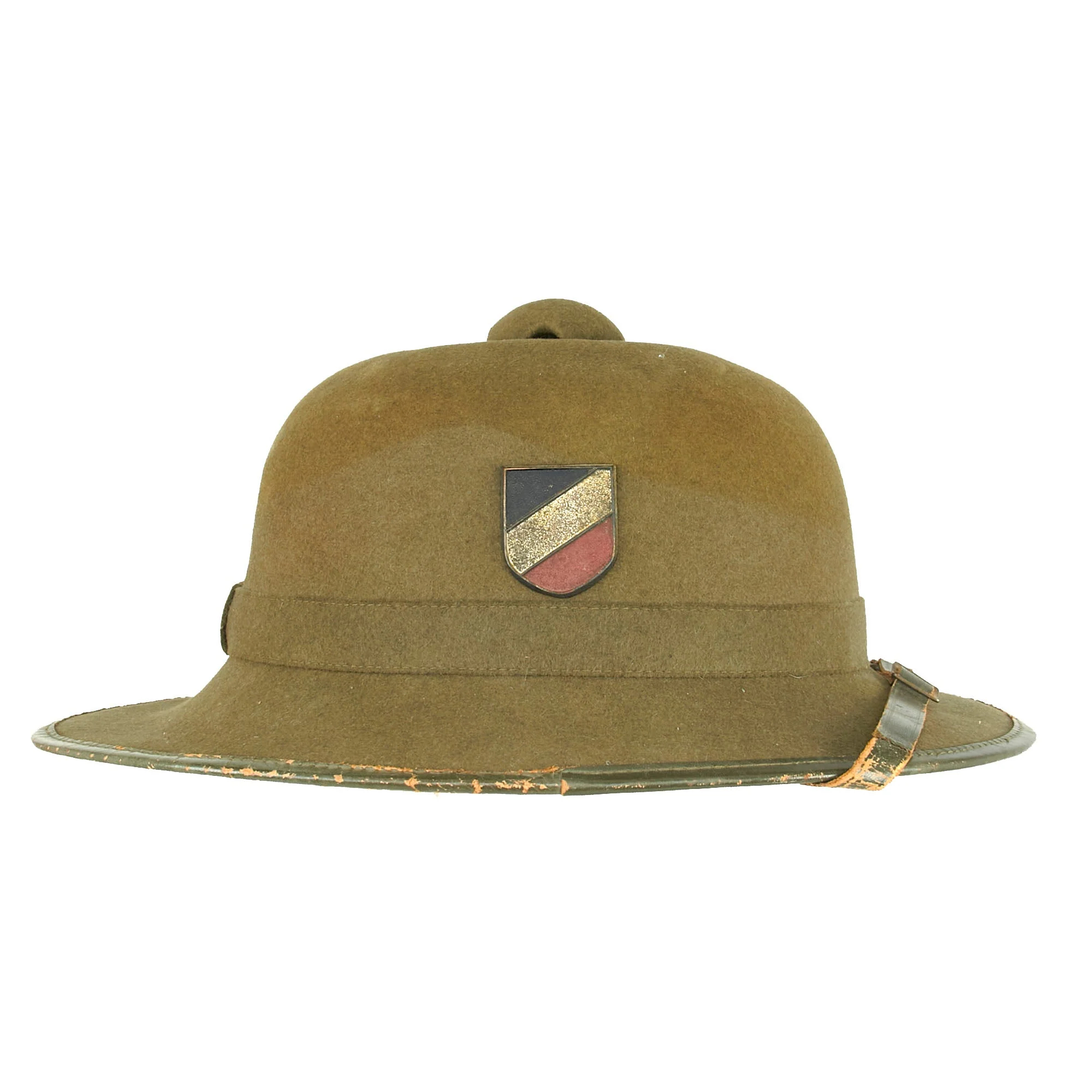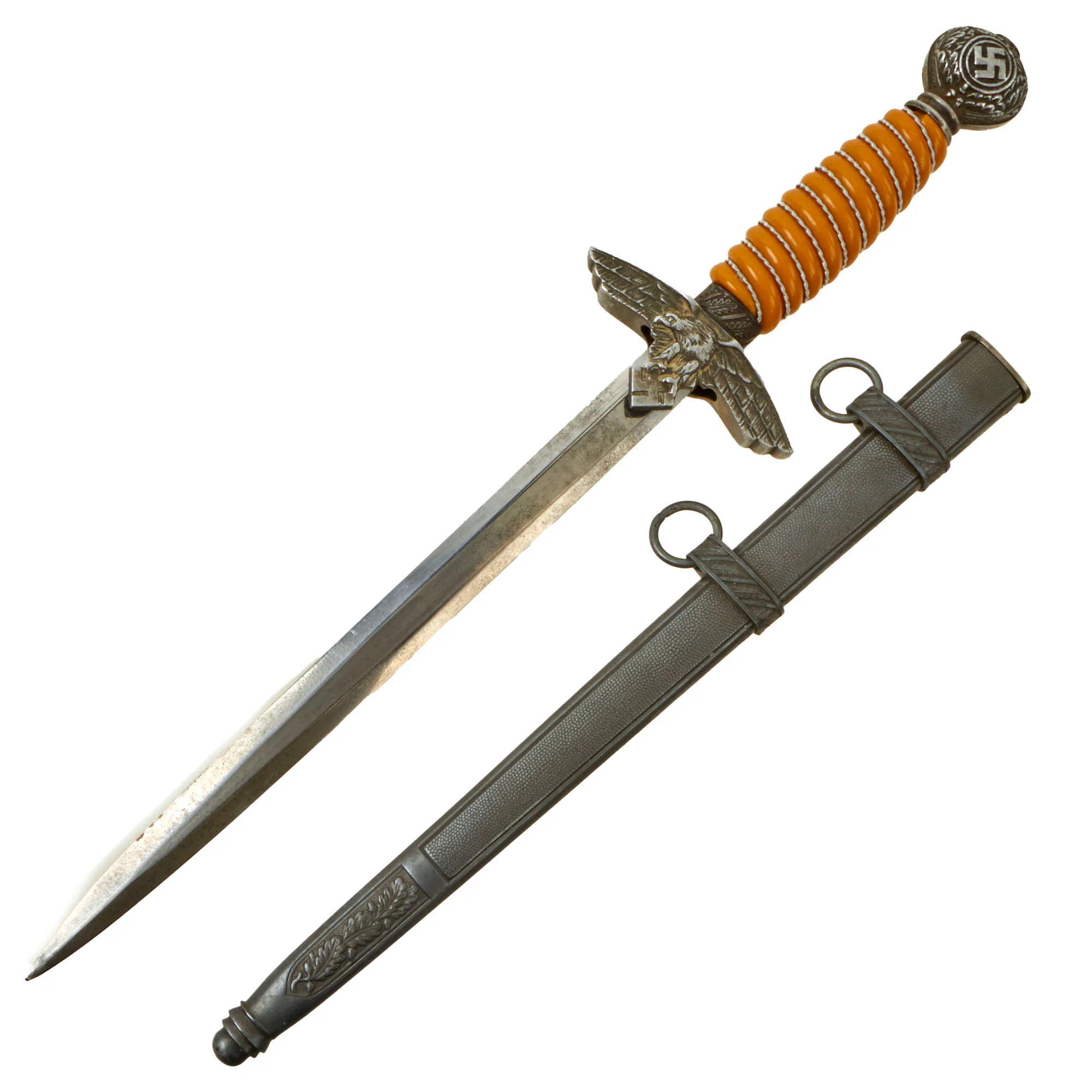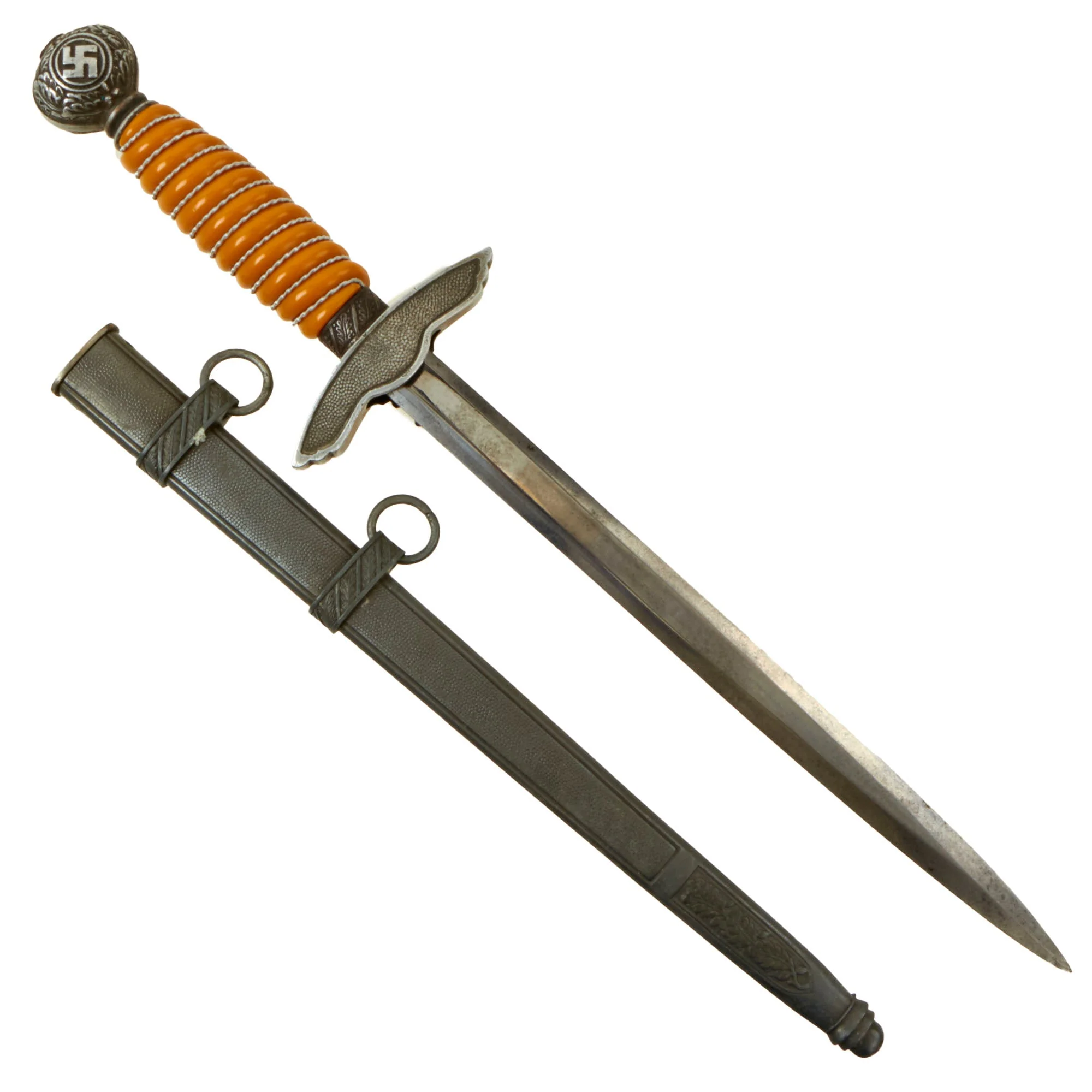

The Story
Original Item: Only One Available. This is a lovely service used example of an early WWII German M-38 Fallschirmjäger "Single Decal" Helmet Shell, complete with a "relic" condition steel liner band. It definitely looks to have seen long service during the war, and unfortunately the chinstraps and all of the leather and rubber components of the liner rotted away long ago. This is an early model M-38 with 2nd Pattern Liner Band fitted to the shell by the means of four vented spanner bolts. Research shows that around heat lot 5000 a wide variety of bolt types were being used, so these are correct. At present most of the nuts are rust frozen to the bolts at present, though we did note that only 2 of the bolts still retain both ring nuts, and one of those is on the wrong side of the liner band. We would guess a collector added the band decades ago, and since then the nuts have rusted in place.
The exterior shell retains a good amount of the original Feldgrau (field gray) lightly textured combat finish on the exterior, however it definitely shows wear, with speckled oxidation overall. Definitely an old campaigner that traveled extensively during the war. The interior paint is in similar condition, possibly a bit worse, and definitely shows signs of weathering and exposure. It has a great service used look to it that is impossible to duplicate. This is the real deal, and it even still has an original Luftwaffe Eagle Decal on the left side! It is well retained at about 40%, with a lovely color and patina, showing fantastic pattern of small cracks and crazing on the portions that are still intact.
The side of the interior shell is stamped ET71 and the rear of the skirt is stamped with the steel lot number 5014. All paratrooper helmets were produced by Eisenhüttenwerke AG of Thale Harz, Germany, and this is the correct early war maker code that they used. The lot number on this helmet indicates (according to Ken Niewariarowicz's work Germany’s Combat Helmets 1933-1934: A Modern Study) that it was manufactured between 1938 (mid-3,000 range) to 1940 (low 5,000 range). The M38 helmets were made in three shell sizes, 66, 68, and 71, and the size 71 shell was used with liner sizes 59-61cm.
Being that this helmet was made between 1938-1940 means that this helmet could have quite possibly been present for some of the early engagements that the Fallschirmjägers were famous for; such as the successful raid on the fortress of Eben-Emael, or the Invasion of Crete. Needless to say, this helmet was used for years, and could have changed hands, being reissued to one Fallschirmjäger or another, a few times.
A great service used M38 Single Decal helmet shell with a fantastic patina and liner band! Ready to add to your collection and display!
Fallschirmjägerhelm M38
Fallschirmjägerhelm M38 ( M38 Heisler / M38 ) - was a German steel paratrooper helmet intended for Fallschirmjäger airborne units from World War II. Originally, the German airborne troops used the standard Stahlhelm M35 helmets throughout the German Army . It soon turned out, however, that this helmet was not suitable for parachuting, as it caused significant air resistance during the jump. A too loosely fastened helmet could have been torn from the jumper's head, and if it was tightly fastened it could cause suffocation.
Therefore, from 1936, work was carried out at the Eisenhüttenwerke factory to create a helmet dedicated specifically to the airborne troops. Their effect was a parachute helmet designed by engineer Karl Heisler, which under the designation M38 was adopted by the army.
The M38 helmet was derived from the standard M35 helmet. However, it was smaller, more streamlined and with a significantly reduced hood. The front part of the hood was only marked, and the rear part was shortened to 1.8 cm. (in experimental versions - 2 cm). The rims of the bell were rolled up. The helmet bell was made in a series of operations from one piece of steel sheet 1.5 mm thick. It was produced in sizes marked as 66, 68 and 71.
The internal equipment of the experimental versions of the helmet was identical to that of the standard M35 helmet. In the version adopted for equipment, a new type of fascia was used, which better protected against possible injuries. For this purpose, the bell walls were additionally lined with a shock-absorbing micro-rubber insert cut into 7 "arms" with a thickness of 10 to 13 mm. The actual fit was in the form of a leather cap with round holes cut for ventilation. Both the micro-rubber insert and the leather cap were attached to an aluminum rim with a thickness of 1 mm. All interior fittings were bolted with four screws to the helmet bell.
A new type of lining was also used in the parachute helmet. The standard two-point suspension was replaced with a four-point "Y" -shaped suspension, which ensured better fit of the helmet on the head. In the model adopted as an accessory, the straps of the lining were widened to 20 mm and latches were introduced to protect the helmet against accidental unfastening.
The helmet's bell was initially painted gray-blue. A national-colored shield on the right side and a Luftwaffe eagle decal on the left side were put on. Later during the war, the bell was painted gray-green or sand colored. Various covers and masking nets were also used. In winter conditions, the helmet bell was painted white.
Polish tankers from the 2nd Corps of the Polish Armed Forces in the West would use captured M38 helmets. The reason for this was their small size and the fact that they fit very tightly to the head. However, they were strictly forbidden to use them, as it happened that their own infantry mistook the tankers leaving their vehicles as Germans and opened fire on them.

Details & Craftsmanship
Every detail has been carefully considered to bring you the perfect product.

Details & Craftsmanship
Every detail has been carefully considered to bring you the perfect product.

Details & Craftsmanship
Every detail has been carefully considered to bring you the perfect product.

Details & Craftsmanship
Every detail has been carefully considered to bring you the perfect product.

Details & Craftsmanship
Every detail has been carefully considered to bring you the perfect product.

Details & Craftsmanship
Every detail has been carefully considered to bring you the perfect product.

Details & Craftsmanship
Every detail has been carefully considered to bring you the perfect product.

Details & Craftsmanship
Every detail has been carefully considered to bring you the perfect product.

Details & Craftsmanship
Every detail has been carefully considered to bring you the perfect product.

Details & Craftsmanship
Every detail has been carefully considered to bring you the perfect product.

Details & Craftsmanship
Every detail has been carefully considered to bring you the perfect product.

Details & Craftsmanship
Every detail has been carefully considered to bring you the perfect product.

Details & Craftsmanship
Every detail has been carefully considered to bring you the perfect product.

Details & Craftsmanship
Every detail has been carefully considered to bring you the perfect product.
Description
Original Item: Only One Available. This is a lovely service used example of an early WWII German M-38 Fallschirmjäger "Single Decal" Helmet Shell, complete with a "relic" condition steel liner band. It definitely looks to have seen long service during the war, and unfortunately the chinstraps and all of the leather and rubber components of the liner rotted away long ago. This is an early model M-38 with 2nd Pattern Liner Band fitted to the shell by the means of four vented spanner bolts. Research shows that around heat lot 5000 a wide variety of bolt types were being used, so these are correct. At present most of the nuts are rust frozen to the bolts at present, though we did note that only 2 of the bolts still retain both ring nuts, and one of those is on the wrong side of the liner band. We would guess a collector added the band decades ago, and since then the nuts have rusted in place.
The exterior shell retains a good amount of the original Feldgrau (field gray) lightly textured combat finish on the exterior, however it definitely shows wear, with speckled oxidation overall. Definitely an old campaigner that traveled extensively during the war. The interior paint is in similar condition, possibly a bit worse, and definitely shows signs of weathering and exposure. It has a great service used look to it that is impossible to duplicate. This is the real deal, and it even still has an original Luftwaffe Eagle Decal on the left side! It is well retained at about 40%, with a lovely color and patina, showing fantastic pattern of small cracks and crazing on the portions that are still intact.
The side of the interior shell is stamped ET71 and the rear of the skirt is stamped with the steel lot number 5014. All paratrooper helmets were produced by Eisenhüttenwerke AG of Thale Harz, Germany, and this is the correct early war maker code that they used. The lot number on this helmet indicates (according to Ken Niewariarowicz's work Germany’s Combat Helmets 1933-1934: A Modern Study) that it was manufactured between 1938 (mid-3,000 range) to 1940 (low 5,000 range). The M38 helmets were made in three shell sizes, 66, 68, and 71, and the size 71 shell was used with liner sizes 59-61cm.
Being that this helmet was made between 1938-1940 means that this helmet could have quite possibly been present for some of the early engagements that the Fallschirmjägers were famous for; such as the successful raid on the fortress of Eben-Emael, or the Invasion of Crete. Needless to say, this helmet was used for years, and could have changed hands, being reissued to one Fallschirmjäger or another, a few times.
A great service used M38 Single Decal helmet shell with a fantastic patina and liner band! Ready to add to your collection and display!
Fallschirmjägerhelm M38
Fallschirmjägerhelm M38 ( M38 Heisler / M38 ) - was a German steel paratrooper helmet intended for Fallschirmjäger airborne units from World War II. Originally, the German airborne troops used the standard Stahlhelm M35 helmets throughout the German Army . It soon turned out, however, that this helmet was not suitable for parachuting, as it caused significant air resistance during the jump. A too loosely fastened helmet could have been torn from the jumper's head, and if it was tightly fastened it could cause suffocation.
Therefore, from 1936, work was carried out at the Eisenhüttenwerke factory to create a helmet dedicated specifically to the airborne troops. Their effect was a parachute helmet designed by engineer Karl Heisler, which under the designation M38 was adopted by the army.
The M38 helmet was derived from the standard M35 helmet. However, it was smaller, more streamlined and with a significantly reduced hood. The front part of the hood was only marked, and the rear part was shortened to 1.8 cm. (in experimental versions - 2 cm). The rims of the bell were rolled up. The helmet bell was made in a series of operations from one piece of steel sheet 1.5 mm thick. It was produced in sizes marked as 66, 68 and 71.
The internal equipment of the experimental versions of the helmet was identical to that of the standard M35 helmet. In the version adopted for equipment, a new type of fascia was used, which better protected against possible injuries. For this purpose, the bell walls were additionally lined with a shock-absorbing micro-rubber insert cut into 7 "arms" with a thickness of 10 to 13 mm. The actual fit was in the form of a leather cap with round holes cut for ventilation. Both the micro-rubber insert and the leather cap were attached to an aluminum rim with a thickness of 1 mm. All interior fittings were bolted with four screws to the helmet bell.
A new type of lining was also used in the parachute helmet. The standard two-point suspension was replaced with a four-point "Y" -shaped suspension, which ensured better fit of the helmet on the head. In the model adopted as an accessory, the straps of the lining were widened to 20 mm and latches were introduced to protect the helmet against accidental unfastening.
The helmet's bell was initially painted gray-blue. A national-colored shield on the right side and a Luftwaffe eagle decal on the left side were put on. Later during the war, the bell was painted gray-green or sand colored. Various covers and masking nets were also used. In winter conditions, the helmet bell was painted white.
Polish tankers from the 2nd Corps of the Polish Armed Forces in the West would use captured M38 helmets. The reason for this was their small size and the fact that they fit very tightly to the head. However, they were strictly forbidden to use them, as it happened that their own infantry mistook the tankers leaving their vehicles as Germans and opened fire on them.