
The Story
Original Item. Only One Available. Stalag VIII-E (also known as Stalag 308) was a German World War II prisoner-of-war camp located next to the village of Neuhammer, Silesia (now Świętoszów, Poland). It was about 15 km (9.3 mi) south of the camps Stalag VIII-C and Stalag Luft III at Sagan, Silesia (now Żagań, Poland). It was built on a large German Army training ground that is still in use today by the Polish Land Forces' 10th Armoured Cavalry Brigade. It housed Polish, French, and Soviet POWs.
The camp was built in September 1939 to house several thousand prisoners from the invasion of Poland. After May 1940, they were joined by French prisoners taken during the Battle of France. In July 1941, the Poles and French were transferred to other camps, and were replaced with Soviet prisoners. In June 1942, Stalag VIII-E became a sub-camp (Zweiglager) of Stalag VIII-C and was renamed Stalag VIII-C/Z. During the war, a total of 57,545 Soviet POWs were held at the camp. The camp was liberated by the Red Army on 15 February 1945.
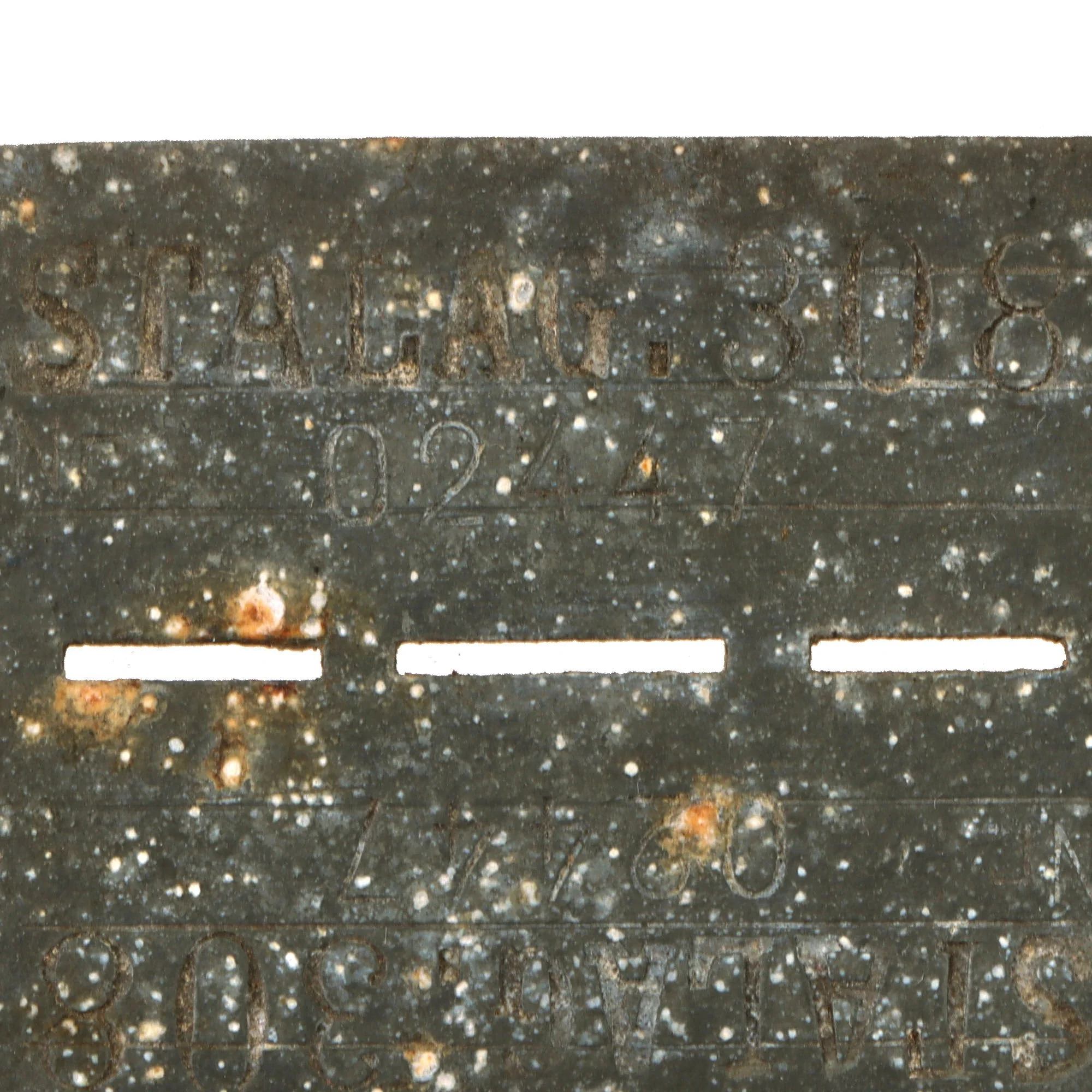
This is a very scarce Erkennungsmarke (identification tag) dog tag worn by a Russian prisoner of war while held at Stalag 308 during the war. It is made from stamped zinc, and shows a lovely oxidized patina with some areas of corrosion, but shows no major damage and is still fully legible, reading:-
STALAG 308
Nr. 02447
It measures 1 ⅝ x 2 ⅜” and is in good shape, without and breakage in the central hatched portion.
A great example from a well-known POW camp, ready for further research and display.
Details & Craftsmanship
Every detail has been carefully considered to bring you the perfect product.

Details & Craftsmanship
Every detail has been carefully considered to bring you the perfect product.

Details & Craftsmanship
Every detail has been carefully considered to bring you the perfect product.

Details & Craftsmanship
Every detail has been carefully considered to bring you the perfect product.
Description
Original Item. Only One Available. Stalag VIII-E (also known as Stalag 308) was a German World War II prisoner-of-war camp located next to the village of Neuhammer, Silesia (now Świętoszów, Poland). It was about 15 km (9.3 mi) south of the camps Stalag VIII-C and Stalag Luft III at Sagan, Silesia (now Żagań, Poland). It was built on a large German Army training ground that is still in use today by the Polish Land Forces' 10th Armoured Cavalry Brigade. It housed Polish, French, and Soviet POWs.
The camp was built in September 1939 to house several thousand prisoners from the invasion of Poland. After May 1940, they were joined by French prisoners taken during the Battle of France. In July 1941, the Poles and French were transferred to other camps, and were replaced with Soviet prisoners. In June 1942, Stalag VIII-E became a sub-camp (Zweiglager) of Stalag VIII-C and was renamed Stalag VIII-C/Z. During the war, a total of 57,545 Soviet POWs were held at the camp. The camp was liberated by the Red Army on 15 February 1945.
This is a very scarce Erkennungsmarke (identification tag) dog tag worn by a Russian prisoner of war while held at Stalag 308 during the war. It is made from stamped zinc, and shows a lovely oxidized patina with some areas of corrosion, but shows no major damage and is still fully legible, reading:-
STALAG 308
Nr. 02447
It measures 1 ⅝ x 2 ⅜” and is in good shape, without and breakage in the central hatched portion.
A great example from a well-known POW camp, ready for further research and display.