
Original: $2,495.00
-70%$2,495.00
$748.50The Story
Original Item. One-of-a-Kind. The Herero Wars were a series of colonial wars between the German Empire and the Herero people of German South West Africa (present-day Namibia). They took place between 1904 and 1908. The Hereros were cattle grazers, occupying most of central and northern South West Africa. Under the leadership of Jonker Afrikaner, who died in 1861, and later under the leadership of Samuel Maharero, they had achieved supremacy over the Nama and Orlam peoples in a series of conflicts that had in their later stages, seen the extensive use of firearms obtained from European traders.
In the early 1880s, the German statesman Otto von Bismarck, reversing his previous rejection of colonial acquisitions, decided on a policy of imperial expansion. In 1882 Bismarck gave permission to Adolf Lüderitz to obtain lands which Germany would bring within its "protection", under the conditions that a port was established within the territories taken and that there was "clear title" to the land. Lüderitz bought the title to Angra Pequena (later renamed Lüderitz Bay) from Joseph Fredericks, a chief of the Oorlam people, in exchange for 200 rifles, 2,500 German marks, and some lead toy soldiers, and established a port there. Clarification of Germany's title among the European powers took some time, as the British demurred in response to a German request to clarify the boundaries of their title, however in April 1884 Bismarck instructed the German consul in declare "Lüderitzland" (as Lüderitz's holding in South-West Africa had become known) as under the "protection" of the German Reich. Lüderitz steadily spread Germany's influence throughout the South-West African territory until by 1885 only one tribe within it – the Witboois – had not concluded some kind of arrangement with Germany.
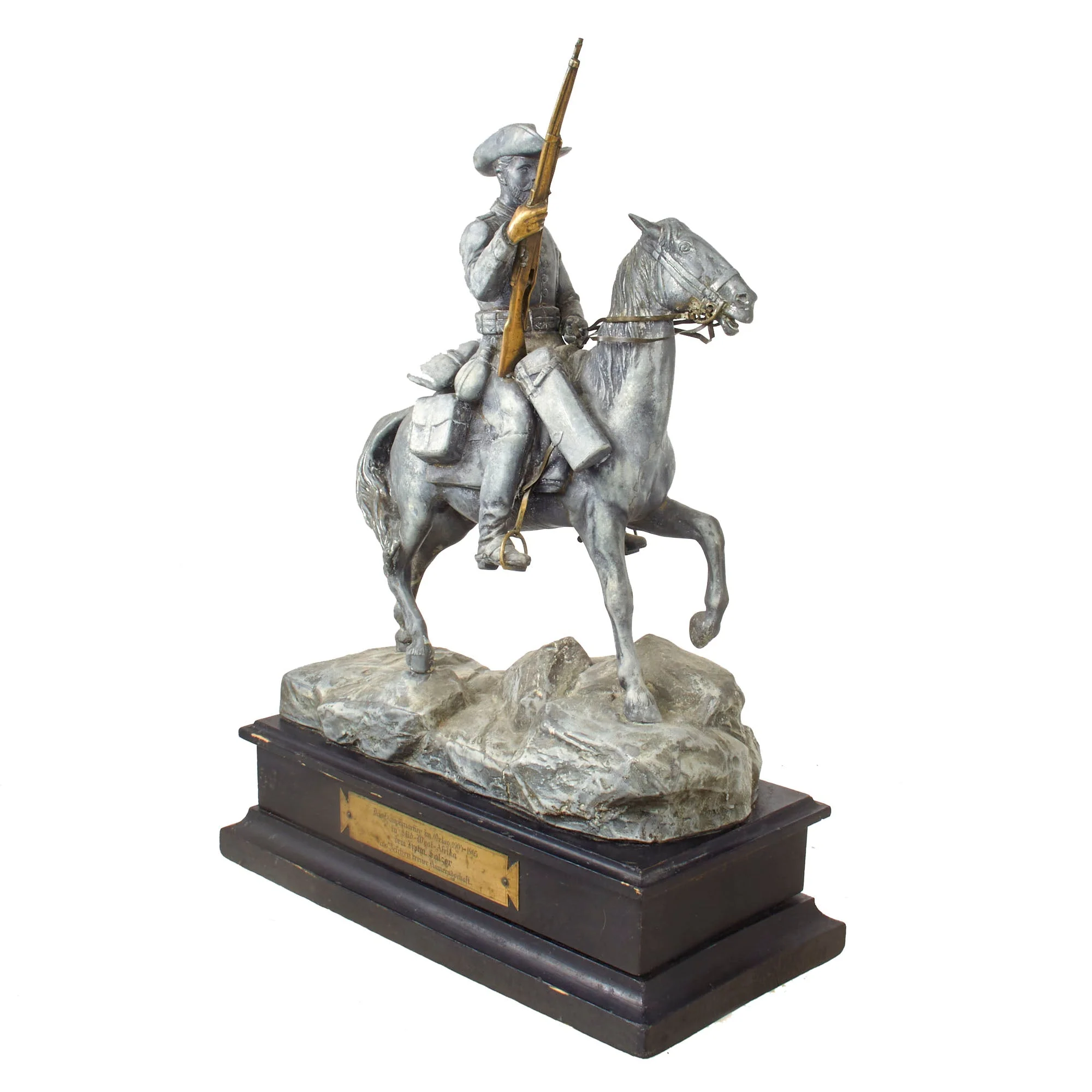
This is an outstanding and unprecedented equestrian bronze statue which still sits atop its original wooden base, upon which is a period dedication plaque which reads:
Das Hauptquartier im Orlog 1904-1905
In Süd-West-Afrika
dem Hptm. Salzer
als Beirhen treuer Hameradschaft
Headquarters in the war 1904-1905
In Southwest Africa
to Captain Salzer
as a loyal comrade
This is referring to Captain Salzer, a specialist for the African colonies of France and Great Britain, which is why he was considered one of the few Africa experts of the general staff. There is very little reference we could find to Salzer, but there is certainly more to be found with the proper resources. We were able to find him in a photo in a pdf, but it was far too compressed for him to be visible.
The statue stands at 19½” tall including the base, and the base itself measures 7⅜ x 15⅛”. The details in the statue are outstanding, including the Südwester slouch hat, the reins for his horse which are likely thin brass, and his rifle, which along with his hand appears to be brass while the rest of the statue is bronze. The back of the statue retains a maker’s logo reading:
R. BELLAIR & CO.
BERLIN
FRIEDRICHSTR. 182
The base of the statue’s wood is warping a little, and there is some minor separation between the bottom and top pieces of the base, but is only a small bit wobbly and will still display like a dream. The statue weighs roughly 16.85lb. The bronze base appears to be signed MORIN.
This is an outstanding display piece that will quickly become the centerpiece of any German or Schutztruppe collection.
Schutztruppe was the official name of the colonial troops in the African territories of the German colonial empire from the late 19th century to 1918. Similar to other colonial armies, the Schutztruppen consisted of volunteer European commissioned and non-commissioned officers, medical and veterinary officers. Most enlisted ranks were recruited from indigenous communities within the German colonies or from elsewhere in Africa.
Military contingents were formed in German East Africa, where they became famous as Askari, in the Kamerun colony of German West Africa, and in German South West Africa. Control of the German colonies of New Guinea, in Samoa, and in Togoland was performed by small local police detachments. Kiautschou in China under Imperial Navy administration was a notable exception. As part of the East Asian Station the navy garrisoned Qingdao with the marines of Seebataillon III, the only all-German unit with permanent status in an overseas protectorate.
The name of the German colonial force dates back to the parlance of Chancellor Otto von Bismarck, who had the term Schutzgebiete, "protectorates", used instead of colonies. Schutztruppe contingents arose from local police forces or private paramilitary units, where German colonizers met with stronger resistance.
The Schutztruppe in German South West Africa was structured in 12 companies of mounted infantry totalling 1,500 men, primarily Germans. The 7th Company, stationed in the northern desert area of the colony, was mounted on imported camels. A single unit, called the Baster Company, consisting of non-local biracial white European-black Africans, was raised and deployed. Relations between the German administration and the natives in this colony had deteriorated to the point that few local Africans were recruited. Some Boers and Afrikaners were able to be recruited, bolstering the fledgling force.
The colonial forces for German Southwest Africa consisted of volunteers from the Imperial Army and Navy (including some Austrians) but essentially consisted of members of German regiments. Before their deployment to Africa these troops were prepared for their special tasks and future environment. Such a training base was at Karlsruhe. Because of the often humid conditions in the upper Rhine valley of the Grand Duchy of Baden, the area provided some early acclimatisation.

Details & Craftsmanship
Every detail has been carefully considered to bring you the perfect product.
Details & Craftsmanship
Every detail has been carefully considered to bring you the perfect product.

Details & Craftsmanship
Every detail has been carefully considered to bring you the perfect product.

Details & Craftsmanship
Every detail has been carefully considered to bring you the perfect product.

Details & Craftsmanship
Every detail has been carefully considered to bring you the perfect product.

Details & Craftsmanship
Every detail has been carefully considered to bring you the perfect product.

Details & Craftsmanship
Every detail has been carefully considered to bring you the perfect product.

Details & Craftsmanship
Every detail has been carefully considered to bring you the perfect product.

Details & Craftsmanship
Every detail has been carefully considered to bring you the perfect product.

Details & Craftsmanship
Every detail has been carefully considered to bring you the perfect product.

Details & Craftsmanship
Every detail has been carefully considered to bring you the perfect product.

Details & Craftsmanship
Every detail has been carefully considered to bring you the perfect product.

Details & Craftsmanship
Every detail has been carefully considered to bring you the perfect product.

Details & Craftsmanship
Every detail has been carefully considered to bring you the perfect product.

Details & Craftsmanship
Every detail has been carefully considered to bring you the perfect product.

Details & Craftsmanship
Every detail has been carefully considered to bring you the perfect product.
Description
Original Item. One-of-a-Kind. The Herero Wars were a series of colonial wars between the German Empire and the Herero people of German South West Africa (present-day Namibia). They took place between 1904 and 1908. The Hereros were cattle grazers, occupying most of central and northern South West Africa. Under the leadership of Jonker Afrikaner, who died in 1861, and later under the leadership of Samuel Maharero, they had achieved supremacy over the Nama and Orlam peoples in a series of conflicts that had in their later stages, seen the extensive use of firearms obtained from European traders.
In the early 1880s, the German statesman Otto von Bismarck, reversing his previous rejection of colonial acquisitions, decided on a policy of imperial expansion. In 1882 Bismarck gave permission to Adolf Lüderitz to obtain lands which Germany would bring within its "protection", under the conditions that a port was established within the territories taken and that there was "clear title" to the land. Lüderitz bought the title to Angra Pequena (later renamed Lüderitz Bay) from Joseph Fredericks, a chief of the Oorlam people, in exchange for 200 rifles, 2,500 German marks, and some lead toy soldiers, and established a port there. Clarification of Germany's title among the European powers took some time, as the British demurred in response to a German request to clarify the boundaries of their title, however in April 1884 Bismarck instructed the German consul in declare "Lüderitzland" (as Lüderitz's holding in South-West Africa had become known) as under the "protection" of the German Reich. Lüderitz steadily spread Germany's influence throughout the South-West African territory until by 1885 only one tribe within it – the Witboois – had not concluded some kind of arrangement with Germany.
This is an outstanding and unprecedented equestrian bronze statue which still sits atop its original wooden base, upon which is a period dedication plaque which reads:
Das Hauptquartier im Orlog 1904-1905
In Süd-West-Afrika
dem Hptm. Salzer
als Beirhen treuer Hameradschaft
Headquarters in the war 1904-1905
In Southwest Africa
to Captain Salzer
as a loyal comrade
This is referring to Captain Salzer, a specialist for the African colonies of France and Great Britain, which is why he was considered one of the few Africa experts of the general staff. There is very little reference we could find to Salzer, but there is certainly more to be found with the proper resources. We were able to find him in a photo in a pdf, but it was far too compressed for him to be visible.
The statue stands at 19½” tall including the base, and the base itself measures 7⅜ x 15⅛”. The details in the statue are outstanding, including the Südwester slouch hat, the reins for his horse which are likely thin brass, and his rifle, which along with his hand appears to be brass while the rest of the statue is bronze. The back of the statue retains a maker’s logo reading:
R. BELLAIR & CO.
BERLIN
FRIEDRICHSTR. 182
The base of the statue’s wood is warping a little, and there is some minor separation between the bottom and top pieces of the base, but is only a small bit wobbly and will still display like a dream. The statue weighs roughly 16.85lb. The bronze base appears to be signed MORIN.
This is an outstanding display piece that will quickly become the centerpiece of any German or Schutztruppe collection.
Schutztruppe was the official name of the colonial troops in the African territories of the German colonial empire from the late 19th century to 1918. Similar to other colonial armies, the Schutztruppen consisted of volunteer European commissioned and non-commissioned officers, medical and veterinary officers. Most enlisted ranks were recruited from indigenous communities within the German colonies or from elsewhere in Africa.
Military contingents were formed in German East Africa, where they became famous as Askari, in the Kamerun colony of German West Africa, and in German South West Africa. Control of the German colonies of New Guinea, in Samoa, and in Togoland was performed by small local police detachments. Kiautschou in China under Imperial Navy administration was a notable exception. As part of the East Asian Station the navy garrisoned Qingdao with the marines of Seebataillon III, the only all-German unit with permanent status in an overseas protectorate.
The name of the German colonial force dates back to the parlance of Chancellor Otto von Bismarck, who had the term Schutzgebiete, "protectorates", used instead of colonies. Schutztruppe contingents arose from local police forces or private paramilitary units, where German colonizers met with stronger resistance.
The Schutztruppe in German South West Africa was structured in 12 companies of mounted infantry totalling 1,500 men, primarily Germans. The 7th Company, stationed in the northern desert area of the colony, was mounted on imported camels. A single unit, called the Baster Company, consisting of non-local biracial white European-black Africans, was raised and deployed. Relations between the German administration and the natives in this colony had deteriorated to the point that few local Africans were recruited. Some Boers and Afrikaners were able to be recruited, bolstering the fledgling force.
The colonial forces for German Southwest Africa consisted of volunteers from the Imperial Army and Navy (including some Austrians) but essentially consisted of members of German regiments. Before their deployment to Africa these troops were prepared for their special tasks and future environment. Such a training base was at Karlsruhe. Because of the often humid conditions in the upper Rhine valley of the Grand Duchy of Baden, the area provided some early acclimatisation.