
The Story
Original Item: Only One Available. Perhaps no other collectible is so shrouded in myth, misinformation and mistaken identity as German regimental steins. These pieces have been steadily reproduced since the 1960s and most experts agree reproductions far outnumber authentic examples. Yet few buyers other than stein specialists know how to identify the fakes. We have examined this stein thoroughly, with reference to several websites such as RealorRepro and SteveonSteins, and this one has all of the correct aspects for being original.
The majority of authentic German regimental beer steins were produced between about 1890 and 1914. During this time, military service was compulsory in Germany. Most men would take basic training between 17 and 20 and then enter the reserves until age 40. A group of men would enter a unit together, stay in the same unit for training and be discharged as a unit. This sense of togetherness fostered the custom of buying souvenirs with the unit name, insignias and decorations as a keepsake of military service. Many souvenir items were available such as pipes, clocks, flasks and especially steins. Rosters of names from your unit, or regiment, could be added to the steins and these became known to collectors as "regimental steins."
Authentic ca. 1890-1914 steins were available in pottery, porcelain, glass and metal. Regardless of what the stein was made of, almost all had pewter lids. The most common sizes are half-liter and one-liter. The beginning of WWI effectively ended the production of regimental steins as labor and materials were diverted to the war.
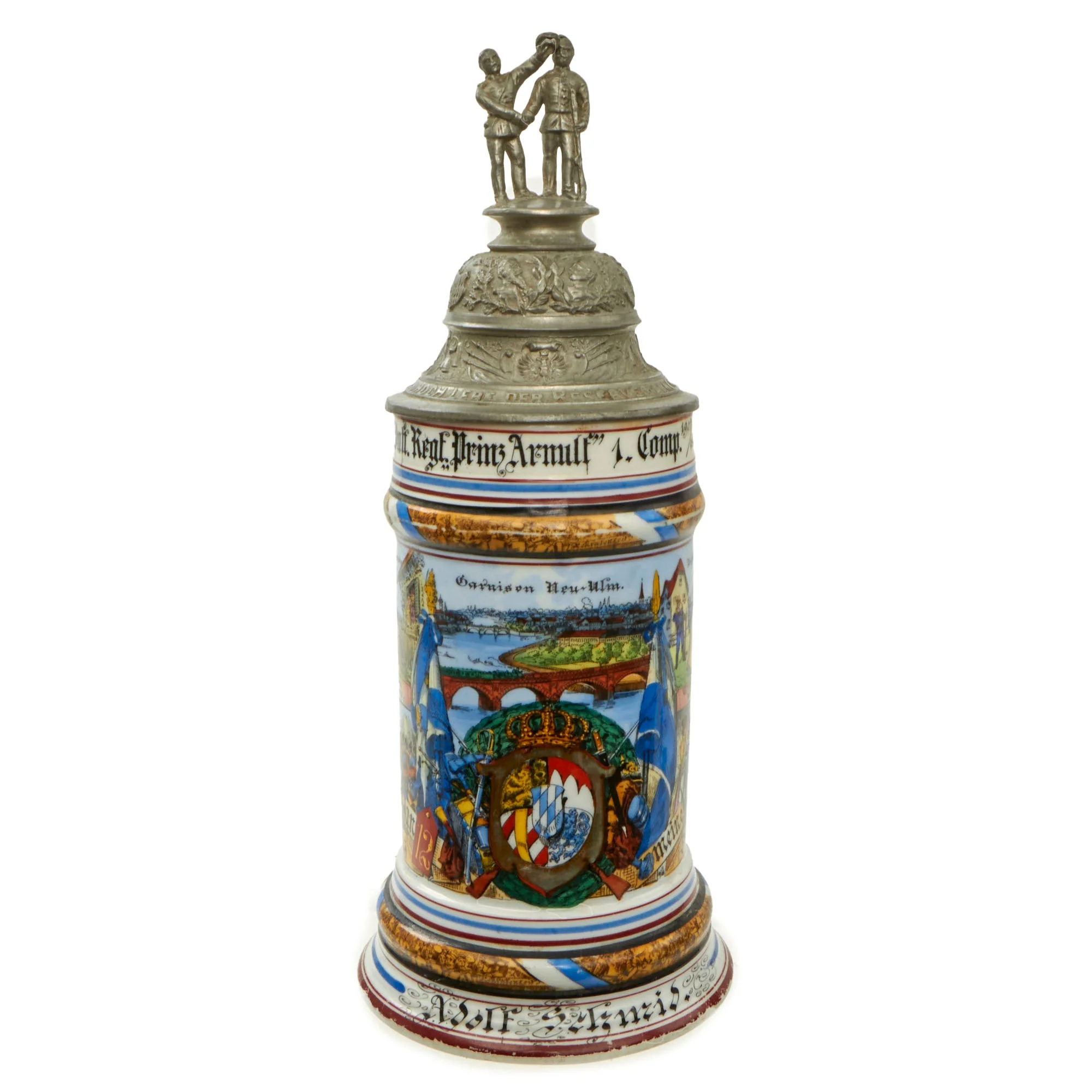
This is a very high quality original Imperial German Regimental beer stein. It is highly decorated on the exterior, and these were generally made with lovely design on the exterior, with banners and other areas where they were customized for the specific regiment / unit that the person ordering the stein requested. These were usually ordered in groups for a particular regiment, and this example is marked for the 12th Royal Bavarian Infantry "Prinz Arnulf". The last names of the men of the company are to the left and right. The other side of the stein has depictions of these men in Battle firing rifles and on the homefront. We can certainly tell that the names of these men were hand-painted, not printed. This example is named to Adolf Schmid. The top of the stein under the lid has the regimental designation:
Kgl. bayr. 12. Inf.-Rgt. „Prinz Arnulf“ 1. Comp. 1903/1905 Neu-Ulm.
This is a clear reference to Königlich Bayerisches 12. Infanterie-Regiment „Prinz Arnulf“. The regiment was raised in 1814 and fought heavily during the First World War. It was stationed in Neu-Ulm during peacetime.
The stein indicates that Schmid was in the 1st company, serving from 1903 to 1905 in Neu-Ulm. At the time Germany had mandatory military service for all able-bodied males. There are also lots of other inscriptions on the body of the stein, probably patriotic phrases and maybe poems or the like.
The lid is in good shape, and the joint with the hinge is still solid and tight to the handle. The rest of the inside of the lid is bright and shiny, as is correct for a vintage stein. The top of the lid shows two soldiers shaking hands, and there is a Rampant lion on the top of the hinge.
The stein measures approximately 10 3/4 inches in height, and is 4 3/8" across the base. The glaze is in good condition, showing some cracking in areas and there is some heavy color loss across the stein. The bottom of the inside has a lovely lithopane showing a soldier and his sweetheart. This is well executed, and they are standing at arms length, correct for the period. There is no size marking, but it is likely 0.5 Liters, the standard capacity for these.
A very impressive display item from the German Empire, ready to research and display!

Details & Craftsmanship
Every detail has been carefully considered to bring you the perfect product.

Details & Craftsmanship
Every detail has been carefully considered to bring you the perfect product.
Details & Craftsmanship
Every detail has been carefully considered to bring you the perfect product.

Details & Craftsmanship
Every detail has been carefully considered to bring you the perfect product.

Details & Craftsmanship
Every detail has been carefully considered to bring you the perfect product.

Details & Craftsmanship
Every detail has been carefully considered to bring you the perfect product.

Details & Craftsmanship
Every detail has been carefully considered to bring you the perfect product.

Details & Craftsmanship
Every detail has been carefully considered to bring you the perfect product.

Details & Craftsmanship
Every detail has been carefully considered to bring you the perfect product.

Details & Craftsmanship
Every detail has been carefully considered to bring you the perfect product.
Description
Original Item: Only One Available. Perhaps no other collectible is so shrouded in myth, misinformation and mistaken identity as German regimental steins. These pieces have been steadily reproduced since the 1960s and most experts agree reproductions far outnumber authentic examples. Yet few buyers other than stein specialists know how to identify the fakes. We have examined this stein thoroughly, with reference to several websites such as RealorRepro and SteveonSteins, and this one has all of the correct aspects for being original.
The majority of authentic German regimental beer steins were produced between about 1890 and 1914. During this time, military service was compulsory in Germany. Most men would take basic training between 17 and 20 and then enter the reserves until age 40. A group of men would enter a unit together, stay in the same unit for training and be discharged as a unit. This sense of togetherness fostered the custom of buying souvenirs with the unit name, insignias and decorations as a keepsake of military service. Many souvenir items were available such as pipes, clocks, flasks and especially steins. Rosters of names from your unit, or regiment, could be added to the steins and these became known to collectors as "regimental steins."
Authentic ca. 1890-1914 steins were available in pottery, porcelain, glass and metal. Regardless of what the stein was made of, almost all had pewter lids. The most common sizes are half-liter and one-liter. The beginning of WWI effectively ended the production of regimental steins as labor and materials were diverted to the war.
This is a very high quality original Imperial German Regimental beer stein. It is highly decorated on the exterior, and these were generally made with lovely design on the exterior, with banners and other areas where they were customized for the specific regiment / unit that the person ordering the stein requested. These were usually ordered in groups for a particular regiment, and this example is marked for the 12th Royal Bavarian Infantry "Prinz Arnulf". The last names of the men of the company are to the left and right. The other side of the stein has depictions of these men in Battle firing rifles and on the homefront. We can certainly tell that the names of these men were hand-painted, not printed. This example is named to Adolf Schmid. The top of the stein under the lid has the regimental designation:
Kgl. bayr. 12. Inf.-Rgt. „Prinz Arnulf“ 1. Comp. 1903/1905 Neu-Ulm.
This is a clear reference to Königlich Bayerisches 12. Infanterie-Regiment „Prinz Arnulf“. The regiment was raised in 1814 and fought heavily during the First World War. It was stationed in Neu-Ulm during peacetime.
The stein indicates that Schmid was in the 1st company, serving from 1903 to 1905 in Neu-Ulm. At the time Germany had mandatory military service for all able-bodied males. There are also lots of other inscriptions on the body of the stein, probably patriotic phrases and maybe poems or the like.
The lid is in good shape, and the joint with the hinge is still solid and tight to the handle. The rest of the inside of the lid is bright and shiny, as is correct for a vintage stein. The top of the lid shows two soldiers shaking hands, and there is a Rampant lion on the top of the hinge.
The stein measures approximately 10 3/4 inches in height, and is 4 3/8" across the base. The glaze is in good condition, showing some cracking in areas and there is some heavy color loss across the stein. The bottom of the inside has a lovely lithopane showing a soldier and his sweetheart. This is well executed, and they are standing at arms length, correct for the period. There is no size marking, but it is likely 0.5 Liters, the standard capacity for these.
A very impressive display item from the German Empire, ready to research and display!