
Original: $395.00
-70%$395.00
$118.50The Story
Original Item: One-of-a-kind. This is a very nice genuine medal bar, owned by a likely Bulgarian soldier who fought during WWI, and also possibly served post war under the Weimar republic. Some of the ribbon colors have faded a bit, but overall the set is quite eye-catching.
The set of 5 medals offered in good condition is mounted on a metal backing board with pin and lined in red wool felt. There is heavy fading of color to many of the ribbons. It consists of the following medals:
- Imperial German WWI Iron Cross 1914 2nd Class Medal
- Imperial German WWI Honor Cross of the World War 1914/1918 (Hindenburg Cross) Medal with Swords (for combat)
- Imperial German 15 Years Long Service Medal
- Austro-Hungarian WWI Pro Deo et Patria Military Medal 1914 1918 for Combatants
- Bulgarian Medal for Participation in the European War 1915-1918
A great parade medal bar that is welcomed into any caliber collection. Comes ready for further research and display.
Below is an explanation of each medal in detail:
German WWI Prussian Iron Cross 2nd Class with Ribbon:
Established by Frederick William in 1813 for gallantry in action, the decoration was revived several times for later conflicts. The bulk of the issues are divided into 1st and 2nd class versions, but a rare and superior 'Grand Cross' was also awarded for successful field commanders. During WW1 the lower decoration was freely awarded with 5½ million second class types issued. Originally, the Iron Cross was an award of the Kingdom of Prussia, however given Prussia's pre-eminent place in the German Empire formed in 1871, it became an award for all of Germany.
The basic design of the WW1 crosses is a central Tatzenkreuz (cross pattée) struck from iron and mounted in a silver frame which has a raised crenulated decorative border. The obverse of the cross bears the date 1914 under a crowned 'W' monogram. Reverse bears an oak leaf cluster with the date of the decoration’s institution, 1813 underneath - the crowned initials of Frederick William are in the top arm above the oak leaf cluster. Suspension for second-class types is by means of a ring, and frequently this ring bears a maker's stamp.
Please examine the edge seam for authentication, which is not present on reproductions. Iron crosses were commonly constructed from an iron core sandwiched in a surrounding two part silver frame, normally the seam of these two silver parts is visible around the edge of the cross as is seen on this fine example.
Hindenburg Cross with Crossed Swords (for combat):
The Honor Cross of the World War 1914/1918 (German: Das Ehrenkreuz des Weltkriegs 1914/1918), commonly, but incorrectly, known as the Hindenburg Cross was established by Field Marshal Paul von Hindenburg, President of the German Republic, by an order dated 13 July 1934, to commemorate the distinguished deeds of the German people during the First World War. This was Germany's first official service medal for soldiers of Imperial Germany who had taken part in the war, and where they had since died it was also awarded to their surviving next-of-kin. Shortly after its issuance, the government of NSDAP Germany declared the award as the only official service decoration of the First World War and further forbid the continued wearing of German Free Corps awards on any military or paramilitary uniform of a state or NSDAP Party organization.
- Imperial German 1st Class Long Service Cross for 15 Years: Instituted July 4, 1913. A straight-armed cross pate constructed of gilded bronze, the obverse center bears the Prussian royal crown, the reverse bears “XV” (for 15 years of service)
- Austro- Hungarian WWI Pro Deo et Patria Military Medal 1914-1918: Hungary (Austro-hungarian Empire): Hungarian WWI Commemorative Combatant's military medal PRO DEO ET PATRIA (for God and Country). Award for the participation in the Great War. The medal was instituted in 1929. It is mounted on the correct red white and green ribbon, though the green has faded almost completely to yellow. It has the crossed swords on the ribbon, indicating it was awarded to a Combatant in the war.
- Bulgarian Medal for Participation in the European War 1915-1918: The Medal for Participation in the European War 1915-1918 was instituted on 9 December 1933 and awarded to Bulgarian and Bulgarian allied force participants of the “1915–1918” war (The Great War). It was issued to all WWI veterans including military personnel, non-combatants (such as medics, war journalists, and civilians) and relatives of KIAs. Also eligible were NCOs, former officers, and soldiers from Central Powers armies.
The medal was awarded until December 31, 1939. About 249,000 medals were issued (about 50,000 to Bulgarians and about 199,000 to allied forces) in three classes.
The medal is circular and measures 32,1 mm in diameter. It was made of gilt bronze. They were manufactured by the Lüdenscheid-based company “Gebrüder Gloerfeld” (the first lot of 30,000), the Swiss company “Huguenin Gebr.&Co.” (59,000), the Sofia-based manufacturer Бердж Керестеджиев and “Otto Shiсkle”(60,000 medals in 1939).
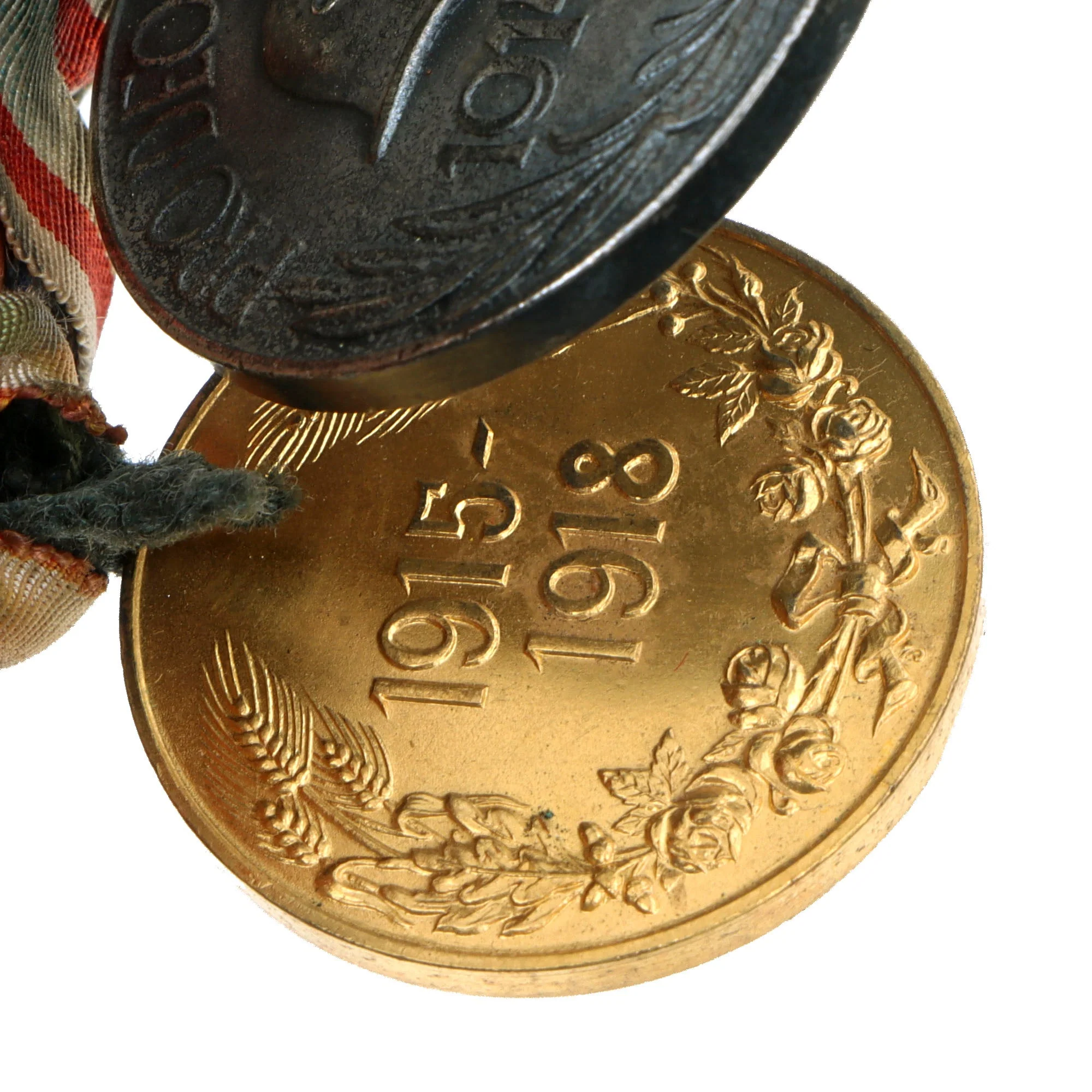
The obverse of the medal shows a crowned Bulgarian coat of arms imposed on crossed swords and flanked by laurel and oak branches. The reverse shows the dates of the Bulgarian participation in the Great War (“1915-1918”) inscribed in two lines in the centre, encircled by a wreath of wheat, laurel, oak and roses that symbolized Macedonia, Thrace and Moesia.
The ribbon was made of 39 mm wide silk and followed colors of the Bulgarian flag. The medal was awarded to people who did not participate directly in war activities with a central white stripe in the ribbon. Medals for next of kin had a central black stripe.

Details & Craftsmanship
Every detail has been carefully considered to bring you the perfect product.

Details & Craftsmanship
Every detail has been carefully considered to bring you the perfect product.

Details & Craftsmanship
Every detail has been carefully considered to bring you the perfect product.

Details & Craftsmanship
Every detail has been carefully considered to bring you the perfect product.

Details & Craftsmanship
Every detail has been carefully considered to bring you the perfect product.

Details & Craftsmanship
Every detail has been carefully considered to bring you the perfect product.

Details & Craftsmanship
Every detail has been carefully considered to bring you the perfect product.
Details & Craftsmanship
Every detail has been carefully considered to bring you the perfect product.

Details & Craftsmanship
Every detail has been carefully considered to bring you the perfect product.

Details & Craftsmanship
Every detail has been carefully considered to bring you the perfect product.
Description
Original Item: One-of-a-kind. This is a very nice genuine medal bar, owned by a likely Bulgarian soldier who fought during WWI, and also possibly served post war under the Weimar republic. Some of the ribbon colors have faded a bit, but overall the set is quite eye-catching.
The set of 5 medals offered in good condition is mounted on a metal backing board with pin and lined in red wool felt. There is heavy fading of color to many of the ribbons. It consists of the following medals:
- Imperial German WWI Iron Cross 1914 2nd Class Medal
- Imperial German WWI Honor Cross of the World War 1914/1918 (Hindenburg Cross) Medal with Swords (for combat)
- Imperial German 15 Years Long Service Medal
- Austro-Hungarian WWI Pro Deo et Patria Military Medal 1914 1918 for Combatants
- Bulgarian Medal for Participation in the European War 1915-1918
A great parade medal bar that is welcomed into any caliber collection. Comes ready for further research and display.
Below is an explanation of each medal in detail:
German WWI Prussian Iron Cross 2nd Class with Ribbon:
Established by Frederick William in 1813 for gallantry in action, the decoration was revived several times for later conflicts. The bulk of the issues are divided into 1st and 2nd class versions, but a rare and superior 'Grand Cross' was also awarded for successful field commanders. During WW1 the lower decoration was freely awarded with 5½ million second class types issued. Originally, the Iron Cross was an award of the Kingdom of Prussia, however given Prussia's pre-eminent place in the German Empire formed in 1871, it became an award for all of Germany.
The basic design of the WW1 crosses is a central Tatzenkreuz (cross pattée) struck from iron and mounted in a silver frame which has a raised crenulated decorative border. The obverse of the cross bears the date 1914 under a crowned 'W' monogram. Reverse bears an oak leaf cluster with the date of the decoration’s institution, 1813 underneath - the crowned initials of Frederick William are in the top arm above the oak leaf cluster. Suspension for second-class types is by means of a ring, and frequently this ring bears a maker's stamp.
Please examine the edge seam for authentication, which is not present on reproductions. Iron crosses were commonly constructed from an iron core sandwiched in a surrounding two part silver frame, normally the seam of these two silver parts is visible around the edge of the cross as is seen on this fine example.
Hindenburg Cross with Crossed Swords (for combat):
The Honor Cross of the World War 1914/1918 (German: Das Ehrenkreuz des Weltkriegs 1914/1918), commonly, but incorrectly, known as the Hindenburg Cross was established by Field Marshal Paul von Hindenburg, President of the German Republic, by an order dated 13 July 1934, to commemorate the distinguished deeds of the German people during the First World War. This was Germany's first official service medal for soldiers of Imperial Germany who had taken part in the war, and where they had since died it was also awarded to their surviving next-of-kin. Shortly after its issuance, the government of NSDAP Germany declared the award as the only official service decoration of the First World War and further forbid the continued wearing of German Free Corps awards on any military or paramilitary uniform of a state or NSDAP Party organization.
- Imperial German 1st Class Long Service Cross for 15 Years: Instituted July 4, 1913. A straight-armed cross pate constructed of gilded bronze, the obverse center bears the Prussian royal crown, the reverse bears “XV” (for 15 years of service)
- Austro- Hungarian WWI Pro Deo et Patria Military Medal 1914-1918: Hungary (Austro-hungarian Empire): Hungarian WWI Commemorative Combatant's military medal PRO DEO ET PATRIA (for God and Country). Award for the participation in the Great War. The medal was instituted in 1929. It is mounted on the correct red white and green ribbon, though the green has faded almost completely to yellow. It has the crossed swords on the ribbon, indicating it was awarded to a Combatant in the war.
- Bulgarian Medal for Participation in the European War 1915-1918: The Medal for Participation in the European War 1915-1918 was instituted on 9 December 1933 and awarded to Bulgarian and Bulgarian allied force participants of the “1915–1918” war (The Great War). It was issued to all WWI veterans including military personnel, non-combatants (such as medics, war journalists, and civilians) and relatives of KIAs. Also eligible were NCOs, former officers, and soldiers from Central Powers armies.
The medal was awarded until December 31, 1939. About 249,000 medals were issued (about 50,000 to Bulgarians and about 199,000 to allied forces) in three classes.
The medal is circular and measures 32,1 mm in diameter. It was made of gilt bronze. They were manufactured by the Lüdenscheid-based company “Gebrüder Gloerfeld” (the first lot of 30,000), the Swiss company “Huguenin Gebr.&Co.” (59,000), the Sofia-based manufacturer Бердж Керестеджиев and “Otto Shiсkle”(60,000 medals in 1939).
The obverse of the medal shows a crowned Bulgarian coat of arms imposed on crossed swords and flanked by laurel and oak branches. The reverse shows the dates of the Bulgarian participation in the Great War (“1915-1918”) inscribed in two lines in the centre, encircled by a wreath of wheat, laurel, oak and roses that symbolized Macedonia, Thrace and Moesia.
The ribbon was made of 39 mm wide silk and followed colors of the Bulgarian flag. The medal was awarded to people who did not participate directly in war activities with a central white stripe in the ribbon. Medals for next of kin had a central black stripe.