
Original: $450.00
-70%$450.00
$135.00The Story
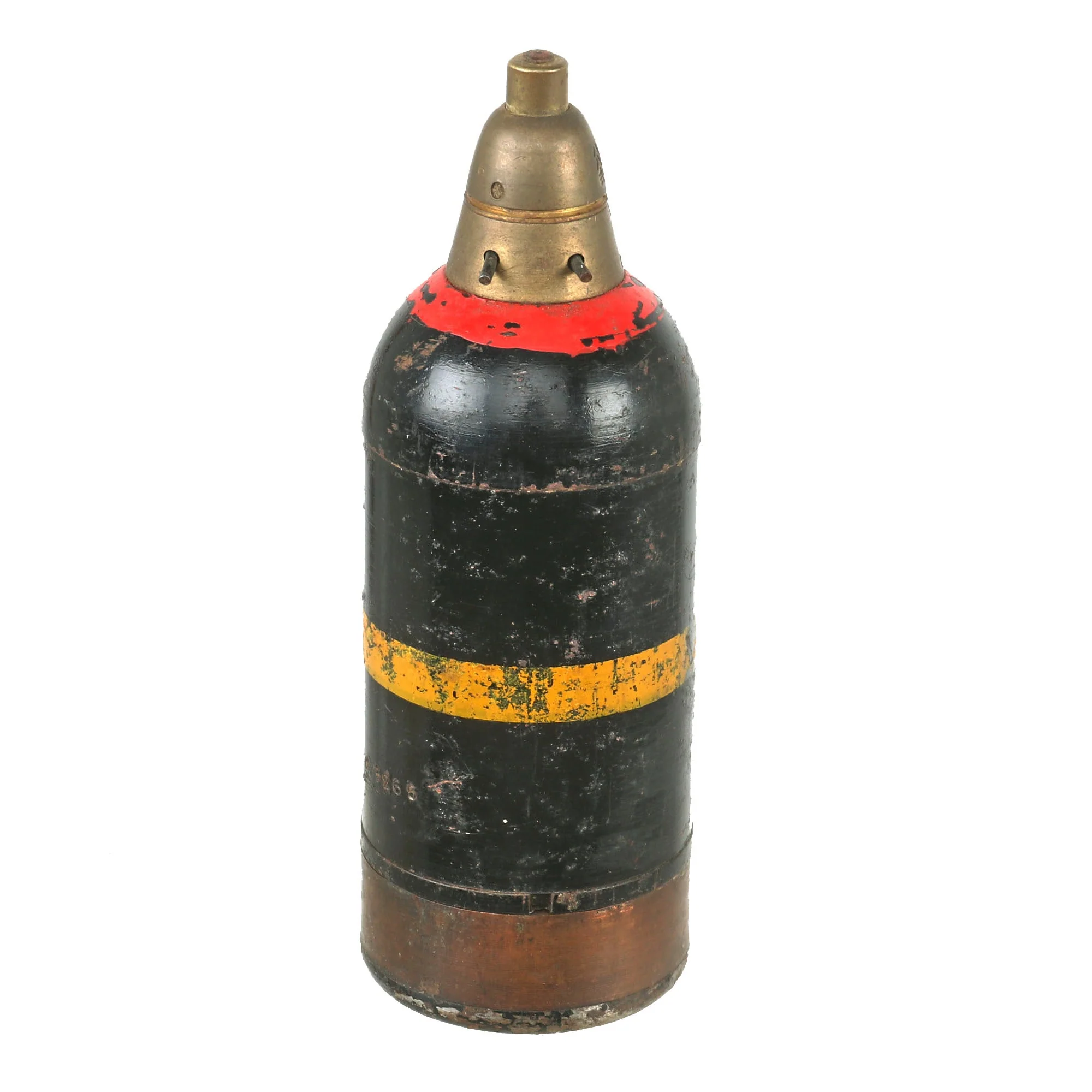
Original Item: Only One Available. This is an exceptionally rare inert demilitarized genuine Japanese Type 99 Hand Grenade. This example is offered in good condition complete with fuse, original top cap, and fuze cover assembly, but is missing the cup. The detonator tube is partially retained but cut off at the bottom. This example disassembles for inspection, with the top cap able to unscrew, revealing the explosives cavity, now empty. Like all deactivated ordnance, this grenade is Not Available for Export.
The bottom side of the fuse is visibly dated with 5 七 十 昭. This marking is written right to left, and would be read: SHOWA (current reigning emperor) Juu-Nana (17th year of reign - 1942) 5th month (April).
There is heavy wear to the exterior as shown. The pin is still inserted, but the pull string is long gone. A great example of a sought after WWII Japanese grenade! Ready for further research and display!
The Type 99 Hand Grenade (九九式手榴弾 Kyūkyū-shiki Teryūdan), also known as Kiska grenade by the American Army was an improved version of the Type 97 fragmentation hand grenade used by the Imperial Japanese Army and Imperial Japanese Navy SNLF during World War II.
History and development
Soon after introduction of the Type 97 hand grenade to front line
troops, a number of problems arose. Instability and inaccuracy of the fuse mechanism made the Type 97 almost as much of a menace to the thrower as to the recipient. Furthermore, the Type 97 was a hand grenade and could not be used with grenade launchers. In 1939, the Army Technical Bureau developed an improved version intended to remove these flaws.
Design
The Type 99 hand grenade could either be thrown by hand or fired from a Type 100 grenade discharger. Unlike the earlier Type 91 or Type 97 grenades, the body was not segmented, but was smooth and flanged on both ends. It was also slightly smaller in diameter than the Type 91. Operation required first removing the safety pin by pulling the cord to which it was attached and then striking the head of the fuse on a hard object, such as a rock or combat helmet, and throwing immediately. Since the firing pin was integral no screwing or unscrewing of the firing pin holder was necessary, as with earlier model Japanese grenades. The Type 99 could also be used as a booby trap by removing the safety pin and setting under a floorboard or chair.
Combat record
The Type 99 was issued as a standard rifle grenade to Japanese infantrymen in the Second Sino-Japanese War and throughout the various campaigns of World War II. The first examples to fall into the hands of Allied military intelligence were captured at the Battle of Kiska in the Aleutian Islands, which gave rise to the nickname of “Kiska grenade” by American troops.

Details & Craftsmanship
Every detail has been carefully considered to bring you the perfect product.

Details & Craftsmanship
Every detail has been carefully considered to bring you the perfect product.

Details & Craftsmanship
Every detail has been carefully considered to bring you the perfect product.

Details & Craftsmanship
Every detail has been carefully considered to bring you the perfect product.

Details & Craftsmanship
Every detail has been carefully considered to bring you the perfect product.
Description
Original Item: Only One Available. This is an exceptionally rare inert demilitarized genuine Japanese Type 99 Hand Grenade. This example is offered in good condition complete with fuse, original top cap, and fuze cover assembly, but is missing the cup. The detonator tube is partially retained but cut off at the bottom. This example disassembles for inspection, with the top cap able to unscrew, revealing the explosives cavity, now empty. Like all deactivated ordnance, this grenade is Not Available for Export.
The bottom side of the fuse is visibly dated with 5 七 十 昭. This marking is written right to left, and would be read: SHOWA (current reigning emperor) Juu-Nana (17th year of reign - 1942) 5th month (April).
There is heavy wear to the exterior as shown. The pin is still inserted, but the pull string is long gone. A great example of a sought after WWII Japanese grenade! Ready for further research and display!
The Type 99 Hand Grenade (九九式手榴弾 Kyūkyū-shiki Teryūdan), also known as Kiska grenade by the American Army was an improved version of the Type 97 fragmentation hand grenade used by the Imperial Japanese Army and Imperial Japanese Navy SNLF during World War II.
History and development
Soon after introduction of the Type 97 hand grenade to front line
troops, a number of problems arose. Instability and inaccuracy of the fuse mechanism made the Type 97 almost as much of a menace to the thrower as to the recipient. Furthermore, the Type 97 was a hand grenade and could not be used with grenade launchers. In 1939, the Army Technical Bureau developed an improved version intended to remove these flaws.
Design
The Type 99 hand grenade could either be thrown by hand or fired from a Type 100 grenade discharger. Unlike the earlier Type 91 or Type 97 grenades, the body was not segmented, but was smooth and flanged on both ends. It was also slightly smaller in diameter than the Type 91. Operation required first removing the safety pin by pulling the cord to which it was attached and then striking the head of the fuse on a hard object, such as a rock or combat helmet, and throwing immediately. Since the firing pin was integral no screwing or unscrewing of the firing pin holder was necessary, as with earlier model Japanese grenades. The Type 99 could also be used as a booby trap by removing the safety pin and setting under a floorboard or chair.
Combat record
The Type 99 was issued as a standard rifle grenade to Japanese infantrymen in the Second Sino-Japanese War and throughout the various campaigns of World War II. The first examples to fall into the hands of Allied military intelligence were captured at the Battle of Kiska in the Aleutian Islands, which gave rise to the nickname of “Kiska grenade” by American troops.