
Original: $7,495.00
-70%$7,495.00
$2,248.50The Story
Original Item: Only One Available: The SS (Schutzstaffel or Protection Squadron) was originally formed in 1925, ostensibly to act as a small, loyal bodyguard unit to protect the Führer, Adolf AH. Under the direction of the Reichsführer-SS Heinrich Himmler, the SS grew to be the most ruthless and feared organization of the 20th century. They were the vanguard of Germany eventually controlled nearly every function of German life and much of Occupied Europe.
The SS Dienstdolch (service dagger), also called the SS Ehrendolch (honor dagger), was introduced in 1933. Early on, members of the SS were awarded their daggers during a ceremony at the Feldherrnhalle Memorial in Munich. The annual ritual, charged with mysticism and meant to evoke the traditions of medieval Teutonic knights, was held on 9 November, the date of the unsuccessful Munich Putsch of 1923. Both officers and enlisted men wore the identical dagger until 1936. After this time, only enlisted men wore the M1933 dagger. After this time, only enlisted men wore the M1933 dagger, while officers and NCOs who had served 1933 and prior would receive the "Chained" version that we have here. These are quite a bit more rare and desirable than the Enlisted version.
It should be noted that as patterned, the M1936 "Chained" SS daggers did not have any maker or RZM markings on the back of the dagger, and were totally unmarked. However officers and senior NCOs who already had M33 daggers often wanted to keep their original daggers, and then would save on the cost by only purchasing the chained scabbards, which were available separately to those qualified for the honor. This is why it is not uncommon at all to see maker marked daggers in Chained scabbards.
Additionally, the chained center "ramp" and top fittings, chains, and "Wotan's knot" end clips all had several different patterns, and could be combined with either "anodized" or enameled steel shells. The bottom fittings could be solid nickel alloy or plated steel. To further complicate things, the various "Types" were produced concurrently. For more information on this please see Exploring The Dress Daggers and Swords of the German ᛋᛋ by Thomas T. Wittmann.
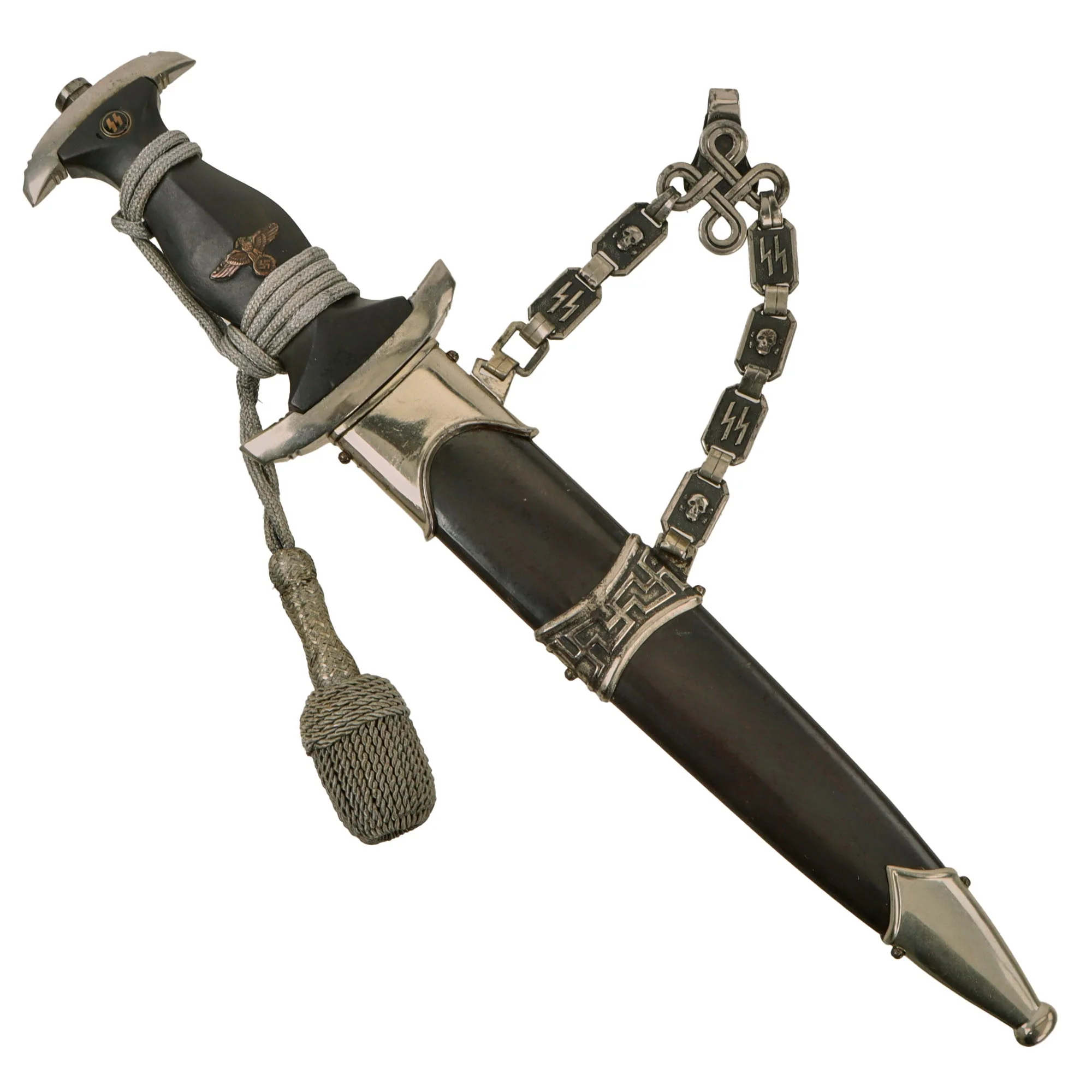
The SS Dagger was originally equipped with nickel crossguards with an ebony wood grip. The black grip contained a National eagle with swas insignia recessed in the center area and an SS doppelte Siegrune (Double Sig/Victory Rune) (ᛋᛋ) roundel button inset at the top. On early examples the scabbard shell surface was factory blackened using a metal bluing process. The scabbard had nickel mounts. The SS blade was a polished type containing the SS motto, Meine Ehre Heisst Treue (My Honor is Loyalty). Early examples were mostly hand-fit. Production of later examples was more standardized, using cheaper, nickel-plated fittings with black painted scabbard shells. They could be held with a standard belt hanger, or a much rarer vertical hanger.
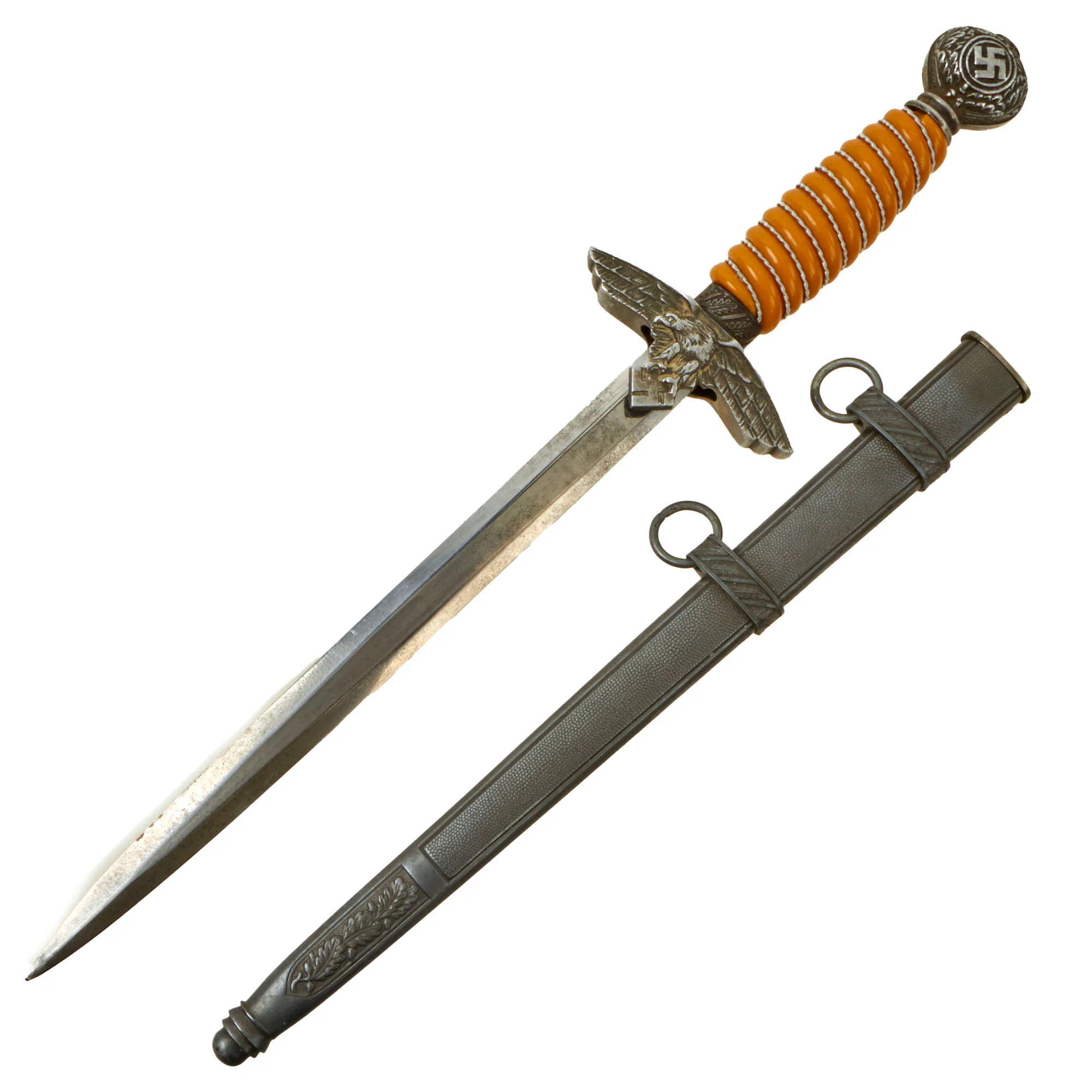
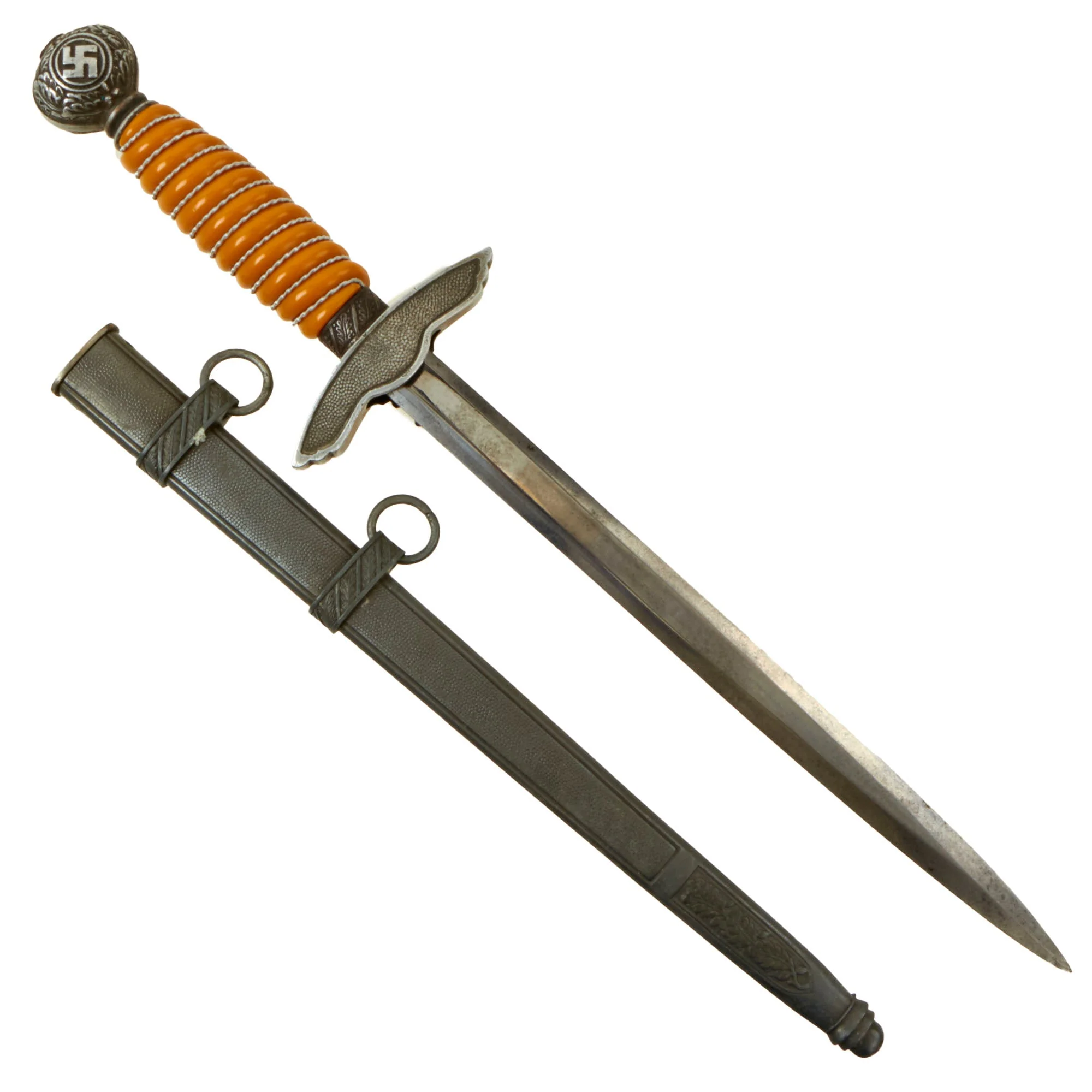
This fine mid production example is unmarked on the blade, which is the correct official pattern. Blades that have maker marks were usually retrofitted early examples, and not officially bestowed as chained daggers. The blade remains bright and still retains almost all of the factory final polish cross grain, visible throughout the blade surface. This texture is iconic, and is the definitive identifying characteristic for a real WWII German Blade. There is some runner wear on the blade, as well as some scratches and swirls from cleaning, but overall it still grades in very good condition. There are just a few areas of past light staining, particularly along the center ridge and on the reverse of the blade. which was polished out long ago. This is definitely one of the best chained dagger blades we have ever seen.
The etched SS motto, Meine Ehre heißt Treue (Loyalty is my Honor) is still crisp and fully legible, with the factory darkening mostly worn away, though the matte texture is still intact. The edge of the blade does not show any non factory sharpening, and is still in great condition, with no nicks or dents. The blade shoulders perfectly meet the lower crossguard contour, and is solid in the grip.
The crossguards of this dagger and tang nut are in very good condition throughout, and are of the mid-production style nickel-plated alloy construction. They have smooth surfaces, good crisp edges and precise accent grooves, and show some lifting and oxidation near the grip, due to moisture and the dyes used to get a uniform color on the wood. We did remove the handle to check the inside of the guards as customers often request, and both are marked on the inside with letters F and B, markings we have seen before on previous examples. The tang nut is nickel-plated steel, and is in very good shape shape, showing just a bit of turning and oxidation from plating loss. The hilt is overall secure on the tang of the blade when the nut is hand-tightened.
The ebony grip is a nice example with a lovely color, and unlike most that we see, it has no cracking or signs of past repairs. It does look like it may have had some type of finish applied when made, which has mostly worn away. We can see some lovely grain in the ebony, and is possibly the best SS dagger grip we have ever seen. Cracking is nearly ubiquitous among SS daggers, as the handles were hand fit, which could over time put pressure on the wood due to the tight fit, but this one is still fully intact, with just a few pressure dents.
The symbol button is positioned at about 7:00 o'clock, and the enamel surfaces are very nice, with just a bit of cracking. The SS symbol and double circles around them have a nice matching patina, with the nickel plating worn away, showing the copper underlayer, which has oxidized. There is also just a bit of verdigris around the edge. The nickel grip eagle is the "high-necked" type with the beak pointing slightly up. Like the symbols button, the nickel plating has worn away, showing the copper underlayer throughout. The bird's head, breast and wing feathering and to the talons, wreath or swas (hook cross) are all still quite crisp, though there is a bit of lifting of the copper layer around the edges, as well as some denting.
Wrapped around the grip is a lovely silver bullion portepee knot, which looks to be tied in the correct fashion. We have consulted several books and websites, and there does not appear to be much consensus on the correct way to tie these unfortunately. It is in very good shape, showing some staining and wear, as well as a bit of fraying of the silver bullion cord.
The scabbard the dagger features a steel shell, which is completely straight, and is the early style, originally made with a black "anodized" finish coated with protective clear lacquer. It does look like most of the original lacquer is still present, with some deterioration and wear through on the reverse. The black anodized finish is very well retained, showing just a few areas of staining and oxidation where the lacquer suffered some damage. We see no sign that it was ever refinished.
The scabbard looks to be a transitional style, as the bottom "drag" fitting is non-magnetic nickel silver alloy, while the top "locket" and center "ramp" fitting are both nickel plated steel. The center ramp is the "double screw" type, which has the three raised intertwined swas (hook cross) designs on both sides that are less pronounced and more shallowly executed compared to the "single screw" type. Chained daggers were often assembled during the period from parts, so mismatched fittings was common. The steel fittings are in good shape, showing a bit of loss and oxidation, particularly on the center ramp, while the ball on the end of the drag shows some denting, very common due to the softer nickel alloy. All six retaining screws are present, and match in design on all three fittings.
The chain attached to the scabbard is definitely what is considered the Type II, or sometimes called the Type B. There are several subtypes of these, and all are collector's terms, and there were no official terms used by Germany for these. It features nickel plated cast steel links with plated steel connecting rings, and the rings connecting to the end clip are tapered (Type I were squared). Both the lower and upper chain are made up of alternating ᛋᛋ runes and Totenkopf (Skull) links, which have the correct "burnished" or darkened centers, and rounded holes on the ends. The second link of the upper chain is stamped with the SS-Kulturzeichen proof (looks like two overlapping ᛋ runes) marking, and it is the more "squared" type that should be on a type II chain. They also show the correct casting marks on the sides that should be seen on the Type II plated steel (B2) links.
The "Wotan's Knot" cloverleaf securing clip has a good working snap hook with the original spring. The loop of the clover leaf over the clip is the closed type normally seen with Type II chains. It is a type B2 plated steel example, which shows some plating loss and oxidation, particularly on the reverse. We have compared the chain and clip to other known examples, and see no reason to double their authenticity.
This is an excellent and very rare chance to own a very good condition Model 1936 SS Chained Officer's dagger, which has no signs of being "messed with". Ready to be the centerpiece of any WWII Edged weapon collection!
Specifications:
Blade Length: 8 3/4"
Overall length: 13 3/4”
Crossguard: 3”
Scabbard Length: 10”

Details & Craftsmanship
Every detail has been carefully considered to bring you the perfect product.

Details & Craftsmanship
Every detail has been carefully considered to bring you the perfect product.
Details & Craftsmanship
Every detail has been carefully considered to bring you the perfect product.

Details & Craftsmanship
Every detail has been carefully considered to bring you the perfect product.

Details & Craftsmanship
Every detail has been carefully considered to bring you the perfect product.

Details & Craftsmanship
Every detail has been carefully considered to bring you the perfect product.

Details & Craftsmanship
Every detail has been carefully considered to bring you the perfect product.

Details & Craftsmanship
Every detail has been carefully considered to bring you the perfect product.

Details & Craftsmanship
Every detail has been carefully considered to bring you the perfect product.

Details & Craftsmanship
Every detail has been carefully considered to bring you the perfect product.

Details & Craftsmanship
Every detail has been carefully considered to bring you the perfect product.

Details & Craftsmanship
Every detail has been carefully considered to bring you the perfect product.

Details & Craftsmanship
Every detail has been carefully considered to bring you the perfect product.

Details & Craftsmanship
Every detail has been carefully considered to bring you the perfect product.

Details & Craftsmanship
Every detail has been carefully considered to bring you the perfect product.

Details & Craftsmanship
Every detail has been carefully considered to bring you the perfect product.

Details & Craftsmanship
Every detail has been carefully considered to bring you the perfect product.

Details & Craftsmanship
Every detail has been carefully considered to bring you the perfect product.
Description
Original Item: Only One Available: The SS (Schutzstaffel or Protection Squadron) was originally formed in 1925, ostensibly to act as a small, loyal bodyguard unit to protect the Führer, Adolf AH. Under the direction of the Reichsführer-SS Heinrich Himmler, the SS grew to be the most ruthless and feared organization of the 20th century. They were the vanguard of Germany eventually controlled nearly every function of German life and much of Occupied Europe.
The SS Dienstdolch (service dagger), also called the SS Ehrendolch (honor dagger), was introduced in 1933. Early on, members of the SS were awarded their daggers during a ceremony at the Feldherrnhalle Memorial in Munich. The annual ritual, charged with mysticism and meant to evoke the traditions of medieval Teutonic knights, was held on 9 November, the date of the unsuccessful Munich Putsch of 1923. Both officers and enlisted men wore the identical dagger until 1936. After this time, only enlisted men wore the M1933 dagger. After this time, only enlisted men wore the M1933 dagger, while officers and NCOs who had served 1933 and prior would receive the "Chained" version that we have here. These are quite a bit more rare and desirable than the Enlisted version.
It should be noted that as patterned, the M1936 "Chained" SS daggers did not have any maker or RZM markings on the back of the dagger, and were totally unmarked. However officers and senior NCOs who already had M33 daggers often wanted to keep their original daggers, and then would save on the cost by only purchasing the chained scabbards, which were available separately to those qualified for the honor. This is why it is not uncommon at all to see maker marked daggers in Chained scabbards.
Additionally, the chained center "ramp" and top fittings, chains, and "Wotan's knot" end clips all had several different patterns, and could be combined with either "anodized" or enameled steel shells. The bottom fittings could be solid nickel alloy or plated steel. To further complicate things, the various "Types" were produced concurrently. For more information on this please see Exploring The Dress Daggers and Swords of the German ᛋᛋ by Thomas T. Wittmann.
The SS Dagger was originally equipped with nickel crossguards with an ebony wood grip. The black grip contained a National eagle with swas insignia recessed in the center area and an SS doppelte Siegrune (Double Sig/Victory Rune) (ᛋᛋ) roundel button inset at the top. On early examples the scabbard shell surface was factory blackened using a metal bluing process. The scabbard had nickel mounts. The SS blade was a polished type containing the SS motto, Meine Ehre Heisst Treue (My Honor is Loyalty). Early examples were mostly hand-fit. Production of later examples was more standardized, using cheaper, nickel-plated fittings with black painted scabbard shells. They could be held with a standard belt hanger, or a much rarer vertical hanger.
This fine mid production example is unmarked on the blade, which is the correct official pattern. Blades that have maker marks were usually retrofitted early examples, and not officially bestowed as chained daggers. The blade remains bright and still retains almost all of the factory final polish cross grain, visible throughout the blade surface. This texture is iconic, and is the definitive identifying characteristic for a real WWII German Blade. There is some runner wear on the blade, as well as some scratches and swirls from cleaning, but overall it still grades in very good condition. There are just a few areas of past light staining, particularly along the center ridge and on the reverse of the blade. which was polished out long ago. This is definitely one of the best chained dagger blades we have ever seen.
The etched SS motto, Meine Ehre heißt Treue (Loyalty is my Honor) is still crisp and fully legible, with the factory darkening mostly worn away, though the matte texture is still intact. The edge of the blade does not show any non factory sharpening, and is still in great condition, with no nicks or dents. The blade shoulders perfectly meet the lower crossguard contour, and is solid in the grip.
The crossguards of this dagger and tang nut are in very good condition throughout, and are of the mid-production style nickel-plated alloy construction. They have smooth surfaces, good crisp edges and precise accent grooves, and show some lifting and oxidation near the grip, due to moisture and the dyes used to get a uniform color on the wood. We did remove the handle to check the inside of the guards as customers often request, and both are marked on the inside with letters F and B, markings we have seen before on previous examples. The tang nut is nickel-plated steel, and is in very good shape shape, showing just a bit of turning and oxidation from plating loss. The hilt is overall secure on the tang of the blade when the nut is hand-tightened.
The ebony grip is a nice example with a lovely color, and unlike most that we see, it has no cracking or signs of past repairs. It does look like it may have had some type of finish applied when made, which has mostly worn away. We can see some lovely grain in the ebony, and is possibly the best SS dagger grip we have ever seen. Cracking is nearly ubiquitous among SS daggers, as the handles were hand fit, which could over time put pressure on the wood due to the tight fit, but this one is still fully intact, with just a few pressure dents.
The symbol button is positioned at about 7:00 o'clock, and the enamel surfaces are very nice, with just a bit of cracking. The SS symbol and double circles around them have a nice matching patina, with the nickel plating worn away, showing the copper underlayer, which has oxidized. There is also just a bit of verdigris around the edge. The nickel grip eagle is the "high-necked" type with the beak pointing slightly up. Like the symbols button, the nickel plating has worn away, showing the copper underlayer throughout. The bird's head, breast and wing feathering and to the talons, wreath or swas (hook cross) are all still quite crisp, though there is a bit of lifting of the copper layer around the edges, as well as some denting.
Wrapped around the grip is a lovely silver bullion portepee knot, which looks to be tied in the correct fashion. We have consulted several books and websites, and there does not appear to be much consensus on the correct way to tie these unfortunately. It is in very good shape, showing some staining and wear, as well as a bit of fraying of the silver bullion cord.
The scabbard the dagger features a steel shell, which is completely straight, and is the early style, originally made with a black "anodized" finish coated with protective clear lacquer. It does look like most of the original lacquer is still present, with some deterioration and wear through on the reverse. The black anodized finish is very well retained, showing just a few areas of staining and oxidation where the lacquer suffered some damage. We see no sign that it was ever refinished.
The scabbard looks to be a transitional style, as the bottom "drag" fitting is non-magnetic nickel silver alloy, while the top "locket" and center "ramp" fitting are both nickel plated steel. The center ramp is the "double screw" type, which has the three raised intertwined swas (hook cross) designs on both sides that are less pronounced and more shallowly executed compared to the "single screw" type. Chained daggers were often assembled during the period from parts, so mismatched fittings was common. The steel fittings are in good shape, showing a bit of loss and oxidation, particularly on the center ramp, while the ball on the end of the drag shows some denting, very common due to the softer nickel alloy. All six retaining screws are present, and match in design on all three fittings.
The chain attached to the scabbard is definitely what is considered the Type II, or sometimes called the Type B. There are several subtypes of these, and all are collector's terms, and there were no official terms used by Germany for these. It features nickel plated cast steel links with plated steel connecting rings, and the rings connecting to the end clip are tapered (Type I were squared). Both the lower and upper chain are made up of alternating ᛋᛋ runes and Totenkopf (Skull) links, which have the correct "burnished" or darkened centers, and rounded holes on the ends. The second link of the upper chain is stamped with the SS-Kulturzeichen proof (looks like two overlapping ᛋ runes) marking, and it is the more "squared" type that should be on a type II chain. They also show the correct casting marks on the sides that should be seen on the Type II plated steel (B2) links.
The "Wotan's Knot" cloverleaf securing clip has a good working snap hook with the original spring. The loop of the clover leaf over the clip is the closed type normally seen with Type II chains. It is a type B2 plated steel example, which shows some plating loss and oxidation, particularly on the reverse. We have compared the chain and clip to other known examples, and see no reason to double their authenticity.
This is an excellent and very rare chance to own a very good condition Model 1936 SS Chained Officer's dagger, which has no signs of being "messed with". Ready to be the centerpiece of any WWII Edged weapon collection!
Specifications:
Blade Length: 8 3/4"
Overall length: 13 3/4”
Crossguard: 3”
Scabbard Length: 10”