
Original: $6,495.00
-70%$6,495.00
$1,948.50The Story
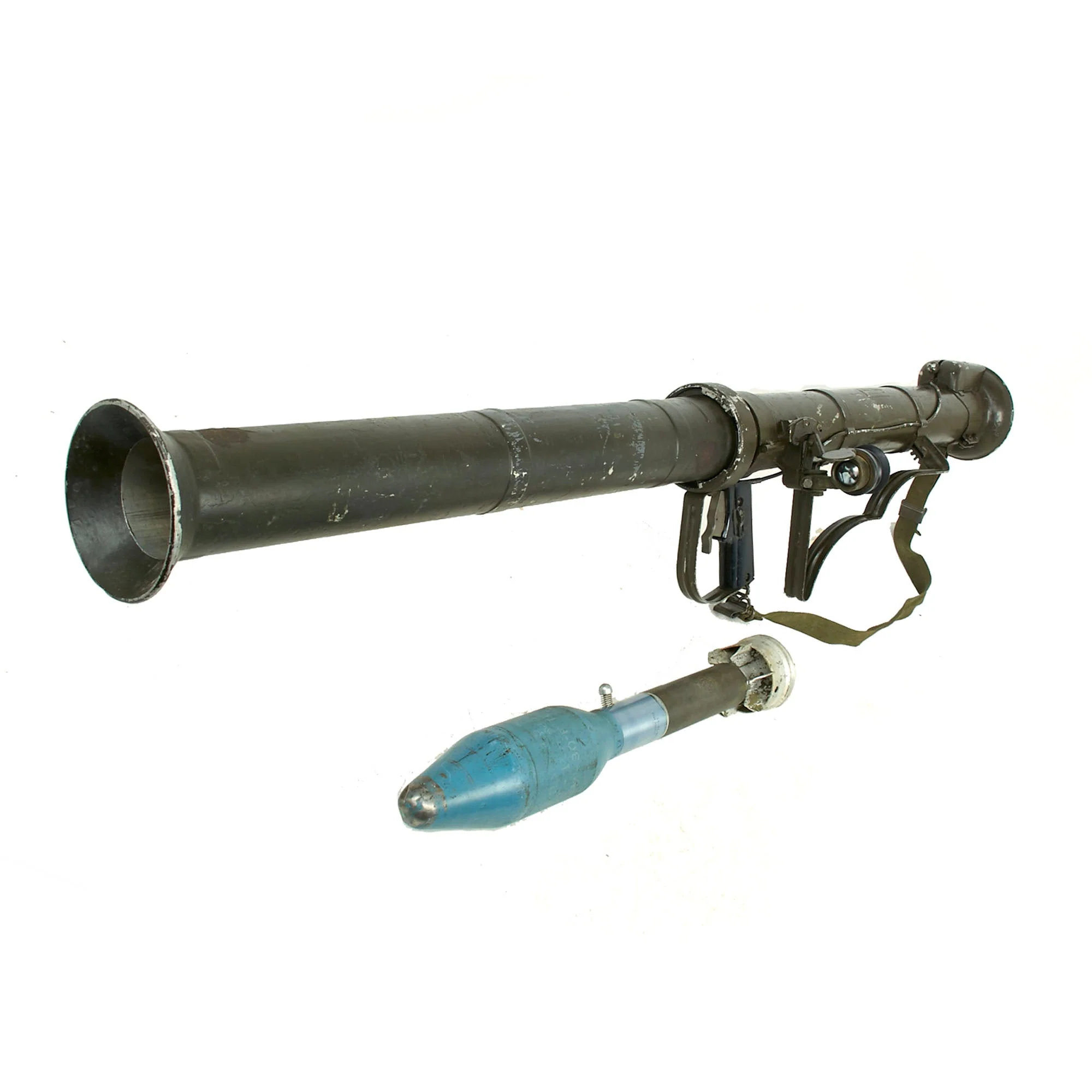
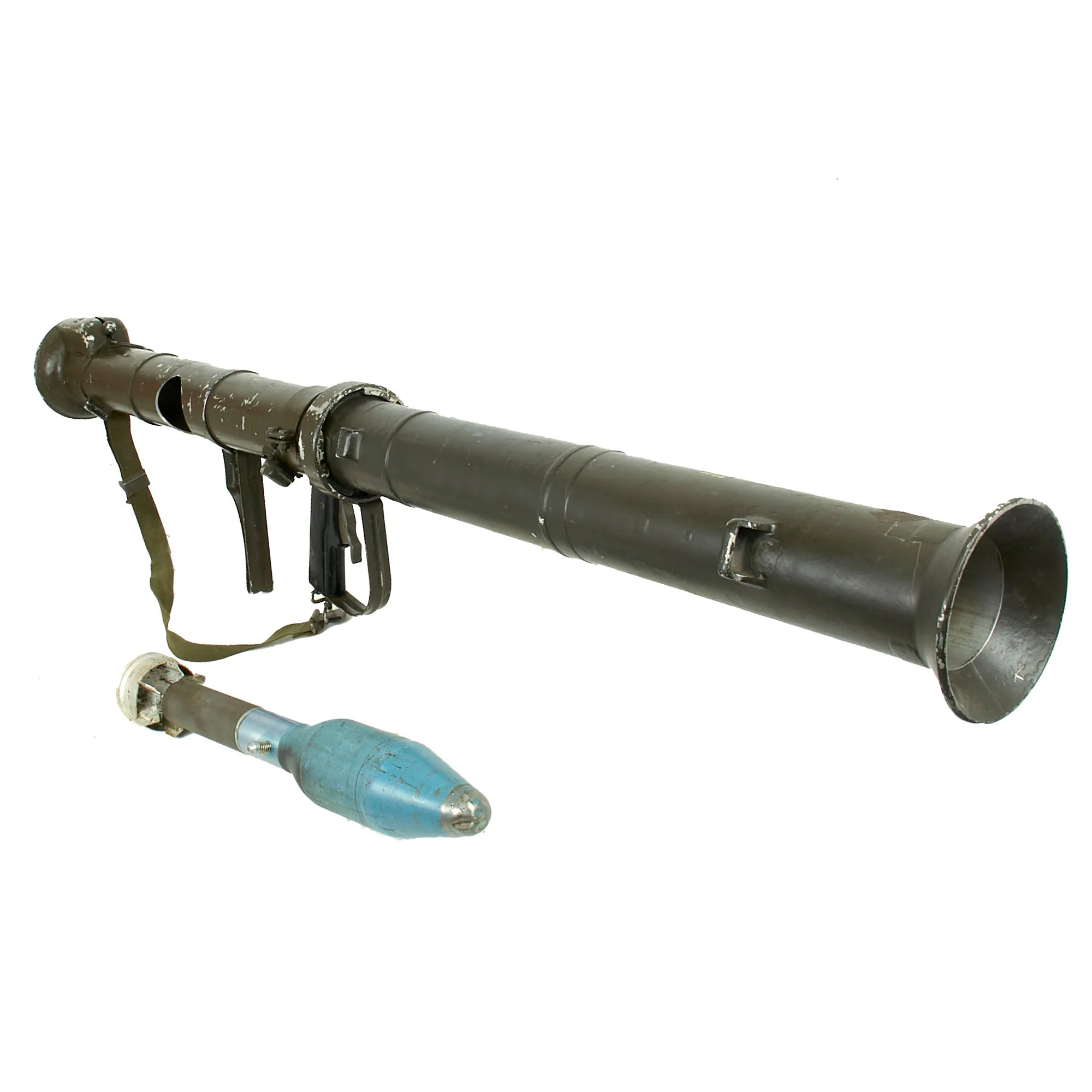
Original Item: Only One Available. This is a totally inert non-firing BATF compliant non-functional Soviet 9K111 Fagot Wire-Guided Anti-tank Missile System. A type of semi-automatic command to line of sight (SACLOS) weapon, this lovely set has the original tripod with sight system, a spare sight system, an inert rocket, and 4 transport / launcher tubes. Once fired, these tubes are unable to be reloaded. Used launchers such as this are "expended ordnance" which "are not classified as a "firearm" or "destructive device"" by the BATF once used, and "therefore, they are not subject to GCA or NFA provisions."
NOT AVAILABLE FOR EXPORT
This example is in great shape, with the paint very well retained, and sets up correctly with the launch tube on the tripod, with the attached optical sight and guidance system. it is finished in a lovely original Soviet era olive green, and dates on various components indicate indicate issue in the early 1980s, after which it may have been in service for years. The tube all have their hinged top caps present, and most have the end cap assembly as well, which would be unscrewed to allow the missile launch. Also included is a spare sight assembly, which looks to have seen long service, and is contained in it's original canvas carrier with some accessories / tools.
This would make a magnificent display piece in any cold war era weapons collection. Ready to display!
NOTE: This will come shipped in several boxes.
The 9K111 Fagot (Russian: Фагот; "bassoon") is a second-generation tube-launched semi-automatic command to line of sight (SACLOS) wire-guided anti-tank missile system of the Soviet Union for use from ground or vehicle mounts. The 9K111 Fagot missile system was developed by the Tula KBP Design Bureau for Instrument Building. 9M111 is the designation for the missile. Its NATO reporting name is AT-4 Spigot.
Development
The 9K111 Fagot was developed by the Tula Machinery Design Bureau (Tula KBP) and development began in 1962 with the aim of producing the next generation of SACLOS anti-tank guided missile (ATGM) for use in two roles: as man portable and tank destroyer. The 9K111 Fagot was developed alongside the 9M113 Konkurs; both missiles use similar technology, differing in size only, and can use the same launchers. The missile entered service in 1970.
History
The anti-tank platoon of a Soviet BTR equipped motor rifle battalion had two (sometimes three) ATGM squads, each with two 9K111 Fagot teams. The team consisted of three men; the gunner carries the 9P135 launcher and tripod as a back pack, and the other two men each carry two launch tubes. The men also carry assault rifles, but do not carry a rocket-propelled grenade (RPG), because, unlike the earlier missiles, there is only a small deadzone within which the missile cannot engage the target. Besides the four missiles carried by each team, each squad would normally have an extra eight missiles carried in their transport, usually a BTR. It can also be deployed from the BMP-1P, BMD-1P, BTR-D and UAZ-469.
North Korea was said to have acquired a number of the systems during the late 1980s until the 2000s. These were subsequently reverse-engineered under the designation Bulsae-2.[8] It was advertised under designation AT-4MLB by North Korean proxy company GLOCOM, in brochure it was stated that it is controlled by laser beam guidance method, which was an upgrade designated Bulsae-3. Its use was first reported in 2014 in the ranks of the Izz ad-Din al-Qassam Brigades and the Al-Nasser Salah al-Deen Brigades.
Description
The missile is stored and carried in a container/launch tube. It is fired from a 9P135 launcher post, a simple tripod. A 9S451 guidance box is fitted to the tripod with the missile sitting just above. The 9Sh119 sight is fitted to the left side (from the gunner's point of view). The complete launcher system weighs 22.5 kg (50 lb). The gunner lies prone while firing. The system can engage moving targets travelling at less than 60 km/h (37 mph). The launcher post can traverse through 360 degrees horizontally, and ±20 degrees in elevation. The sight has a magnification of 10× and a 5 degree field of view. Up to three missiles a minute can be fired from a launcher post.
The system uses a gas generator to push the missile out of the launch tube, with the gas exiting the rear of the launch tube in a manner similar to a recoilless rifle. The missile leaves the launch tube at 80 m/s (180 mph; 290 km/h), and is then quickly accelerated to 186 m/s (420 mph; 670 km/h) by its solid fuel motor. This initial high speed reduces the missile's deadzone, since it can be launched directly at the target, rather than in an upward arc.
The launcher tracks the position of an incandescent infrared bulb on the back of the missile relative to the target and transmits appropriate commands to the missile via a thin wire that trails behind the missile. The SACLOS guidance system has many benefits over manual command to line of sight (MCLOS), with the accuracy of the system stated as 90% in some sources, though its performance is probably comparable to the TOW or the later SACLOS versions of the 9M14 Malyutka.

Details & Craftsmanship
Every detail has been carefully considered to bring you the perfect product.

Details & Craftsmanship
Every detail has been carefully considered to bring you the perfect product.

Details & Craftsmanship
Every detail has been carefully considered to bring you the perfect product.

Details & Craftsmanship
Every detail has been carefully considered to bring you the perfect product.

Details & Craftsmanship
Every detail has been carefully considered to bring you the perfect product.

Details & Craftsmanship
Every detail has been carefully considered to bring you the perfect product.

Details & Craftsmanship
Every detail has been carefully considered to bring you the perfect product.

Details & Craftsmanship
Every detail has been carefully considered to bring you the perfect product.

Details & Craftsmanship
Every detail has been carefully considered to bring you the perfect product.

Details & Craftsmanship
Every detail has been carefully considered to bring you the perfect product.

Details & Craftsmanship
Every detail has been carefully considered to bring you the perfect product.

Details & Craftsmanship
Every detail has been carefully considered to bring you the perfect product.

Details & Craftsmanship
Every detail has been carefully considered to bring you the perfect product.

Details & Craftsmanship
Every detail has been carefully considered to bring you the perfect product.

Details & Craftsmanship
Every detail has been carefully considered to bring you the perfect product.

Details & Craftsmanship
Every detail has been carefully considered to bring you the perfect product.

Details & Craftsmanship
Every detail has been carefully considered to bring you the perfect product.

Details & Craftsmanship
Every detail has been carefully considered to bring you the perfect product.

Details & Craftsmanship
Every detail has been carefully considered to bring you the perfect product.

Details & Craftsmanship
Every detail has been carefully considered to bring you the perfect product.

Details & Craftsmanship
Every detail has been carefully considered to bring you the perfect product.

Details & Craftsmanship
Every detail has been carefully considered to bring you the perfect product.

Details & Craftsmanship
Every detail has been carefully considered to bring you the perfect product.

Details & Craftsmanship
Every detail has been carefully considered to bring you the perfect product.

Details & Craftsmanship
Every detail has been carefully considered to bring you the perfect product.

Details & Craftsmanship
Every detail has been carefully considered to bring you the perfect product.

Details & Craftsmanship
Every detail has been carefully considered to bring you the perfect product.

Details & Craftsmanship
Every detail has been carefully considered to bring you the perfect product.

Details & Craftsmanship
Every detail has been carefully considered to bring you the perfect product.

Details & Craftsmanship
Every detail has been carefully considered to bring you the perfect product.

Details & Craftsmanship
Every detail has been carefully considered to bring you the perfect product.

Details & Craftsmanship
Every detail has been carefully considered to bring you the perfect product.

Details & Craftsmanship
Every detail has been carefully considered to bring you the perfect product.

Details & Craftsmanship
Every detail has been carefully considered to bring you the perfect product.

Details & Craftsmanship
Every detail has been carefully considered to bring you the perfect product.

Details & Craftsmanship
Every detail has been carefully considered to bring you the perfect product.

Details & Craftsmanship
Every detail has been carefully considered to bring you the perfect product.
Description
Original Item: Only One Available. This is a totally inert non-firing BATF compliant non-functional Soviet 9K111 Fagot Wire-Guided Anti-tank Missile System. A type of semi-automatic command to line of sight (SACLOS) weapon, this lovely set has the original tripod with sight system, a spare sight system, an inert rocket, and 4 transport / launcher tubes. Once fired, these tubes are unable to be reloaded. Used launchers such as this are "expended ordnance" which "are not classified as a "firearm" or "destructive device"" by the BATF once used, and "therefore, they are not subject to GCA or NFA provisions."
NOT AVAILABLE FOR EXPORT
This example is in great shape, with the paint very well retained, and sets up correctly with the launch tube on the tripod, with the attached optical sight and guidance system. it is finished in a lovely original Soviet era olive green, and dates on various components indicate indicate issue in the early 1980s, after which it may have been in service for years. The tube all have their hinged top caps present, and most have the end cap assembly as well, which would be unscrewed to allow the missile launch. Also included is a spare sight assembly, which looks to have seen long service, and is contained in it's original canvas carrier with some accessories / tools.
This would make a magnificent display piece in any cold war era weapons collection. Ready to display!
NOTE: This will come shipped in several boxes.
The 9K111 Fagot (Russian: Фагот; "bassoon") is a second-generation tube-launched semi-automatic command to line of sight (SACLOS) wire-guided anti-tank missile system of the Soviet Union for use from ground or vehicle mounts. The 9K111 Fagot missile system was developed by the Tula KBP Design Bureau for Instrument Building. 9M111 is the designation for the missile. Its NATO reporting name is AT-4 Spigot.
Development
The 9K111 Fagot was developed by the Tula Machinery Design Bureau (Tula KBP) and development began in 1962 with the aim of producing the next generation of SACLOS anti-tank guided missile (ATGM) for use in two roles: as man portable and tank destroyer. The 9K111 Fagot was developed alongside the 9M113 Konkurs; both missiles use similar technology, differing in size only, and can use the same launchers. The missile entered service in 1970.
History
The anti-tank platoon of a Soviet BTR equipped motor rifle battalion had two (sometimes three) ATGM squads, each with two 9K111 Fagot teams. The team consisted of three men; the gunner carries the 9P135 launcher and tripod as a back pack, and the other two men each carry two launch tubes. The men also carry assault rifles, but do not carry a rocket-propelled grenade (RPG), because, unlike the earlier missiles, there is only a small deadzone within which the missile cannot engage the target. Besides the four missiles carried by each team, each squad would normally have an extra eight missiles carried in their transport, usually a BTR. It can also be deployed from the BMP-1P, BMD-1P, BTR-D and UAZ-469.
North Korea was said to have acquired a number of the systems during the late 1980s until the 2000s. These were subsequently reverse-engineered under the designation Bulsae-2.[8] It was advertised under designation AT-4MLB by North Korean proxy company GLOCOM, in brochure it was stated that it is controlled by laser beam guidance method, which was an upgrade designated Bulsae-3. Its use was first reported in 2014 in the ranks of the Izz ad-Din al-Qassam Brigades and the Al-Nasser Salah al-Deen Brigades.
Description
The missile is stored and carried in a container/launch tube. It is fired from a 9P135 launcher post, a simple tripod. A 9S451 guidance box is fitted to the tripod with the missile sitting just above. The 9Sh119 sight is fitted to the left side (from the gunner's point of view). The complete launcher system weighs 22.5 kg (50 lb). The gunner lies prone while firing. The system can engage moving targets travelling at less than 60 km/h (37 mph). The launcher post can traverse through 360 degrees horizontally, and ±20 degrees in elevation. The sight has a magnification of 10× and a 5 degree field of view. Up to three missiles a minute can be fired from a launcher post.
The system uses a gas generator to push the missile out of the launch tube, with the gas exiting the rear of the launch tube in a manner similar to a recoilless rifle. The missile leaves the launch tube at 80 m/s (180 mph; 290 km/h), and is then quickly accelerated to 186 m/s (420 mph; 670 km/h) by its solid fuel motor. This initial high speed reduces the missile's deadzone, since it can be launched directly at the target, rather than in an upward arc.
The launcher tracks the position of an incandescent infrared bulb on the back of the missile relative to the target and transmits appropriate commands to the missile via a thin wire that trails behind the missile. The SACLOS guidance system has many benefits over manual command to line of sight (MCLOS), with the accuracy of the system stated as 90% in some sources, though its performance is probably comparable to the TOW or the later SACLOS versions of the 9M14 Malyutka.