
Original: $1,195.00
-70%$1,195.00
$358.50The Story
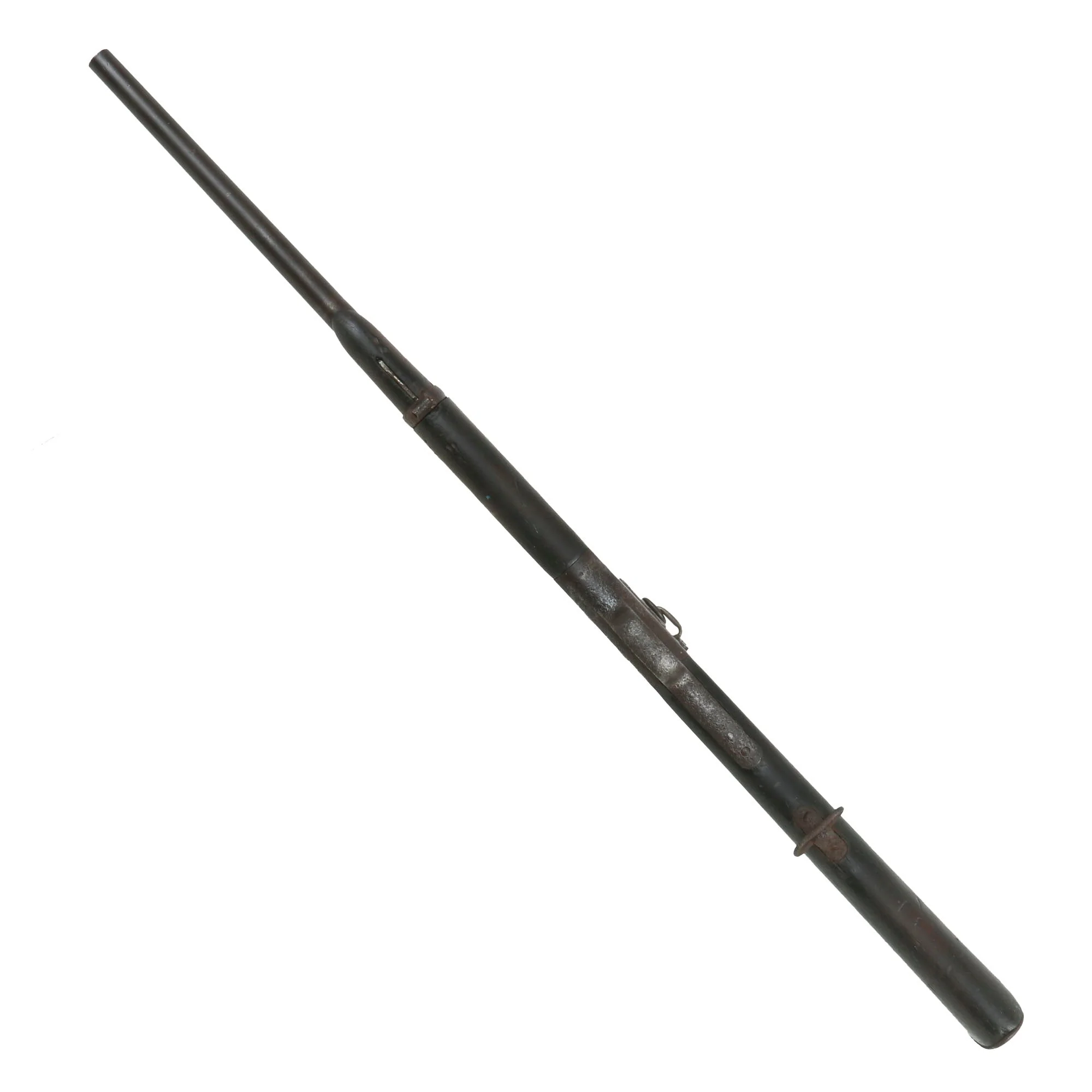
Original Item: One of a Kind. We have had many Spanish Remington Blocks before, but never one like this! Here we have a well patinated example of the Carbine version of the Spanish Rolling block, which definitely looks to have seen long use. The metalwork shows past pitting on many areas, looking to have been used in a very humid environment, such as a seaport or in the tropics.
This carbine looks to have been issued in Cuba, where it almost certainly took part in the Spanish-American War of 1898. The colonies were seldom issued the most modern weapons, so this is typical of a weapon that would have been issued at a secondary location. The markings on the receiver have unfortunately been destroyed by rust, however there is an FB (or maybe FP) stamping over R, with the latter indicating that the carbine is chambered in .43 Spanish "Reformado". Overall length is approximately 35 1/2 inches, with a 20 3/8 inch barrel.
In contrast to the metalwork, the wood butt stock still has a plethora of markings on it, with a circular cartouche on the right side that reads:
MTZA
HABANA
1881
This is the marking for the Maestranza (Arsenal) in Havana, Cuba, indicating acceptance in 1881. Under this cartouche there is a 16679 marking, which we assume is a serial number. The other side of the stock is marked with various letters and numbers, with the following still legible in the middle:-
CARDENAS
5'A C'A N'o 20
Cardenas is a seaport in Cuba, about 80 miles to the east of Havana. This may mean that after processing in the Havana Arsenal, it was dispersed to the port for defense. There is really some incredible research potential in this well patinated carbine!
We checked the receiver back strap with a magnifier, and there are no traces of any patent markings. We did check the action, and it opens and closes correctly, with the ejector presenting, but it is definitely stiff due to corrosion. The hammer is fully functional, with a working half cock position, and it fires at full cock. We checked the bore, and it is still in very good condition, showing clear lands and grooves and a mostly bright finish. There is some wear and past oxidation, particularly near the muzzle end, typical of a firearm used in the tropics. The flip up rear carbine sight is present, but frozen, and only the rear sling swivel is present, showing rust but still moving easily.
This carbine is a very interesting piece with some great historical significance and research potential. We do not get offerings like this very often at all!
Specifications-
Year of Manufacture: circa 1880
Caliber: .43 Spanish "reformado"
Cartridge Type: Centerfire Cartridge
Barrel Length: 20 3/8 Inches
Overall Length: 35 1/2 Inches
Action type: Rolling Block with Rear Hammer
Feed System: Single Shot
History of the Remington Rolling Block Rifle:
It was made in a variety of calibers, both rimfire and centerfire, including the 12.17x42 mm rimfire, 12.17x44 mm rimfire and 12.17x44 mm rimmed centerfire Swedish and Norwegian cartridges, .43 Spanish (11.15x58mmR), .50-70, 40-70,45-70, and later in .22 caliber. Later models were produced in .30-06 Springfield, 7×57mm Mauser, and 8×50mmR Lebel.
In 12.17x42mmRF and 12.18x44mmRF (two cartridges that were interchangeable), and towards the end of its service life also 8x58mmR Danish Krag centerfire, it served as the standard service rifle of the Swedish Army from 1867 to the mid-1890s (when it was replaced by the Swedish Mauser) and in Norway as the standard service rifle from 1867 to the mid-1880s (when it was replaced by the M1884 Jarmann). In .43 Spanish it was the chief service arm of the Spanish Army from 1870-1893, and was used by reserve and militia forces for many years thereafter. Many Rolling Block rifles were used by Argentina before being replaced in 1891 by the new 7.65mm Mauser, and were also widely used by Egypt and Mexico. The Remington rolling block also became the standard service rifle of the Danish Army. During the Franco-Prussian War, France acquired 210,000 Rolling Block rifles to make up for a shortage of the standard-issue Chassepot.
During World War I, the British Royal Navy purchased 4,500 Rolling Block rifles in 7mm Mauser from Remington's leftover stock after production had ended, issuing them to the crews of minesweepers and Q-ships. In November 1914, production of the Rolling Block was resumed, in the form of a French contract for rifles in 8×50mmR Lebel, designated by France as "Fusil Remington modèle 1914". 100,291 such rifles were delivered by 1916, and used to equip rear-line troops.
NOTE: International orders of antique firearms MUST be shipped using UPS WW Services (courier). USPS Priority Mail international will not accept these. International customers should always consult their country's antique gun laws prior to ordering.

Details & Craftsmanship
Every detail has been carefully considered to bring you the perfect product.
Details & Craftsmanship
Every detail has been carefully considered to bring you the perfect product.

Details & Craftsmanship
Every detail has been carefully considered to bring you the perfect product.

Details & Craftsmanship
Every detail has been carefully considered to bring you the perfect product.

Details & Craftsmanship
Every detail has been carefully considered to bring you the perfect product.

Details & Craftsmanship
Every detail has been carefully considered to bring you the perfect product.

Details & Craftsmanship
Every detail has been carefully considered to bring you the perfect product.

Details & Craftsmanship
Every detail has been carefully considered to bring you the perfect product.

Details & Craftsmanship
Every detail has been carefully considered to bring you the perfect product.

Details & Craftsmanship
Every detail has been carefully considered to bring you the perfect product.

Details & Craftsmanship
Every detail has been carefully considered to bring you the perfect product.

Details & Craftsmanship
Every detail has been carefully considered to bring you the perfect product.

Details & Craftsmanship
Every detail has been carefully considered to bring you the perfect product.

Details & Craftsmanship
Every detail has been carefully considered to bring you the perfect product.

Details & Craftsmanship
Every detail has been carefully considered to bring you the perfect product.

Details & Craftsmanship
Every detail has been carefully considered to bring you the perfect product.

Details & Craftsmanship
Every detail has been carefully considered to bring you the perfect product.

Details & Craftsmanship
Every detail has been carefully considered to bring you the perfect product.

Details & Craftsmanship
Every detail has been carefully considered to bring you the perfect product.
Description
Original Item: One of a Kind. We have had many Spanish Remington Blocks before, but never one like this! Here we have a well patinated example of the Carbine version of the Spanish Rolling block, which definitely looks to have seen long use. The metalwork shows past pitting on many areas, looking to have been used in a very humid environment, such as a seaport or in the tropics.
This carbine looks to have been issued in Cuba, where it almost certainly took part in the Spanish-American War of 1898. The colonies were seldom issued the most modern weapons, so this is typical of a weapon that would have been issued at a secondary location. The markings on the receiver have unfortunately been destroyed by rust, however there is an FB (or maybe FP) stamping over R, with the latter indicating that the carbine is chambered in .43 Spanish "Reformado". Overall length is approximately 35 1/2 inches, with a 20 3/8 inch barrel.
In contrast to the metalwork, the wood butt stock still has a plethora of markings on it, with a circular cartouche on the right side that reads:
MTZA
HABANA
1881
This is the marking for the Maestranza (Arsenal) in Havana, Cuba, indicating acceptance in 1881. Under this cartouche there is a 16679 marking, which we assume is a serial number. The other side of the stock is marked with various letters and numbers, with the following still legible in the middle:-
CARDENAS
5'A C'A N'o 20
Cardenas is a seaport in Cuba, about 80 miles to the east of Havana. This may mean that after processing in the Havana Arsenal, it was dispersed to the port for defense. There is really some incredible research potential in this well patinated carbine!
We checked the receiver back strap with a magnifier, and there are no traces of any patent markings. We did check the action, and it opens and closes correctly, with the ejector presenting, but it is definitely stiff due to corrosion. The hammer is fully functional, with a working half cock position, and it fires at full cock. We checked the bore, and it is still in very good condition, showing clear lands and grooves and a mostly bright finish. There is some wear and past oxidation, particularly near the muzzle end, typical of a firearm used in the tropics. The flip up rear carbine sight is present, but frozen, and only the rear sling swivel is present, showing rust but still moving easily.
This carbine is a very interesting piece with some great historical significance and research potential. We do not get offerings like this very often at all!
Specifications-
Year of Manufacture: circa 1880
Caliber: .43 Spanish "reformado"
Cartridge Type: Centerfire Cartridge
Barrel Length: 20 3/8 Inches
Overall Length: 35 1/2 Inches
Action type: Rolling Block with Rear Hammer
Feed System: Single Shot
History of the Remington Rolling Block Rifle:
It was made in a variety of calibers, both rimfire and centerfire, including the 12.17x42 mm rimfire, 12.17x44 mm rimfire and 12.17x44 mm rimmed centerfire Swedish and Norwegian cartridges, .43 Spanish (11.15x58mmR), .50-70, 40-70,45-70, and later in .22 caliber. Later models were produced in .30-06 Springfield, 7×57mm Mauser, and 8×50mmR Lebel.
In 12.17x42mmRF and 12.18x44mmRF (two cartridges that were interchangeable), and towards the end of its service life also 8x58mmR Danish Krag centerfire, it served as the standard service rifle of the Swedish Army from 1867 to the mid-1890s (when it was replaced by the Swedish Mauser) and in Norway as the standard service rifle from 1867 to the mid-1880s (when it was replaced by the M1884 Jarmann). In .43 Spanish it was the chief service arm of the Spanish Army from 1870-1893, and was used by reserve and militia forces for many years thereafter. Many Rolling Block rifles were used by Argentina before being replaced in 1891 by the new 7.65mm Mauser, and were also widely used by Egypt and Mexico. The Remington rolling block also became the standard service rifle of the Danish Army. During the Franco-Prussian War, France acquired 210,000 Rolling Block rifles to make up for a shortage of the standard-issue Chassepot.
During World War I, the British Royal Navy purchased 4,500 Rolling Block rifles in 7mm Mauser from Remington's leftover stock after production had ended, issuing them to the crews of minesweepers and Q-ships. In November 1914, production of the Rolling Block was resumed, in the form of a French contract for rifles in 8×50mmR Lebel, designated by France as "Fusil Remington modèle 1914". 100,291 such rifles were delivered by 1916, and used to equip rear-line troops.
NOTE: International orders of antique firearms MUST be shipped using UPS WW Services (courier). USPS Priority Mail international will not accept these. International customers should always consult their country's antique gun laws prior to ordering.