
Original: $750.00
-70%$750.00
$225.00The Story
Original Item: Only One Available. This is a lovely example of a small just post Civil War Moore's Patent revolver, with a six shot cylinder in .32 Teat-fire caliber. The frame is brass, and this example looks to have had silver plat applied over the nickel, which is actually still very well retained. Now showing a good amount of tarnish, it has beautiful floral and scroll engraving all over the frame, with some minimal accent engraving on the barrel. The metalwork overall shows use and cleaning, but no major restoration, with the steel faded to a lovely gray polished patina. The wooden grips now display a lovely worn look, having originally been finished black or dark brown at the factory. Please note that the barrel wedge definitely IS included, it was unfortunately forgotten on the workbench before photography.
The underside of the barrel is marked with serial number 15143, which we estimate puts production around 1866-18678. Additionally, the gun is marked on the rear of the barrel, the rear of the cylinder, the cylinder arbor pin, the barrel wedge, and under the grip scales with assembly number EQ 43, which is even on the interior of BOTH grip scales! This is a great "ALL MATCHING" example, with no parts swapped out over the years! These were made by the National Arms Company in Brooklyn, NY, however only some were marked by the company, while others were marked by Moore's company. The 3 1/4" barrel of this example is still relatively clearly marked on the top, though there are some dents on top that can make it difficult to read:-
MOORES PAT. FIRE ARMS CO. BROOKLYN N.Y.
The back of the cylinder is also marked with patent information:
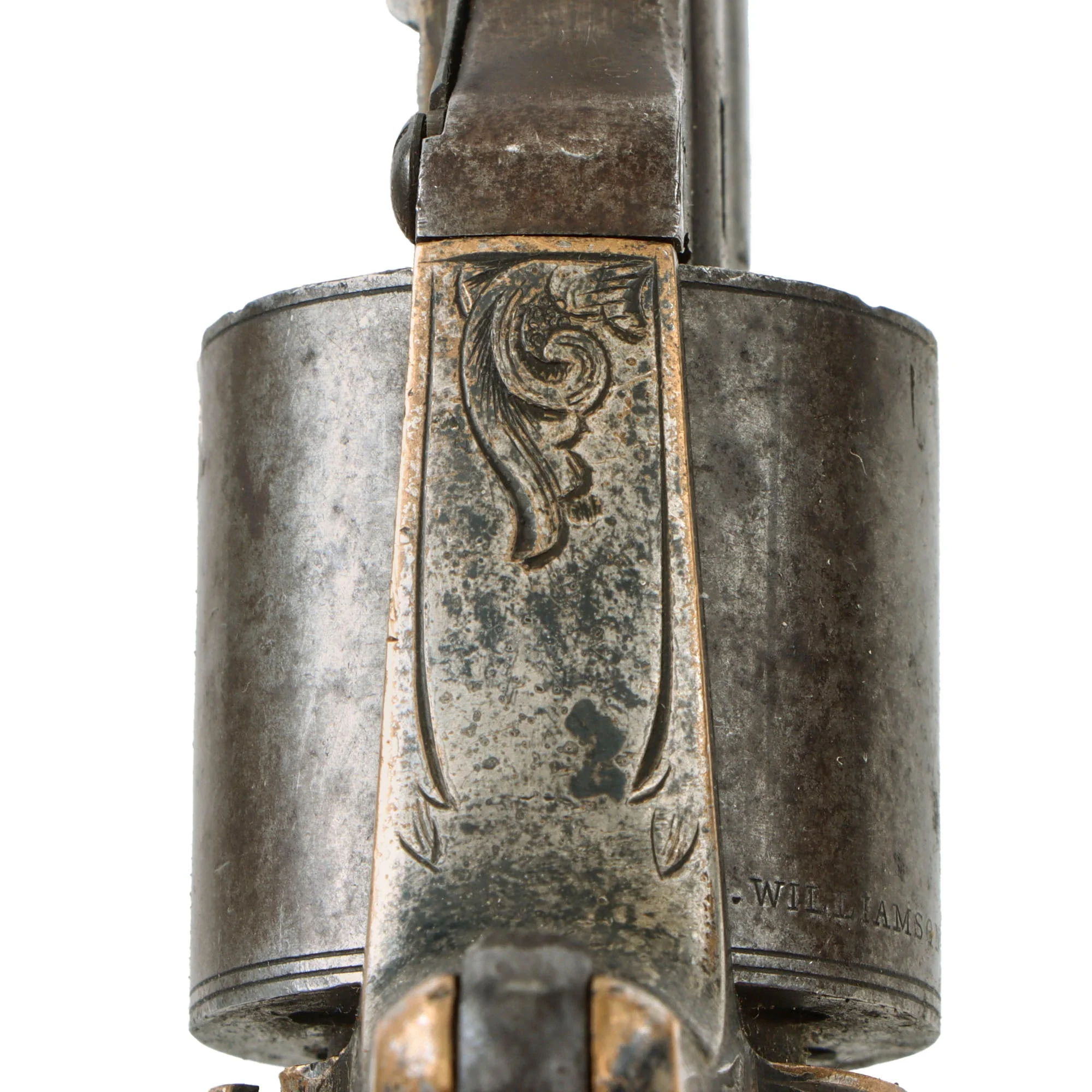
D. WILLIAMSON'S PATENT JANUARY 5. 1864
The action functions beautifully, with accurate indexing and a solid cylinder lockup. We did not notice any of the finicky behavior we often see on revolvers of this age, and there is no play in the barrel to frame connection. The revolver properly breaks down when the barrel wedge is removed, and has the early pattern gate on the lower right barrel, which would allow cartridges to be removed and loaded when open. There is a small inlet on the back of the recoil shield where an ejection tool would be used to push out spent cartridges.
We checked the bore, and it is in very good condition, showing a mostly bright finish with crisp lands and grooves. There is a bit of light wear and past fouling, making this a truly exceptional bore for a gun from the era of black powder. The brass frame displays lovely mixture of tarnished silver and brass faded to an aged mustard patina. The grips are in good shape with a lovely color, with the factory black finish still very well retained, missing only on the raised ridge on the sides.
In lovely condition with some fantastic engraving, this is definitely a very nice example of a Moore's Patent teat fire revolver. An interesting stepping stone in firearms development, ready to add to your collection!
Specifications:-
Years of Manufacture: 1864-1870
Caliber: .32 cal Teat-fire
Ammunition Type: Teat-Fire cartridge
Barrel Length: 3 1/4 inches
Overall Length: 7 inches
Action: Single Action
Feed System: 6 Shot Revolver
The Teat-fire cartridge was a .32 caliber pistol cartridge designed by Daniel Moore and manufactured by Moore and his partner David Williamson for their Pocket Revolver and was produced under both the Moore and National Arms marques by the National Arms Company of Brooklyn, New York in the mid-19th century.
The Moore Caliber .32 Teat-fire, which used a unique cartridge to get around the Rollin White patent owned by Horace Smith and Daniel Wesson, proved very popular during the Civil War, with both soldiers and civilians. The "Teat-fire" cartridges did not have a rim at the back like conventional cartridges, but were rounded at the rear, with a small "teat" that would protrude through a tiny opening in the rear of the cylinder. The priming mixture was contained in the "teat" and when the hammer struck it, the cartridge would fire. Thus, it was akin to a rimfire cartridge, but instead of having priming all the way around the edge of the rim, it is centrally located in the teat. This also meant that the revolver cylinder was loaded from the front, which is why there is a loading gate at the front of the frame, and not the rear.
Moore's Caliber .32 Teat-fire Pocket Revolver proved very popular during the American Civil War, with both soldiers and civilians. National Arms produced about 30,000 of the revolvers from 1864 to 1870, when it was acquired by Colt's Manufacturing Company.
NOTE: International orders of antique firearms MUST be shipped using UPS WW Services (courier). USPS Priority Mail international will not accept these. International customers should always consult their country's antique gun laws prior to ordering.

Details & Craftsmanship
Every detail has been carefully considered to bring you the perfect product.

Details & Craftsmanship
Every detail has been carefully considered to bring you the perfect product.

Details & Craftsmanship
Every detail has been carefully considered to bring you the perfect product.

Details & Craftsmanship
Every detail has been carefully considered to bring you the perfect product.

Details & Craftsmanship
Every detail has been carefully considered to bring you the perfect product.

Details & Craftsmanship
Every detail has been carefully considered to bring you the perfect product.

Details & Craftsmanship
Every detail has been carefully considered to bring you the perfect product.

Details & Craftsmanship
Every detail has been carefully considered to bring you the perfect product.

Details & Craftsmanship
Every detail has been carefully considered to bring you the perfect product.

Details & Craftsmanship
Every detail has been carefully considered to bring you the perfect product.

Details & Craftsmanship
Every detail has been carefully considered to bring you the perfect product.

Details & Craftsmanship
Every detail has been carefully considered to bring you the perfect product.

Details & Craftsmanship
Every detail has been carefully considered to bring you the perfect product.
Details & Craftsmanship
Every detail has been carefully considered to bring you the perfect product.

Details & Craftsmanship
Every detail has been carefully considered to bring you the perfect product.

Details & Craftsmanship
Every detail has been carefully considered to bring you the perfect product.

Details & Craftsmanship
Every detail has been carefully considered to bring you the perfect product.

Details & Craftsmanship
Every detail has been carefully considered to bring you the perfect product.

Details & Craftsmanship
Every detail has been carefully considered to bring you the perfect product.
Description
Original Item: Only One Available. This is a lovely example of a small just post Civil War Moore's Patent revolver, with a six shot cylinder in .32 Teat-fire caliber. The frame is brass, and this example looks to have had silver plat applied over the nickel, which is actually still very well retained. Now showing a good amount of tarnish, it has beautiful floral and scroll engraving all over the frame, with some minimal accent engraving on the barrel. The metalwork overall shows use and cleaning, but no major restoration, with the steel faded to a lovely gray polished patina. The wooden grips now display a lovely worn look, having originally been finished black or dark brown at the factory. Please note that the barrel wedge definitely IS included, it was unfortunately forgotten on the workbench before photography.
The underside of the barrel is marked with serial number 15143, which we estimate puts production around 1866-18678. Additionally, the gun is marked on the rear of the barrel, the rear of the cylinder, the cylinder arbor pin, the barrel wedge, and under the grip scales with assembly number EQ 43, which is even on the interior of BOTH grip scales! This is a great "ALL MATCHING" example, with no parts swapped out over the years! These were made by the National Arms Company in Brooklyn, NY, however only some were marked by the company, while others were marked by Moore's company. The 3 1/4" barrel of this example is still relatively clearly marked on the top, though there are some dents on top that can make it difficult to read:-
MOORES PAT. FIRE ARMS CO. BROOKLYN N.Y.
The back of the cylinder is also marked with patent information:
D. WILLIAMSON'S PATENT JANUARY 5. 1864
The action functions beautifully, with accurate indexing and a solid cylinder lockup. We did not notice any of the finicky behavior we often see on revolvers of this age, and there is no play in the barrel to frame connection. The revolver properly breaks down when the barrel wedge is removed, and has the early pattern gate on the lower right barrel, which would allow cartridges to be removed and loaded when open. There is a small inlet on the back of the recoil shield where an ejection tool would be used to push out spent cartridges.
We checked the bore, and it is in very good condition, showing a mostly bright finish with crisp lands and grooves. There is a bit of light wear and past fouling, making this a truly exceptional bore for a gun from the era of black powder. The brass frame displays lovely mixture of tarnished silver and brass faded to an aged mustard patina. The grips are in good shape with a lovely color, with the factory black finish still very well retained, missing only on the raised ridge on the sides.
In lovely condition with some fantastic engraving, this is definitely a very nice example of a Moore's Patent teat fire revolver. An interesting stepping stone in firearms development, ready to add to your collection!
Specifications:-
Years of Manufacture: 1864-1870
Caliber: .32 cal Teat-fire
Ammunition Type: Teat-Fire cartridge
Barrel Length: 3 1/4 inches
Overall Length: 7 inches
Action: Single Action
Feed System: 6 Shot Revolver
The Teat-fire cartridge was a .32 caliber pistol cartridge designed by Daniel Moore and manufactured by Moore and his partner David Williamson for their Pocket Revolver and was produced under both the Moore and National Arms marques by the National Arms Company of Brooklyn, New York in the mid-19th century.
The Moore Caliber .32 Teat-fire, which used a unique cartridge to get around the Rollin White patent owned by Horace Smith and Daniel Wesson, proved very popular during the Civil War, with both soldiers and civilians. The "Teat-fire" cartridges did not have a rim at the back like conventional cartridges, but were rounded at the rear, with a small "teat" that would protrude through a tiny opening in the rear of the cylinder. The priming mixture was contained in the "teat" and when the hammer struck it, the cartridge would fire. Thus, it was akin to a rimfire cartridge, but instead of having priming all the way around the edge of the rim, it is centrally located in the teat. This also meant that the revolver cylinder was loaded from the front, which is why there is a loading gate at the front of the frame, and not the rear.
Moore's Caliber .32 Teat-fire Pocket Revolver proved very popular during the American Civil War, with both soldiers and civilians. National Arms produced about 30,000 of the revolvers from 1864 to 1870, when it was acquired by Colt's Manufacturing Company.
NOTE: International orders of antique firearms MUST be shipped using UPS WW Services (courier). USPS Priority Mail international will not accept these. International customers should always consult their country's antique gun laws prior to ordering.