
The Story
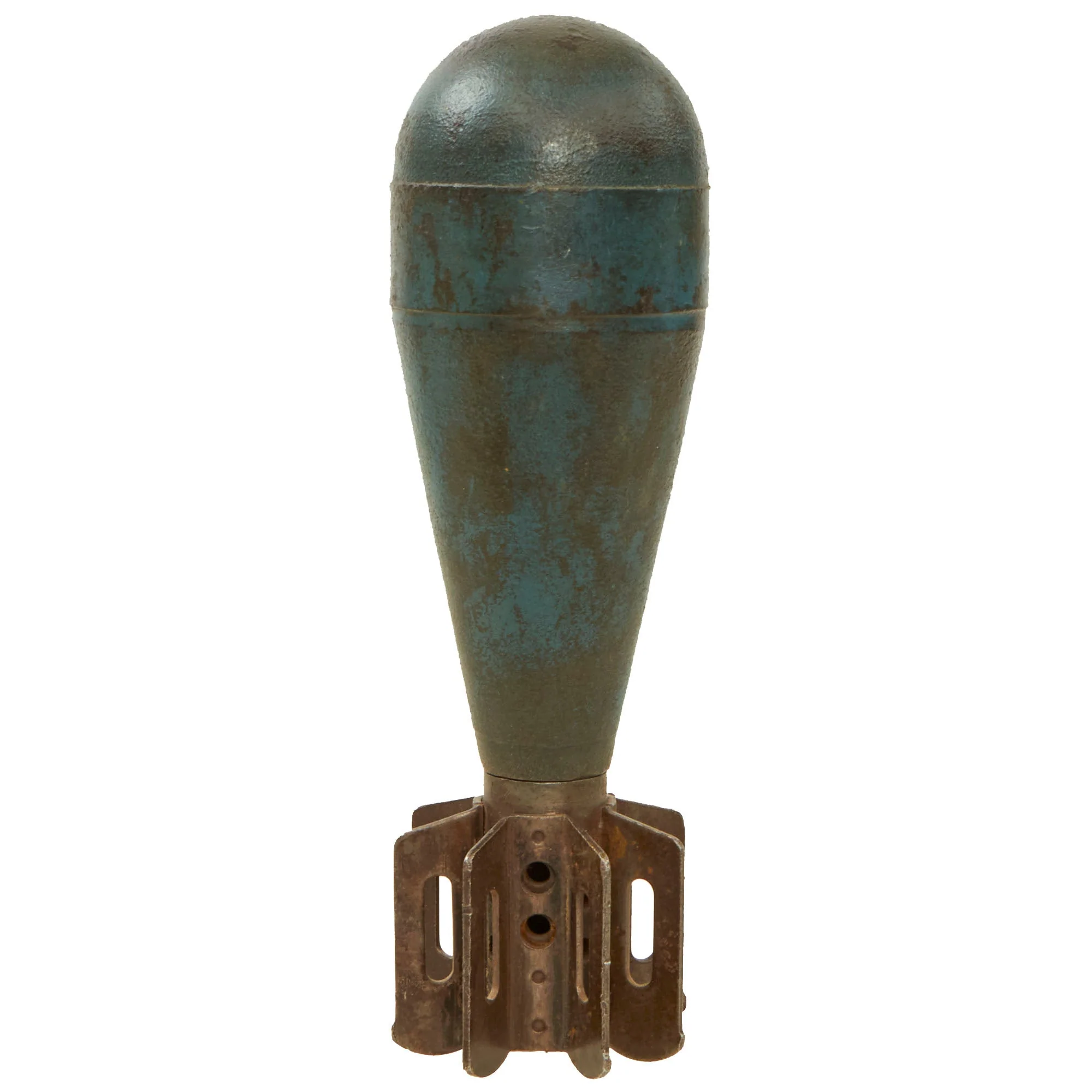
Original Item. Only One Available. The 90 mm gun M1/M2/M3 was an American heavy anti-aircraft and anti-tank gun, playing a role similar to the German 8.8cm Flak 18. It had a 3.5 in (90 mm) diameter bore, and a 50 caliber barrel, giving it a length of 15 ft (4.6 m). It was capable of firing a 3.5 in × 23.6 in (90 mm × 600 mm) shell 62,474 ft (19,042 m) horizontally, or a maximum altitude of 43,500 ft (13,300 m). This round is completely inert, and cannot be converted to any type of explosive device. As with all deactivated ordnance, this item is not available for export.
The round measures roughly 37½” tall. This example is marked on the fuze:
MK418 MOD 0 KDP95A001-001
53711-5178407-B
The side of the projectile is marked:
LOT CSX-10-88 1957 90MM., M71
This denotes a manufacture date of 1957, and that the model of projectile is M71.
The bottom of the casing is marked:
90MM - M19
1945 LOT GL 1-329
The projectile can be removed from the casing for inspection of the interior. A great Post-WWII round, ready for further research and display.
90mm HE M71
The projectile consists of a hollow steel forging with a boat tailed base and a streamlined ogive, and may be either the normal fuze cavity or deep cavity type. It is loaded with 2.15 pounds of Comp B (1.68 pounds, deep cavity) or 2.15 pounds of TNT (1.6 pounds, deep cavity). Some earlier rounds are loaded with 50-50 amatol and a booster surround of a small amount of TNT. The supplementary charge consists of 0.3 pounds of TNT. Most deep cavity projectiles are assembled with supplementary charge, spacers, and closing plug; however, some rounds of earlier manufacture were assembled with supplementary charge and PD fuzes or unfused without supplementary charge but fitted with a closing plug.

Details & Craftsmanship
Every detail has been carefully considered to bring you the perfect product.

Details & Craftsmanship
Every detail has been carefully considered to bring you the perfect product.

Details & Craftsmanship
Every detail has been carefully considered to bring you the perfect product.

Details & Craftsmanship
Every detail has been carefully considered to bring you the perfect product.

Details & Craftsmanship
Every detail has been carefully considered to bring you the perfect product.

Details & Craftsmanship
Every detail has been carefully considered to bring you the perfect product.

Details & Craftsmanship
Every detail has been carefully considered to bring you the perfect product.

Details & Craftsmanship
Every detail has been carefully considered to bring you the perfect product.
Description
Original Item. Only One Available. The 90 mm gun M1/M2/M3 was an American heavy anti-aircraft and anti-tank gun, playing a role similar to the German 8.8cm Flak 18. It had a 3.5 in (90 mm) diameter bore, and a 50 caliber barrel, giving it a length of 15 ft (4.6 m). It was capable of firing a 3.5 in × 23.6 in (90 mm × 600 mm) shell 62,474 ft (19,042 m) horizontally, or a maximum altitude of 43,500 ft (13,300 m). This round is completely inert, and cannot be converted to any type of explosive device. As with all deactivated ordnance, this item is not available for export.
The round measures roughly 37½” tall. This example is marked on the fuze:
MK418 MOD 0 KDP95A001-001
53711-5178407-B
The side of the projectile is marked:
LOT CSX-10-88 1957 90MM., M71
This denotes a manufacture date of 1957, and that the model of projectile is M71.
The bottom of the casing is marked:
90MM - M19
1945 LOT GL 1-329
The projectile can be removed from the casing for inspection of the interior. A great Post-WWII round, ready for further research and display.
90mm HE M71
The projectile consists of a hollow steel forging with a boat tailed base and a streamlined ogive, and may be either the normal fuze cavity or deep cavity type. It is loaded with 2.15 pounds of Comp B (1.68 pounds, deep cavity) or 2.15 pounds of TNT (1.6 pounds, deep cavity). Some earlier rounds are loaded with 50-50 amatol and a booster surround of a small amount of TNT. The supplementary charge consists of 0.3 pounds of TNT. Most deep cavity projectiles are assembled with supplementary charge, spacers, and closing plug; however, some rounds of earlier manufacture were assembled with supplementary charge and PD fuzes or unfused without supplementary charge but fitted with a closing plug.