
The Story
Original item: One of a Kind. Now this is something we do not see every day! This is a very early American Flintlock Rifle, in fact the first model rifle ever issued by the Federal Armories! Previously only Flintlock muskets and pistols has been produced, but with the world moving towards the increased accuracy of rifled barrels, the United States had to keep up. The first model designed the Harpers Ferry Model 1803, which is what we have here. There were several different models made, and the earliest had a 33 inch barrel and overall length of 49 inches, with a two stage octagonal to round barrel. By 1805, the barrel design had changed to have the entire bottom octagonal, and in 1806 production ceased.
In 1814 production restarted, ending in 1819 with 15,703 produced in the run. There some changes made to the design, such as the length of the patch box, as well as a change to a 36 inch long barrel, which was again octagonal to round, and returned to having a round bottom at the front. However leftover 33 inch barrels were also used indiscriminately during this period, which definitely muddies the waters regarding identification. With a lock date of 1819 and a 36 inch barrel, this is definitely a type II.
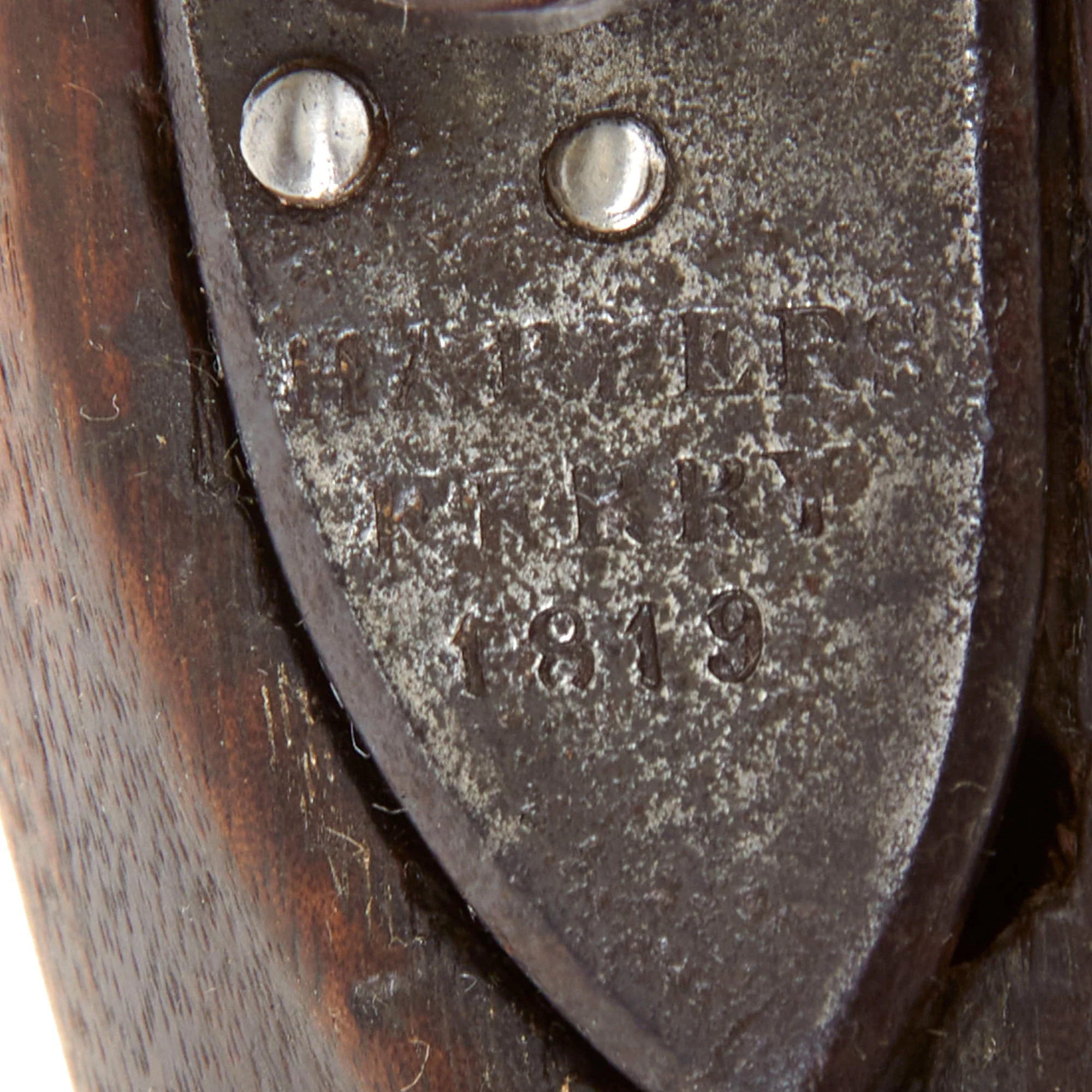
The rifle is in very good condition, especially considering the age, and has a great look. It shows long service, particularly on the metalwork, which shows past pitting and oxidation throughout. It also was converted to percussion, as so many other U.S. arms were during the 1840s and 1850s. The lock plate is worn from past oxidation and cleaning, however we can still make out HARPERS / FERRY / 1819 on the lock plate tail, indicating it was originally manufactured at the United States Armory and Arsenal at Harpers Ferry itself in 1819. The Federal Eagle marking in the center of the lock plate is also present, which is definitely a surprise! The markings on the barrel are however completely gone, and the entire barrel upper surface shows past pitting and oxidation, now cleaned away. We can see some faded cartouches on the left side of the stock below the which look to be AR in an oval and V over PH, both of which are markings we do not recognize.
The rifles mounts are all of brass, including the spring loaded brass patch box, which still pops open easily by pressing the button on top. They show a lovely mellow patina now, having been gently cleaned for over two centuries. The ironwork shows more wear, and we can see past peppering and pitting on the lock plate and particularly on the entire exterior surface of the barrel. There is also a good amount on the cap bolster and cap nipple cone. This is a gun that saw long use during service, probably exposed to the elements for a significant amount of time, possibly during the U.S. Civil War.
There is a ramrod present, but it is a period replacement and lacks the correct brass end. The lock is fully functional, holding at half cock and firing at full, though it is a bit sticky and slow at times. The bore of the barrel is clear, but is definitely no longer rifled, and shows quite a bit of past oxidation and fouling. It was most certainly not cleaned properly after the last use. The bore is about 0.56", so it does not look to have been converted for fouling use, it was simply used extensively.
The stock has a lovely red brown color with a great polished oil finish. There are some tiny dents and scratches, but it really does look great. There is a bit of cracking running from the side plate to the breech area, a very common place to see this, and there also is some missing wood around the lock plate from oxidation. There is also some erosion of the stock around the cap nipple cone, a very common place to see this.
A lovely well used example of a rare Model 1803 Type II Harpers Ferry Rifle, converted to percussion during the mid 19th century. Ready to research and display!
Specifications -
Year of Manufacture: 1819
Caliber: originally .54" - now 0.56"
Cartridge Type: Cap and Ball
Barrel Length: 36 Inches
Overall Length: 52 Inches
Action type: Side Action Percussion
Feed System: Muzzle Loading
The Harpers Ferry Arsenal Model 1803 rifle was the first standard rifle (as opposed to a smoothbore musket), made by an American armory. Rifles existed long before the 17th century, but were rarely used by military forces. Problems with powder fouling, cleaning, as well as reloading the smaller bores caused many problems. However, by the beginning of the 19th Century, the excellent accuracy of Pennsylvania / Kentucky rifles was too much to ignore. Great Britain had just started to use the Baker rifle, officially known as the Pattern 1800 Infantry Rifle in small numbers, so the United States decided to follow suit.
In 1803, Secretary of War Henry Dearborn wrote about the utility of a short barreled rifle, it being easier to charge enemy positions with, and "less likely to foul by firing". He specified that the new rifle that should "not exceed 33 inches" and have a ball "one thirtieth of a pound weight, about .54 caliber". Under Dearborn's direction, the war department issued an order for the new rifle on May 25, 1803. Joseph Perkin, superintendent of the recently created Harper's Ferry Armory, was placed in charge of the design of the new rifle. Perkin and several other armorers created several patterns from Dearborn's instructions, and in November 1803 these patterns were presented to the War Department. With a few minor changes, one of these patterns was approved and became the M1803 rifle. Dearborn was so impressed that he complimented Perkin for submitting such "an excellent pattern", and an order was placed for 2,000 rifles. Based on the rifle's success and performance, Dearborn later expanded the production from 2,000 to 4,000 rifles. In November 1805, Dearborn also asked Perkin to create a horseman's pistol that was in many ways a scaled down version of the M1803 rifle.
Perkin and Dearborn originally planned to produce 2,000 rifles per year. The rifle proved to be more difficult to produce than expected, due to mechanical difficulties as well as a large amount of handwork required to finish each rifle. Production was also slowed by outbreaks of malaria in the summers of 1805 and 1806, which reduced the available manpower at Harpers Ferry. The order of 4,000 rifles was eventually completed in 1807. A second production run was ordered in 1814. This production lasted until 1819, and a total of 15,703 rifles were produced at this time.
The M1803 rifle was later replaced by the M1814 common rifle, the M1817 common rifle and the M1819 rifle, when it was decided that a more rugged weapon was needed.
NOTE: International orders of antique firearms MUST be shipped using UPS WW Services (courier). USPS Priority Mail international will not accept these. International customers should always consult their country's antique gun laws prior to ordering.

Details & Craftsmanship
Every detail has been carefully considered to bring you the perfect product.

Details & Craftsmanship
Every detail has been carefully considered to bring you the perfect product.

Details & Craftsmanship
Every detail has been carefully considered to bring you the perfect product.

Details & Craftsmanship
Every detail has been carefully considered to bring you the perfect product.
Details & Craftsmanship
Every detail has been carefully considered to bring you the perfect product.

Details & Craftsmanship
Every detail has been carefully considered to bring you the perfect product.

Details & Craftsmanship
Every detail has been carefully considered to bring you the perfect product.

Details & Craftsmanship
Every detail has been carefully considered to bring you the perfect product.

Details & Craftsmanship
Every detail has been carefully considered to bring you the perfect product.

Details & Craftsmanship
Every detail has been carefully considered to bring you the perfect product.

Details & Craftsmanship
Every detail has been carefully considered to bring you the perfect product.

Details & Craftsmanship
Every detail has been carefully considered to bring you the perfect product.

Details & Craftsmanship
Every detail has been carefully considered to bring you the perfect product.

Details & Craftsmanship
Every detail has been carefully considered to bring you the perfect product.

Details & Craftsmanship
Every detail has been carefully considered to bring you the perfect product.

Details & Craftsmanship
Every detail has been carefully considered to bring you the perfect product.

Details & Craftsmanship
Every detail has been carefully considered to bring you the perfect product.
Description
Original item: One of a Kind. Now this is something we do not see every day! This is a very early American Flintlock Rifle, in fact the first model rifle ever issued by the Federal Armories! Previously only Flintlock muskets and pistols has been produced, but with the world moving towards the increased accuracy of rifled barrels, the United States had to keep up. The first model designed the Harpers Ferry Model 1803, which is what we have here. There were several different models made, and the earliest had a 33 inch barrel and overall length of 49 inches, with a two stage octagonal to round barrel. By 1805, the barrel design had changed to have the entire bottom octagonal, and in 1806 production ceased.
In 1814 production restarted, ending in 1819 with 15,703 produced in the run. There some changes made to the design, such as the length of the patch box, as well as a change to a 36 inch long barrel, which was again octagonal to round, and returned to having a round bottom at the front. However leftover 33 inch barrels were also used indiscriminately during this period, which definitely muddies the waters regarding identification. With a lock date of 1819 and a 36 inch barrel, this is definitely a type II.
The rifle is in very good condition, especially considering the age, and has a great look. It shows long service, particularly on the metalwork, which shows past pitting and oxidation throughout. It also was converted to percussion, as so many other U.S. arms were during the 1840s and 1850s. The lock plate is worn from past oxidation and cleaning, however we can still make out HARPERS / FERRY / 1819 on the lock plate tail, indicating it was originally manufactured at the United States Armory and Arsenal at Harpers Ferry itself in 1819. The Federal Eagle marking in the center of the lock plate is also present, which is definitely a surprise! The markings on the barrel are however completely gone, and the entire barrel upper surface shows past pitting and oxidation, now cleaned away. We can see some faded cartouches on the left side of the stock below the which look to be AR in an oval and V over PH, both of which are markings we do not recognize.
The rifles mounts are all of brass, including the spring loaded brass patch box, which still pops open easily by pressing the button on top. They show a lovely mellow patina now, having been gently cleaned for over two centuries. The ironwork shows more wear, and we can see past peppering and pitting on the lock plate and particularly on the entire exterior surface of the barrel. There is also a good amount on the cap bolster and cap nipple cone. This is a gun that saw long use during service, probably exposed to the elements for a significant amount of time, possibly during the U.S. Civil War.
There is a ramrod present, but it is a period replacement and lacks the correct brass end. The lock is fully functional, holding at half cock and firing at full, though it is a bit sticky and slow at times. The bore of the barrel is clear, but is definitely no longer rifled, and shows quite a bit of past oxidation and fouling. It was most certainly not cleaned properly after the last use. The bore is about 0.56", so it does not look to have been converted for fouling use, it was simply used extensively.
The stock has a lovely red brown color with a great polished oil finish. There are some tiny dents and scratches, but it really does look great. There is a bit of cracking running from the side plate to the breech area, a very common place to see this, and there also is some missing wood around the lock plate from oxidation. There is also some erosion of the stock around the cap nipple cone, a very common place to see this.
A lovely well used example of a rare Model 1803 Type II Harpers Ferry Rifle, converted to percussion during the mid 19th century. Ready to research and display!
Specifications -
Year of Manufacture: 1819
Caliber: originally .54" - now 0.56"
Cartridge Type: Cap and Ball
Barrel Length: 36 Inches
Overall Length: 52 Inches
Action type: Side Action Percussion
Feed System: Muzzle Loading
The Harpers Ferry Arsenal Model 1803 rifle was the first standard rifle (as opposed to a smoothbore musket), made by an American armory. Rifles existed long before the 17th century, but were rarely used by military forces. Problems with powder fouling, cleaning, as well as reloading the smaller bores caused many problems. However, by the beginning of the 19th Century, the excellent accuracy of Pennsylvania / Kentucky rifles was too much to ignore. Great Britain had just started to use the Baker rifle, officially known as the Pattern 1800 Infantry Rifle in small numbers, so the United States decided to follow suit.
In 1803, Secretary of War Henry Dearborn wrote about the utility of a short barreled rifle, it being easier to charge enemy positions with, and "less likely to foul by firing". He specified that the new rifle that should "not exceed 33 inches" and have a ball "one thirtieth of a pound weight, about .54 caliber". Under Dearborn's direction, the war department issued an order for the new rifle on May 25, 1803. Joseph Perkin, superintendent of the recently created Harper's Ferry Armory, was placed in charge of the design of the new rifle. Perkin and several other armorers created several patterns from Dearborn's instructions, and in November 1803 these patterns were presented to the War Department. With a few minor changes, one of these patterns was approved and became the M1803 rifle. Dearborn was so impressed that he complimented Perkin for submitting such "an excellent pattern", and an order was placed for 2,000 rifles. Based on the rifle's success and performance, Dearborn later expanded the production from 2,000 to 4,000 rifles. In November 1805, Dearborn also asked Perkin to create a horseman's pistol that was in many ways a scaled down version of the M1803 rifle.
Perkin and Dearborn originally planned to produce 2,000 rifles per year. The rifle proved to be more difficult to produce than expected, due to mechanical difficulties as well as a large amount of handwork required to finish each rifle. Production was also slowed by outbreaks of malaria in the summers of 1805 and 1806, which reduced the available manpower at Harpers Ferry. The order of 4,000 rifles was eventually completed in 1807. A second production run was ordered in 1814. This production lasted until 1819, and a total of 15,703 rifles were produced at this time.
The M1803 rifle was later replaced by the M1814 common rifle, the M1817 common rifle and the M1819 rifle, when it was decided that a more rugged weapon was needed.
NOTE: International orders of antique firearms MUST be shipped using UPS WW Services (courier). USPS Priority Mail international will not accept these. International customers should always consult their country's antique gun laws prior to ordering.