Original: $1,295.00
-70%$1,295.00
$388.50The Story
Original Item: Only One Available. The Springfield Model 1812 Musket was a .69 caliber, flintlock musket designed and manufactured by the Springfield Armory. In the years after the War of 1812, due to deficiencies perceived in the model 1795, the U.S. wanted them quickly replaced, and so also contracted out various orders to gun manufacturers of the time.
On July 18th 1812 ELI WHITNEY received a U.S. Government Order for 15,000 Flintlock Muskets, to be delivered at a rate of 1,500 units per year for the next 10 years. To avoid confusion with his existing Contracts with the State of New York and others, he marked these muskets, at least initially with just N.HAVEN in a Scroll on the Lock Plates. Please see Page 96 of UNITED STATES MARTIAL FLINTLOCKS by ROBERT M. REILLY, published in 1986, a truly marvelous work, for full description and details.
This is a very interesting flintlock musket from this 1812 contract, which was cut down into an "Artillery Carbine" with a 23" barrel, measuring 38 1/4" overall. For artillery emplacements the biggest hazard was close quarters combat, so the full length muskets could be as liability, resulting in modifications such as this. The stock and barrel were shortened and adjusted so that the nose cap now fits the end of the shortened stock. The lower sling swivel was also removed, as it would no longer really be useful.
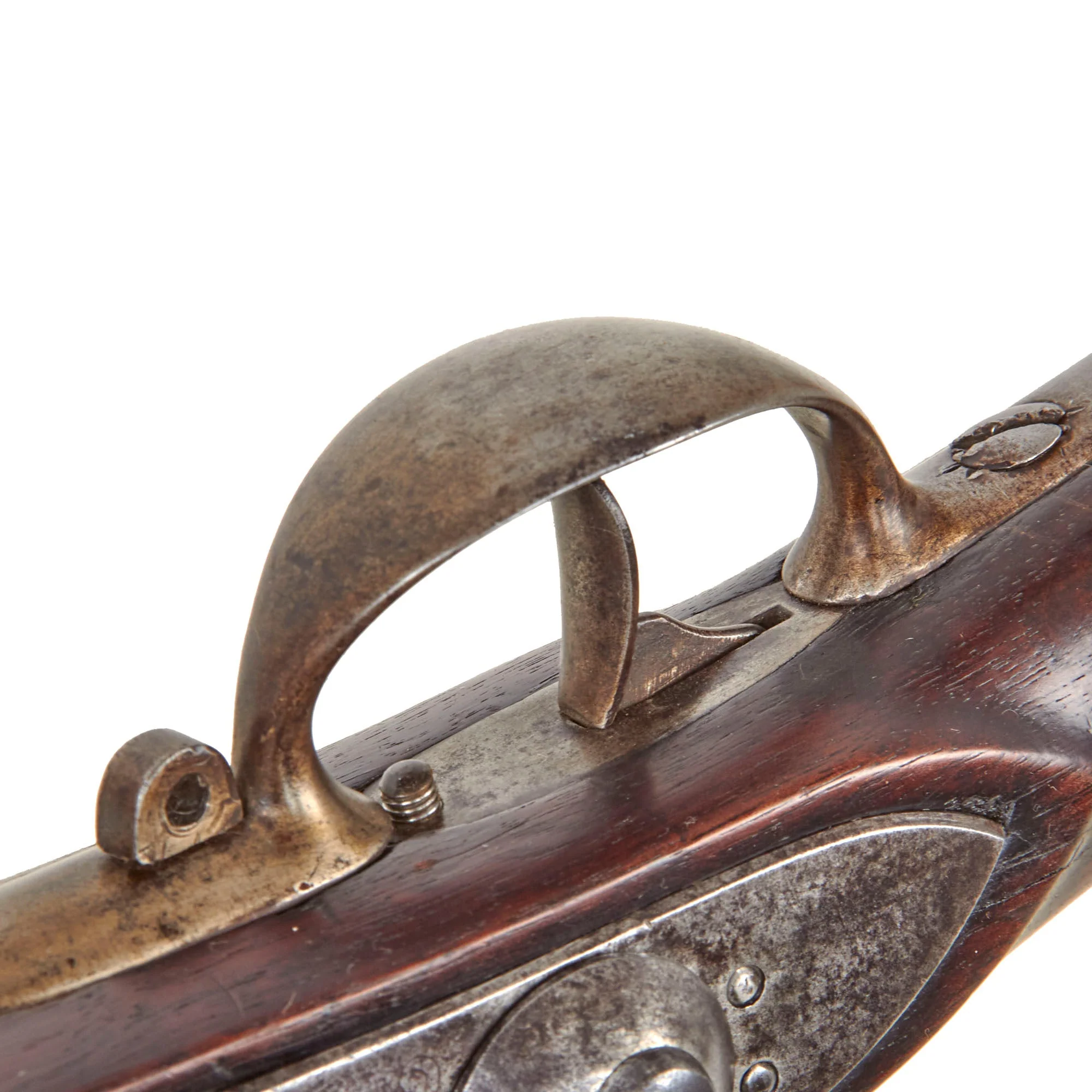
The shortened musket is in fine condition, iron mounts and a very nice wood stock, and there is even still the shortened ramrod present. There is a good amount of powder burn on the breech area, but there is still a P in an oval present, the correct proof for the area. There is also what looks to be JN in script on the left side a towards the rear of the flat area by the lock, for an inspector we have not been able to identify. This example has been fully cleaned and put into excellent display condition. The lock is functional, holding correctly at half cock and firing at full. The metalwork has a really nice patina, and the wood stock is in great shape with a very nice color.
A very interesting shortened U.S. Flintlock Musket that can fit into any advanced U.S. Martial Collection. In just lovely condition and ready to display!
Specifications-
Year of Manufacture: c. 1812-1816
Caliber: .69"
Cartridge Type: Ball and Powder
Barrel Length: 23 Inches
Overall Length: 38 1/4 Inches
Action type: Side Action Flintlock
Feed System: Muzzle Loading
History of the Model 1812 Musket:
The War of 1812 revealed many weaknesses in the earlier Model 1795 Musket. The Model 1812 was an attempt to improve both the design and manufacturing process of the musket. The design borrowed heavily from the French Charleville model 1777 musket. The Springfield Model 1812 musket arrived too late to be of use in the War of 1812 but would later become standard issue to regular infantry and militia units.
The Model 1812 was a .69 caliber smoothbore musket, with a 42-inch (107 cm) barrel and a 54-inch (137 cm) stock, and a total length of 57-inch (145 cm). The Model 1812 was produced only at Springfield: the M1795 would continue in production at Harpers Ferry into 1818.
The Model 1812 was produced in a quantity of almost 30,000 between the years 1814 and 1816. It was replaced by the Model 1816 Musket. However, the Model 1812 remained in service for many years, and was even used in the American Civil War, mostly by the Confederate forces. By the start of the Civil war, the weapon was considered to be old and obsolete but was needed to fill arms shortages.
Some Model 1812 muskets were later converted to percussion lock firing mechanisms. The percussion cap system was much more reliable and weatherproof than the flintlock system used on the Model 1812 in its original configuration.
NOTE: International orders of antique firearms MUST be shipped using UPS WW Services (courier). USPS Priority Mail international will not accept these. International customers should always consult their country's antique gun laws prior to ordering.

Details & Craftsmanship
Every detail has been carefully considered to bring you the perfect product.

Details & Craftsmanship
Every detail has been carefully considered to bring you the perfect product.

Details & Craftsmanship
Every detail has been carefully considered to bring you the perfect product.

Details & Craftsmanship
Every detail has been carefully considered to bring you the perfect product.

Details & Craftsmanship
Every detail has been carefully considered to bring you the perfect product.

Details & Craftsmanship
Every detail has been carefully considered to bring you the perfect product.

Details & Craftsmanship
Every detail has been carefully considered to bring you the perfect product.

Details & Craftsmanship
Every detail has been carefully considered to bring you the perfect product.

Details & Craftsmanship
Every detail has been carefully considered to bring you the perfect product.

Details & Craftsmanship
Every detail has been carefully considered to bring you the perfect product.

Details & Craftsmanship
Every detail has been carefully considered to bring you the perfect product.

Details & Craftsmanship
Every detail has been carefully considered to bring you the perfect product.

Details & Craftsmanship
Every detail has been carefully considered to bring you the perfect product.

Details & Craftsmanship
Every detail has been carefully considered to bring you the perfect product.
Details & Craftsmanship
Every detail has been carefully considered to bring you the perfect product.

Details & Craftsmanship
Every detail has been carefully considered to bring you the perfect product.

Details & Craftsmanship
Every detail has been carefully considered to bring you the perfect product.

Details & Craftsmanship
Every detail has been carefully considered to bring you the perfect product.

Details & Craftsmanship
Every detail has been carefully considered to bring you the perfect product.
Description
Original Item: Only One Available. The Springfield Model 1812 Musket was a .69 caliber, flintlock musket designed and manufactured by the Springfield Armory. In the years after the War of 1812, due to deficiencies perceived in the model 1795, the U.S. wanted them quickly replaced, and so also contracted out various orders to gun manufacturers of the time.
On July 18th 1812 ELI WHITNEY received a U.S. Government Order for 15,000 Flintlock Muskets, to be delivered at a rate of 1,500 units per year for the next 10 years. To avoid confusion with his existing Contracts with the State of New York and others, he marked these muskets, at least initially with just N.HAVEN in a Scroll on the Lock Plates. Please see Page 96 of UNITED STATES MARTIAL FLINTLOCKS by ROBERT M. REILLY, published in 1986, a truly marvelous work, for full description and details.
This is a very interesting flintlock musket from this 1812 contract, which was cut down into an "Artillery Carbine" with a 23" barrel, measuring 38 1/4" overall. For artillery emplacements the biggest hazard was close quarters combat, so the full length muskets could be as liability, resulting in modifications such as this. The stock and barrel were shortened and adjusted so that the nose cap now fits the end of the shortened stock. The lower sling swivel was also removed, as it would no longer really be useful.
The shortened musket is in fine condition, iron mounts and a very nice wood stock, and there is even still the shortened ramrod present. There is a good amount of powder burn on the breech area, but there is still a P in an oval present, the correct proof for the area. There is also what looks to be JN in script on the left side a towards the rear of the flat area by the lock, for an inspector we have not been able to identify. This example has been fully cleaned and put into excellent display condition. The lock is functional, holding correctly at half cock and firing at full. The metalwork has a really nice patina, and the wood stock is in great shape with a very nice color.
A very interesting shortened U.S. Flintlock Musket that can fit into any advanced U.S. Martial Collection. In just lovely condition and ready to display!
Specifications-
Year of Manufacture: c. 1812-1816
Caliber: .69"
Cartridge Type: Ball and Powder
Barrel Length: 23 Inches
Overall Length: 38 1/4 Inches
Action type: Side Action Flintlock
Feed System: Muzzle Loading
History of the Model 1812 Musket:
The War of 1812 revealed many weaknesses in the earlier Model 1795 Musket. The Model 1812 was an attempt to improve both the design and manufacturing process of the musket. The design borrowed heavily from the French Charleville model 1777 musket. The Springfield Model 1812 musket arrived too late to be of use in the War of 1812 but would later become standard issue to regular infantry and militia units.
The Model 1812 was a .69 caliber smoothbore musket, with a 42-inch (107 cm) barrel and a 54-inch (137 cm) stock, and a total length of 57-inch (145 cm). The Model 1812 was produced only at Springfield: the M1795 would continue in production at Harpers Ferry into 1818.
The Model 1812 was produced in a quantity of almost 30,000 between the years 1814 and 1816. It was replaced by the Model 1816 Musket. However, the Model 1812 remained in service for many years, and was even used in the American Civil War, mostly by the Confederate forces. By the start of the Civil war, the weapon was considered to be old and obsolete but was needed to fill arms shortages.
Some Model 1812 muskets were later converted to percussion lock firing mechanisms. The percussion cap system was much more reliable and weatherproof than the flintlock system used on the Model 1812 in its original configuration.
NOTE: International orders of antique firearms MUST be shipped using UPS WW Services (courier). USPS Priority Mail international will not accept these. International customers should always consult their country's antique gun laws prior to ordering.