
The Story
Original item: One Only. The U.S. Model 1816 Musket was a .69 caliber smoothbore flintlock, with a 42-inch barrel and an overall length of 58 inches. It replaced the previous model 1812 musket, and often is viewed as a further development of that design. Like the Model 1812, the Model 1816 borrowed heavily from the design of the French Charleville model 1777 musket, but had a longer lock plate, a shorter trigger guard, and a longer bayonet than the Model 1812. The Model 1816 also had a more straight lined stock.
The Model 1816 was produced by the Springfield Armory, Harpers Ferry Armory, and numerous other contractors, such as M.T. Wickham. It was eventually replaced by the Springfield Model 1822, which is also considered by many to be a continuation of the Model 1816. These were sometimes referred to as "Whitney Flintlocks" due to the large number made in New Haven, Connecticut by Eli Whitney.
The outbreak of the Civil War in the United States created a large need for percussion muskets, as the number of modern firearms currently on hand was far short of what was needed. To fill this need, updating older design firearms was both faster and more cost effective, so many Model 1816 family muskets still in service were updated to percussion rifles.
This patinated and service used example however still is in the original flintlock configuration, and was originally manufactured in 1817 at the United States Armory and Arsenal at Harpers Ferry in what was then Virginia, today in the state of West Virginia. This is indicated by markings on the tail of the lock plate:
HARPERS
FERRY
1817
The "Federal Eagle over U.S." marking on the lock plate is very worn, and we can just see a bit of ghost of the original shape, and the lock plate overall is definitely worn, as the markings on the tail are also a bit faint. The original markings on the barrel are also completely missing, including the poofs and any date. The barrel tang also shows a repair, so this is a musket that saw extensive service and refitting. There are no stock cartouches visible on the left side below the lock screws, and there is also a hole in the stock, which looks to have been caused by the sear extension on the lock.
Overall this is a very nice patinated example of a Model 1816 Long Musket, still in the original flintlock configuration with no signs of alteration or reconversion to the lock and barrel. The stock is in very nice condition, showing evidence of long use, with the expected dents and dings from service, and overall wear. We do not see any major repairs, but it definitely shows a good amount of wear on the fore stock area, as well as some elsewhere. The butt stock also looks bot a bit smaller than we are used to seeing, and the musket overall is a bit short. Part of this is also that the barrel is 41 inches long, an inch shorter than usual, but it does not look to have been shortened.
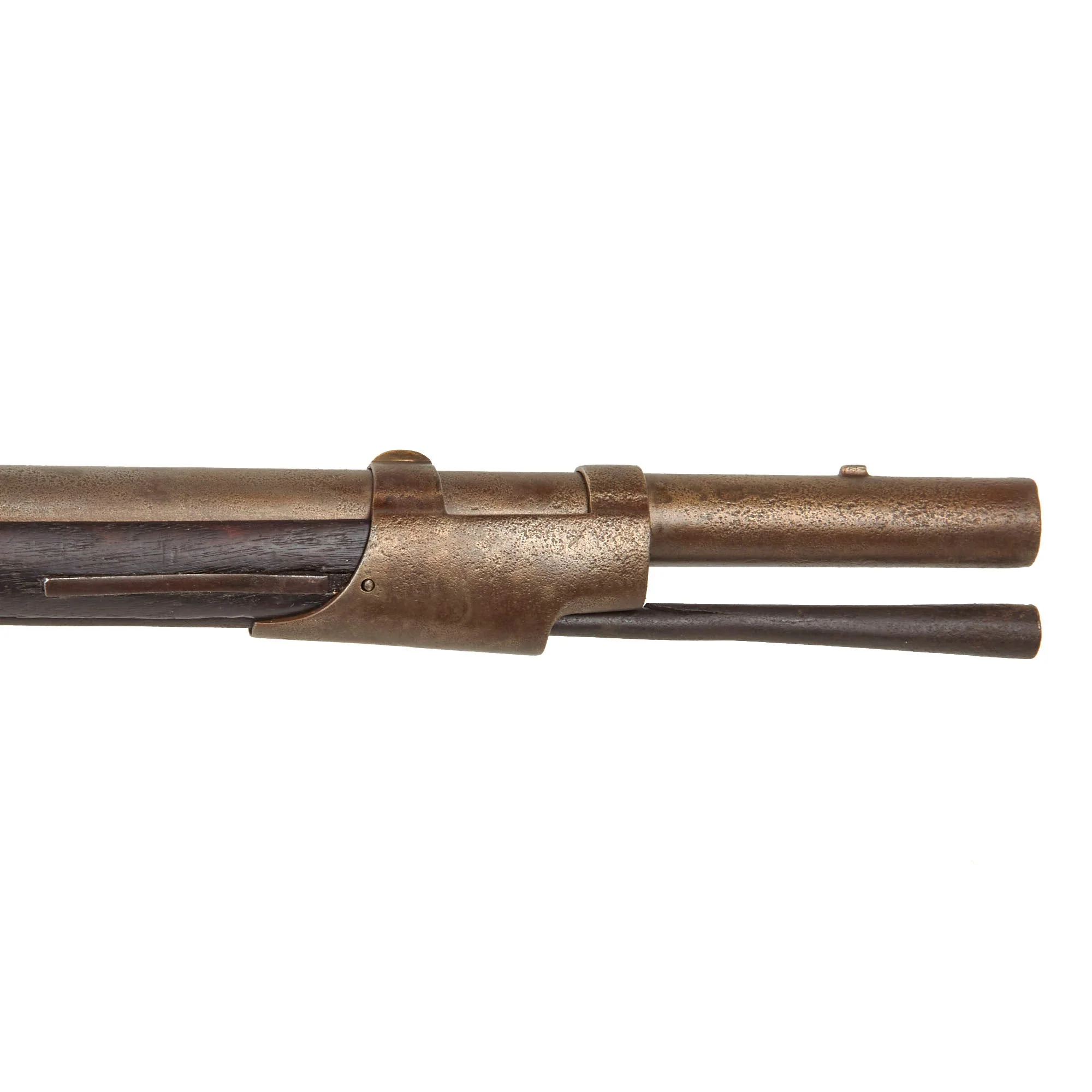
The metalwork is lovely, showing a nice aged peppered patina overall, with past rust pitting giving it a lovely speckled lookin many areas. The lock still functions correctly, holding at full cock and firing at full, however the mainspring is a bit weak. There is a ramrod under the barrel, but it is somewhat crude, and shows a split near the nose cap. Also, both sling swivels are missing, though the bolsters repain.
A lovely patinated example of an early American Musket, most likely never reissued for use in the Civil War. Ready to research and display!
Specifications-
Year of Manufacture: 1817
Caliber: .69"
Cartridge Type: Ball and Powder
Barrel Length: 41 Inches
Overall Length: 55 3/4 Inches
Action type: Side Action Percussion Lock
Feed System: Muzzle Loading
History of the Model 1816 Musket:
The War of 1812 had revealed many weaknesses in American muskets. The Model 1812 Musket was created in an attempt to improve both the design and manufacture of the musket. The Model 1816 made further improvements, and replaced the Model 1812. The Model 1812 had borrowed heavily from the design of the French Charleville model 1777 musket, and this design was retained for the Model 1816. The Model 1816 had a 42 inch long .69 caliber smoothbore barrel, similar to the Model 1812, but had a longer lock plate, a shorter trigger guard, and a longer bayonet than the Model 1812. The Model 1816 also had a more straight lined stock. The overall length of the weapon was 58 inches.
The Model 1816 musket was originally produced at the Harpers Ferry and Springfield Arsenals between 1816 and 1844. Around 675,000 were made, more than any other flintlock in U.S. history.
The Model 1816 was originally produced as a flintlock musket. Like many flintlock muskets, many of these were later converted to percussion cap, as the percussion cap system was much more reliable and weather resistant.
This model of Springfield musket was used by Texans during the Texas Revolution and by the US Army and militia during the Mexican-American War. During this conflict, the flintlock version of the Model 1816 was preferred by U.S. regular forces, due to percussion cap supply concerns. It was also used during the early years of the American Civil War until around 1862.
Many improvements to the Model 1816 were made, producing the Model 1822, Model 1835, Model 1840, and Model 1842. U.S. Ordnance Department referred to these as different models, but in other U.S. government documents they are referred to as a continuation of the Model 1816. Modern histories are similarly inconsistent in the nomenclature of these weapons.
NOTE: International orders of antique firearms MUST be shipped using UPS WW Services (courier). USPS Priority Mail international will not accept these. International customers should always consult their country's antique gun laws prior to ordering.

Details & Craftsmanship
Every detail has been carefully considered to bring you the perfect product.

Details & Craftsmanship
Every detail has been carefully considered to bring you the perfect product.

Details & Craftsmanship
Every detail has been carefully considered to bring you the perfect product.

Details & Craftsmanship
Every detail has been carefully considered to bring you the perfect product.

Details & Craftsmanship
Every detail has been carefully considered to bring you the perfect product.

Details & Craftsmanship
Every detail has been carefully considered to bring you the perfect product.

Details & Craftsmanship
Every detail has been carefully considered to bring you the perfect product.
Details & Craftsmanship
Every detail has been carefully considered to bring you the perfect product.

Details & Craftsmanship
Every detail has been carefully considered to bring you the perfect product.

Details & Craftsmanship
Every detail has been carefully considered to bring you the perfect product.

Details & Craftsmanship
Every detail has been carefully considered to bring you the perfect product.

Details & Craftsmanship
Every detail has been carefully considered to bring you the perfect product.

Details & Craftsmanship
Every detail has been carefully considered to bring you the perfect product.

Details & Craftsmanship
Every detail has been carefully considered to bring you the perfect product.

Details & Craftsmanship
Every detail has been carefully considered to bring you the perfect product.

Details & Craftsmanship
Every detail has been carefully considered to bring you the perfect product.

Details & Craftsmanship
Every detail has been carefully considered to bring you the perfect product.
Description
Original item: One Only. The U.S. Model 1816 Musket was a .69 caliber smoothbore flintlock, with a 42-inch barrel and an overall length of 58 inches. It replaced the previous model 1812 musket, and often is viewed as a further development of that design. Like the Model 1812, the Model 1816 borrowed heavily from the design of the French Charleville model 1777 musket, but had a longer lock plate, a shorter trigger guard, and a longer bayonet than the Model 1812. The Model 1816 also had a more straight lined stock.
The Model 1816 was produced by the Springfield Armory, Harpers Ferry Armory, and numerous other contractors, such as M.T. Wickham. It was eventually replaced by the Springfield Model 1822, which is also considered by many to be a continuation of the Model 1816. These were sometimes referred to as "Whitney Flintlocks" due to the large number made in New Haven, Connecticut by Eli Whitney.
The outbreak of the Civil War in the United States created a large need for percussion muskets, as the number of modern firearms currently on hand was far short of what was needed. To fill this need, updating older design firearms was both faster and more cost effective, so many Model 1816 family muskets still in service were updated to percussion rifles.
This patinated and service used example however still is in the original flintlock configuration, and was originally manufactured in 1817 at the United States Armory and Arsenal at Harpers Ferry in what was then Virginia, today in the state of West Virginia. This is indicated by markings on the tail of the lock plate:
HARPERS
FERRY
1817
The "Federal Eagle over U.S." marking on the lock plate is very worn, and we can just see a bit of ghost of the original shape, and the lock plate overall is definitely worn, as the markings on the tail are also a bit faint. The original markings on the barrel are also completely missing, including the poofs and any date. The barrel tang also shows a repair, so this is a musket that saw extensive service and refitting. There are no stock cartouches visible on the left side below the lock screws, and there is also a hole in the stock, which looks to have been caused by the sear extension on the lock.
Overall this is a very nice patinated example of a Model 1816 Long Musket, still in the original flintlock configuration with no signs of alteration or reconversion to the lock and barrel. The stock is in very nice condition, showing evidence of long use, with the expected dents and dings from service, and overall wear. We do not see any major repairs, but it definitely shows a good amount of wear on the fore stock area, as well as some elsewhere. The butt stock also looks bot a bit smaller than we are used to seeing, and the musket overall is a bit short. Part of this is also that the barrel is 41 inches long, an inch shorter than usual, but it does not look to have been shortened.
The metalwork is lovely, showing a nice aged peppered patina overall, with past rust pitting giving it a lovely speckled lookin many areas. The lock still functions correctly, holding at full cock and firing at full, however the mainspring is a bit weak. There is a ramrod under the barrel, but it is somewhat crude, and shows a split near the nose cap. Also, both sling swivels are missing, though the bolsters repain.
A lovely patinated example of an early American Musket, most likely never reissued for use in the Civil War. Ready to research and display!
Specifications-
Year of Manufacture: 1817
Caliber: .69"
Cartridge Type: Ball and Powder
Barrel Length: 41 Inches
Overall Length: 55 3/4 Inches
Action type: Side Action Percussion Lock
Feed System: Muzzle Loading
History of the Model 1816 Musket:
The War of 1812 had revealed many weaknesses in American muskets. The Model 1812 Musket was created in an attempt to improve both the design and manufacture of the musket. The Model 1816 made further improvements, and replaced the Model 1812. The Model 1812 had borrowed heavily from the design of the French Charleville model 1777 musket, and this design was retained for the Model 1816. The Model 1816 had a 42 inch long .69 caliber smoothbore barrel, similar to the Model 1812, but had a longer lock plate, a shorter trigger guard, and a longer bayonet than the Model 1812. The Model 1816 also had a more straight lined stock. The overall length of the weapon was 58 inches.
The Model 1816 musket was originally produced at the Harpers Ferry and Springfield Arsenals between 1816 and 1844. Around 675,000 were made, more than any other flintlock in U.S. history.
The Model 1816 was originally produced as a flintlock musket. Like many flintlock muskets, many of these were later converted to percussion cap, as the percussion cap system was much more reliable and weather resistant.
This model of Springfield musket was used by Texans during the Texas Revolution and by the US Army and militia during the Mexican-American War. During this conflict, the flintlock version of the Model 1816 was preferred by U.S. regular forces, due to percussion cap supply concerns. It was also used during the early years of the American Civil War until around 1862.
Many improvements to the Model 1816 were made, producing the Model 1822, Model 1835, Model 1840, and Model 1842. U.S. Ordnance Department referred to these as different models, but in other U.S. government documents they are referred to as a continuation of the Model 1816. Modern histories are similarly inconsistent in the nomenclature of these weapons.
NOTE: International orders of antique firearms MUST be shipped using UPS WW Services (courier). USPS Priority Mail international will not accept these. International customers should always consult their country's antique gun laws prior to ordering.